Kumaon Regiment: History, Motto, War Cry, Battles and Heroes
If one regiment could claim to have shaped the story of independent India’s Army, the Kumaon Regiment would be a strong candidate. It won India’s very first Param Vir Chakra at Badgam in 1947. It fought the legendary last stand at Rezang La in 1962. And it has given the nation three Chiefs of the Army Staff. Proud, tough and fiercely loyal, the Kumaonis have earned their place among India’s finest infantry.
This guide covers the history and lineage of the Kumaon Regiment, a clear timeline, its major operations and battle honours, its motto, war cries and insignia, its greatest heroes and what life in the regiment is like. At the end you will find a special section for NDA, CDS and SSB aspirants and a 10-question quiz.
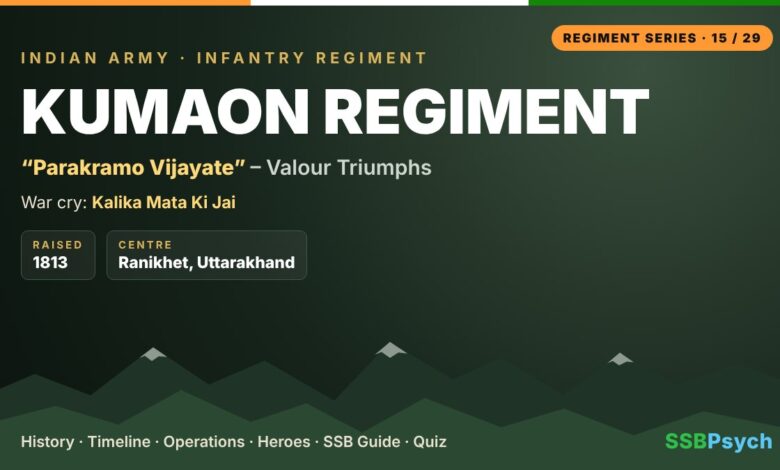
Kumaon Regiment – Quick Facts
| Oldest lineage | 1813, the Russell Brigade of Hyderabad |
| Named Kumaon Regiment | 27 October 1945 (from 19th Hyderabad Regiment) |
| Regimental Centre | Ranikhet, Almora district, Uttarakhand |
| Motto | Parakramo Vijayate (Valour Triumphs) |
| War Cries | Kalika Mata Ki Jai, Bajrang Bali Ki Jai, Dada Kishan Ki Jai |
| Recruitment | Kumaonis of Uttarakhand and Ahirs from north India |
| Battalions | Over 20 regular battalions |
| Param Vir Chakras | 2 (Maj Somnath Sharma and Maj Shaitan Singh) |
| Army Chiefs | 3 (Gens Shrinagesh, Thimayya and Raina) |
| Affiliated | Naga Regiment and Kumaon Scouts |
History of the Kumaon Regiment
The regiment’s roots lie far from the Kumaon hills, in the Deccan. In 1813 Henry Russell, the British Resident at the court of the Nizam of Hyderabad, raised two battalions that came to be known as the Russell Brigade. More battalions were added over the following years. By the 1850s these forces, paid for by the Nizam but led by British officers, were organised as the Hyderabad Contingent and became part of the British Indian Army.
Meanwhile, men from the Kumaon hills of present-day Uttarakhand had been serving in various units since the early 1800s. During the First World War, the first all-Kumaoni battalion was raised at Ranikhet on 23 October 1917. It later became the 1st Kumaon Rifles.
In the 1922 reorganisation of the Indian Army, the Hyderabad Contingent’s units were grouped into the 19th Hyderabad Regiment, and the Kumaon Rifles joined it the following year. Over time, Kumaonis became the main recruits of the regiment, and on 27 October 1945 its name was changed to the 19th Kumaon Regiment. After Independence it became simply the Kumaon Regiment, with its home at Ranikhet.
The insignia still reminds everyone of this history. It shows a demi-rampant lion holding a cross, taken from the family arms of the Russells, whose founder raised the first battalions in 1813.
Kumaon Regiment Timeline: From Raising to Today
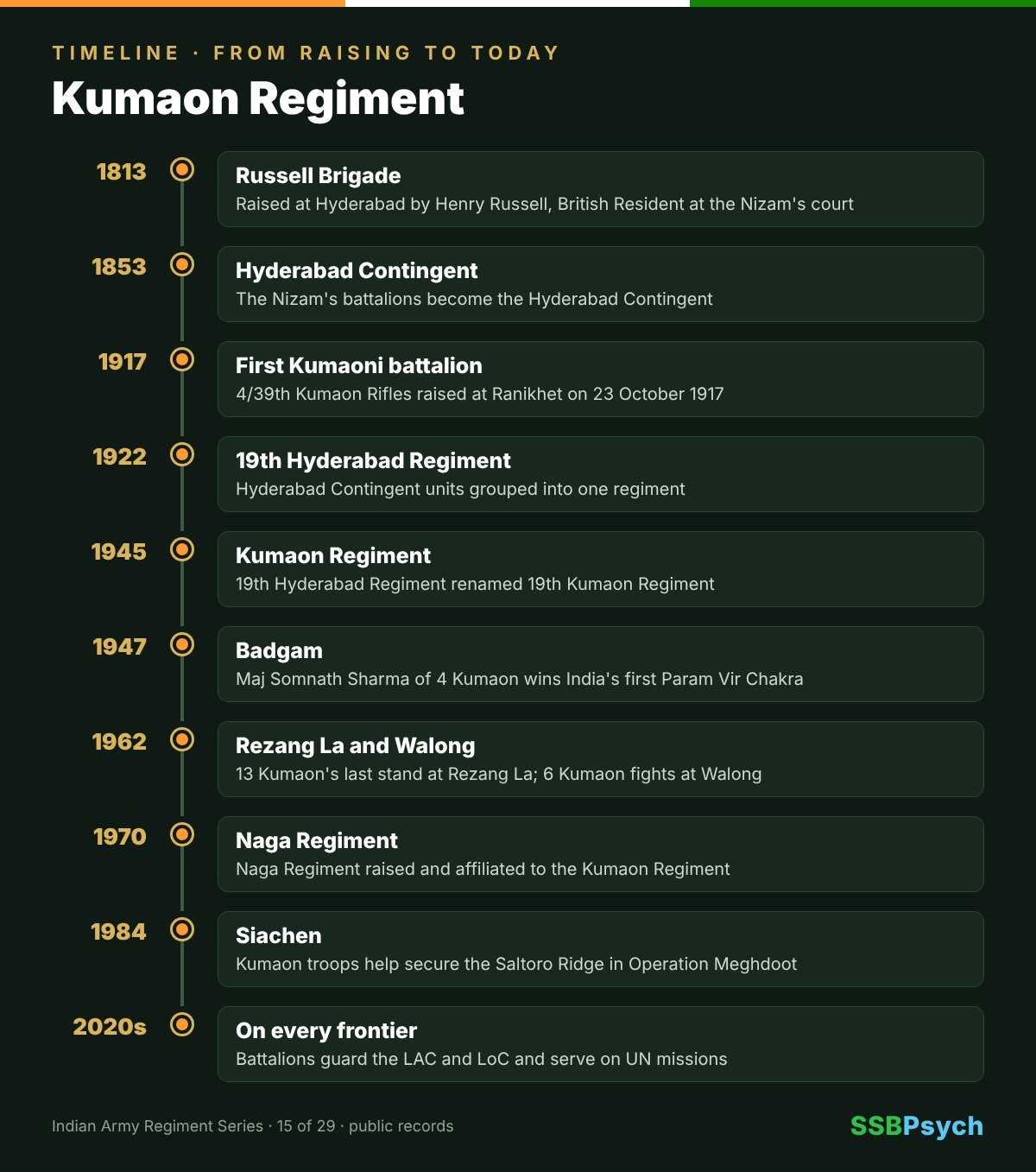
- 1813 – Russell Brigade: Raised at Hyderabad by Henry Russell, British Resident at the Nizam’s court
- 1853 – Hyderabad Contingent: The Nizam’s battalions become the Hyderabad Contingent
- 1917 – First Kumaoni battalion: 4/39th Kumaon Rifles raised at Ranikhet on 23 October 1917
- 1922 – 19th Hyderabad Regiment: Hyderabad Contingent units grouped into one regiment
- 1945 – Kumaon Regiment: 19th Hyderabad Regiment renamed 19th Kumaon Regiment
- 1947 – Badgam: Maj Somnath Sharma of 4 Kumaon wins India’s first Param Vir Chakra
- 1962 – Rezang La and Walong: 13 Kumaon’s last stand at Rezang La; 6 Kumaon fights at Walong
- 1970 – Naga Regiment: Naga Regiment raised and affiliated to the Kumaon Regiment
- 1984 – Siachen: Kumaon troops help secure the Saltoro Ridge in Operation Meghdoot
- 2020s – On every frontier: Battalions guard the LAC and LoC and serve on UN missions
Major Operations and Battle Honours of the Kumaon Regiment
Before Independence, the regiment’s battalions earned honours in both World Wars, in places such as Megiddo in Palestine and Slim River, Kangaw and Bishenpur in South-East Asia. But it is the story after 1947 that has made the Kumaonis legends.
1947: The Battle of Badgam
In October 1947 tribal raiders backed by Pakistan swept into Kashmir and headed for Srinagar. The airfield was the only way to bring in Indian reinforcements. On 3 November 1947, a company of 4 Kumaon under Major Somnath Sharma was sent to Badgam near the airfield. They were attacked by a far larger force. Major Sharma, who already had a plastered arm from an earlier injury, moved between trenches under fire, encouraged his men and helped load the light machine guns himself. He was killed by a mortar shell, but his company held on long enough for reinforcements to arrive and save the airfield. He became the first recipient of the Param Vir Chakra, India’s highest wartime gallantry award.
1962: Rezang La – A Stand for the Ages
On 18 November 1962, C Company of 13 Kumaon, made up mostly of Ahir soldiers from Haryana, was holding Rezang La, a pass over 16,000 feet high in Ladakh. Under Major Shaitan Singh, about 120 men faced wave after wave of Chinese attacks supported by artillery. In bitter cold and with no hope of reinforcement, they fought to almost the last man and the last round. Most of the company was killed, including Major Shaitan Singh, who kept moving between positions to lead his men despite serious wounds. He was awarded the Param Vir Chakra posthumously. Rezang La is remembered as one of the greatest last stands in military history.
1962: Walong
In the same war, 6 Kumaon fought at Walong in the eastern sector. A company held a ridge against a much larger Chinese force, and only a handful of men returned. The battalion still remembers its fallen on Walong Day each year, and Walong is a battle honour of the regiment.
1965 and 1971
In 1965 Kumaon battalions fought in Jammu and Kashmir and Punjab, including in the Chhamb sector. In 1971 the regiment fought on both fronts, earning honours such as Gadra City in the west and Shamsher Nagar and Daudkandi in the east, where Indian forces advanced rapidly towards Dhaka.
Siachen, Sri Lanka and Kargil
In April 1984, during Operation Meghdoot, Kumaon troops were among the first to secure the Saltoro Ridge on the Siachen Glacier, and 19 Kumaon hoisted the flag at a key height there. Kumaon battalions served in Sri Lanka with the Indian Peace Keeping Force, and took part in Operation Vijay in Kargil in 1999. Today they continue to guard the Line of Actual Control and the Line of Control.
Insignia, Motto and War Cry
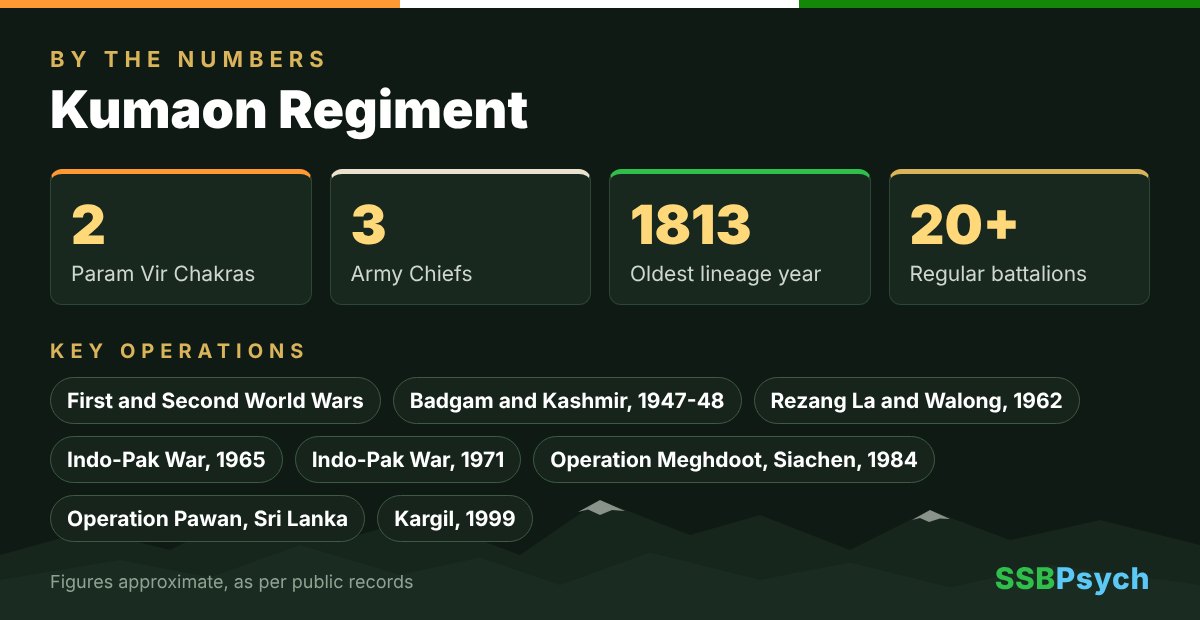
The Kumaon Regiment’s motto is Parakramo Vijayate, which means Valour Triumphs. Few regiments have shown the truth of their motto as clearly as the Kumaonis at Badgam and Rezang La.
The regiment has more than one war cry, reflecting the faith of its different soldiers. The best known are Kalika Mata Ki Jai (Victory to Goddess Kali), Bajrang Bali Ki Jai (Victory to Lord Hanuman) and Dada Kishan Ki Jai (Victory to Dada Kishan). The insignia is the Russell lion holding a cross, and the regimental march is the much-loved Kumaoni folk song Bedu Pako Baro Masa, which you will hear at many military events across India.
Heroes of the Kumaon Regiment
- Major Somnath Sharma, Param Vir Chakra (posthumous) – 4 Kumaon, Badgam, 3 November 1947; India’s first PVC.
- Major Shaitan Singh, Param Vir Chakra (posthumous) – 13 Kumaon, Rezang La, 18 November 1962.
- General S M Shrinagesh – Kumaon officer who served as Chief of the Army Staff in the 1950s.
- General K S Thimayya – one of India’s most admired Army Chiefs (1957–61); he later commanded the UN peacekeeping force in Cyprus.
- General T N Raina – Kumaon officer and Chief of the Army Staff from 1975 to 1978.
- Lt Bikram Singh and the men of 6 Kumaon – remembered for their stand at Walong in 1962.
Alongside these famous names, the regiment’s soldiers have won a long list of Maha Vir Chakras, Vir Chakras, Kirti Chakras and Shaurya Chakras in war and counter-insurgency.
Role and Life in the Kumaon Regiment
The Kumaon Regiment is a line infantry regiment whose battalions are trained for mountains, high altitude, plains and deserts. Most soldiers are Kumaonis from districts such as Almora, Pithoragarh, Bageshwar and Nainital, while some battalions are made up of Ahirs from Haryana and nearby states. 13 Kumaon, the battalion of Rezang La, is the regiment’s Ahir battalion.
The regiment has a wide family. The Naga Regiment, raised in 1970 and recruited partly from Nagaland, is affiliated to it and shares the Kumaon Regimental Centre at Ranikhet. The Kumaon Scouts are a specialist battalion for high-altitude border duties. One of the regiment’s battalions was converted long ago into a parachute battalion, a sign of the regiment’s role in shaping other parts of the Army.
Ranikhet is a peaceful hill cantonment surrounded by pine and oak forests with views of the snow peaks. The regimental centre has a museum that preserves memories of Badgam, Rezang La and other battles. Recruits are trained hard, but they also learn the regiment’s songs, customs and history so that they understand the legacy they now carry.
Officers in Kumaon battalions are known for staying close to their men. They learn Kumaoni phrases, attend regimental festivals and take a personal interest in soldiers’ families. This close bond is a big reason why Kumaoni companies have held positions against such great odds.
Why the Kumaon Regiment Produces Leaders
It is unusual for one regiment to give India three Army Chiefs. General S M Shrinagesh, General K S Thimayya and General T N Raina all grew up professionally in Kumaon battalions. General Thimayya is especially remembered: after the Korean War he headed the neutral commission that handled the repatriation of prisoners of war, and as Army Chief he was respected by soldiers and politicians alike. Years later he died in Cyprus while commanding the United Nations force there in 1965, still serving the cause of peace.
Part of the reason for this record is the regiment’s culture. Kumaon battalions place great weight on professional excellence, personal example and caring for soldiers. Young officers are pushed to take responsibility early, whether on a remote post in Ladakh or during counter-insurgency operations in the North-East. These experiences build the judgment and confidence that senior leaders need.
Kumaoni Culture in Uniform
Kumaoni soldiers bring their hill culture with them. Folk songs, local festivals and temple traditions are part of battalion life, and regimental functions often end with soldiers dancing to Kumaoni tunes. The men are known for being straightforward, hardworking and quietly proud of their villages. Many families in Almora, Pithoragarh and Bageshwar have served the regiment for three or four generations, and memorials to fallen soldiers can be found in small towns across the Kumaon hills.
Rezang La: What It Teaches an Officer
Rezang La is studied in leadership classes for a reason. The company was cut off, short of warm clothing and heavily outnumbered. Yet every platoon fought because they trusted their company commander and believed in each other. Major Shaitan Singh did not lead from a safe distance; he went from post to post to steady his men. The lesson for an officer candidate is simple: soldiers follow an example, not an order alone. A war memorial near Chushul honours the brave men of Rezang La, and the Ahir community of Haryana remembers them with deep pride every year.
Kumaon Regiment for SSB Candidates: What You Should Know
How officers join
- Officers from all over India can be commissioned into the Kumaon Regiment; there is no regional quota for officers.
- You can join through NDA after Class 12, IMA through CDS, TES, TGC or ACC, or OTA Chennai through Short Service Commission.
- Infantry and regiment allotment is done at the academy based on your preferences, merit and vacancies.
- Many officers ask for the Kumaon Regiment because of its history and its tradition of producing senior leaders.
How soldiers join
- Soldiers are mainly Kumaonis from Uttarakhand, with some battalions drawn from Ahirs of Haryana and nearby states.
- Since 2022, soldiers join as Agniveers under the Agnipath scheme through Army recruitment rallies; check joinindianarmy.nic.in for current details.
Questions you may face in the SSB interview, GD or lecturette
- Who was the first recipient of the Param Vir Chakra, and what did he do?
- What lessons in leadership do you take from the battle of Rezang La?
- Name the Army Chiefs who came from the Kumaon Regiment.
- Why is the Siachen Glacier strategically important for India?
- Give a short lecturette on the 1962 war with China.
SSBPsych tip: Before your SSB, prepare one short, accurate story such as Badgam or Rezang La that you can use in the GD, lecturette or interview to show your knowledge of military history and your values.
Read the stories of its Param Vir Chakra heroes: Major Somnath Sharma, Major Shaitan Singh.
Conclusion
From the Russell Brigade of 1813 to the frozen heights of Siachen, the Kumaon Regiment has proved its motto, Valour Triumphs, again and again. Its PVC winners, its three Army Chiefs and its countless unnamed soldiers make it one of the most inspiring regiments for any young aspirant. Their story proves that a small, determined team led by a brave officer can hold back a much larger force and change the course of history. Try the quiz below, and keep preparing with SSBPsych for your own journey into uniform.
Quiz: How Well Do You Know the Kumaon Regiment?
Test yourself! Click an option to see if you are right. Your score updates live.
Kumaon Regiment: Frequently Asked Questions
The motto is Parakramo Vijayate, meaning Valour Triumphs.
Its war cries include Kalika Mata Ki Jai, Bajrang Bali Ki Jai and Dada Kishan Ki Jai.
The Kumaon Regimental Centre is at Ranikhet in Almora district, Uttarakhand.
Two – Major Somnath Sharma at Badgam in 1947 and Major Shaitan Singh at Rezang La in 1962, both posthumous.
Generals S M Shrinagesh, K S Thimayya and T N Raina all came from the Kumaon Regiment.
Indian Army Regiments Series on SSBPsych
This is part 15 of 29 in our series on every infantry regiment of the Indian Army – a new regiment every day at 11 AM. Previous in the series: Garhwal Rifles. Also follow our Param Vir Chakra series.
Sources: en.wikipedia.org, bharat-rakshak.com, aviation-defence-universe.com, globalsecurity.org.
Preparing for NDA, CDS, AFCAT or your SSB? Join SSBPsych’s online and offline batches – explore our courses or call +91 8076540582.