Viraat vs Vikramaditya vs Vikrant: Indian Carriers Compared
Viraat was the carrier that kept India’s naval aviation alive from 1987 to 2017. Vikramaditya and the new Vikrant took the baton after her. So how do they stack up? In this Viraat vs Vikramaditya vs Vikrant showdown we compare INS Viraat, INS Vikramaditya and INS Vikrant (2022), the three carriers of modern India.
You will get a side-by-side table, simple explanations of displacement, knots and launch systems, the aircraft each ship flew, their builders, years of service, reported costs and operations. We finish with who was better at what, how the technology changed, and a fun verdict. Useful for NDA, CDS and AFCAT GK and for SSB group discussions.

Viraat vs Vikramaditya vs Vikrant: The Short Answer
Viraat was a British-built carrier of about 28,700 tonnes fully loaded that flew Sea Harrier jump jets. Vikramaditya, rebuilt in Russia, and Vikrant (2022), built in India, are both in the 43,000 to 45,000 tonne class and fly MiG-29K fighters. That is roughly a 50 percent jump in weight and a big jump in fighting power.
The key technical change is the launch method. Viraat was a STOVL carrier for jump jets. The two newer ships are STOBAR carriers that launch normal fighters off a ski-jump and catch them with arrestor wires. Same ski-jump idea, very different aircraft.
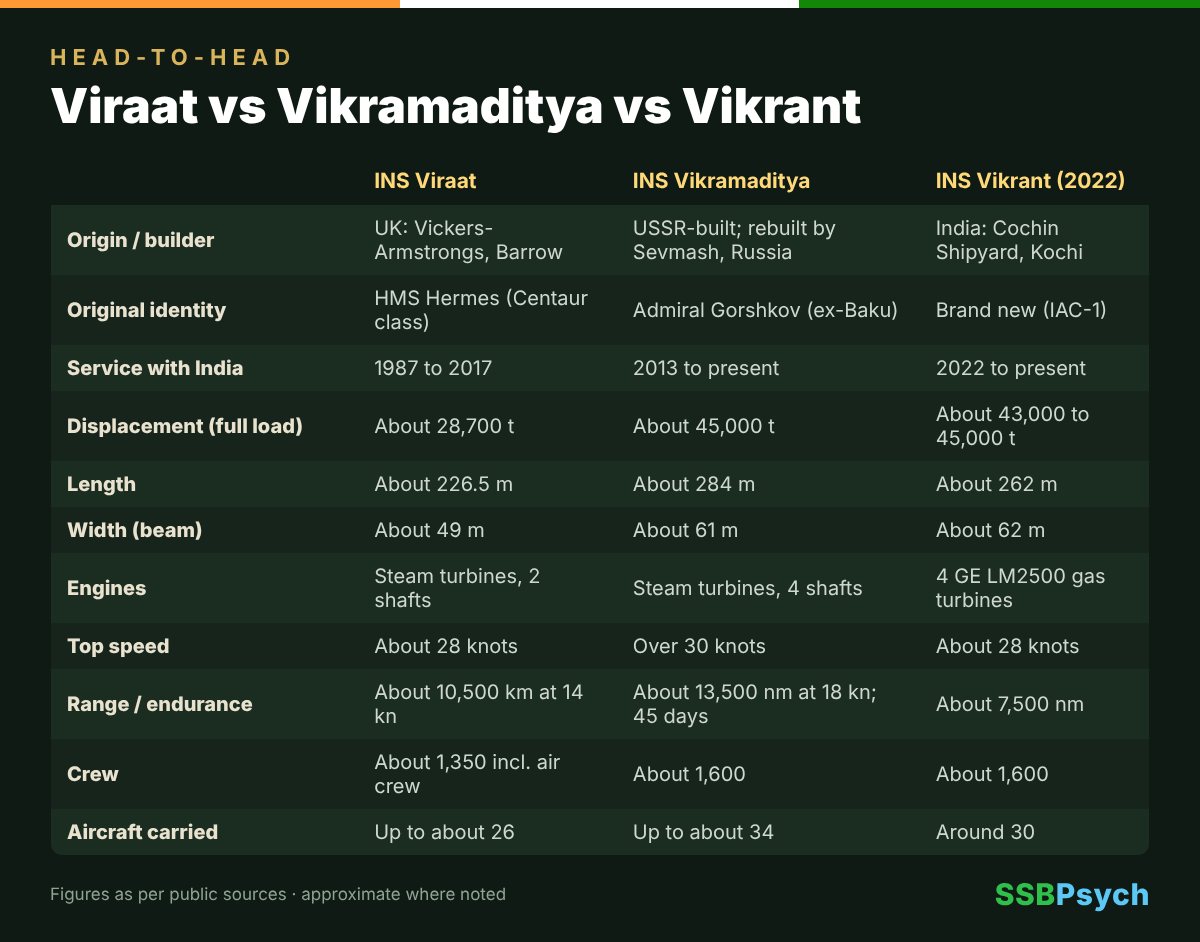
Viraat vs Vikramaditya vs Vikrant: Side-by-Side Comparison
| INS Viraat | INS Vikramaditya | INS Vikrant (2022) | |
|---|---|---|---|
| Origin / builder | UK: Vickers-Armstrongs, Barrow | USSR-built; rebuilt by Sevmash, Russia | India: Cochin Shipyard, Kochi |
| Original identity | HMS Hermes (Centaur class) | Admiral Gorshkov (ex-Baku) | Brand new (IAC-1) |
| Service with India | 1987 to 2017 | 2013 to present | 2022 to present |
| Displacement (full load) | About 28,700 t | About 45,000 t | About 43,000 to 45,000 t |
| Length | About 226.5 m | About 284 m | About 262 m |
| Width (beam) | About 49 m | About 61 m | About 62 m |
| Engines | Steam turbines, 2 shafts | Steam turbines, 4 shafts | 4 GE LM2500 gas turbines |
| Top speed | About 28 knots | Over 30 knots | About 28 knots |
| Range / endurance | About 10,500 km at 14 kn | About 13,500 nm at 18 kn; 45 days | About 7,500 nm |
| Crew | About 1,350 incl. air crew | About 1,600 | About 1,600 |
| Aircraft carried | Up to about 26 | Up to about 34 | Around 30 |
| Main fighter | Sea Harrier | MiG-29K | MiG-29K (Rafale M ordered) |
| Launch method | Ski-jump (STOVL) | 14 deg ski-jump plus wires (STOBAR) | 14 deg ski-jump plus wires (STOBAR) |
| Reported cost | Not clearly reported | Refit about USD 2.35 bn (reported) | Nearly Rs 20,000 crore (2022) |
| Key operations | Falklands 1982 (as Hermes); Gulf of Aden 2009 | Fleet exercises; twin-carrier ops | Op Sindoor deployment 2025 |
| Fate / status | Retired 2017, broken up at Alang | In service (Karwar) | In service |
Carrier Jargon Made Easy
- Displacement: the weight of water a ship pushes aside when it floats. In simple words, how heavy the ship is. One tonne is about the weight of a small car.
- Knot: one nautical mile per hour, about 1.85 km per hour. So 28 knots is about 52 km per hour.
- Catapult launch (CATOBAR): a powerful catapult flings a plane off the deck, and wires catch it on landing.
- STOVL: Short Take-Off and Vertical Landing. Jump jets like the Sea Harrier take off from a short run and can land almost straight down.
- STOBAR: Short Take-Off But Arrested Recovery. Normal fighters run up a ski-jump ramp to take off and catch a steel wire with a tail hook to land.
- Ski-jump: a curved ramp at the bow that throws a jet upward, like a skier leaving a slope, so it needs a shorter run.
Meet the Three Carriers
INS Viraat: The Grand Old Lady
INS Viraat started life as the British carrier HMS Hermes, commissioned into the Royal Navy in 1959. She was the flagship of the British task force in the 1982 Falklands War. India bought her in the mid-1980s and, after a refit in Britain, she was commissioned into the Indian Navy on 12 May 1987. Her name means giant.
Viraat was about 226.5 metres long and about 28,700 tonnes fully loaded, with a top speed of about 28 knots. She flew Sea Harrier jump jets and Sea King anti-submarine helicopters, using a ski-jump at the bow. She served India for about 30 years and was decommissioned on 6 March 2017. Counting her British years, she spent close to six decades in naval service, which makes her one of the longest-serving carriers in history. She was later broken up at Alang in Gujarat.
INS Vikramaditya: The Rebuilt Russian Giant
INS Vikramaditya was built in the Soviet Union as Baku, later renamed Admiral Gorshkov. She was a hybrid, part cruiser and part carrier, with large missiles on her front deck. India signed the deal for her on 20 January 2004. Russia’s Sevmash yard stripped out the missiles, added a 14-degree ski-jump and arrestor wires, and rebuilt most of her insides. She was commissioned on 16 November 2013.
She is about 284 metres long and about 45,000 tonnes fully loaded, can exceed 30 knots, and is reported to carry up to about 34 aircraft, led by the MiG-29K fighter. Her steam plant gives her long legs: about 13,500 nautical miles at 18 knots and about 45 days at sea. Her home port is Karwar in Karnataka.
INS Vikrant (2022): Made in India
INS Vikrant (2022), also called IAC-1 (Indigenous Aircraft Carrier 1), was designed by the Indian Navy’s own designers and built by Cochin Shipyard Limited in Kochi. Her keel was laid in 2009, she was floated out on 12 August 2013 and she was commissioned on 2 September 2022. She proudly carries the name of India’s first carrier.
She is about 262 metres long and 62 metres wide, with a reported full-load displacement of about 43,000 to 45,000 tonnes. Four gas turbines give her an official top speed of about 28 knots. She operates around 30 aircraft, including MiG-29K fighters and MH-60R helicopters, and 26 French Rafale M jets have been ordered for her. Official statements in 2022 put her cost at nearly Rs 20,000 crore.
Aircraft, Weapons and Sensors
- Sea Harrier FRS51 jump jets (Viraat)
- Sea King anti-submarine helicopters (Viraat)
- Chetak and Dhruv utility helicopters (Viraat)
- Barak surface-to-air missiles (Viraat)
- MiG-29K and MiG-29KUB fighters (Vikramaditya)
- Kamov Ka-31 early-warning helicopters (Vikramaditya)
- Kamov Ka-28 and Sea King anti-submarine helicopters (Vikramaditya)
- MiG-29K fighters (Vikrant 2022)
- MH-60R multi-role helicopters (Vikrant 2022)
- Kamov Ka-31 early-warning helicopters (Vikrant 2022)
Size and Speed Side by Side
Viraat was about 226.5 metres long and 49 metres wide. Vikramaditya is about 284 metres long and 61 metres wide, and Vikrant (2022) about 262 metres long and 62 metres wide. So both newer carriers have much more deck space for jets and helicopters to park, refuel and launch.
On speed, Viraat and Vikrant (2022) are both rated at about 28 knots, roughly 52 km per hour, while Vikramaditya can exceed 30 knots. Vikramaditya also has the longest reported reach, about 13,500 nautical miles at 18 knots and about 45 days at sea. Vikrant (2022) has a reported endurance of about 7,500 nautical miles, and Viraat’s range was reported at about 10,500 km at 14 knots.
Engines
Viraat and Vikramaditya both run on steam turbines fed by boilers, a powerful but labour-hungry system. Vikrant (2022) uses four GE LM2500 gas turbines, which start quickly, need fewer people and are simpler to look after.
Aircraft: From Sea Harrier to MiG-29K
Viraat’s star was the Sea Harrier FRS51, a British jump jet that could take off after a short run and land vertically. It was small and agile, but it carried limited fuel and weapons. Viraat could carry up to about 26 aircraft, including Sea King anti-submarine helicopters and Chetak and Dhruv utility helicopters. She also had Barak missiles for self-defence. Sea Harrier flying from her deck ended in May 2016.
The MiG-29K on Vikramaditya and Vikrant (2022) is a larger, twin-engine fighter with a stronger radar, higher speed and much more weapons load. Vikramaditya is reported to carry up to about 34 aircraft and Vikrant (2022) around 30. Both use Ka-31 radar helicopters as eyes in the sky. Vikrant (2022) also operates the MH-60R helicopter, and 26 Rafale M fighters have been ordered for her.

Origin, Builder and Cost
Viraat was built by Vickers-Armstrongs in Britain as HMS Hermes. Vikramaditya was built in the Soviet Union and rebuilt by Russia’s Sevmash shipyard. Vikrant (2022) was designed by the Indian Navy and built by Cochin Shipyard Limited.
A clear public figure for Viraat’s purchase price is hard to find, so we leave it out. Vikramaditya’s rebuild was reported at about USD 2.35 billion, excluding aircraft. Vikrant (2022) cost nearly Rs 20,000 crore, as stated officially at her commissioning in 2022. Running a carrier also costs a lot every year because of fuel, crew salaries, spare parts, aircraft upkeep and dry-dock refits.
Operations and Missions
- 1982 – Falklands War, as HMS Hermes (Viraat): Flagship of the British task force before India bought her.
- 2009 – Gulf of Aden deployment (Viraat): Sent to the anti-piracy zone after a refit.
- 2016 – International Fleet Review (Viraat): Took part in the review at Visakhapatnam in her final year.
- 2016 – First foreign visits (Vikramaditya): Port calls at Colombo and Male.
- 2020 – Naval Tejas landing (Vikramaditya): Hosted the first deck landing of the naval LCA Tejas.
- 2023 – First fighter landings (Vikrant 2022): MiG-29K and naval LCA landed on deck in February.
- 2023-24 – Twin-carrier operations: Vikramaditya and Vikrant (2022) operated jets together at sea.
- 2024 – Exercise with Italy (Vikramaditya): Sailed with the Italian carrier Cavour in the Arabian Sea.
Operations and Achievements
Before India, Viraat had a famous war career as HMS Hermes, the British flagship in the 1982 Falklands War. With India she spent 30 years at the heart of the fleet, training Sea Harrier pilots and taking part in exercises. In 2009 she was deployed to the Gulf of Aden, and in 2016 she took part in the International Fleet Review at Visakhapatnam before retiring in March 2017.
Vikramaditya made her first foreign port visits in 2016 and hosted the first naval Tejas deck landing in 2020. In October 2024 she exercised with the Italian carrier Cavour. Vikrant (2022) saw her first MiG-29K and naval LCA landings in February 2023, and in 2025 her group was forward-deployed in the Arabian Sea during Operation Sindoor. The two modern carriers have also operated together in twin-carrier drills.
Which Is Better at What?
- Longevity: Viraat, with close to six decades of service across two navies.
- Real war experience: Viraat, as HMS Hermes in the Falklands, before her Indian career.
- Speed and range: Vikramaditya, over 30 knots and the longest reported reach.
- Most aircraft: Vikramaditya, up to about 34.
- Modern technology: Vikrant (2022), with gas turbines and newer systems.
- Self-reliance: Vikrant (2022), India’s first home-built carrier.
How Carrier Technology Evolved
Viraat belonged to the jump-jet era. Smaller carriers without catapults could still fly fast jets thanks to the Harrier’s swivelling nozzles. But jump jets had limits on fuel, weapons and radar. By the 2000s India wanted a more capable fighter at sea, so it chose bigger carriers that could launch full-size fighters with a ski-jump and recover them with wires.
Vikramaditya delivered that capability by rebuilding an existing hull. Vikrant (2022) delivered it with an Indian design, Indian shipbuilding and modern gas turbine power. Next on the wish list for many navy watchers is a larger carrier with catapults, but that is a topic for another day.
Viraat vs Vikramaditya vs Vikrant Timeline
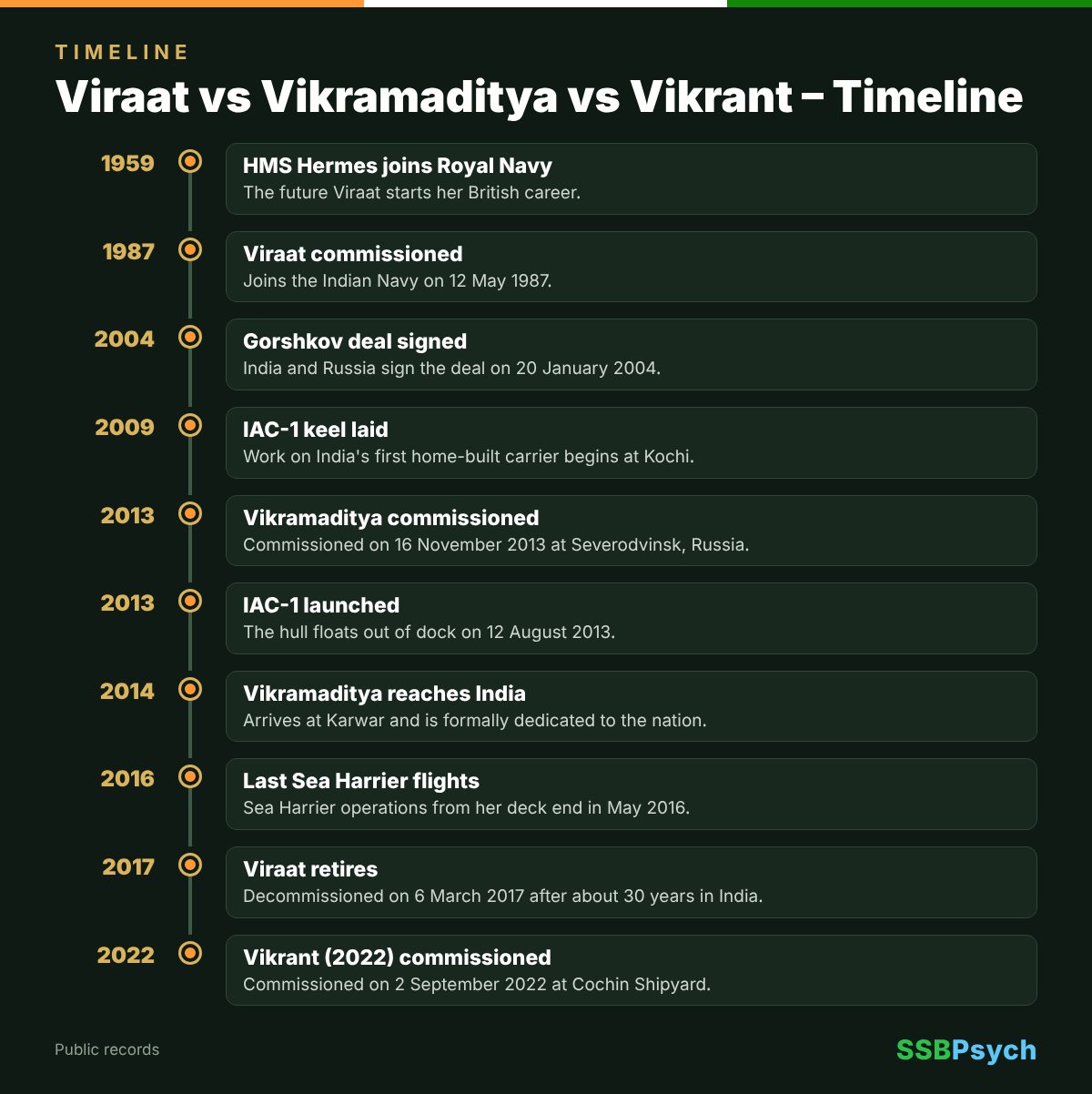
- 1959 – HMS Hermes joins Royal Navy: The future Viraat starts her British career.
- 1987 – Viraat commissioned: Joins the Indian Navy on 12 May 1987.
- 2004 – Gorshkov deal signed: India and Russia sign the deal on 20 January 2004.
- 2009 – IAC-1 keel laid: Work on India’s first home-built carrier begins at Kochi.
- 2013 – Vikramaditya commissioned: Commissioned on 16 November 2013 at Severodvinsk, Russia.
- 2013 – IAC-1 launched: The hull floats out of dock on 12 August 2013.
- 2014 – Vikramaditya reaches India: Arrives at Karwar and is formally dedicated to the nation.
- 2016 – Last Sea Harrier flights: Sea Harrier operations from her deck end in May 2016.
- 2017 – Viraat retires: Decommissioned on 6 March 2017 after about 30 years in India.
- 2022 – Vikrant (2022) commissioned: Commissioned on 2 September 2022 at Cochin Shipyard.
Who Commands a Carrier?
An Indian aircraft carrier is commanded by an officer of Captain rank. Below the captain are heads of departments for navigation, engineering, electrical systems, weapons, logistics, medical care and aviation. More than a thousand sailors and officers live aboard, along with pilots and aircraft technicians. Every carrier is effectively a floating town with kitchens, a hospital, workshops and its own power station.
The Verdict: Viraat vs Vikramaditya vs Vikrant
Think of three generations of one family. Viraat is the wise grandparent who has seen it all, from the Falklands to the Gulf of Aden. Vikramaditya is the strong parent who brought new muscle home. Vikrant (2022) is the bright young member who carries the family into the future. On sheer fighting power, Vikramaditya and Vikrant (2022) clearly outclass Viraat, and Vikrant (2022) wins the tiebreaker for modern technology and national pride.
For quick revision: Viraat was STOVL with Sea Harriers; Vikramaditya and Vikrant (2022) are STOBAR with MiG-29Ks.
Did You Know?
- Viraat was launched in 1953 and commissioned into the Royal Navy in 1959.
- Viraat’s last voyage under her own power was from Mumbai to Kochi in July 2016.
- Viraat was broken up at Alang in Gujarat from 2020.
- Vikramaditya’s rebuild needed roughly 2,300 km of new cable.
- Vikrant (2022) is about 59 metres tall.
- Vikrant (2022)’s flight deck covers about 12,500 square metres.
- In 2023 and 2024 the Navy operated Vikramaditya and Vikrant (2022) together, launching MiG-29Ks from both decks.
Quiz: Test Your Knowledge of Viraat vs Vikramaditya vs Vikrant
Click an option to see if you are right. Your score updates live.
Viraat vs Vikramaditya vs Vikrant: Frequently Asked Questions
No. INS Viraat was decommissioned on 6 March 2017 and later broken up at Alang.
Vikramaditya is far bigger, about 284 m long and 45,000 tonnes, against about 226.5 m and 28,700 tonnes for Viraat.
The Sea Harriers were ageing and limited in fuel and weapons. The MiG-29K is a more capable fighter suited to larger STOBAR carriers.
INS Vikramaditya, commissioned in 2013, and INS Vikrant (2022), commissioned on 2 September 2022.
An officer of Captain rank commands each carrier, supported by heads of departments for engineering, aviation, weapons, navigation and logistics.
This is part 16 of 16 in SSBPsych’s Indian Navy aircraft carrier series – a new post every day at 2 PM.
Sources: en.wikipedia.org, en.wikipedia.org, en.wikipedia.org.
Preparing for NDA, CDS, AFCAT or your SSB? Join SSBPsych’s online and offline batches – explore our courses or call +91 8076540582.