2nd Lt Arun Khetarpal, PVC: The 21-Year-Old Tank Hero of Basantar – Full Story (with Quiz)
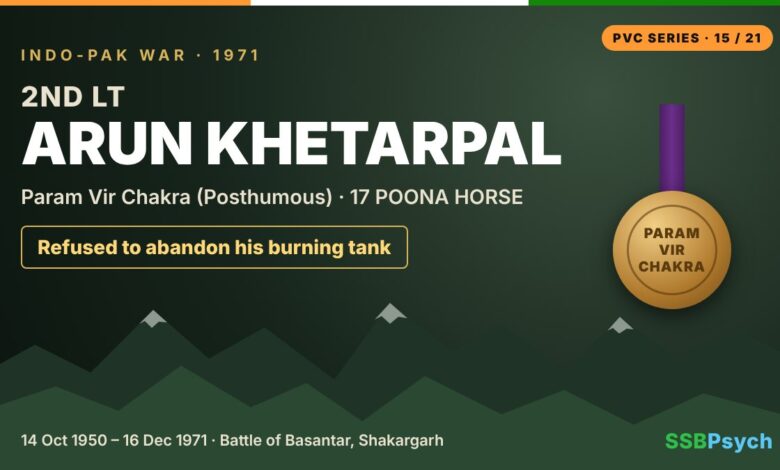
He had been an officer for barely six months. On the morning of 16 December 1971, Second Lieutenant Arun Khetarpal of 17 Horse, The Poona Horse, was in command of a Centurion tank named Famagusta on the battlefield of Basantar when the enemy’s armour came rolling towards the Indian bridgehead. His tank was hit and set on fire. Ordered over the radio to abandon it, he refused, because his gun still worked and the enemy was still coming. He fought until his tank was hit again and he was killed. He was just 21.
Arun Khetarpal is perhaps the Param Vir Chakra hero that NDA and IMA cadets feel closest to, because he was one of them only months before he died. In this post, the fifteenth in our 21 Param Vir Chakra heroes series, we cover his early life, his years at NDA and IMA, the background of the 1971 war in the Shakargarh sector, a detailed account of the Battle of Basantar, his citation in plain words, his legacy, and the officer-like qualities every aspirant can learn from him. Test yourself with the 10-question quiz at the end.
2nd Lt Arun Khetarpal – Quick Facts
| Full name | Arun Khetarpal |
| Born | 14 October 1950, Pune, Maharashtra |
| Father | Brigadier M. L. Khetarpal, Corps of Engineers |
| Schools | St. Columba’s School, Delhi, and The Lawrence School, Sanawar |
| Training | National Defence Academy (38th Course) and Indian Military Academy |
| Commissioned | 13 June 1971, 17 Horse (The Poona Horse) |
| Tank | Centurion named Famagusta |
| War | Indo-Pakistan War of 1971 |
| Battle | Battle of Basantar, Jarpal area, Shakargarh sector |
| Date of action | 16 December 1971 |
| Age at death | 21 |
| Award | Param Vir Chakra (Posthumous) |
Early Life: A Soldier’s Son
Arun Khetarpal was born on 14 October 1950 in Pune, Maharashtra. His family had roots in Sargodha in western Punjab and had come to India as refugees after Partition. Soldiering ran deep in the family: his great-grandfather had served in the Sikh Khalsa Army, his grandfather served in the First World War, and his father, M. L. Khetarpal, was an officer in the Corps of Engineers who rose to the rank of Brigadier.
Arun studied at St. Columba’s School in Delhi and then at The Lawrence School, Sanawar, in the hills of Himachal Pradesh. At Sanawar he made his mark as a good student, a keen sportsman and a school prefect, the kind of all-rounder whom teachers trust with responsibility.
NDA, IMA and the Poona Horse
In June 1967, Arun joined the National Defence Academy at Khadakwasla with the 38th Course. He was appointed Squadron Cadet Captain of Foxtrot Squadron, and under his leadership the squadron won the inter-squadron championship. He then went on to the Indian Military Academy in Dehradun, where, in his final term, he was chosen to carry the President’s Colours.
On 13 June 1971, he was commissioned into 17 Horse, The Poona Horse, the same armoured regiment in which Lt Col A. B. Tarapore had won the Param Vir Chakra in 1965. Young officers normally spend their first months learning the regiment’s ways and attending courses. Arun had very little time. War clouds were gathering, and by December he was at the front, commanding a troop of tanks.
The 1971 War: The Battle for the Bridgehead
When war broke out on 3 December 1971, Indian forces advanced into the Shakargarh bulge, a piece of Pakistani territory that pointed like a finger towards Jammu and Punjab. The goal was to remove the threat it posed to India’s road link with Jammu and Kashmir.
The 47th Infantry Brigade, with the Poona Horse attached to it, was given the task of building a bridgehead across the Basantar River. The infantry took its objectives by 9 pm on 15 December, but the tanks were held up by deep enemy minefields. The engineers were still clearing a path when the Poona Horse decided it could not wait. Its tanks pushed through the minefield during the night and joined up with the infantry by first light on 16 December. Arun was among them. It was a bold move that would prove decisive in the hours ahead.
The Battle of Basantar: 16 December 1971
The Enemy Strikes at Jarpal
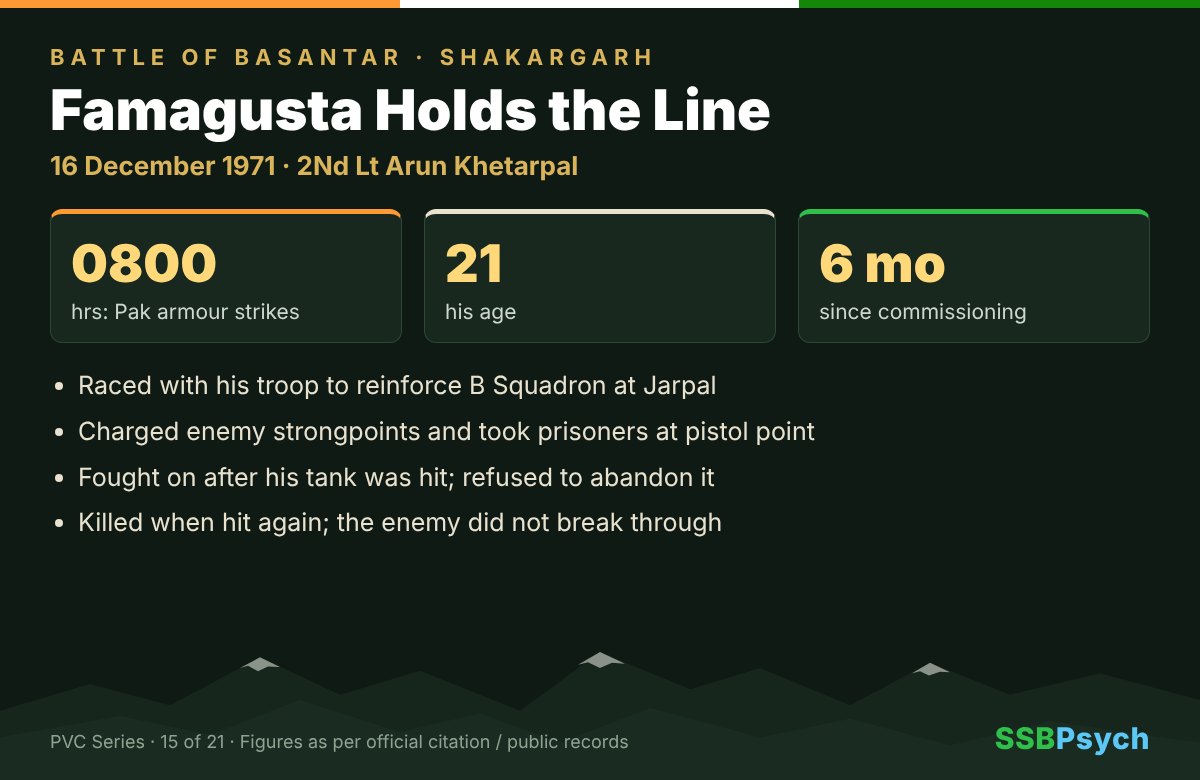
At about 8 am on 16 December, Pakistani armour launched a powerful counter-attack, aimed at Jarpal, the pivot of the Poona Horse’s position. The enemy’s goal was to crush the bridgehead before it could grow stronger. ‘B’ Squadron, holding Jarpal, called for help. Arun Khetarpal, commanding a troop in ‘A’ Squadron, immediately moved his tanks towards the threatened sector.
Charging the Strongpoints
On the way, his tanks ran into enemy strongpoints and recoilless gun positions that were still holding out. Arun did not go around them. He attacked them head-on, overran the positions and even took enemy soldiers prisoner at pistol point. During this fighting, the commander of the other tank in his troop was killed, leaving Arun to fight on with his own tank.
He pressed on towards ‘B’ Squadron’s area and reached the fight in time. As the enemy tanks began to fall back, he chased them and destroyed a tank. Then came a fresh wave of enemy armour, and the most intense tank battle of the day began.
I Will Not Abandon My Tank
In the tank-versus-tank fighting that followed, Arun’s Centurion, Famagusta, was hit and caught fire. His squadron commander ordered him over the radio to abandon the burning tank. Arun knew that if his tank pulled out, the enemy would find a gap in the line and break through. He refused.
No, Sir, I will not abandon my tank. My main gun is still working.
– 2nd Lt Arun Khetarpal over the radio, 16 December 1971, as widely recounted
He kept firing and continued to hit enemy tanks. Then Famagusta was hit a second time, and Arun Khetarpal was mortally wounded. His radio operator, Sowar Nand Singh, was also killed, while his driver and gunner were wounded and captured. But the line had held. The enemy’s armoured thrust against the bridgehead failed, and the Basantar bridgehead stayed in Indian hands. The war ended with a ceasefire the next evening.
Think about what that decision meant. A tank on fire is a death trap; every instinct tells the crew to get out. Arun was also the junior-most officer on the field, with every reason to obey the order to pull back. Instead, he weighed the situation in seconds and saw that the whole bridgehead, and the lives of the infantry who had fought to win it, depended on that one stretch of ground not giving way. He chose the mission over his own life.
The Param Vir Chakra Citation
Second Lieutenant Arun Khetarpal was awarded the Param Vir Chakra posthumously. In simple words, his citation records that:
- When enemy armour counter-attacked at Jarpal on 16 December 1971, he moved with his troop to support the squadron under attack.
- He charged enemy strongpoints and positions, capturing enemy soldiers at pistol point, even after the commander of his second tank was killed.
- He pursued the withdrawing enemy and destroyed a tank, then fought in the fierce tank battle that followed.
- When his tank was hit and set on fire, he chose not to abandon it, knowing the enemy would break through if he did, and he kept destroying enemy tanks.
- He was killed when his tank was hit again. Through his courage and determination, not one enemy tank got through.
Legacy: A Name Every Cadet Knows
Few heroes are remembered as warmly by the institutions that shaped them. At the National Defence Academy, the main parade ground is named Khetarpal Ground, where generations of cadets march past every term. At the Indian Military Academy, an auditorium and one of the main gates carry his name. His tank, Famagusta, is preserved at the Armoured Corps Centre and School in Ahmednagar, and his name was inscribed at the Balidan Stambh in Jammu in 2009.
One of the most moving chapters came three decades after the war. In 2001, Brigadier M. L. Khetarpal, by then an old man, visited his birthplace in Pakistan. There he met a retired Pakistani officer, Brigadier Khwaja Mohammad Naser of 13 Lancers, who told him that he had been the tank commander who faced Arun at Basantar, and who spoke with deep respect of the young officer’s courage. Two old soldiers, once enemies, shared a moment of grief and honour.
His story has been told in the 1988 Doordarshan series Param Vir Chakra, in graphic novels, and in the Hindi film Ikkis, whose title means twenty-one, his age when he died. The Poona Horse is proud to count two Param Vir Chakra heroes from two different wars, Tarapore in 1965 and Khetarpal in 1971.
What This Means for You as an Aspirant
Arun Khetarpal was not a battle-hardened veteran. He was a young officer, just like the one you hope to become, only months out of the academy. Yet when the moment came, he understood his duty perfectly: the line must hold. His years at Sanawar, NDA and IMA show that leadership is built step by step, as prefect, as cadet captain, as colours bearer, long before any war. Treat every small responsibility you get today as preparation for the big ones tomorrow.
Lessons for SSB Aspirants: OLQs in Action
The SSB does not test whether you can recite history – it looks for the qualities of an officer. Here is how 2nd Lt Arun Khetarpal showed them:
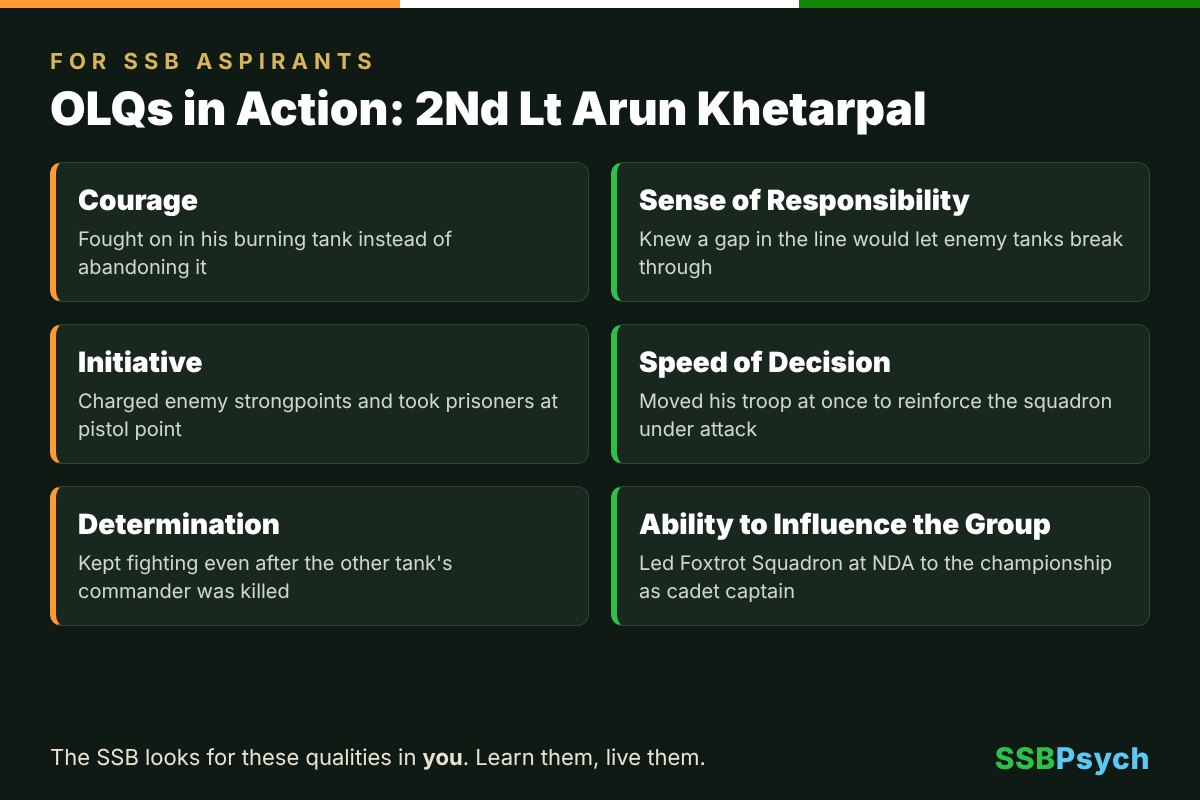
- Courage – Fought on in his burning tank instead of abandoning it
- Sense of Responsibility – Knew a gap in the line would let enemy tanks break through
- Initiative – Charged enemy strongpoints and took prisoners at pistol point
- Speed of Decision – Moved his troop at once to reinforce the squadron under attack
- Determination – Kept fighting even after the other tank’s commander was killed
- Ability to Influence the Group – Led Foxtrot Squadron at NDA to the championship as cadet captain
Tip for your SSB interview: Interviewing officers often ask about responsibilities you have held, such as prefect, captain or NCC roles. Like Arun Khetarpal’s journey from school prefect to NDA cadet captain, describe what you actually did in each role and what you learnt, not just the title.
Practice Corner: WAT and SRT
Write your first spontaneous response to these before you scroll to the quiz. Keep WAT sentences short, positive and action-oriented.
WAT Words
- Tank
- Abandon
- Young
- Line
- Gun
SRTs
- He has just joined a new job and, in his first month, a serious crisis hits while his seniors are away. He…
- He is told by his team captain to leave the field after an injury, but the team will be one player short at a crucial moment. He…
- He is the youngest member of a rescue team, and the senior member leading the team gets injured. He…
Quiz: How Well Do You Know 2nd Lt Arun Khetarpal?
Test yourself! Click an option to see if you are right. Your score updates live.
Frequently Asked Questions
Why was 2nd Lt Arun Khetarpal awarded the Param Vir Chakra?
During the Battle of Basantar on 16 December 1971, he attacked enemy strongpoints, destroyed enemy tanks and refused to abandon his burning tank so that the enemy could not break through, until he was killed when his tank was hit again.
How old was Arun Khetarpal when he won the Param Vir Chakra?
He was 21 years old and had been commissioned only about six months earlier, on 13 June 1971.
What was his tank called and where is it now?
His Centurion tank was named Famagusta. It is preserved at the Armoured Corps Centre and School in Ahmednagar.
How is Arun Khetarpal honoured at NDA and IMA?
The NDA parade ground is named Khetarpal Ground, and the IMA has an auditorium and a main gate named after him.
What can NDA and SSB aspirants learn from him?
That duty comes before personal safety, that young officers can lead with great courage, and that every responsibility in school and training builds the leader you will become.
The Param Vir Chakra Series on SSBPsych
This is part 15 of 21 in our series on every Param Vir Chakra awardee. A new hero goes live every morning at 7:30 AM. Also read the story of Captain Vikram Batra, PVC – the Sher Shah of Kargil.
Sources: en.wikipedia.org, bharat-rakshak.com.
Preparing for your SSB? Join SSBPsych’s online and offline SSB batches and learn how to show your OLQs with confidence – explore our courses or call +91 8076540582.