Punjab Regiment: History, Motto, War Cry, Battles and Heroes
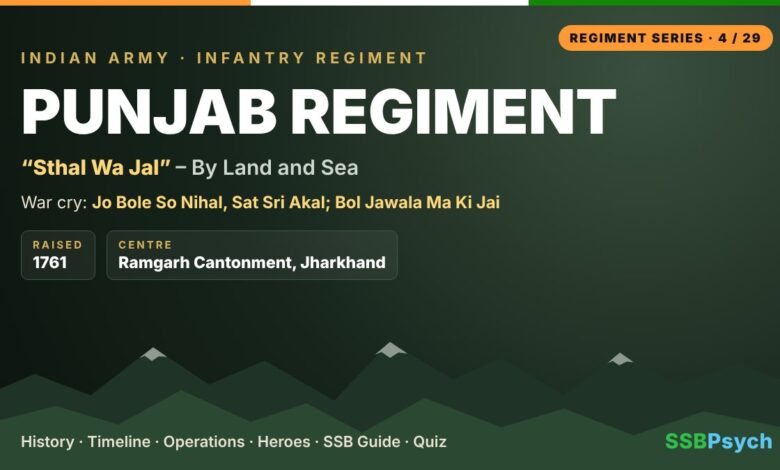
On the night of 4 December 1971, a single company of soldiers in a lonely post in the Thar desert saw a large Pakistani armoured column heading their way. They chose to stand and fight. That post was Longewala, and the soldiers belonged to the Punjab Regiment, one of the oldest and most decorated regiments of the Indian Army. With a motto that means By Land and Sea and a ship on its badge, it is also one of the most unusual.
This guide for NDA, CDS, AFCAT, TES and SSB aspirants covers the regiment’s long lineage, a visual timeline, its major operations and battle honours, its insignia, motto and war cries, its heroes, and life in the regiment. We also explain what candidates should know for the SSB and finish with a 10-question quiz.
Punjab Regiment – Quick Facts
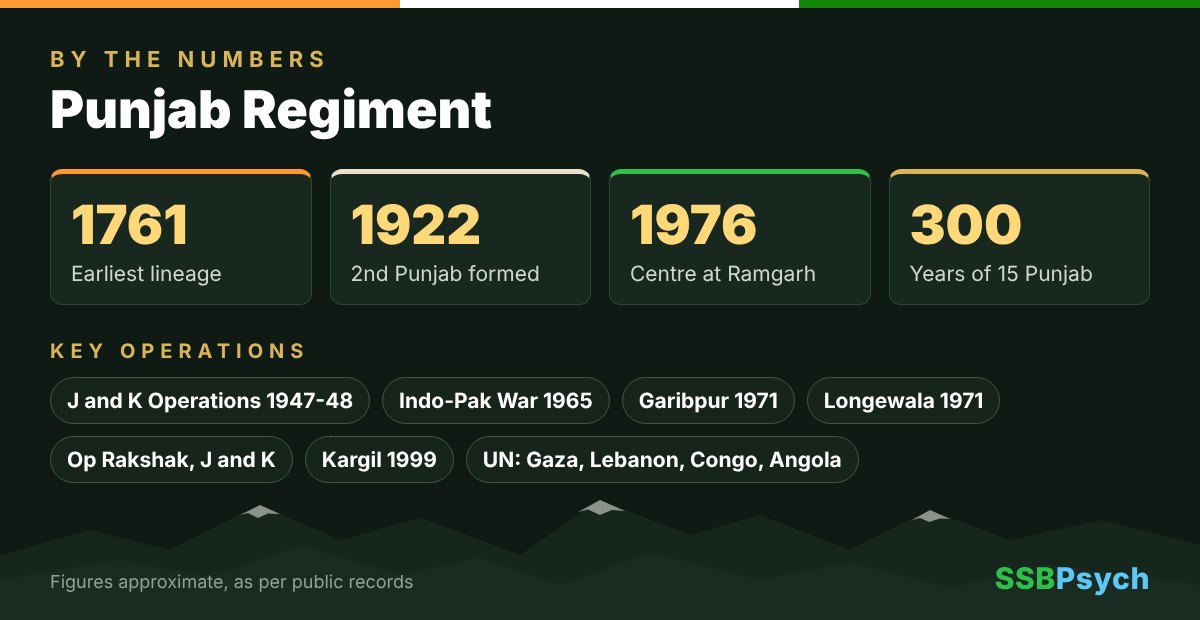
| Raised | Lineage from 1761 (Madras Presidency); 2nd Punjab Regiment formed 1922 |
| Regimental Centre | Ramgarh Cantonment, Jharkhand (since 1976) |
| Motto | Sthal Wa Jal, also Khushki wa Tari (By Land and Sea) |
| War Cries | Jo Bole So Nihal, Sat Sri Akal (Sikh troops); Bol Jawala Ma Ki Jai (Dogra troops) |
| Insignia | A galley, an oared sailing ship, marking early overseas service |
| Recruitment | Mainly Sikhs and Dogras from Punjab, Himachal Pradesh and Jammu |
| Battalions | Around 20 regular battalions, plus TA and RR units |
| Famous action | Longewala, 1971 (23 Punjab) |
| Notable gallantry | Maha Vir Chakras including Maj Kuldip Singh Chandpuri |
History of the Punjab Regiment
Surprisingly, the story of the Punjab Regiment begins not in Punjab but in the south. Its earliest battalions were raised by the East India Company in the Madras Presidency between 1761 and 1776, during the wars in the Carnatic region. Over the next century and a half they changed names many times, being called Coast Sepoys, Carnatic Infantry and Madras Native Infantry. As recruitment shifted northwards in the late nineteenth century, these battalions began to enlist Punjabi soldiers and became known as Punjabis.
These battalions served in campaigns across Asia and beyond. One of them, the 69th Punjabis, had sailed overseas on so many campaigns by 1824 that it was granted the right to show a galley, a ship with oars and a sail, on its badge. This galley is still the insignia of the Punjab Regiment today, a rare symbol for an infantry regiment.
In the army reorganisation of 1922, several Punjabi battalions, including the 69th Punjabis, were grouped together as the 2nd Punjab Regiment. At Partition in 1947, the 1st, 8th, 14th, 15th and 16th Punjab Regiments went to Pakistan, while the 2nd Punjab Regiment stayed with India and later became simply the Punjab Regiment.
After Independence, the regiment grew stronger. In 1951, battalions from the former princely states of Jind, Nabha and Patiala joined as the 13th to 16th Battalions. 15 Punjab, which came from the 1st Patiala Infantry, has an especially long history and marked 300 years of service in 2005. The regiment also gave some of its finest units to new formations: its 1st Battalion became 1 Para, now a Special Forces battalion, and its 2nd Battalion became 1 Guards. After moving through several homes, including Meerut, the Punjab Regimental Centre settled at Ramgarh Cantonment in Jharkhand in 1976.
Through all these changes, one thing stayed constant: the regiment’s reputation for steady, dependable soldiering. Its lineage battalions served across many theatres in both World Wars, and that experience passed on to the officers and soldiers who carried the regiment into independent India. When the new nation needed tested battalions in 1947 and 1948, the Punjab Regiment was ready.
Punjab Regiment Timeline: From Raising to Today
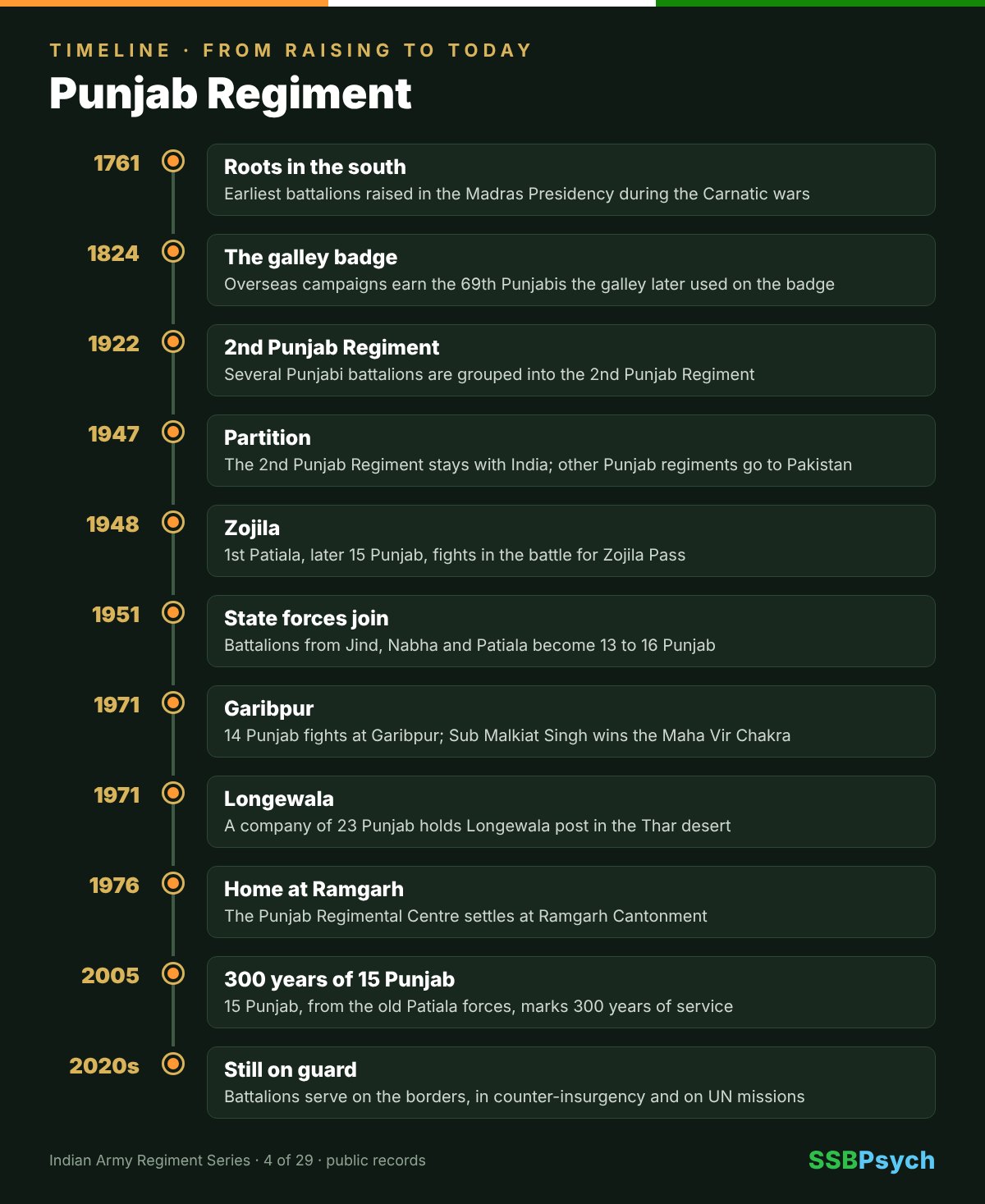
- 1761 – Roots in the south: Earliest battalions raised in the Madras Presidency during the Carnatic wars
- 1824 – The galley badge: Overseas campaigns earn the 69th Punjabis the galley later used on the badge
- 1922 – 2nd Punjab Regiment: Several Punjabi battalions are grouped into the 2nd Punjab Regiment
- 1947 – Partition: The 2nd Punjab Regiment stays with India; other Punjab regiments go to Pakistan
- 1948 – Zojila: 1st Patiala, later 15 Punjab, fights in the battle for Zojila Pass
- 1951 – State forces join: Battalions from Jind, Nabha and Patiala become 13 to 16 Punjab
- 1971 – Garibpur: 14 Punjab fights at Garibpur; Sub Malkiat Singh wins the Maha Vir Chakra
- 1971 – Longewala: A company of 23 Punjab holds Longewala post in the Thar desert
- 1976 – Home at Ramgarh: The Punjab Regimental Centre settles at Ramgarh Cantonment
- 2005 – 300 years of 15 Punjab: 15 Punjab, from the old Patiala forces, marks 300 years of service
- 2020s – Still on guard: Battalions serve on the borders, in counter-insurgency and on UN missions
Major Operations and Battle Honours
The Punjab Regiment’s battalions have fought in every major war of independent India. Post-Independence battle honours connected with the regiment include Zojila, Kalidhar, Longewala and Garibpur, among others, in addition to many honours won before 1947 in Asia, Africa and Europe.
1947-48: The Battle for Zojila
In 1948, Pakistani raiders and troops threatened Ladakh by holding the high Zojila Pass. Indian troops, including the 1st Patiala Infantry, which later became 15 Punjab, fought in bitter cold to clear the pass, an operation famous for the use of tanks at very high altitude. 15 Punjab still celebrates its role in this battle.
1971: Garibpur
Even before the war formally began, 14 Punjab fought a fierce battle at Garibpur in November 1971, close to the border with East Pakistan, with the support of Indian tanks. Pakistani forces counter-attacked with tanks and infantry but were beaten back. Subedar Malkiat Singh of 14 Punjab was killed in this action and was awarded the Maha Vir Chakra.
1971: Longewala
The most famous chapter came at Longewala in Rajasthan. A company of 23 Punjab, commanded by Major Kuldip Singh Chandpuri, held the post through the night of 4 to 5 December 1971 against a much larger Pakistani force that included tanks. The soldiers used mines, recoilless guns and sheer determination to hold on until daylight, when Indian Air Force aircraft attacked the enemy column and destroyed many of its vehicles. Major Chandpuri received the Maha Vir Chakra. The battle later inspired the Hindi film Border.
What makes Longewala such a powerful lesson is the decision taken in the dark. The company could have withdrawn, and few would have blamed it. Instead, its commander judged that the post could be held until help arrived, and his men trusted him. Leadership, morale, good use of ground and timely support from another service all came together that night. It remains a favourite case study in training establishments and a proud memory for the regiment.
Counter-Insurgency, Kargil and the UN
Punjab battalions have served long tours in Jammu and Kashmir under Operation Rakshak and took part in Operation Vijay during the Kargil conflict of 1999. Under the UN flag, battalions have served in Gaza, Lebanon, Angola and the Democratic Republic of the Congo. These deployments test patience as much as courage, since soldiers must win the trust of local people while dealing firmly with armed militants.
Punjab Regiment Insignia, Motto and War Cry
The regiment’s insignia is the galley, a reminder that its battalions were among the first Indian infantry to sail overseas to fight. Most infantry badges show weapons, animals or symbols of strength, so a ship is a striking and memorable choice.
The motto Sthal Wa Jal, also written in its older form as Khushki wa Tari, means By Land and Sea, and it matches the galley badge perfectly. The regiment has two war cries, reflecting its two main classes of soldiers. Sikh soldiers shout Jo Bole So Nihal, Sat Sri Akal, while Dogra soldiers call out Bol Jawala Ma Ki Jai, invoking the goddess Jawala. In battle, both cries rise together from the same battalion.
Heroes of the Punjab Regiment
- Major (later Brigadier) Kuldip Singh Chandpuri, Maha Vir Chakra – 23 Punjab, defence of Longewala, 1971.
- Subedar Malkiat Singh, Maha Vir Chakra (posthumous) – 14 Punjab, Battle of Garibpur, November 1971.
- Sepoy Harbhajan Singh – 23 Punjab; died in 1968 in eastern Sikkim and is revered by soldiers as Baba Harbhajan Singh, with a shrine near Nathu La.
- Lt Col (later Brigadier) Shivinder Singh – commanded 2 Punjab when it became 1 Guards, the senior battalion of the Brigade of the Guards.
Before Independence, soldiers of the regiment’s lineage battalions won many British gallantry awards, including the Victoria Cross. After 1947, its soldiers have won Maha Vir Chakras, Kirti Chakras, Vir Chakras and Shaurya Chakras in war and in counter-insurgency, making it one of the most decorated regiments of the Army.
The story of Baba Harbhajan Singh deserves a special mention. After the young sepoy of 23 Punjab lost his life in 1968 in the high mountains of eastern Sikkim, soldiers in the area began to believe that his spirit continued to watch over the border. A shrine in his memory near Nathu La is visited by soldiers and travellers, and he is affectionately remembered as a guardian of the troops posted there. Whatever one believes, the story shows the deep bond soldiers feel with comrades they have lost.
Role and Life in the Regiment
The Punjab Regiment is a standard infantry regiment. Its battalions hold posts on the Line of Control and the Line of Actual Control, guard the deserts of Rajasthan, serve in counter-insurgency in Jammu and Kashmir and the North-East, and help civil authorities during disasters. Its soldiers are mainly Sikhs and Dogras from Punjab, Himachal Pradesh and Jammu, though some battalions also include soldiers of other classes.
A young officer in the regiment quickly learns to respect both Sikh and Dogra traditions. Gurpurabs and Hindu festivals are celebrated with equal enthusiasm in the unit lines, and the gurdwara and the mandir often stand side by side. Many officers also pick up Punjabi or Dogri phrases, which helps them connect with their men.
The regiment is known for its sporting talent, especially in athletics, hockey, boxing and kabaddi, and its soldiers have represented the Army and the country in many events. Physical toughness and good humour are part of the regiment’s identity. Adventure activities such as mountaineering, rafting and long-distance expeditions are also encouraged, because they build the same courage, endurance and teamwork that soldiers need in operations. For a young officer, taking part alongside his men in such events is one of the quickest ways to earn their trust and respect.
Why the Punjab Regiment Matters for SSB Aspirants
The battle of Longewala is one of the most popular examples in SSB lectures, group discussions and interviews, especially on themes such as leadership under pressure, Army and Air Force cooperation, and the importance of holding ground. If you mention it, get the facts right: it was a company of 23 Punjab under Major Kuldip Singh Chandpuri, in December 1971, supported at first light by the Indian Air Force.
The regiment’s long lineage, from Madras to Punjab, is also a good talking point on how the Indian Army evolved from the armies of the East India Company into a national force. Knowing that the regiment’s soldiers come from different faiths but share one battalion spirit can help you answer questions on unity and secularism in the Army.
In group discussions on topics like the role of the Army in nation building, you can also mention how the Punjab Regiment has served in disaster relief and in UN peacekeeping in places such as Lebanon and the Congo. Such examples show that the Army’s job is not limited to war. Keep each example short, accurate and relevant, and let it support your main argument rather than replace it.
Punjab Regiment for SSB Candidates: What You Should Know
How officers join
- Officers join the Army through NDA, the IMA (via CDS, TES or TGC) or the OTA Chennai (Short Service Commission), after clearing the SSB and medicals.
- Regiment allotment is done during academy training based on choice, merit and vacancies; there is no direct entry to a specific regiment.
- Officers of any background can be commissioned into the Punjab Regiment; knowing its traditions helps you lead its soldiers well.
- Sons of officers who served in a regiment may express a preference for it, but allotment still depends on Army rules and vacancies.
How soldiers join
- The regiment recruits mainly Sikhs and Dogras from Punjab, Himachal Pradesh and Jammu, as per the Army’s recruitment pattern for the regiment.
- Since 2022, soldiers join through the Agnipath scheme as Agniveers, via Army recruitment rallies and the online common entrance exam.
- Recruits train at the Punjab Regimental Centre, Ramgarh Cantonment, Jharkhand.
Questions you may face in the SSB interview, GD or lecturette
- Tell us about the battle of Longewala. What leadership lessons does it teach?
- Why does the Punjab Regiment have a ship on its badge?
- How did Army and Air Force cooperation decide the result at Longewala?
- What is the motto of the Punjab Regiment and what does it mean?
- How do regiments with soldiers of different faiths maintain unity?
SSBPsych tip: Use Longewala as an example of calm leadership under pressure, but keep the facts precise and add your own reflection on what you would have learnt as a young officer there.
The Punjab Regiment’s story shows how a small group of determined soldiers can change the course of a battle. Remember its galley badge, its motto Sthal Wa Jal and the heroes of Longewala and Garibpur, and then try the quiz below.
Quiz: How Well Do You Know the Punjab Regiment?
Test yourself! Click an option to see if you are right. Your score updates live.
Punjab Regiment: Frequently Asked Questions
The motto is Sthal Wa Jal, also written as Khushki wa Tari, meaning By Land and Sea.
The Punjab Regimental Centre is at Ramgarh Cantonment in Jharkhand, where it has been since 1976.
It has two: Jo Bole So Nihal, Sat Sri Akal for Sikh soldiers, and Bol Jawala Ma Ki Jai for Dogra soldiers.
A company of 23 Punjab, led by Major Kuldip Singh Chandpuri, held Longewala in December 1971 until the Indian Air Force struck the attacking column.
The regiment mainly recruits Sikhs and Dogras from Punjab, Himachal Pradesh and Jammu, now through the Agnipath scheme.
Indian Army Regiments Series on SSBPsych
This is part 4 of 29 in our series on every infantry regiment of the Indian Army – a new regiment every day at 11 AM. Previous in the series: Mechanised Infantry Regiment. Also follow our Param Vir Chakra series.
Sources: en.wikipedia.org, globalsecurity.org, en.wikipedia.org, honourpoint.in, tribuneindia.com.
Preparing for NDA, CDS, AFCAT or your SSB? Join SSBPsych’s online and offline batches – explore our courses or call +91 8076540582.