CHM Piru Singh Shekhawat, PVC: The Lion of Tithwal, 1948 – Full Story (with Quiz)
In the darkness of 18 July 1948, on a narrow ridge high in the Tithwal sector of Kashmir, a company of Rajputana Riflemen was being torn apart by machine-gun fire from hidden bunkers. Within half an hour, more than fifty men had fallen. At the front of the attack, a Company Havildar Major from a small village in Rajasthan shouted his battle cry and ran straight at the guns. Wounded, bleeding and nearly blind, he kept attacking post after post until he could fight no more. He was Company Havildar Major Piru Singh Shekhawat, and his extraordinary charge earned him the Param Vir Chakra.
For NDA, CDS, AFCAT and SSB aspirants, Piru Singh’s story is a lesson in raw courage combined with a clear sense of purpose. He knew exactly which enemy position was causing the most damage, and he went after it. This post explains his early life, his long Army career, the background of the Tithwal battles, a detailed account of his final action, his citation in simple words and his legacy. At the end you will find a 10-question quiz, WAT words and SRT situations.
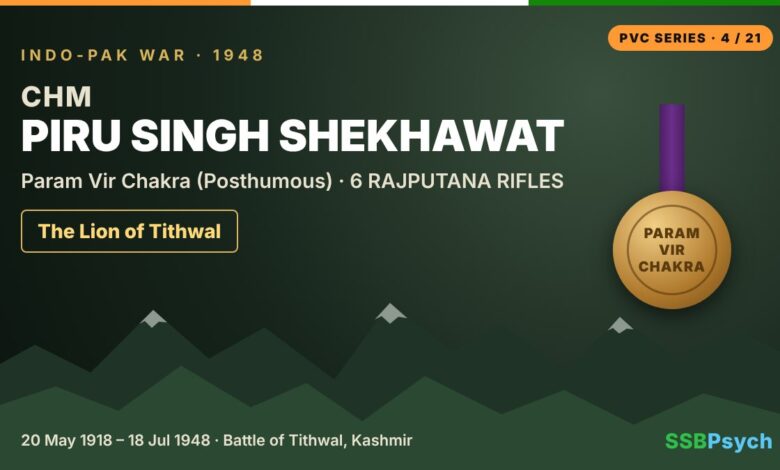
CHM Piru Singh Shekhawat – Quick Facts
| Full name | Company Havildar Major Piru Singh Shekhawat |
| Born | 20 May 1918, Rampura Beri, Jhunjhunu area, Rajasthan |
| Father | Lal Singh |
| Enlisted | 20 May 1936, 1st Punjab Regiment |
| Unit in 1948 | 6th Battalion, The Rajputana Rifles (6 RAJ RIF) |
| Battle | Battle of Tithwal, Jammu and Kashmir |
| Date of action | Night of 17–18 July 1948 |
| Died | 18 July 1948, Tithwal (aged 30) |
| Award | Param Vir Chakra (Posthumous) |
| Earlier service | North-West Frontier; Commonwealth Occupation Force, Japan |
Early Life in Rajasthan
Piru Singh was born on 20 May 1918 in Rampura Beri, a village in the Shekhawati region of present-day Rajasthan, which was then part of Rajputana. His father was Lal Singh, and Piru was the youngest of seven children, with three brothers and four sisters.
School was not for him. After a quarrel with a classmate led to a scolding from his teacher, he left school and never went back. He helped his parents on the family farm instead, and his favourite pastime was hunting. From childhood he dreamed of becoming a soldier. He tried to join the Army twice but was turned away for being too young. He did not give up, and he was finally accepted at the age of eighteen.
A Long Career in Uniform
Piru Singh enlisted on 20 May 1936, his eighteenth birthday, in the 10th Battalion of the 1st Punjab Regiment at Jhelum, which was the regiment’s training battalion. A year later he joined its 5th Battalion. His dedication was soon noticed and promotions followed steadily:
- Lance Naik in August 1940
- Naik in March 1941
- Havildar in February 1942
- Company Havildar Major in May 1945
He served on the North-West Frontier, a tough region known for tribal fighting, and also worked as an instructor at the Punjab Regimental Centre in Jhelum, where he helped train new soldiers. After the Second World War he went to Japan with the British Commonwealth Occupation Force and served there until September 1947.
When India was partitioned, the Punjab Regiment went to Pakistan. Piru Singh, choosing India, was transferred to the 6th Battalion of the Rajputana Rifles. As Company Havildar Major, he was the senior non-commissioned soldier of his company, responsible for discipline, administration and supporting the company commander in battle.
Background: The Fight for Tithwal
Tithwal lies on the Kishanganga River in the Kupwara area of north Kashmir. Indian troops had captured it in May 1948, but the enemy counter-attacked fiercely and occupied strong positions on the heights nearby. On 8 July 1948, the enemy captured an important position in the sector, forcing Indian troops to fall back across the Kishanganga.
To restore the situation, 6 Rajputana Rifles was moved from Uri to Tithwal and placed under the 163rd Infantry Brigade. The battalion was ordered to capture two enemy positions on a ridge. D Company was to take the first objective, after which C Company would go for the second. Piru Singh was with D Company.
The Battle of Tithwal: 18 July 1948
A Deadly Approach
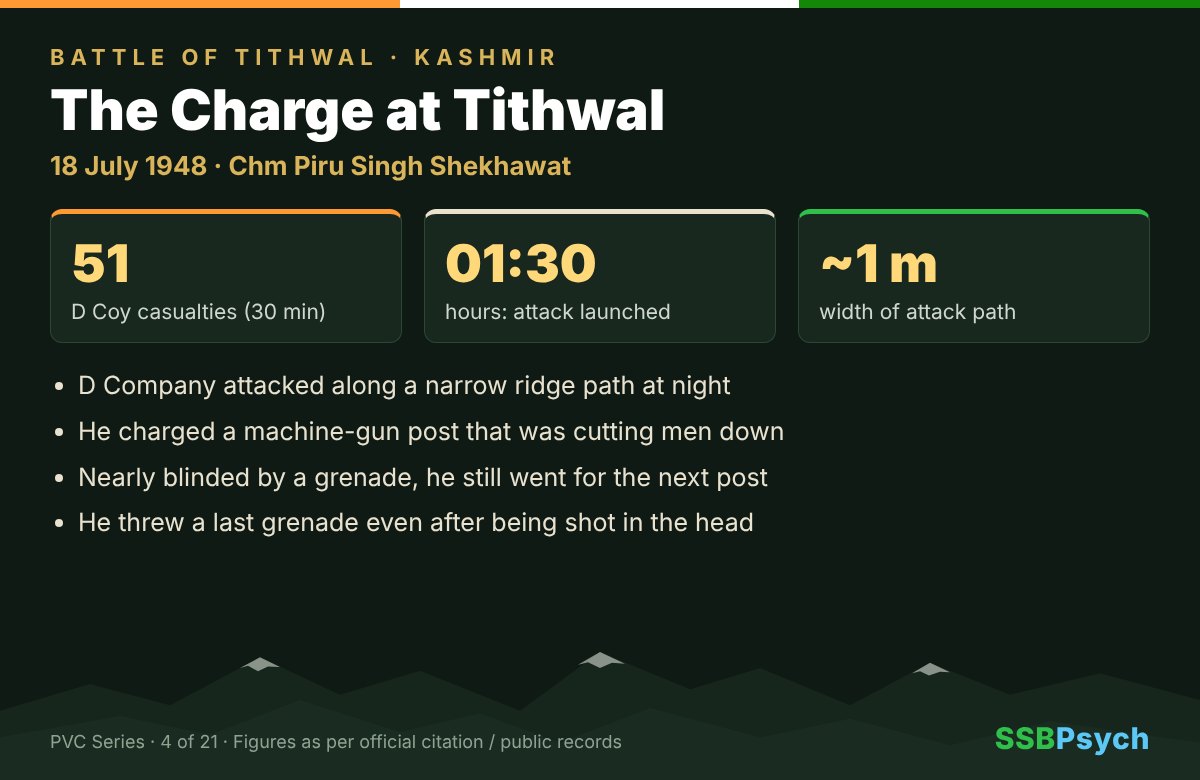
At 1:30 in the morning on 18 July 1948, D Company began its attack. The only way forward was a path barely a metre wide, with steep ravines on both sides. The enemy had well-hidden bunkers that overlooked this path, and their medium machine guns covered every step. It was the kind of ground where attackers have almost no room to manoeuvre and defenders have every advantage.
As soon as the company moved, the enemy opened fire. The losses were terrible. Within about thirty minutes, D Company had suffered 51 casualties. Piru Singh’s section was leading the attack, and more than half of it was killed or wounded.
The First Machine-Gun Post
Piru Singh saw that one medium machine-gun post was causing most of the casualties. He knew that if it continued firing, the whole attack would fail. Shouting his battle cry, Raja Ramchandra ki Jai, he rushed forward towards it. He was hit by shrapnel from grenades in several places, and his clothes were soaked with blood, but he did not stop. He reached the post and killed the gun crew with his Sten gun and bayonet, silencing the gun.
Fighting On Alone
By now, the rest of the men around him had fallen. Piru Singh was effectively the only survivor of his section, yet he went straight for the next machine-gun post. A grenade exploded near his face, wounding him so badly that he could barely see. His Sten gun ran out of ammunition. Still he crawled forward and threw grenades at the next post. He then jumped into another enemy trench and killed two more enemy soldiers with his bayonet.
As he came out of that trench to attack yet another bunker, he was shot in the head. Even then, as he fell, he threw one last grenade at the enemy position. He died on the ridge at Tithwal, still attacking.
What Made His Action So Special
Military experts often say that the hardest moment in any attack is when it stalls under heavy fire. Men go to ground, leaders fall, and the natural instinct is to stay down and wait. At that moment, someone has to stand up and move forward, or the attack dies. Piru Singh was that someone at Tithwal. He did not have a large group behind him and he did not have the advantage of surprise. What he had was a clear understanding of the single biggest threat, the machine-gun post, and the willingness to deal with it personally.
It is also worth remembering his age and experience. He was 30 years old, with twelve years of service, and had trained many young soldiers as an instructor. He knew the risks better than anyone. His charge was not a moment of reckless excitement; it was the considered choice of a seasoned soldier who understood that his company’s survival depended on him.
The Param Vir Chakra Citation
Company Havildar Major Piru Singh was awarded the Param Vir Chakra after his death. In simple words, his citation records the following:
- During the attack on an enemy position at Tithwal, his company came under heavy machine-gun and grenade fire from well-dug positions.
- With more than half his section killed or wounded, he rushed the medium machine-gun post that was causing the most damage.
- Though wounded by grenade splinters, he kept advancing, shouting encouragement to his men, and silenced the post.
- Left as the only survivor of his section, he went on to attack further enemy positions with grenades and the bayonet.
- He kept fighting despite serious wounds to his face and eyes until he was killed.
- The citation praises his dash, determination and complete disregard for his own life, which inspired his comrades.
His sacrifice set a standard for the men who followed. Even in an attack that did not go as planned, his single-minded courage showed the enemy, and his own battalion, what an Indian soldier was willing to do.
Legacy of Piru Singh Shekhawat
Piru Singh is remembered with great pride in Rajasthan, in the Rajputana Rifles and across India:
- The Government of Rajasthan named the Shahid Piru Singh Shekhawat Circle in Jhunjhunu in his honour.
- A crude oil tanker of the Shipping Corporation of India was named after him in 1984.
- A crossroads called Piru Singh Chowk in Yol, Himachal Pradesh, carries his name.
- His name is inscribed on the Balidan Stambh war memorial in Jammu.
- His story was told in the 1988 Doordarshan series Param Vir Chakra and in graphic novels by Amar Chitra Katha and Major General Ian Cardozo.
He was married, and he left behind a son, Om Prakash Singh. For young aspirants, his life shows that formal schooling is not the only path to greatness. Piru Singh left school early, was rejected twice by the Army, and still rose to become a trusted instructor and senior soldier through sheer persistence. On the ridge at Tithwal, that same persistence made him unstoppable.
Lessons for SSB Aspirants: OLQs in Action
The SSB does not test whether you can recite history – it looks for the qualities of an officer. Here is how CHM Piru Singh Shekhawat showed them:
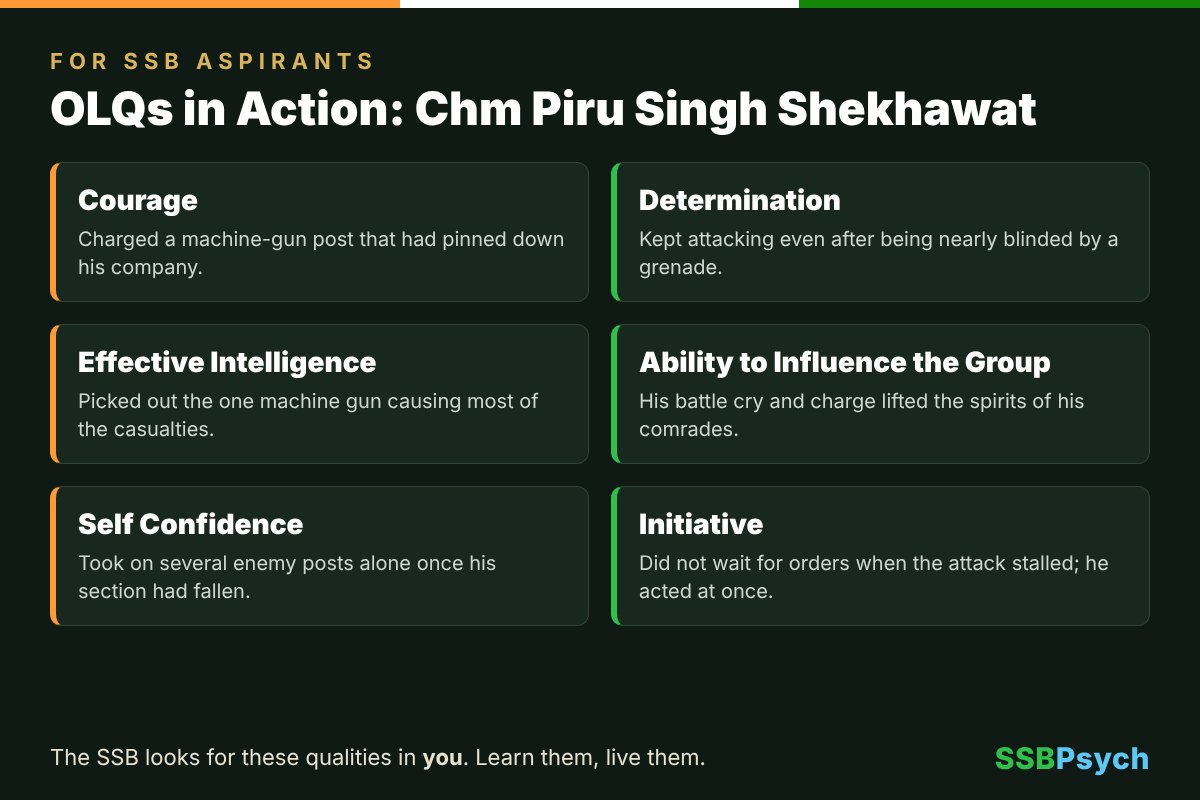
- Courage – Charged a machine-gun post that had pinned down his company.
- Determination – Kept attacking even after being nearly blinded by a grenade.
- Effective Intelligence – Picked out the one machine gun causing most of the casualties.
- Ability to Influence the Group – His battle cry and charge lifted the spirits of his comrades.
- Self Confidence – Took on several enemy posts alone once his section had fallen.
- Initiative – Did not wait for orders when the attack stalled; he acted at once.
Tip for your SSB interview: If asked about a failure or rejection, be honest and show what you did next. Piru Singh was rejected by the Army twice for being too young and still came back; tell your own story of trying again and what you learned.
Practice Corner: WAT and SRT
Write your first spontaneous response to these before you scroll to the quiz. Keep WAT sentences short, positive and action-oriented.
WAT Words
- Machine gun
- Ridge
- Battle cry
- Rejection
- Grenade
SRTs
- He is part of a team project that is failing because one member is not doing his part. He…
- He has been rejected twice in the selection for his college team. He…
- During a group activity, most members lose hope after an early setback. He…
Quiz: How Well Do You Know CHM Piru Singh Shekhawat?
Test yourself! Click an option to see if you are right. Your score updates live.
Frequently Asked Questions
Why is Piru Singh called the Lion of Tithwal?
Because of his fearless charge on 18 July 1948, when he attacked several enemy machine-gun posts on his own at Tithwal despite serious wounds.
Which regiment did Piru Singh belong to?
He began in the 1st Punjab Regiment and, after Partition, joined the 6th Battalion of the Rajputana Rifles, with which he won the Param Vir Chakra.
What does Company Havildar Major mean?
A Company Havildar Major is the senior non-commissioned soldier of a company, responsible for discipline, administration and supporting the company commander.
How old was Piru Singh when he died?
He was 30 years old. He was born on 20 May 1918 and died on 18 July 1948.
The Param Vir Chakra Series on SSBPsych
This is part 4 of 21 in our series on every Param Vir Chakra awardee. A new hero goes live every morning at 7:30 AM. Also read the story of Captain Vikram Batra, PVC – the Sher Shah of Kargil.
Sources: en.wikipedia.org, esamskriti.com.
Preparing for your SSB? Join SSBPsych’s online and offline SSB batches and learn how to show your OLQs with confidence – explore our courses or call +91 8076540582.