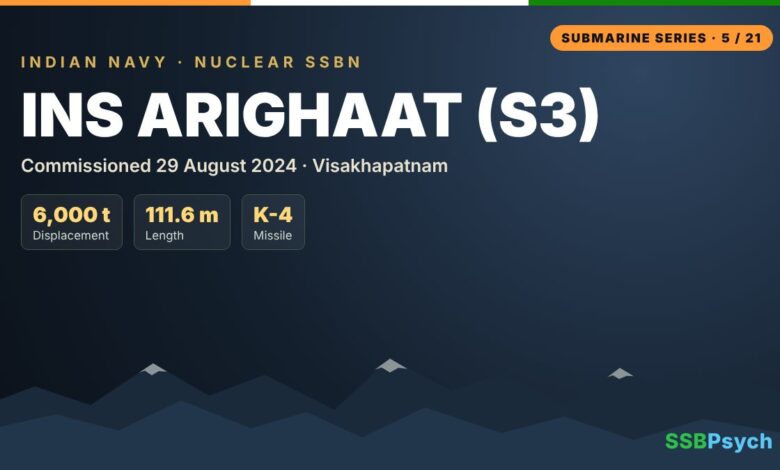
INS Arighaat (S3): India’s Second Nuclear Missile Submarine
On 29 August 2024, in a quiet ceremony at Visakhapatnam with no grand public show, India added a second nuclear-armed guardian to its underwater fleet. INS Arighaat is India’s second nuclear-powered ballistic missile submarine, and it brought something its older sister could not: the ability to carry the much longer-range K-4 missile. For India’s nuclear deterrent, that is a big leap.
In this guide we explain what INS Arighaat is, how it differs from INS Arihant, its size and power, the weapons it is reported to carry, its role, what life on board a nuclear submarine is like, and what remains classified. If you are preparing for NDA, CDS, AFCAT or the SSB interview, this is a current affairs topic you should know well.

What Is INS Arighaat?
INS Arighaat, often referred to as S3, is the second submarine of the Arihant class. Like its sister, it is an SSBN, meaning it is nuclear-powered and carries ballistic missiles. Its name is commonly translated as destroyer of enemies. Reports say the boat was originally meant to carry the name Aridhaman, which was later given to the next, larger submarine.
It was built at the Ship Building Centre in Visakhapatnam under the Advanced Technology Vessel (ATV) project, the same programme that produced INS Arihant. It was launched on 19 November 2017 and spent several years in harbour and sea trials before commissioning. At the commissioning, the Defence Ministry said the boat would further strengthen India’s nuclear triad and deterrence, and highlighted the role of Indian scientists, industry and naval personnel.
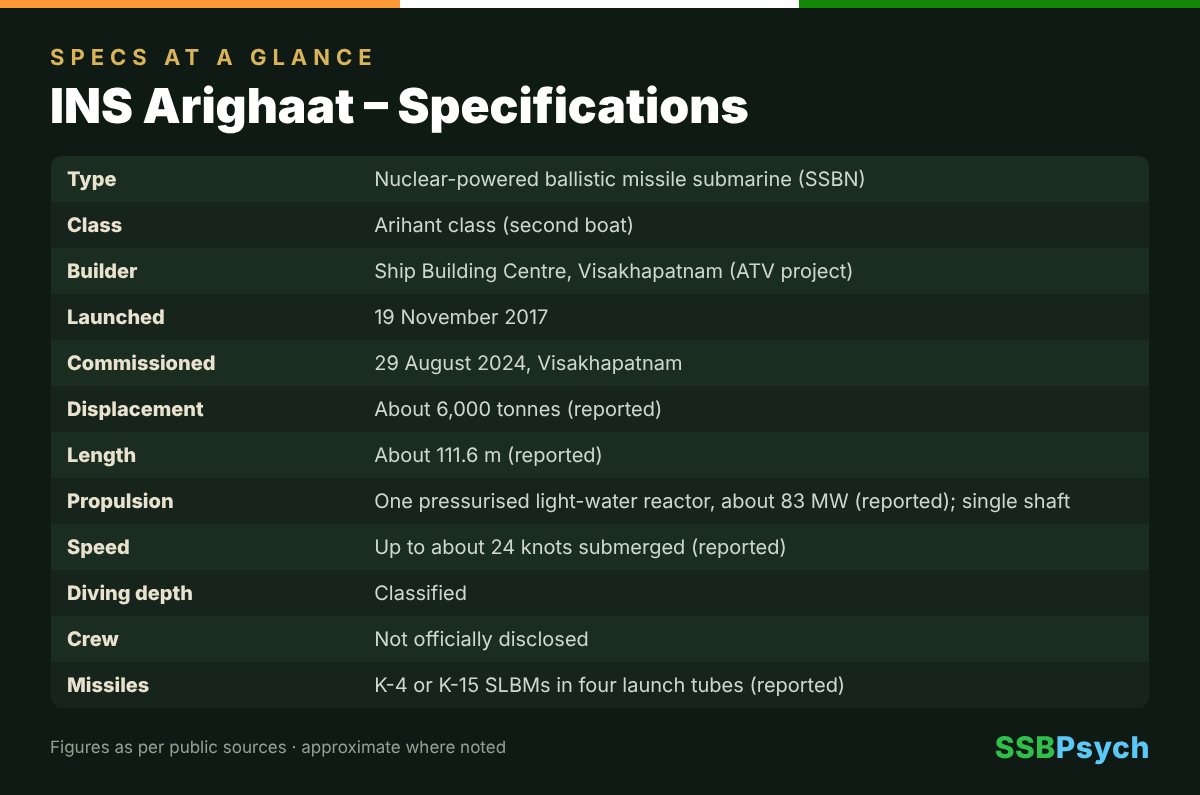
INS Arighaat Specifications
| Type | Nuclear-powered ballistic missile submarine (SSBN) |
| Class | Arihant class (second boat) |
| Builder | Ship Building Centre, Visakhapatnam (ATV project) |
| Launched | 19 November 2017 |
| Commissioned | 29 August 2024, Visakhapatnam |
| Displacement | About 6,000 tonnes (reported) |
| Length | About 111.6 m (reported) |
| Propulsion | One pressurised light-water reactor, about 83 MW (reported); single shaft |
| Speed | Up to about 24 knots submerged (reported) |
| Diving depth | Classified |
| Crew | Not officially disclosed |
| Missiles | K-4 or K-15 SLBMs in four launch tubes (reported) |
| Torpedoes | 533 mm torpedo tubes (reported) |
| Status | In service |
INS Arighaat vs INS Arihant: What Is New?
From the outside, the two sisters look very similar. Both are reported to displace about 6,000 tonnes and be roughly 111 metres long, longer than a football field. The differences lie inside.
- Longer-range missiles: Arighaat is reported to be able to carry the K-4 missile, with a reported range of about 3,500 km, while Arihant has mainly relied on the K-15 with a reported range of about 750 km.
- Improved systems: official statements described Arighaat as having technological advancements over its predecessor, and reports say its reactor and systems were refined using lessons from Arihant.
- More Indian content: reports say a larger share of its equipment was made in India than on the first boat.
- Same core design: both use a pressurised light-water reactor reported at about 83 MW and four missile tubes.
Why does missile range matter so much? With a short-range missile, a submarine has to sail closer to a potential adversary to cover important targets, which increases risk. A longer-range missile lets the submarine stay in safer, deeper waters far from enemy patrols while still being able to respond. That makes the whole deterrent more survivable.
Size and Power of INS Arighaat
At around 6,000 tonnes, INS Arighaat weighs about as much as 4,000 to 5,000 family cars, and it is nearly four times heavier than a Kalvari-class diesel submarine. Much of its interior is taken up by the reactor compartment, the steam turbine machinery, the missile section in the raised hump behind the tower, and the life-support systems.
Its reactor works like a tiny, tightly controlled power station. The heat from nuclear fission turns water into steam, steam spins the turbines, and the turbines drive the single propeller and produce electricity. Because no air is needed, the submarine can stay underwater for very long periods and make its own oxygen and fresh water. Its top submerged speed is reported to be around 24 knots (about 44 km per hour), while its diving depth and other performance figures are classified.
INS Arighaat Role: Why India Needs It
India’s nuclear doctrine rests on No First Use and credible minimum deterrence. India will not use nuclear weapons first, but must be able to respond to a nuclear attack with certainty. Submarines that disappear into the ocean are the most reliable way to guarantee that response, because they are so hard to find and destroy.
Here is the key point: a single SSBN cannot be at sea all the time. It needs maintenance, refits and crew rest. With INS Arihant alone, there would be periods when no Indian SSBN was on patrol. Adding INS Arighaat, and later INS Aridhaman, helps India move towards keeping a submarine deterrent at sea far more often. Their operational control is widely reported to rest with India’s Strategic Forces Command.
Aircraft, Weapons and Sensors
- K-4 submarine-launched ballistic missiles, range about 3,500 km (reported)
- K-15 Sagarika submarine-launched ballistic missiles, range about 750 km (reported)
- Four vertical missile launch tubes in the hump: up to 4 K-4 or 12 K-15 (reported)
- 533 mm heavyweight torpedo tubes (reported)
- Indian-developed sonar and combat systems (details classified)
The exact number and mix of missiles carried on any patrol is not made public, and navies never reveal such details for security reasons.
Operations and Missions
- 2024 – Commissioning: Commissioned on 29 August 2024 at Visakhapatnam, attended by Defence Minister Rajnath Singh
- 2024 – K-4 missile test: Media reported a K-4 test launch from Arighaat in the Bay of Bengal on 27 November
The Navy chief later acknowledged a K-4 test without revealing details, and said no warhead was carried. Further details of the test were not officially released, so we describe it as reported.
INS Arighaat Timeline
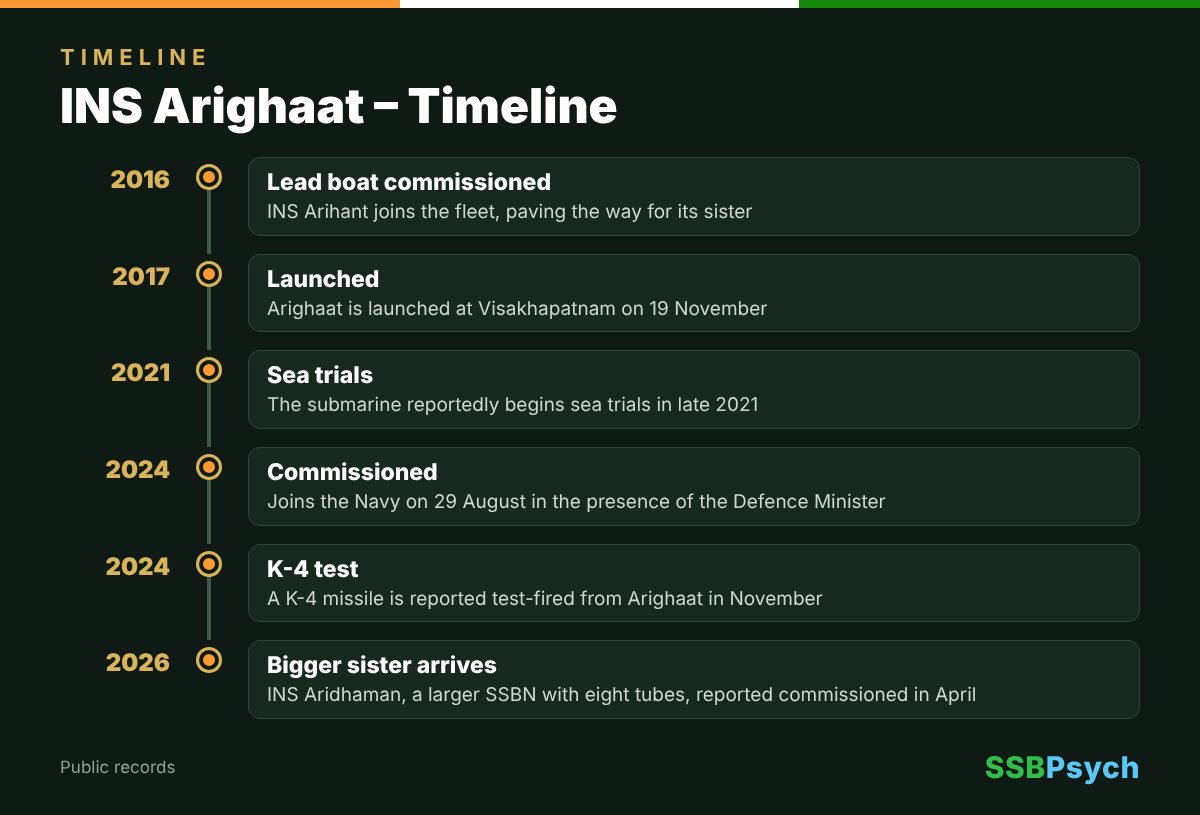
- 2016 – Lead boat commissioned: INS Arihant joins the fleet, paving the way for its sister
- 2017 – Launched: Arighaat is launched at Visakhapatnam on 19 November
- 2021 – Sea trials: The submarine reportedly begins sea trials in late 2021
- 2024 – Commissioned: Joins the Navy on 29 August in the presence of the Defence Minister
- 2024 – K-4 test: A K-4 missile is reported test-fired from Arighaat in November
- 2026 – Bigger sister arrives: INS Aridhaman, a larger SSBN with eight tubes, reported commissioned in April
How a Submarine Fires a Ballistic Missile
Launching a missile from deep underwater sounds like science fiction, but the basic idea is simple. In general, a submarine-launched ballistic missile sits upright in a sealed tube. When fired, it is pushed out of the tube and up through the water. Once it breaks the surface, its rocket motor takes over and drives it high into the sky on a curved path towards the target, much like a ball thrown very far and very high.
The hard part is making this work reliably while the submarine stays hidden and stable. The boat must hold its depth and balance as heavy missiles leave the tubes, and the missile must survive the shock of water and the sudden change to air. That is why every successful underwater launch is treated as a major technical milestone.
The Arihant Family at a Glance
- INS Arihant (S2): lead boat, commissioned in 2016, about 6,000 tonnes (reported), four missile tubes.
- INS Arighaat (S3): commissioned on 29 August 2024, similar size, able to carry K-4 missiles (reported).
- INS Aridhaman (S4): larger boat of about 7,000 tonnes with eight missile tubes (reported), commissioned in April 2026 according to media reports.
- Fourth boat: launched in October 2024 and reported to be on trials.
Together they form the growing sea leg of India’s nuclear triad, with each boat bigger or better than the last. More boats mean more flexibility: while one submarine is in refit and another is training its crew, a third can be on patrol. For a country that promises never to strike first, this steady, hidden presence at sea is the strongest guarantee that no enemy will ever risk a nuclear attack on India.
Home Port and Operations
INS Arighaat was built and commissioned at Visakhapatnam, home of the Eastern Naval Command, and is publicly reported to operate from the east coast. A dedicated base for nuclear submarines, INS Varsha, is reported to be under development at Rambilli, around 50 km from Visakhapatnam, with underground pens to shelter submarines. The submarine’s patrol areas, schedules and movements are secret.

Crew and Life on Board
The Navy has not officially disclosed Arighaat’s crew size. Its sister INS Arihant is reported to carry about 95 to 100 officers and sailors, and Arighaat is broadly similar in size. Indian submarines are commanded by senior officers, typically of Commander or Captain rank in submarine service, supported by specialist teams for the reactor, weapons, sonar, navigation and communications. Names of serving commanding officers are not discussed here.
- Weeks without sunlight: life follows strict watches and routines rather than day and night.
- Silence is survival: crews avoid unnecessary noise, because sound is what enemy sonar listens for.
- Nuclear expertise: reactor operators and engineers train for years and must follow strict safety drills.
- Self-sufficient but cut off: oxygen and water are made on board, but contact with family during a patrol is very limited.
- Mental strength: calmness, teamwork and discipline matter as much as technical skill.
How Much Does INS Arighaat Cost?
No separate official price for INS Arighaat has been published. The broader ATV programme was reported at about Rs 30,000 crore when three submarines were authorised in 2006, and media reports in 2017 put the overall project cost at around Rs 90,000 crore. These figures include research, infrastructure and several boats.
What drives running costs?
Exact running costs are not public. The main drivers are reactor maintenance and fuel, radiation safety, long dockyard refits, specialised shore support, expensive missile tests, and the long training of a highly skilled crew. Even so, many experts argue that a credible sea-based deterrent is worth the cost because it helps prevent war in the first place.
Dangers and Challenges
Every submarine faces the risks of fire, flooding, equipment failure and collision in the dark depths. A nuclear submarine adds the need for absolute reactor safety. Testing a missile from underwater is also a complex and risky task, which is why such tests are carefully planned. India’s two Deep Submergence Rescue Vehicle systems, based at Mumbai and Visakhapatnam since 2018 and 2019, add a layer of safety for all Indian submarine crews.
Why INS Arighaat Was a Turning Point
Arihant proved that India could build and operate a nuclear ballistic missile submarine. Arighaat showed that India could repeat the feat and improve on it, and the K-4 missile test from its hull pointed to a much more capable sea-based deterrent. Building a second boat is often harder than it sounds, because the industry must keep skilled workers, suppliers and test facilities running for years. Success here gave confidence for the bigger submarines that followed.
INS Arighaat in Your SSB Interview
If asked about recent naval developments, you can say: INS Arighaat is India’s second indigenous SSBN, commissioned on 29 August 2024 at Visakhapatnam, and it can carry the longer-range K-4 missile, which strengthens India’s second-strike capability. If an officer asks about classified details like diving depth or patrol areas, it is perfectly fine, and wise, to say these are not public.
Did You Know?
- INS Arighaat was launched in 2017 but commissioned only in 2024, showing how long nuclear submarine trials can take.
- The commissioning ceremony was low-key, in keeping with the secret nature of strategic submarines.
- The K-4 missile’s reported range of about 3,500 km is more than four times that of the K-15.
- The name Aridhaman was reportedly first meant for this boat before going to its bigger successor.
- With Arihant and Arighaat both in service, India had two SSBNs for the first time in 2024.
- Both boats were built in the same city that hosts India’s submarine museum, INS Kursura.
Quiz: Test Your Knowledge of INS Arighaat
Click an option to see if you are right. Your score updates live.
INS Arighaat: Frequently Asked Questions
INS Arighaat is India’s second indigenously built nuclear-powered ballistic missile submarine (SSBN). It was commissioned on 29 August 2024 at Visakhapatnam.
Both are similar in size, but Arighaat is reported to be able to carry the longer-range K-4 missile and to have improved systems based on lessons from Arihant.
It is reported to carry K-4 missiles with a range of about 3,500 km or K-15 missiles with a range of about 750 km, plus torpedoes. The exact load is not disclosed.
The Navy has not officially disclosed it. Its sister INS Arihant is reported to carry about 95 to 100 personnel.
It strengthens India’s sea-based nuclear deterrent and second-strike capability, helping India keep an SSBN at sea more often in line with its No First Use doctrine.
This is part 5 of 21 in SSBPsych’s submarine series – a new post every morning at 10 AM.
Sources: en.wikipedia.org, en.wikipedia.org, en.wikipedia.org, en.wikipedia.org, en.wikipedia.org.
Preparing for NDA, CDS, AFCAT or your SSB? Join SSBPsych’s online and offline batches – explore our courses or call +91 8076540582.