Mechanised Infantry Regiment: History, Motto, Role and Heroes
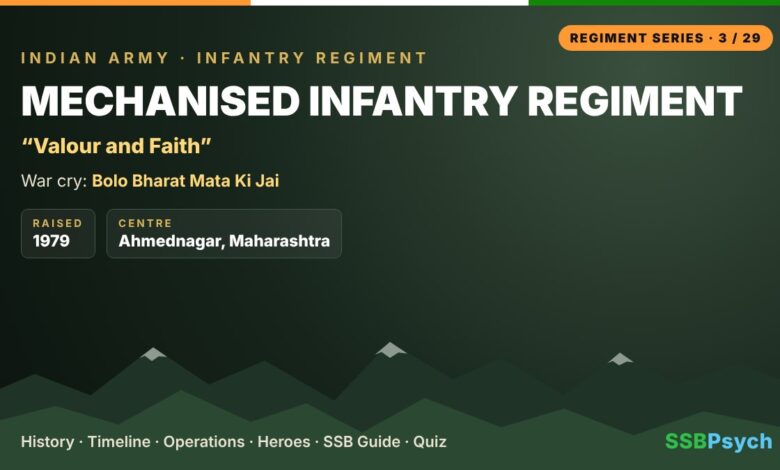
Modern wars are fast. Tanks race across deserts and plains, and infantry must keep up with them, protected from enemy fire and ready to fight the moment they dismount. This is the job of the Mechanised Infantry Regiment of the Indian Army, raised on 2 April 1979. Its soldiers move and fight from armoured infantry combat vehicles, and its war cry, Bolo Bharat Mata Ki Jai, echoes over the roar of their engines.
In this guide for NDA, CDS, AFCAT, TES and SSB aspirants, we explain how the regiment was formed, its timeline, operations, insignia, motto and war cry, its heroes, daily life in a mechanised battalion, and what all this means for your SSB preparation. A 10-question quiz waits at the end.
Mechanised Infantry Regiment – Quick Facts
| Raised | 2 April 1979 |
| Regimental Centre | Mechanised Infantry Centre and School, Ahmednagar (Ahilyanagar), Maharashtra |
| Motto | Valour and Faith (also written as Faith and Valour) |
| War Cry | Bolo Bharat Mata Ki Jai |
| Insignia | A rifle with bayonet mounted on a BMP infantry combat vehicle |
| Recruitment | Older battalions keep their original class mix; later raisings are all-India mixed class |
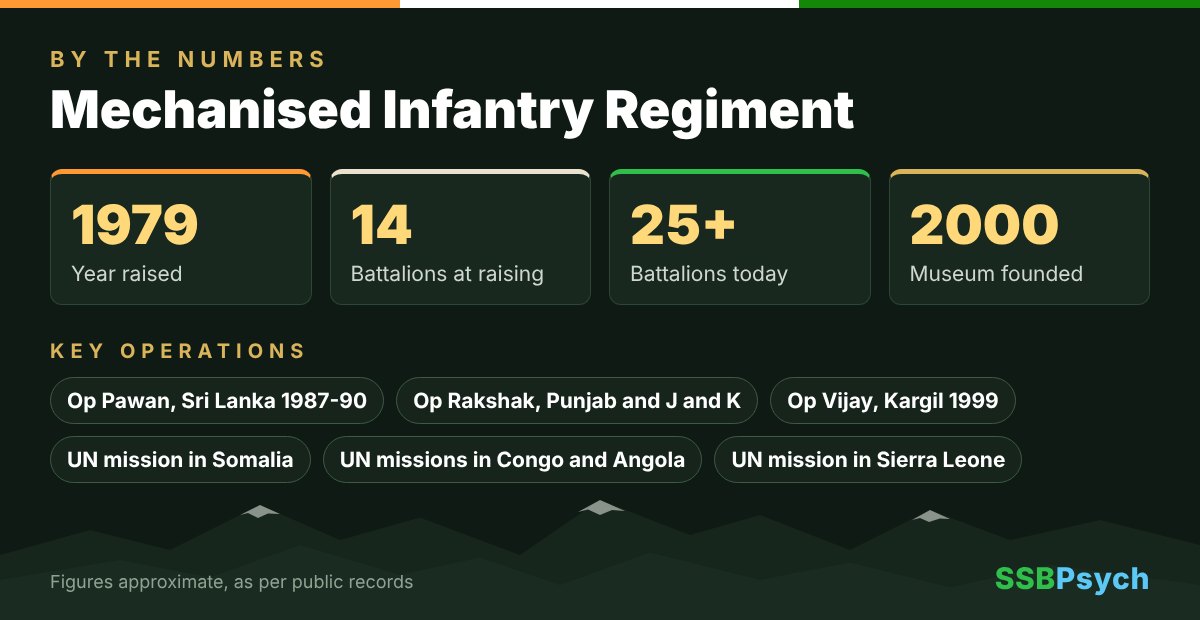
| Battalions | About 14 at raising, now over 25 |
| Main vehicles | BMP-1 and BMP-2 infantry combat vehicles |
| Role | Fighting alongside tanks in armoured and mechanised formations |
| Naval affiliation | INS Gharial |
History of the Mechanised Infantry Regiment
After the wars of 1965 and 1971, the Indian Army saw clearly that infantry riding in lorries or walking could not keep pace with tank columns. In the 1970s, some infantry battalions were given armoured personnel carriers, and from 1977-78 the Army began receiving the Soviet-designed BMP-1 infantry combat vehicle. The BMP was a big step up: it could carry a section of soldiers under armour, float across water obstacles and fire anti-tank missiles.
To manage this new kind of warfare properly, the Army decided to create a dedicated regiment. On 2 April 1979, the Mechanised Infantry Regiment was formed with about 14 battalions. Rather than starting from scratch, the Army converted some of its most distinguished infantry battalions. For example, 1st Battalion of the Madras Regiment became 1 Mech Inf, 1st Battalion of the Jat Regiment became 2 Mech Inf, 1st Battalion of 8 Gorkha Rifles became 3 Mech Inf, 1st Battalion of the Sikh Regiment became 4 Mech Inf, and 1st Battalion of the Garhwal Rifles became 6 Mech Inf. Battalions from the Kumaon, Dogra, Punjab, Grenadiers, Maratha Light Infantry, Rajputana Rifles, Rajput and Jammu and Kashmir Rifles regiments, among others, also joined.
This gave the new regiment a remarkable inheritance. Each converted battalion brought its own battle honours, traditions and history, so the Mechanised Infantry Regiment began life with a rich honour roll. Later battalions, starting with the 15th, were raised directly as mechanised infantry, and these were organised on an all-India, all-class basis.
General K. Sundarji, one of the Army’s most influential thinkers on armoured and mechanised warfare and later the Chief of the Army Staff, was the first Colonel of the Regiment. He was followed by Lt Gen Satish Nambiar, who later became the first Force Commander of the United Nations protection force in the former Yugoslavia. Their leadership helped shape how India fights mechanised battles.
The regiment’s home is at Ahmednagar in Maharashtra, now officially called Ahilyanagar. Its centre trains recruits and also runs courses for officers and soldiers on mechanised tactics, vehicles and weapons. On 17 September 2021 it was renamed the Mechanised Infantry Centre and School, reflecting its dual role as a regimental centre and a training school.
Mechanised Infantry Regiment Timeline: From Raising to Today
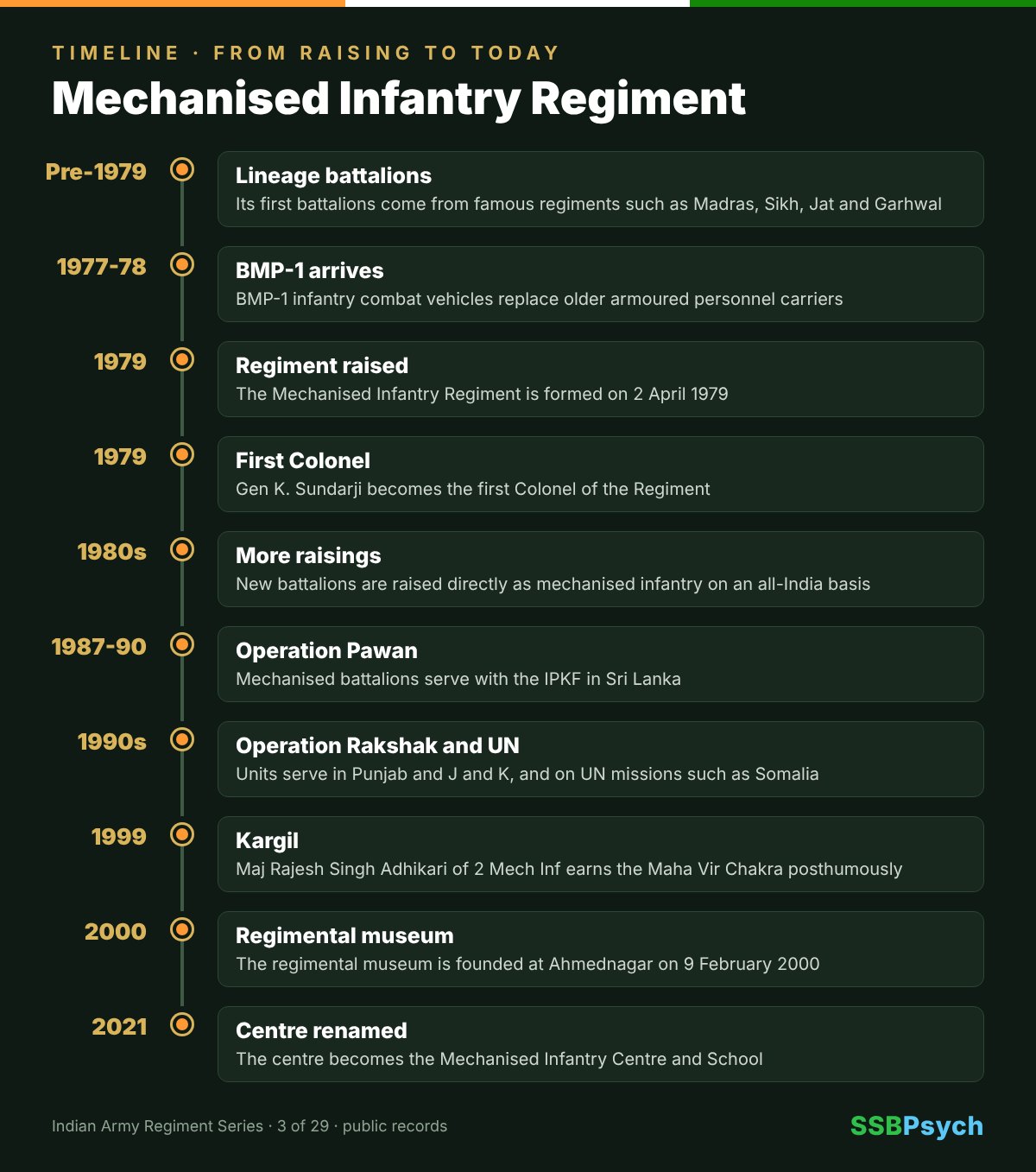
- Pre-1979 – Lineage battalions: Its first battalions come from famous regiments such as Madras, Sikh, Jat and Garhwal
- 1977-78 – BMP-1 arrives: BMP-1 infantry combat vehicles replace older armoured personnel carriers
- 1979 – Regiment raised: The Mechanised Infantry Regiment is formed on 2 April 1979
- 1979 – First Colonel: Gen K. Sundarji becomes the first Colonel of the Regiment
- 1980s – More raisings: New battalions are raised directly as mechanised infantry on an all-India basis
- 1987-90 – Operation Pawan: Mechanised battalions serve with the IPKF in Sri Lanka
- 1990s – Operation Rakshak and UN: Units serve in Punjab and J and K, and on UN missions such as Somalia
- 1999 – Kargil: Maj Rajesh Singh Adhikari of 2 Mech Inf earns the Maha Vir Chakra posthumously
- 2000 – Regimental museum: The regimental museum is founded at Ahmednagar on 9 February 2000
- 2021 – Centre renamed: The centre becomes the Mechanised Infantry Centre and School
Major Operations and Battle Honours
Because many of its battalions are older than the regiment, the Mechanised Infantry Regiment carries battle honours from earlier wars. These inherited honours include Kalidhar, Festubert, Chushul, Tithwal, OP Hill, Gadra City, Asal Uttar, Ichhogil, Chhadbet, Basantar River and Akhaura, each linked to the battalion that earned it before conversion. Together they span the First World War, the 1947-48 operations, the 1962 conflict and the wars of 1965 and 1971.
Operation Pawan
When the Indian Peace Keeping Force went to Sri Lanka from 1987, mechanised battalions were among the units deployed. They learned to operate their vehicles in thick vegetation and built-up areas, which was very different from the open plains they had trained for.
Operation Rakshak and Counter-Insurgency
During the troubled years in Punjab and later in Jammu and Kashmir, mechanised battalions served under Operation Rakshak. In counter-insurgency, soldiers often leave their vehicles behind and work as regular infantry, showing the regiment’s flexibility.
Kargil 1999
During Operation Vijay in 1999, officers of the regiment fought on the mountain heights of Kargil. The most famous is Major Rajesh Singh Adhikari of 2 Mech Inf, who was attached to 18 Grenadiers. He led an assault in the Tololing area, destroying enemy positions before he was killed, and was posthumously awarded the Maha Vir Chakra.
United Nations Missions
The regiment has served under the UN flag in Somalia, Congo, Angola and Sierra Leone. Armoured vehicles are valuable in peacekeeping because they protect troops and civilians, escort convoys and show strength without needing to fight.
Mechanised Infantry Regiment Insignia, Motto and War Cry
The regimental insignia shows a rifle with a fixed bayonet mounted on a BMP infantry combat vehicle. The design neatly sums up the regiment: it is still infantry at heart, represented by the rifle and bayonet, but it moves and fights on armour.
The motto is usually given as Valour and Faith, though some sources write it as Faith and Valour. Either way, the meaning is the same: courage in battle and faith in comrades, country and mission. The war cry, Bolo Bharat Mata Ki Jai, means Say Victory to Mother India. Unlike war cries tied to a particular community or deity, it reflects the regiment’s mixed, all-India character.
The regiment’s honour roll also carries the stories of its parent regiments. Each converted battalion keeps alive the history of the regiment it came from, along with the newer story of the Mechanised Infantry. Young officers learn both, and this double heritage gives every battalion a strong sense of identity and pride. It also means that the regiment can claim links to some of the most famous actions in Indian military history, from the First World War to the liberation of Bangladesh.
Heroes of the Mechanised Infantry Regiment
- Major Rajesh Singh Adhikari, Maha Vir Chakra (posthumous) – 2 Mech Inf, attached to 18 Grenadiers, Tololing, Kargil 1999.
- General K. Sundarji – first Colonel of the Regiment and later Chief of the Army Staff, known for modernising mechanised warfare doctrine.
- Lt Gen Satish Nambiar – second Colonel of the Regiment and first Force Commander of the UN force in the former Yugoslavia.
- Second Lieutenant Satish Kumar Prabhakaran Menon, Vir Chakra – 15 Mech Inf.
Beyond these names, the regiment’s soldiers have earned a large number of Shaurya Chakras and Sena Medals, many of them in counter-insurgency operations. Its converted battalions also carry the memory of heroes from their parent regiments, who are honoured in the regimental museum at Ahmednagar.
Role and Life in the Regiment
How a Mechanised Battle Works
To understand the regiment, imagine an attack across open ground. Tanks provide heavy firepower and armour, but they are vulnerable to enemy infantry hiding with anti-tank weapons in trenches, buildings or crops. Mechanised infantry travel with the tanks, and when such threats appear, they dismount and clear them, then remount and move on. In defence, the same team uses its vehicles to counter-attack quickly wherever the enemy breaks through. This close partnership between tanks and infantry is often called a combined-arms team, and it is the heart of mechanised warfare.
Speed is everything in such battles. Commanders must read maps, radio messages and the ground in front of them while on the move, and make decisions in minutes rather than hours. Logistics matter too, because vehicles need fuel, ammunition and spare parts to keep going. This is why the regiment places such importance on training, maintenance and good communication at every level.
A mechanised battalion is built around its infantry combat vehicles. Each BMP has a crew of a driver, a gunner and a commander, and carries a section of infantry in the back. In battle, the vehicles move with tank regiments as part of armoured or mechanised formations. When the enemy is found, the vehicles can fire their cannon and anti-tank guided missiles, and the infantry can dismount to clear trenches, villages or woods.
Life in the regiment is therefore a mix of soldiering and technology. Soldiers learn to drive and maintain heavy tracked vehicles, use night-vision equipment and fire missiles, while still keeping their infantry skills sharp. Officers must think quickly because mechanised battles develop at high speed, and they must coordinate closely with tanks, artillery, engineers and air support.
Mechanised formations are mainly positioned to defend the plains and deserts along the western border, where large-scale armoured operations are most likely. But mechanised battalions also take their turn in high-altitude areas and counter-insurgency, so a career in the regiment offers a wide variety of experience. The regiment is also affiliated with the Navy’s INS Gharial, a link that suits a vehicle able to float across water.
Training never stops in a mechanised battalion. Young officers attend courses at the Mechanised Infantry Centre and School to master vehicle gunnery, tactics and maintenance management. Drivers and gunners are trained on simulators before they handle live vehicles and weapons. Large field exercises, often held in the deserts, test whole battalions working with tanks, artillery and air support. For a young officer, leading a mechanised platoon or company in such exercises is an exciting test of planning, speed and judgement.
Why the Mechanised Infantry Regiment Matters for SSB Aspirants
Questions about modernisation, technology and future warfare are common in SSB interviews and group discussions. The Mechanised Infantry Regiment gives you a strong example of how the Indian Army adapted to new technology after studying its own wars. You can also use it to discuss jointness, since mechanised forces depend on close teamwork between different arms. Another useful angle is how the Army balances heavy, expensive equipment with the need for soldiers who are fit, skilled and adaptable, because even the best vehicle is only as good as the crew inside it.
If you are a technically minded candidate, perhaps from an engineering background or the TES entry, you can honestly say that a mechanised regiment would let you combine leadership with technology. Just remember that allotment is decided at the academy, so show interest without sounding as if it is your only option.
Mechanised Infantry Regiment for SSB Candidates: What You Should Know
How officers join
- Officers join the Army through NDA, the IMA (via CDS, TES or TGC) or the OTA Chennai (Short Service Commission), after clearing the SSB and medicals.
- Arm allotment is done during academy training based on the cadet’s choice, merit in training and vacancies.
- Cadets allotted to Mechanised Infantry are commissioned into the regiment and then attend courses at the Mechanised Infantry Centre and School.
- No entry scheme guarantees a particular regiment, so keep an open mind.
How soldiers join
- Since 2022, soldiers join through the Agnipath scheme as Agniveers, via Army recruitment rallies and the online common entrance exam.
- Battalions raised directly as mechanised infantry recruit on an all-India mixed-class basis, while older converted battalions largely keep their original class composition.
- Recruits train at the Mechanised Infantry Centre and School, Ahmednagar.
Questions you may face in the SSB interview, GD or lecturette
- What is the difference between infantry and mechanised infantry?
- Why did the Indian Army raise the Mechanised Infantry Regiment in 1979?
- What role does an infantry combat vehicle play in battle?
- How should the Army balance new technology with traditional infantry skills?
- Who was Major Rajesh Singh Adhikari and what did he do in Kargil?
SSBPsych tip: When speaking about mechanised warfare in the SSB, explain one concept clearly, such as why infantry must stay close to tanks, instead of listing equipment names you only half know.
Learn the key facts about the Mechanised Infantry Regiment, from its raising in 1979 to its role alongside tanks, and you will be ready for any question on it. Now take the quiz below.
Quiz: How Well Do You Know the Mechanised Infantry Regiment?
Test yourself! Click an option to see if you are right. Your score updates live.
Mechanised Infantry Regiment: Frequently Asked Questions
The motto is usually given as Valour and Faith, though some sources write it as Faith and Valour.
It is at Ahmednagar (now Ahilyanagar), Maharashtra, and has been called the Mechanised Infantry Centre and School since 2021.
The war cry is Bolo Bharat Mata Ki Jai, meaning Say Victory to Mother India.
It was raised on 2 April 1979 by converting about 14 existing infantry battalions.
Its main vehicles are the BMP-1 and BMP-2 infantry combat vehicles, which carry soldiers under armour and fight alongside tanks.
Indian Army Regiments Series on SSBPsych
This is part 3 of 29 in our series on every infantry regiment of the Indian Army – a new regiment every day at 11 AM. Previous in the series: Parachute Regiment. Also follow our Param Vir Chakra series.
Sources: en.wikipedia.org, salute.co.in, bharat-rakshak.com, indianarmy.nic.in.
Preparing for NDA, CDS, AFCAT or your SSB? Join SSBPsych’s online and offline batches – explore our courses or call +91 8076540582.