Apache Helicopter in Indian Air Force: Specs, Weapons, History
Picture a flying tank that can hide behind a hill, pop up for a few seconds, destroy an enemy tank kilometres away and vanish again. That is the Apache helicopter, and the Indian Air Force flies the latest version, the Boeing AH-64E Apache Guardian. Since 2019, these fearsome machines have guarded India’s western and eastern borders and even the icy heights of Ladakh.
In this guide we explain everything an NDA, CDS or AFCAT aspirant should know about the Apache: its full specifications, how it flies, the missiles and gun it carries, its history in the IAF, where it is based, who flies it and what comes next. There is a 10-question quiz and an FAQ at the end to help you remember it all.

Apache Helicopter Specifications
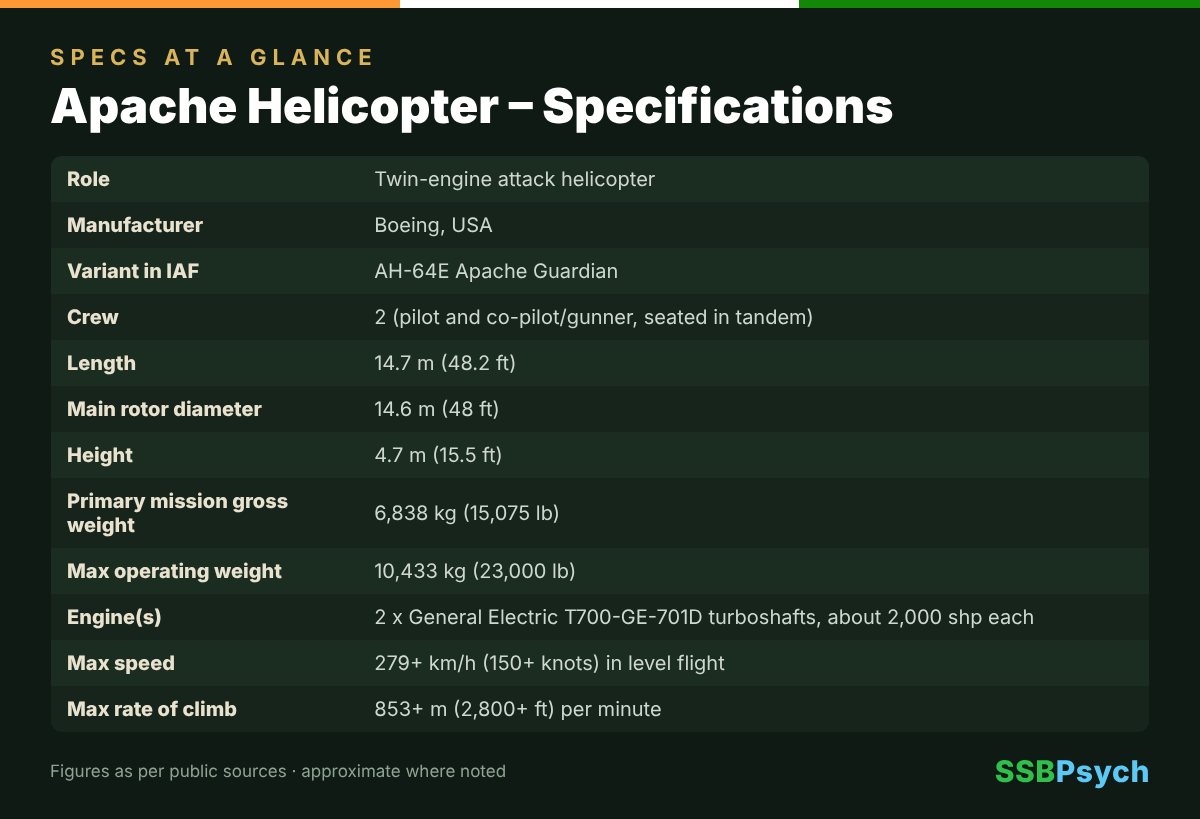
| Role | Twin-engine attack helicopter |
| Manufacturer | Boeing, USA |
| Variant in IAF | AH-64E Apache Guardian |
| Crew | 2 (pilot and co-pilot/gunner, seated in tandem) |
| Length | 14.7 m (48.2 ft) |
| Main rotor diameter | 14.6 m (48 ft) |
| Height | 4.7 m (15.5 ft) |
| Primary mission gross weight | 6,838 kg (15,075 lb) |
| Max operating weight | 10,433 kg (23,000 lb) |
| Engine(s) | 2 x General Electric T700-GE-701D turboshafts, about 2,000 shp each |
| Max speed | 279+ km/h (150+ knots) in level flight |
| Max rate of climb | 853+ m (2,800+ ft) per minute |
| Service ceiling | 6,096 m (20,000 ft) |
| Gun rate of fire | 600 to 650 rounds per minute |
| First flight | 30 September 1975 (YAH-64 prototype) |
| Inducted in IAF | 3 September 2019, Pathankot |
| Number in IAF | 22 |
What Is the Apache Helicopter?
The AH-64 Apache is an attack helicopter, which means its main job is to destroy targets on the ground, especially tanks and armoured vehicles, rather than carry troops or cargo. It was first developed for the US Army and first flew on 30 September 1975. Since then, Boeing has produced more than 2,875 Apaches, and the helicopter has fought in many conflicts around the world.
The “E” model, called the Apache Guardian, is the newest version. It has stronger engines, better gearboxes, a digital cockpit and the ability to work with drones. Its two crew members sit one behind the other in a narrow body, which makes the helicopter slim and harder to hit. The pilot sits at the back, a little higher, and the co-pilot/gunner sits in front.
Above the main rotor, some Apaches carry a round, mushroom-shaped Longbow fire control radar. Because the radar sits above the blades, the helicopter can hide behind trees or hills with only the radar peeking out, scan the battlefield, pick targets and fire, all while staying mostly hidden. Under the nose are night-vision and targeting sensors, so the crew can fight in darkness and bad weather.
Apaches usually fight in teams. A helicopter fitted with the Longbow radar can scan a wide area, spot many vehicles and share the target information digitally with other Apaches nearby, even ones without radar. Each crew can then attack its share of targets from behind cover. This “see first, shoot first” style of fighting is what makes attack helicopters so dangerous to tank columns.
Why India Needed the Apache Helicopter
The IAF has flown attack helicopters since 1983, when No. 125 Helicopter Squadron was raised with Soviet Mi-25 gunships, later replaced by the Mi-35. By the 2010s these Russian machines were ageing, and India wanted a modern helicopter that could fight day and night, in deserts and mountains, and support Army strike corps on the battlefield.
After trials, India picked the AH-64E and signed a government-to-government deal with the United States in September 2015 for 22 Apaches, alongside 15 CH-47F Chinook heavy-lift helicopters. The Apache deal was worth over Rs 10,000 crore and included missiles, radars and training. In 2020 the Indian Army also ordered six Apaches of its own.
History of the Apache Helicopter in the IAF
The first Indian Apache was handed over at Boeing’s facility in Mesa, Arizona, in May 2019, where IAF crews had been training. The first helicopters were shipped to India and reached Air Force Station Hindan near Delhi in July 2019. On 3 September 2019, eight Apaches were formally inducted into No. 125 Helicopter Squadron, the “Gladiators”, at Pathankot in Punjab. With this, India became one of more than a dozen countries flying the Apache.
A second unit, No. 137 Helicopter Squadron, was raised at Jorhat in Assam to cover the north-east. The last of the 22 IAF Apaches arrived in July 2020. Just weeks earlier, the Galwan clash had sparked a tense standoff with China in eastern Ladakh, and Apaches were soon deployed to Leh, flying in some of the most difficult conditions any attack helicopter faces.
Mountain flying is never easy. In April 2024, an IAF Apache made a precautionary landing in Ladakh during a training sortie and was damaged by the rough, high-altitude ground. Both pilots were safe, and the helicopter was later moved by road and air for repairs, a reminder of how tough the terrain is.
Why is Ladakh so hard for helicopters? A rotor blade works by pushing air downwards. At high altitude the air is thin, so each turn of the blades pushes less air and produces less lift, while engines also make less power. Pilots have to carry less fuel and fewer weapons, plan carefully for wind and cold, and land on rough patches of ground far from proper airfields. Operating the Apache there shows how much skill IAF crews bring to the job.
Engine and Performance Explained Simply
The Apache has two General Electric T700-GE-701D turboshaft engines, each producing close to 2,000 shaft horsepower. A turboshaft is a jet engine that, instead of pushing out hot air, spins a shaft that turns the rotor blades. Together the two engines produce roughly as much power as about 25 big SUVs. Having two engines also means the helicopter can limp home if one is damaged.
Speed: Boeing lists a maximum level flight speed of over 150 knots, or more than 279 km/h. That is slower than a fighter jet, but very fast for a heavily armed helicopter, enough to cover the 200-odd km from Delhi to Agra in under an hour.
Service ceiling: This is the highest altitude where the helicopter can still fly usefully. For the AH-64E it is about 6,096 metres (20,000 feet). Leh airfield sits at about 3,250 metres, so the Apache can work well above it, though thin mountain air reduces how much it can lift.
Climb and weight: It can climb more than 853 metres per minute, which means it could rise higher than the Burj Khalifa in around a minute. On a typical mission it weighs about 6.8 tonnes, and its maximum operating weight is about 10.4 tonnes. At 14.7 metres long, it is longer than a typical city bus, and its main rotor spans 14.6 metres.
Weapons and Missiles
- AGM-114 Hellfire anti-tank guided missiles (up to 16)
- FIM-92 Stinger air-to-air missiles
- Hydra 70 (2.75-inch) unguided rockets (up to 76)
- M230 30 mm chain gun with up to 1,200 rounds
- Longbow fire control radar on part of the fleet
- Electronic warfare and self-protection systems
The Hellfire is a guided missile designed to kill tanks; an Apache can carry up to 16 of them. Stinger missiles, which India bought for its Apaches, let the helicopter defend itself against enemy helicopters and slow aircraft. Hydra rockets are used against groups of targets, and the 30 mm chain gun under the nose follows the gunner’s helmet, so it points wherever the gunner looks, firing 600 to 650 rounds a minute.
Apache Helicopter Missions and Operations
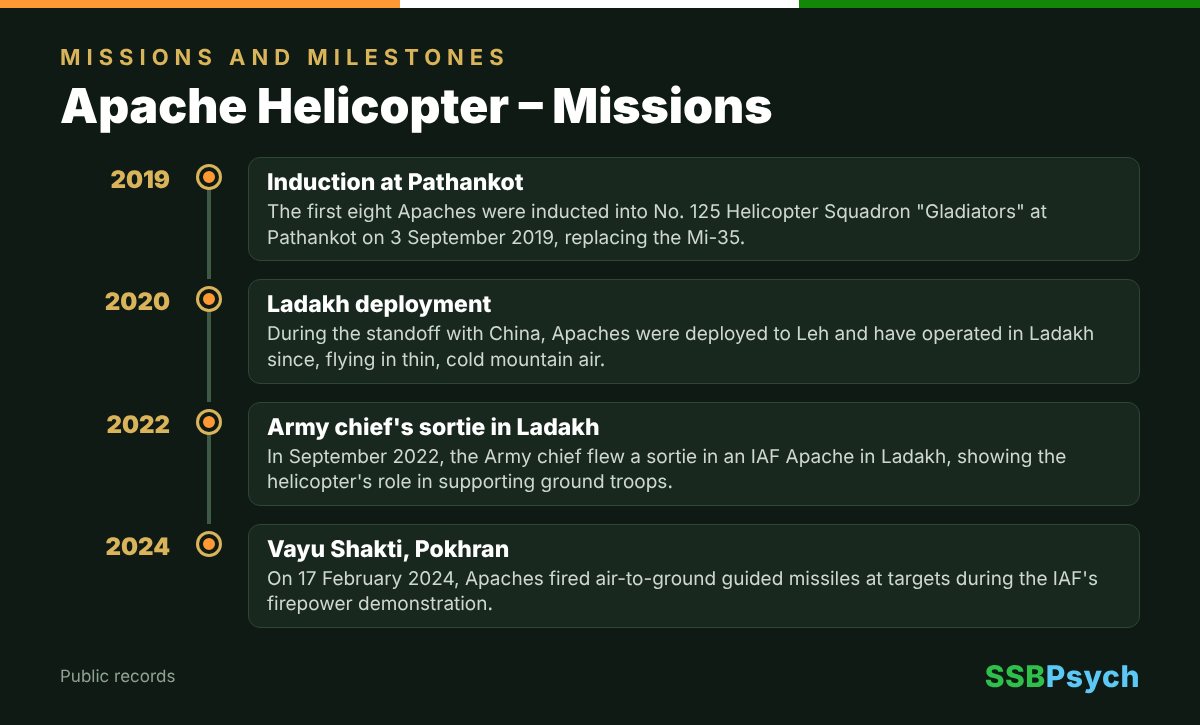
- 2019 – Induction at Pathankot: The first eight Apaches were inducted into No. 125 Helicopter Squadron “Gladiators” at Pathankot on 3 September 2019, replacing the Mi-35.
- 2020 – Ladakh deployment: During the standoff with China, Apaches were deployed to Leh and have operated in Ladakh since, flying in thin, cold mountain air.
- 2022 – Army chief’s sortie in Ladakh: In September 2022, the Army chief flew a sortie in an IAF Apache in Ladakh, showing the helicopter’s role in supporting ground troops.
- 2024 – Vayu Shakti, Pokhran: On 17 February 2024, Apaches fired air-to-ground guided missiles at targets during the IAF’s firepower demonstration.
Notice a pattern in these missions: the Apache works hand in hand with the Army. Attack helicopters exist to protect soldiers and tanks on the ground, so IAF Apache crews train regularly with Army units, practising how to find enemy armour, call in fire and strike quickly. This jointness between services is a big theme in modern warfare and a useful talking point at the SSB.

Where the Apache Helicopter Is Based and Who Flies It
As publicly reported, the IAF’s Apaches fly with two units: No. 125 Helicopter Squadron “Gladiators” at Pathankot in Punjab, under Western Air Command, which faces the western front and Jammu and Kashmir, and No. 137 Helicopter Squadron at Jorhat in Assam, which covers the eastern sector. From these bases they can be moved quickly to forward areas such as Ladakh.
Like a fighter squadron, a helicopter squadron is usually commanded by a Wing Commander. Squadron Leaders serve as flight commanders, and Flight Lieutenants and Flying Officers make up most of the crews. Each Apache needs two highly trained officers, plus a large team of engineers and technicians to keep the complex machine ready.
IAF helicopter pilots join through NDA, CDS or AFCAT like fighter pilots. After basic flying on the Pilatus PC-7 Mk II at the Air Force Academy, cadets chosen for the helicopter stream train at the Helicopter Training School at Hakimpet near Hyderabad, and are commissioned after roughly one and a half to two years. Only after gaining experience on other helicopters such as the Mi-17 or ALH Dhruv are pilots usually selected for an attack type like the Apache.
Strengths and Limitations of the Apache Helicopter
No weapon is perfect. Here is a balanced look at what the Apache helicopter does well and where it faces challenges in Indian conditions.
- Strength: Combat-proven design with powerful anti-tank weapons.
- Strength: Longbow radar and night sensors let it find and attack targets while staying hidden.
- Strength: Built to survive battle damage, with armour and two engines.
- Strength: Can fight day or night and in deserts or mountains.
- Limitation: Thin air at very high altitudes reduces its lifting power and weapon load.
- Limitation: Only 22 in IAF service, and only part of the fleet has the Longbow radar.
- Limitation: Spares and weapons come from the USA, so support depends on foreign suppliers.
Future of the Apache Helicopter in India
The Apache’s family in India is growing. The Indian Army received its own six AH-64E Apaches by December 2025, to work closely with Army formations on the ground. Indian industry is also part of the story: a Tata and Boeing joint venture in Hyderabad builds Apache fuselages, including for helicopters sold around the world.
At the same time, India is building its own attack helicopters. HAL’s Light Combat Helicopter Prachand, designed to fly and fight at very high altitudes, has joined the IAF and Army. Together, the Apache and Prachand give India a strong mix: the Apache as a heavyweight tank-killer and the Prachand as a nimble mountain fighter.
Why It Matters for SSB and AFCAT Aspirants
Questions on attack helicopters, especially the Apache and Prachand, are common in AFCAT, CDS and NDA papers. At the SSB, the Apache is a good example when discussing India-US defence ties, jointness between the Army and Air Force, or the challenges of fighting in Ladakh. If you are interested in the helicopter stream, knowing about the Apache shows the interviewing officer that you understand what that career can lead to.
Did You Know?
- No. 125 Helicopter Squadron, the “Gladiators”, was the IAF’s first attack helicopter squadron, raised in 1983.
- The Apache’s 30 mm gun turns to follow the gunner’s helmet.
- India ordered 22 Apaches for the IAF in September 2015 together with 15 Chinooks.
- The Longbow radar sits above the rotor, letting the Apache peek over hills while staying hidden.
- An Apache can carry up to 16 Hellfire missiles.
- Boeing has built more than 2,875 Apaches of all models.
- The Indian Army also flies six AH-64E Apaches of its own.
Quiz: Test Your Knowledge of Apache Helicopter
Click an option to see if you are right. Your score updates live.
Apache Helicopter: Frequently Asked Questions
The IAF ordered 22 AH-64E Apaches in 2015, and all were delivered by July 2020. The Indian Army operates six more of its own.
Boeing lists the AH-64E’s maximum level flight speed as more than 150 knots, which is over 279 km/h.
As publicly reported, IAF Apaches fly with No. 125 Helicopter Squadron at Pathankot and No. 137 Helicopter Squadron at Jorhat.
It carries Hellfire anti-tank missiles, Stinger air-to-air missiles, Hydra 70 rockets and a 30 mm chain gun with up to 1,200 rounds.
The first eight Apaches were formally inducted at Pathankot on 3 September 2019.
This is part 3 of 50 in SSBPsych’s Indian Air Force aircraft series – a new aircraft every evening at 6 PM.
Sources: boeing.com, en.wikipedia.org, en.wikipedia.org, deccanherald.com, tribuneindia.com.
Preparing for NDA, CDS, AFCAT or your SSB? Join SSBPsych’s online and offline batches – explore our courses or call +91 8076540582.