Brigade of the Guards: History, Motto, Battles and Heroes
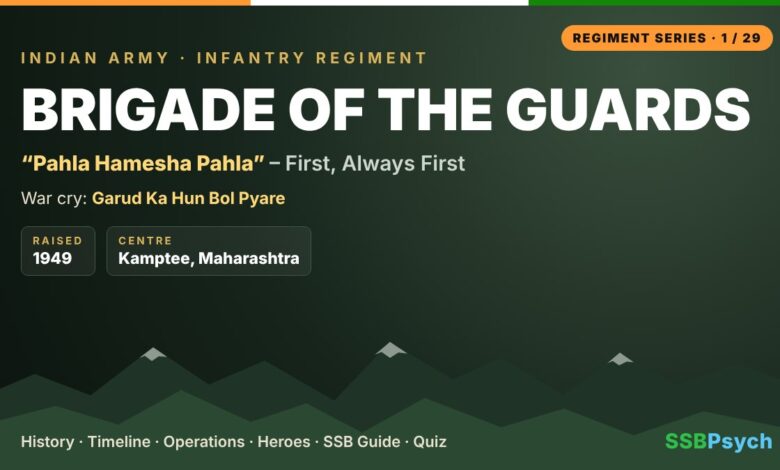
Every regiment of the Indian Army has a story, but the Brigade of the Guards has a story that began with an idea. In 1949, soon after Independence, the Army’s first Indian Commander-in-Chief, General (later Field Marshal) K. M. Cariappa, wanted a regiment where a soldier’s home state, caste or community would not matter at all. The result was the Brigade of the Guards, the first all-India, all-class infantry regiment of the Indian Army. Its motto says it simply: Pahla Hamesha Pahla, which means First, Always First.
In this guide, written for NDA, CDS, AFCAT, TES and SSB aspirants, we cover the regiment’s history and lineage, a visual timeline, its major operations and battle honours, its insignia, motto and war cry, the heroes who made it famous, and what life in the regiment looks like. At the end you will find a section on what this means for SSB candidates, likely interview questions, and a 10-question quiz to test what you have learnt.
Brigade of the Guards – Quick Facts
| Raised | 1949, on the vision of Field Marshal K. M. Cariappa |
| Regimental Centre | Kamptee, near Nagpur, Maharashtra (since 1976) |
| Motto | Pahla Hamesha Pahla (First, Always First) |
| War Cry | Garud Ka Hun Bol Pyare |
| Insignia | Garuda, the mythical eagle |
| Recruitment | All-India, all-class: soldiers from every region serve together |
| Original battalions | Converted from 2 Punjab, 1 Grenadiers, 1 Rajputana Rifles and 1 Rajput |
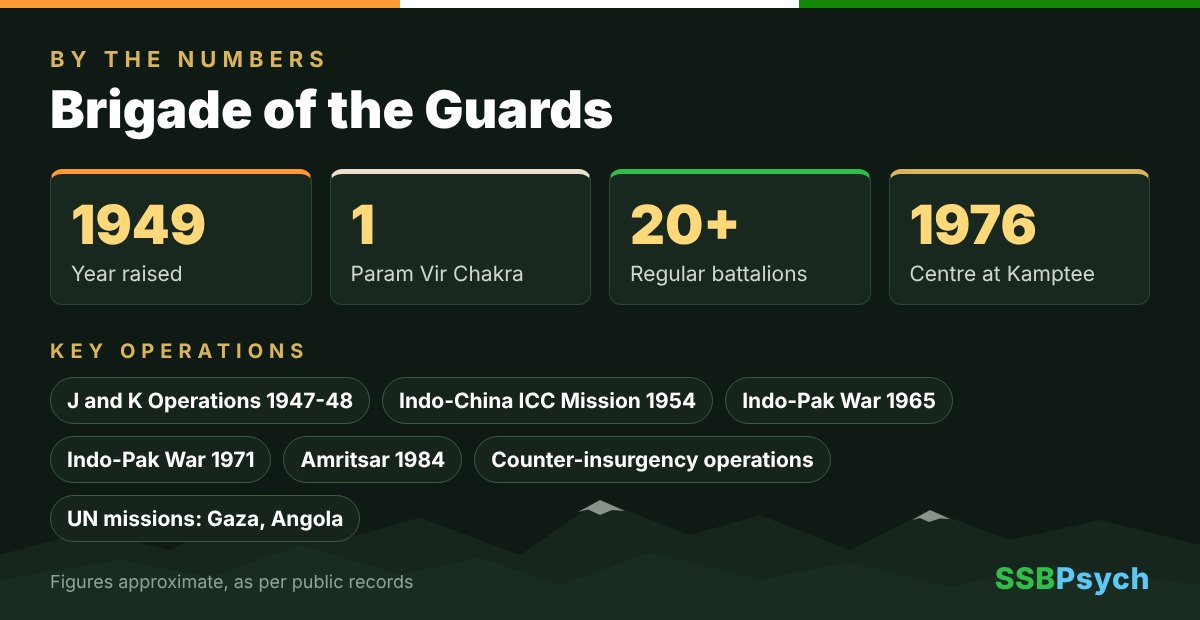
| Battalions | Over 20 regular battalions, many of them mechanised |
| Highest gallantry | Param Vir Chakra: Lance Naik Albert Ekka, 14 Guards, 1971 |
| Role | Infantry and mechanised infantry |
History of the Brigade of the Guards
Before 1947, most infantry regiments in India recruited from particular communities or regions. This was called the class-company or fixed-class system. After Independence, many leaders felt that the new Army should also reflect the idea of one nation. General Cariappa turned that thought into action. He wanted a regiment that would draw young men from every corner of India, including areas that had sent few soldiers to the Army before, and train them to fight shoulder to shoulder.
Instead of raising untested new units, he chose some of the most senior and battle-hardened battalions of the Army and converted them into Guards battalions. The 2nd Battalion of the Punjab Regiment became 1 Guards, the 1st Battalion of The Grenadiers became 2 Guards, the 1st Battalion of the Rajputana Rifles became 3 Guards, and the 1st Battalion of the Rajput Regiment became 4 Guards. Sources give slightly different dates for each conversion, between 1949 and 1951, but together these four battalions brought centuries of tradition into the new regiment.
This is why the Brigade of the Guards is both one of the youngest regiments by name and one of the oldest by lineage. Its battalions carried with them the battle honours of their parent units, including the Jammu and Kashmir operations of 1947-48, where they fought only months before becoming Guards. New battalions were raised in the following decades, and today the regiment has over 20 regular battalions along with Territorial Army and Rashtriya Rifles units.
The regiment’s first home was at Delhi Cantonment. It later moved to Kota in Rajasthan and, in October 1976, settled at Kamptee, near Nagpur in Maharashtra, which remains the Guards Regimental Centre. Here every recruit begins his journey, learning drill, weapons, fieldcraft and, above all, the Guards spirit of being first in everything.
Brigade of the Guards Timeline: From Raising to Today
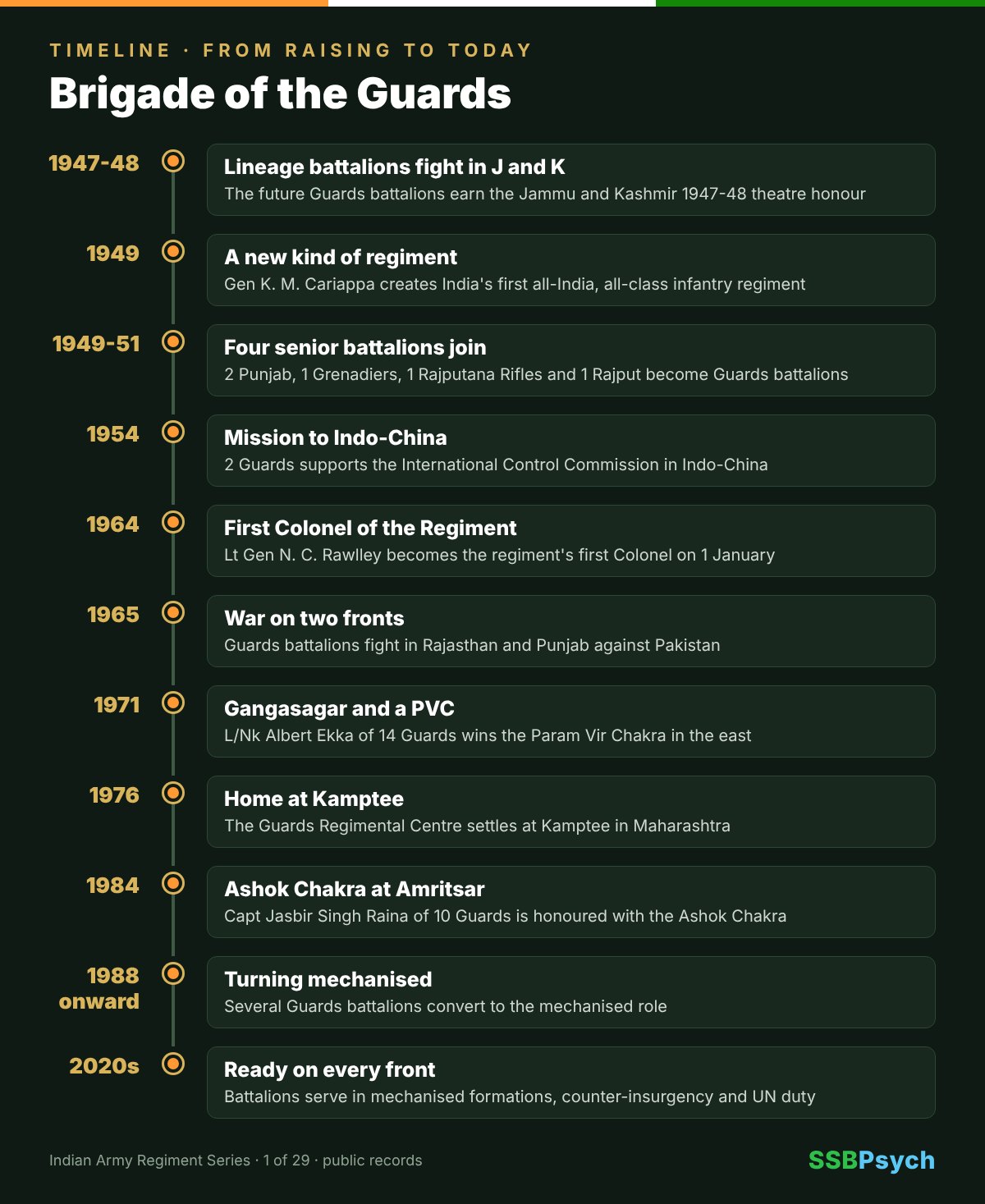
- 1947-48 – Lineage battalions fight in J and K: The future Guards battalions earn the Jammu and Kashmir 1947-48 theatre honour
- 1949 – A new kind of regiment: Gen K. M. Cariappa creates India’s first all-India, all-class infantry regiment
- 1949-51 – Four senior battalions join: 2 Punjab, 1 Grenadiers, 1 Rajputana Rifles and 1 Rajput become Guards battalions
- 1954 – Mission to Indo-China: 2 Guards supports the International Control Commission in Indo-China
- 1964 – First Colonel of the Regiment: Lt Gen N. C. Rawlley becomes the regiment’s first Colonel on 1 January
- 1965 – War on two fronts: Guards battalions fight in Rajasthan and Punjab against Pakistan
- 1971 – Gangasagar and a PVC: L/Nk Albert Ekka of 14 Guards wins the Param Vir Chakra in the east
- 1976 – Home at Kamptee: The Guards Regimental Centre settles at Kamptee in Maharashtra
- 1984 – Ashok Chakra at Amritsar: Capt Jasbir Singh Raina of 10 Guards is honoured with the Ashok Chakra
- 1988 onward – Turning mechanised: Several Guards battalions convert to the mechanised role
- 2020s – Ready on every front: Battalions serve in mechanised formations, counter-insurgency and UN duty
Major Operations and Battle Honours
The Brigade of the Guards has taken part in almost every major operation of independent India. Its battalions share a large number of battle and theatre honours, many inherited from their parent regiments and many earned after 1949. Post-Independence honours associated with the regiment include Naushera, Gurais, Burki, Gadra Road, Akhaura, Gangasagar, Hilli, Sylhet and Shingo River Valley, along with theatre honours for Jammu and Kashmir 1947-48, Punjab 1965, Rajasthan 1965, East Pakistan 1971 and Jammu and Kashmir 1971.
1947-48 and the Early Years
The battalions that later became Guards fought in the first war for Jammu and Kashmir, helping secure areas such as Naushera and Gurais. Soon after its formation, the regiment also served beyond India’s borders. In 1954, 2 Guards was sent to Indo-China to support the International Control Commission, a peace mission set up after the war in that region. It was an early sign that the new regiment could be trusted with sensitive tasks.
The 1965 War
During the 1965 war with Pakistan, Guards battalions fought on the Punjab front and in the Rajasthan desert. Battle honours such as Burki and Gadra Road come from this period, showing how the regiment fought in very different terrain, from the canals and villages of Punjab to the sand dunes of the western desert.
The 1971 War
The 1971 war, which led to the liberation of Bangladesh, was a defining moment. Guards battalions fought on both the eastern and western fronts. In the east, honours such as Gangasagar, Akhaura, Hilli and Sylhet were won in hard fighting. It was at Gangasagar, near Akhaura, that Lance Naik Albert Ekka of 14 Guards showed the courage that earned him the Param Vir Chakra, India’s highest wartime gallantry award. In the west, the Shingo River Valley honour was earned in the Jammu and Kashmir sector.
The 1971 campaign in the east was fast-moving, with Indian columns advancing towards Dhaka from several directions. Infantry battalions had to attack fortified positions, cross rivers and marshes, and keep moving day and night. The honours won by the Guards in this campaign reflect that pace and determination, and they remain a proud chapter in regimental history that every young officer learns about at the Regimental Centre.
Internal Security and Peacekeeping
In 1984, 10 Guards was part of the operation at Amritsar, where it faced heavy fighting and suffered casualties. Since then, Guards battalions have served in counter-insurgency operations in Jammu and Kashmir and the North-East. The regiment has also contributed to United Nations peacekeeping, with missions in places such as Gaza and Angola.
Brigade of the Guards Insignia, Motto and War Cry
The insignia of the Brigade of the Guards is the Garuda, the mighty eagle of Indian mythology who serves as the mount of Lord Vishnu. The Garuda stands for speed, strength and loyalty, which are qualities every Guardsman is expected to show. The regiment’s hackle, a coloured plume worn on ceremonial headgear, is red over yellow.
The motto Pahla Hamesha Pahla means First, Always First. It reflects the regiment’s pride in being the first all-India, all-class regiment, and its wish to be first in battle, sports, drill and discipline. The war cry is Garud Ka Hun Bol Pyare, roughly meaning I belong to the Garuda, say it, my friend. When Guardsmen shout it before an attack, it reminds every man that he belongs to one family, no matter where he comes from.
Heroes of the Brigade of the Guards
The regiment’s honour roll includes gallantry award winners and senior commanders who shaped the Army. Here are some names every aspirant should know.
- Lance Naik Albert Ekka, Param Vir Chakra (posthumous) – 14 Guards, Gangasagar, 1971; he attacked enemy machine-gun positions in spite of serious wounds.
- Captain Jasbir Singh Raina, Ashok Chakra – 10 Guards, honoured for courage during the 1984 operation at Amritsar.
- Field Marshal K. M. Cariappa – not a Guardsman himself, but the visionary who created the regiment in 1949.
- Lt Gen N. C. Rawlley – first Colonel of the Regiment (1964), later GOC-in-C Eastern Command and Vice Chief of the Army Staff.
- Lt Gen W. A. G. Pinto – Guards officer who rose to command Central Command.
- Lt Gen S. R. Ghosh – Guards officer who served as GOC-in-C Western Command.
Albert Ekka’s story is especially inspiring. A young soldier from the tribal belt of what is now Jharkhand, he is the regiment’s Param Vir Chakra awardee. On the night of 3 December 1971, during the attack at Gangasagar, he charged enemy bunkers that were holding up his company and kept fighting after being badly wounded, until the position was cleared. He did not survive his wounds. His life is a perfect example of the Guards idea: talent and courage can come from anywhere in India.
Role and Life in the Regiment
What makes the Brigade of the Guards different from most older regiments is its mixed composition. In many regiments, a company is made up of soldiers from one community, who share a language, festivals and customs. In the Guards, soldiers from different states live, train and fight together in the same section and platoon. Over the decades this has proved that a mixed unit can be just as tough and close-knit as any single-class unit. Hindi becomes the common language of the barracks, and festivals from every part of India are celebrated together in the unit lines.
The Brigade of the Guards is unusual because it has both standard infantry battalions and mechanised battalions. From the late 1980s, several Guards battalions were converted to the mechanised role, operating infantry combat vehicles alongside tank regiments. These battalions train at the Mechanised Infantry Centre and School at Ahmednagar for their vehicles and tactics, while keeping their Guards identity, traditions and centre.
The standard infantry battalions do everything infantry is known for: holding posts on the Line of Control, patrolling high mountains, carrying out counter-insurgency operations and helping civilians during floods and earthquakes. A Guards officer may command soldiers from Kerala, Assam, Punjab and Maharashtra in the same platoon, which makes leadership both challenging and rewarding. Officers learn to unite people of different languages and customs into one team.
The regiment is also known for its high standards of drill and turnout. Guardsmen have often taken part in ceremonial duties and parades. Most importantly, the President of India is the Honorary Colonel-in-Chief of the regiment, a rare honour that adds to its prestige.
Sports and adventure activities are part of daily life too. Like other regiments, the Guards encourage soldiers to take part in athletics, boxing, mountaineering and other events, because physical fitness and team spirit carry straight into battle performance.
Why the Brigade of the Guards Matters for SSB Aspirants
For an SSB candidate, the Brigade of the Guards is a perfect example of national integration in action. Interviewing officers often ask candidates about the Army’s values, and the Guards story gives you a strong, factual example to quote. If you are asked how the Army builds unity, you can talk about how this regiment mixes soldiers from every state in the same sub-units, and how that leads to trust and cohesion in battle.
The regiment is also a useful topic for lecturettes and group discussions on themes such as unity in diversity, the role of the Army in nation building, and the Param Vir Chakra awardees. Knowing a few accurate facts, such as the motto, the year 1949, Field Marshal Cariappa’s role and Albert Ekka’s action at Gangasagar, can make your answers stand out.
Brigade of the Guards for SSB Candidates: What You Should Know
How officers join
- Officers enter through the NDA (after Class 12), the IMA via CDS, TES or TGC, or the OTA Chennai through Short Service Commission entries.
- All entries require you to clear the SSB interview and a medical board before joining training.
- Arm and regiment allotment happens during academy training, based on your choice, training merit and the vacancies available.
- A cadet allotted to the Infantry may be posted to the Brigade of the Guards if a vacancy exists there; no entry guarantees a particular regiment.
How soldiers join
- As an all-India, all-class regiment, the Guards can take soldiers from every state and community.
- Since 2022, soldiers join the Army through the Agnipath scheme as Agniveers, selected through Army recruitment rallies and the online common entrance exam.
- Recruits train at the Guards Regimental Centre, Kamptee, before joining a battalion.
Questions you may face in the SSB interview, GD or lecturette
- Why was the Brigade of the Guards called the first all-India, all-class regiment?
- What is the motto of the Brigade of the Guards and what does it mean to you?
- Tell us about Lance Naik Albert Ekka and the action at Gangasagar.
- How does a mixed-class regiment help national integration?
- Should all infantry regiments become all-class? Give arguments for both sides.
SSBPsych tip: In your interview, link the Guards idea of soldiers from every state serving together to your own experience of teamwork with people from different backgrounds; examples from your life count more than memorised facts.
Remember, you do not join a regiment directly as an officer. You first clear the SSB, train at an academy, and are then commissioned into an arm and regiment. But knowing the story of regiments like the Brigade of the Guards shows the board that your interest in the Army is genuine and informed. Now try the quiz below and see how much you remember.
Quiz: How Well Do You Know the Brigade of the Guards?
Test yourself! Click an option to see if you are right. Your score updates live.
Brigade of the Guards: Frequently Asked Questions
The motto is Pahla Hamesha Pahla, which means First, Always First.
The Guards Regimental Centre is at Kamptee, near Nagpur in Maharashtra. It moved there in 1976 after earlier stays at Delhi and Kota.
The war cry is Garud Ka Hun Bol Pyare, linking every Guardsman to the Garuda, the regiment’s symbol.
It was raised in 1949 on the vision of General (later Field Marshal) K. M. Cariappa, the first Indian Commander-in-Chief of the Indian Army.
Join the Army as an officer through NDA, CDS, TES or other entries after clearing the SSB. Infantry regiments are allotted during academy training based on choice, merit and vacancies.
Indian Army Regiments Series on SSBPsych
This is part 1 of 29 in our series on every infantry regiment of the Indian Army – a new regiment every day at 11 AM. Also follow our Param Vir Chakra series.
Sources: en.wikipedia.org, en.wikipedia.org, bharat-rakshak.com, indianarmy.nic.in.
Preparing for NDA, CDS, AFCAT or your SSB? Join SSBPsych’s online and offline batches – explore our courses or call +91 8076540582.