What Is a Submarine? How It Dives, Breathes and Fights
Imagine a steel ship as heavy as hundreds of elephants that sinks on purpose, hides in total darkness for weeks, and then rises back to the surface exactly when it wants. That is the magic of a submarine. If you have ever wondered what is a submarine and how it really works, this guide explains it in plain words, from diving and breathing to navigating and fighting.
We will cover the science of sinking and floating, how sailors get fresh air under the sea, how a submarine finds its way without seeing anything, the main types of submarines, what daily life inside feels like, and the real dangers submariners face. Along the way we will use Indian Navy examples like INS Kalvari and INS Arihant, which every NDA, CDS and SSB aspirant should know.

What Is a Submarine? The Simple Answer
A submarine is a warship (or research vessel) that can operate fully underwater for long periods and come back to the surface on its own. A normal ship can only float on top of the water. A submarine can float, sink, hover at a chosen depth, and move in all three directions, a bit like an aircraft that flies through water instead of air.
Navies love submarines for one main reason: stealth. Water hides a submarine from eyes, cameras and most radars. An enemy may know a submarine is somewhere in the ocean, but not exactly where. That uncertainty alone forces the enemy to be careful, which is why people call submarines the silent service.
How Does a Submarine Dive and Surface?
The secret lies in a simple rule you studied in school: an object floats if it weighs less than the water it pushes aside, and sinks if it weighs more. A submarine changes its own weight by taking in or pushing out seawater.
Ballast tanks: the lungs of a submarine
Between the inner hull and outer skin, a submarine has large ballast tanks. On the surface these tanks are full of air, so the boat floats like an empty bottle. To dive, valves open, air escapes from the top and seawater rushes in from the bottom. The boat becomes heavier and slides under the waves.
To surface, the crew blows high-pressure compressed air into the tanks. The air pushes the water out, the boat becomes lighter, and it rises. In an emergency, a full blow of all tanks can send a submarine shooting up quickly.
Trim tanks and hydroplanes: fine control
Main ballast tanks are like a big on and off switch. For fine control, smaller trim tanks move water forward or backward and adjust the weight slightly, so the boat stays level at the exact depth. When the boat is moving, small wing-like fins called hydroplanes (or diving planes) tilt the nose up or down, just like the flaps on an aircraft wing.
The pressure hull: a steel shell against crushing water
Every 10 metres of seawater adds roughly one more atmosphere of pressure. At 300 metres, the water presses on every square centimetre of the hull with about 30 times the force we feel at sea level. To survive, the crew lives inside a thick, round pressure hull made of special high-strength steel. A lighter outer hull gives the boat its smooth, fish-like shape. The deepest a submarine is designed to go safely is called its test depth. For example, India’s Scorpene-based Kalvari class has a publicly reported test depth of about 350 metres. For most frontline submarines, especially nuclear ones, the real figure is classified.
How Do Sailors Breathe Underwater?
A submarine is a sealed metal tube full of people, machines and batteries, so air is a serious business. Modern submarines handle it in three ways.
- Making oxygen: larger submarines split fresh water into hydrogen and oxygen using electricity (electrolysis). Emergency oxygen candles can also release oxygen when burned.
- Removing carbon dioxide: the gas we breathe out is absorbed by chemical scrubbers, otherwise it would slowly poison the crew.
- The snorkel: a diesel-electric submarine can rise to just below the surface and raise a pipe called a snorkel. Its diesel engines suck in fresh air through this pipe to recharge the batteries, and fresh air reaches the crew too.
Sensors constantly watch the air for dangerous gases. Lead-acid batteries, for example, can give off hydrogen while charging, which must be controlled carefully.
How Does a Submarine Navigate Without Seeing?
Underwater there is no GPS signal and almost no light. So how does a submarine know where it is? It uses a mix of clever tools.
- Inertial navigation: very sensitive gyroscopes and motion sensors track every turn and change of speed from a known starting point. Small errors add up over time, so the boat occasionally rises to take a GPS fix.
- Passive sonar: sensitive underwater microphones listen for the sounds of ships, other submarines and even marine life. Listening does not reveal the submarine, so this is its main sense.
- Active sonar: the boat sends out a sound ping and listens for the echo. It is accurate, but the ping can give away the submarine’s own position, so it is used rarely.
- Periscope and masts: near the surface, a periscope or modern optronic mast lets the crew take a quick look around.
- Charts of the seabed: detailed maps of underwater mountains and depths help the navigator plan safe routes.
Talking to a submarine is also tricky because normal radio waves barely enter seawater. Navies use very low frequency (VLF) radio stations to send short messages to submarines near the surface, and the boats usually reply only when needed to stay hidden.
How Does a Submarine Fight?
A submarine is a hunter that strikes without being seen. Its main weapons are fired from tubes in the front of the hull or from vertical launch tubes.
- Heavyweight torpedoes: self-guided underwater missiles that can break the back of a large warship.
- Anti-ship missiles: fired from underwater, they pop out of the sea and fly to the target. India’s Kalvari class can carry SM39 Exocet missiles.
- Mines: laid quietly near enemy harbours or sea lanes.
- Ballistic missiles: big strategic submarines like INS Arihant carry nuclear-capable missiles meant to deter any nuclear attack on India.
Besides attacking, submarines spend much of their time gathering intelligence, watching enemy ships, protecting their own fleet and simply making the enemy nervous by being somewhere unknown.
What Is a Submarine Timeline
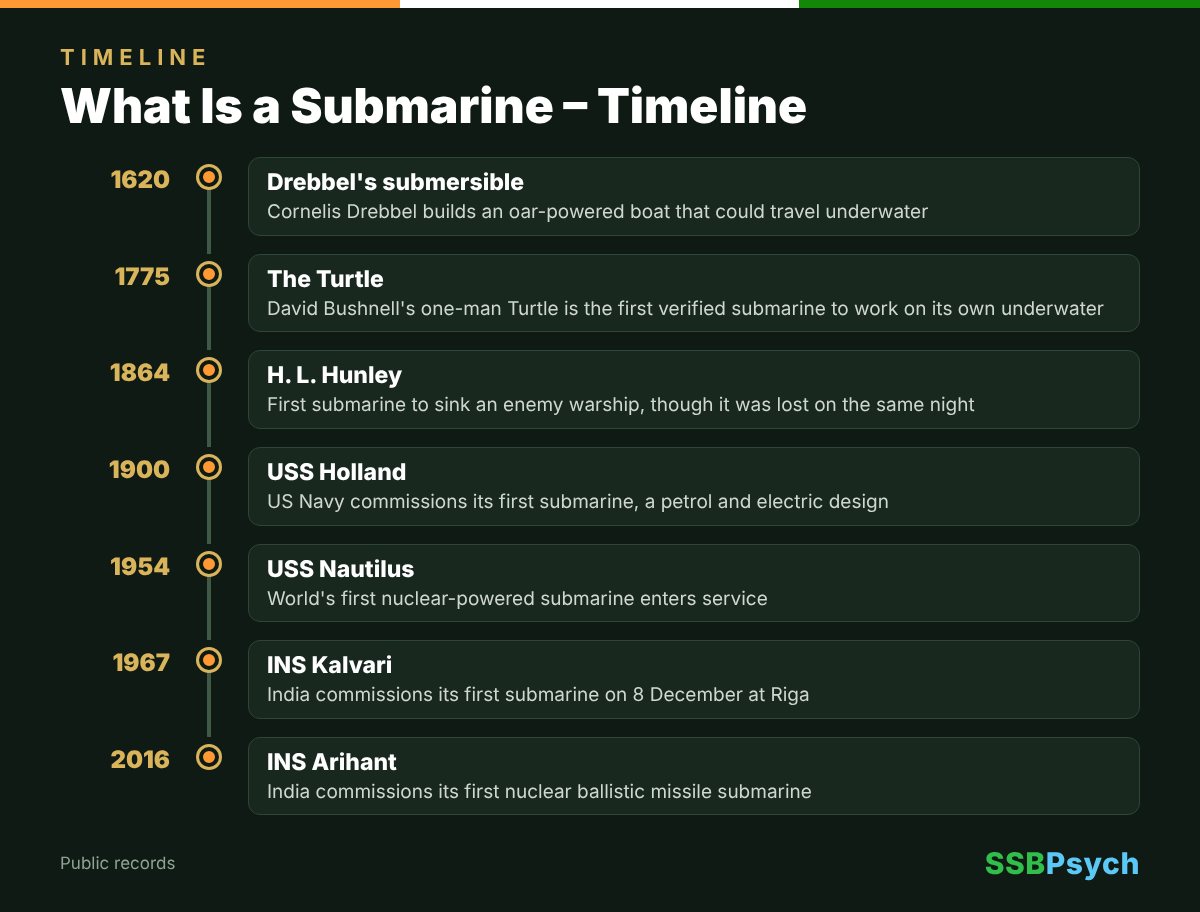
- 1620 – Drebbel’s submersible: Cornelis Drebbel builds an oar-powered boat that could travel underwater
- 1775 – The Turtle: David Bushnell’s one-man Turtle is the first verified submarine to work on its own underwater
- 1864 – H. L. Hunley: First submarine to sink an enemy warship, though it was lost on the same night
- 1900 – USS Holland: US Navy commissions its first submarine, a petrol and electric design
- 1954 – USS Nautilus: World’s first nuclear-powered submarine enters service
- 1967 – INS Kalvari: India commissions its first submarine on 8 December at Riga
- 2016 – INS Arihant: India commissions its first nuclear ballistic missile submarine
Types of Submarines Explained
Submarines are grouped mainly by what powers them and what job they do. Navies use short codes that you will often see in news reports.
- SSK (diesel-electric attack submarine): diesel engines charge large batteries, and the batteries drive the boat underwater. Very quiet on battery power and cheaper to build. Examples: India’s Kalvari, Sindhughosh and Shishumar classes.
- AIP submarine: a conventional submarine with Air Independent Propulsion, which lets it stay submerged for much longer without snorkelling.
- SSN (nuclear attack submarine): a nuclear reactor gives almost unlimited range and high underwater speed. India operated leased Russian boats named INS Chakra.
- SSBN (nuclear ballistic missile submarine): a nuclear-powered boat that carries long-range missiles for deterrence. India’s Arihant class belongs here.
- SSGN: a nuclear submarine armed mainly with cruise missiles, operated by a few large navies.
We explain the nuclear versus conventional debate in detail in the next post of this series.

Life on Board a Submarine
Life inside a submarine is like living in a crowded railway coach that never stops at a station. India’s Kalvari class, for instance, is about 67.5 metres long, shorter than a football field, and carries a crew of around 43 people (8 officers and 35 sailors) according to published figures. Every bit of space is shared with pipes, cables, valves and weapons.
- No sunlight: days and nights are marked by lighting changes and watch schedules, not by the sun.
- Watches and shifts: the crew works in rotating shifts so the boat is fully alert all day and night.
- Tight bunks: beds are narrow and stacked, and in many navies junior sailors share bunks in shifts.
- Water is precious: fresh water is made on board, so quick showers are the rule.
- Silence matters: during quiet running, even dropping a metal tool can make noise that enemy sonar may hear.
- Teamwork: every submariner learns the boat’s systems in depth, because in an emergency anyone may need to shut a valve or fight a fire.
Good food is a big morale booster on long patrols, and cooks are among the most respected people on board. Submariners also need strong mental fitness, which is why calm, adaptable personalities thrive in this branch, a quality SSB assessors also look for.
Dangers Submariners Face
The sea is unforgiving, and submarines operate at the edge of what machines and humans can handle. The main dangers are:
- Flooding: a leak under high pressure can let in water with tremendous force.
- Fire and explosions: in a closed space, smoke and heat spread fast. In August 2013, an explosion and fire on INS Sindhurakshak at Mumbai’s naval dockyard killed 18 crew members, one of the Indian Navy’s worst peacetime tragedies.
- Toxic air: a failure of air purification can harm the crew within hours.
- Going too deep: beyond the safe depth, the hull can be crushed by water pressure.
- Collisions: submarines can hit the seabed, rocks or other vessels while running blind.
To rescue crews from a stricken submarine, India inducted its first Deep Submergence Rescue Vehicle (DSRV) system in December 2018 and a second in 2019. One is based in Mumbai and the other in Visakhapatnam, and they are reported to be able to rescue personnel from depths of up to about 650 metres.
Why Submarines Matter for India
India sits at the centre of the Indian Ocean, through which a large share of the world’s trade and energy supplies pass. Submarines help India watch these waters, protect its ships and deter any enemy from trying adventures at sea. Strategic submarines like INS Arihant also give India a hidden second-strike nuclear capability, completing what is called the nuclear triad.
India’s submarine story began on 8 December 1967, when INS Kalvari was commissioned. That date is now celebrated every year as Submarine Day. You can even walk inside a real retired submarine, INS Kursura, which is a museum on Ramakrishna Beach in Visakhapatnam.
What Is a Submarine? Key Points to Remember
- Submarines dive and surface by filling and emptying ballast tanks.
- A thick pressure hull protects the crew from crushing water pressure.
- Oxygen is made on board, and carbon dioxide is removed by scrubbers.
- Passive sonar is the submarine’s main sense; inertial navigation tells it where it is.
- The main types are SSK, AIP, SSN and SSBN.
Did You Know?
- The name Kalvari comes from the Malayalam word for the tiger shark.
- The first submarine to sink an enemy warship, the H. L. Hunley, was itself lost the same night in 1864.
- USS Nautilus, the first nuclear-powered submarine, entered service in 1954.
- Submarines are traditionally called boats, not ships, even when they are huge.
- Sound travels about four times faster in water than in air, which is why sonar works so well.
- India marks Submarine Day every year on 8 December.
Quiz: Test Your Knowledge of What Is a Submarine
Click an option to see if you are right. Your score updates live.
What Is a Submarine: Frequently Asked Questions
A submarine is a vessel that can operate fully underwater and surface on its own. Navies use it to hide, watch and strike without being seen.
It fills ballast tanks with seawater to become heavier and dive, and blows them with compressed air to become lighter and rise. Trim tanks and hydroplanes fine-tune its depth.
Oxygen is produced on board from water by electrolysis or released from oxygen candles, and carbon dioxide is removed by scrubbers. Diesel-electric boats also take in fresh air through a snorkel.
It depends on the design. India’s Kalvari class has a reported test depth of about 350 metres, while the exact depth of most frontline submarines is classified.
Submarine Day is observed every year on 8 December, the date INS Kalvari, India’s first submarine, was commissioned in 1967.
This is part 1 of 21 in SSBPsych’s submarine series – a new post every morning at 10 AM.
Sources: en.wikipedia.org, en.wikipedia.org, en.wikipedia.org, en.wikipedia.org, en.wikipedia.org.
Preparing for NDA, CDS, AFCAT or your SSB? Join SSBPsych’s online and offline batches – explore our courses or call +91 8076540582.