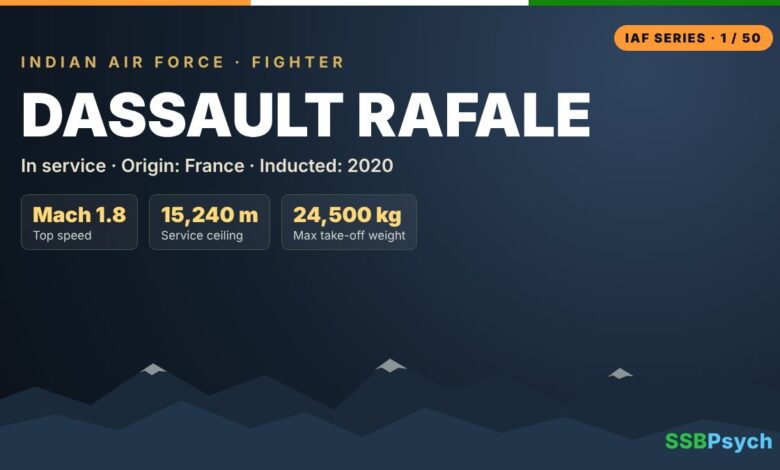
Rafale in Indian Air Force: Specs, Missiles, Speed, History
Imagine a fighter jet that can hunt enemy aircraft, strike targets hundreds of kilometres away and spy on the enemy, all in a single flight. That is the Rafale, the French-built fighter that has become the sharpest sword of the Indian Air Force (IAF). When five of these jets landed at Ambala in July 2020, the whole country watched live on television. Since then, the Rafale has become a symbol of a modern, confident IAF.
In this guide you will learn everything an NDA, CDS or AFCAT aspirant should know about the Rafale: its full specifications, how fast and how high it flies (explained in plain words), the deadly missiles it carries, the operations it has flown, where it is based, and what the future holds. At the end there is a 10-question quiz and a quick FAQ to lock the facts into your memory.

Rafale Specifications
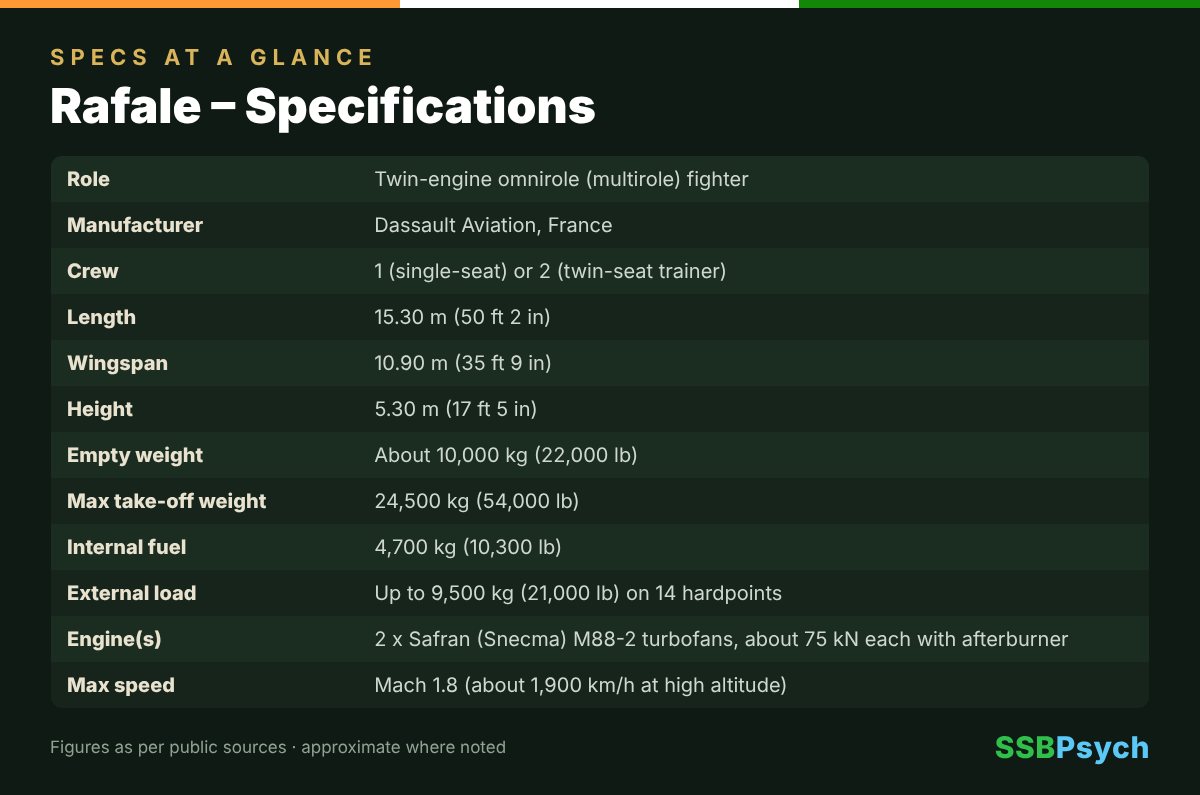
| Role | Twin-engine omnirole (multirole) fighter |
| Manufacturer | Dassault Aviation, France |
| Crew | 1 (single-seat) or 2 (twin-seat trainer) |
| Length | 15.30 m (50 ft 2 in) |
| Wingspan | 10.90 m (35 ft 9 in) |
| Height | 5.30 m (17 ft 5 in) |
| Empty weight | About 10,000 kg (22,000 lb) |
| Max take-off weight | 24,500 kg (54,000 lb) |
| Internal fuel | 4,700 kg (10,300 lb) |
| External load | Up to 9,500 kg (21,000 lb) on 14 hardpoints |
| Engine(s) | 2 x Safran (Snecma) M88-2 turbofans, about 75 kN each with afterburner |
| Max speed | Mach 1.8 (about 1,900 km/h at high altitude) |
| Service ceiling | 15,240 m (50,000 ft) |
| G limits | +9 g to -3.2 g |
| First flight | 4 July 1986 (Rafale A demonstrator) |
| Inducted in IAF | 10 September 2020, Ambala |
| Number in IAF | 36 (single-seat and twin-seat) |
What Is the Rafale?
The Rafale is a twin-engine fighter made by Dassault Aviation of France. The word “rafale” means “gust of wind” or “burst of fire” in French, which suits a jet built for speed and firepower. Dassault calls it an omnirole fighter. Normal multirole jets can do different jobs, but often one at a time. The Rafale is designed to switch between air combat, ground attack, reconnaissance and even nuclear deterrence in the same sortie.
It belongs to the so-called 4.5 generation of fighters. That means it is more advanced than older fourth-generation jets like the MiG-29 or Mirage 2000, with modern sensors, a smart cockpit and some stealth-friendly design touches, but it is not a full stealth fighter like the American F-35. The IAF flies two versions: a single-seat fighter and a twin-seat version mainly used for training and complex missions.
Why India Needed the Rafale
By the 2000s, the IAF knew it had a problem. Old MiG-21 squadrons were retiring faster than new jets were arriving, and India faces two neighbours with modern air forces. In 2007 the IAF began a huge contest called MMRCA (Medium Multi-Role Combat Aircraft) to buy 126 new fighters. Six jets from around the world competed, and in 2012 the Rafale was picked as the winner on cost and performance.
However, talks on building most of the jets in India dragged on for years. To fill the gap quickly, India and France signed a government-to-government deal on 23 September 2016 for 36 Rafales in fly-away condition, worth about Rs 58,000 crore. The package included weapons like the Meteor missile, long-term support and special India-specific upgrades.
History of the Rafale in the IAF
The first Rafale for India was handed over in France on 8 October 2019, which was also Air Force Day. Indian Rafales carry tail numbers beginning with “RB”, widely reported to honour the then IAF chief, Air Chief Marshal R.K.S. Bhadauria, who played a key role in the deal. Indian pilots and technicians trained in France before bringing the jets home.
On 29 July 2020, the first five Rafales landed at Air Force Station Ambala in Haryana after a long ferry flight from France with a stop in the UAE. The timing was dramatic: Indian and Chinese troops were in a tense standoff in eastern Ladakh after the Galwan clash. On 10 September 2020, the jets were formally inducted into No. 17 Squadron, the “Golden Arrows”, in a ceremony attended by the defence ministers of India and France.
Deliveries continued in batches. In July 2021, a second squadron, No. 101 Squadron (“Falcons of Chhamb and Akhnoor”), received the Rafale at Hasimara in West Bengal, close to the strategic Chumbi Valley and the Siliguri Corridor. By the end of 2022, all 36 jets had reached India, many with India-specific enhancements such as a helmet-mounted display and the ability to start the engines in very cold conditions at high-altitude airfields.
Engine and Performance Explained Simply
The Rafale is powered by two M88-2 turbofan engines made by Safran (earlier called Snecma). Each engine gives about 75 kilonewtons of thrust with the afterburner on. An afterburner sprays extra fuel into the hot exhaust, a bit like a turbo boost in a racing game, giving a big push for take-off, climbing or chasing an enemy.
Top speed: Dassault lists the Rafale’s maximum speed as Mach 1.8. “Mach 1” is the speed of sound, so Mach 1.8 means almost twice the speed of sound, roughly 1,900 km/h at high altitude. India’s fastest bullet trains are planned to run at around 320 km/h, so the Rafale is about six times faster. It could cross from Delhi to Mumbai in well under an hour. The jet can also supercruise, meaning fly faster than sound without the afterburner in some configurations, which saves fuel.
Service ceiling: This is the highest altitude at which the jet can still fly and climb usefully. For the Rafale it is 50,000 feet, or about 15,240 metres. Mount Everest is 8,849 metres tall, so the Rafale can operate at roughly one and three-quarter times the height of Everest, far above where passenger jets normally cruise.
Weight and payload: Empty, the Rafale weighs around 10 tonnes. Fully loaded for take-off, it can reach 24.5 tonnes. “Payload” means everything it carries on top of itself: missiles, bombs, sensor pods and fuel tanks. The Rafale can carry up to 9.5 tonnes of external load on 14 hardpoints (attachment points under the wings and body). That is like hanging the weight of about seven small cars under one fighter jet.
Fuel and reach: It carries 4.7 tonnes of fuel inside and can take up to 6.7 tonnes more in external tanks. It can also be refuelled in mid-air by tanker aircraft, so its reach depends on the mission rather than one fixed number. At 15.3 metres long, it is about as long as four hatchback cars parked nose to tail, and it can land on a runway roll of only around 450 metres.
Weapons and Missiles
- Meteor beyond-visual-range air-to-air missile
- MICA air-to-air missile (infrared and radar-guided versions)
- SCALP long-range air-launched cruise missile
- HAMMER (AASM) precision-guided glide bomb
- 30 mm GIAT 30 internal revolver cannon
- Electronic warfare self-protection suite (SPECTRA), chaff and flares
The star weapon is the Meteor, a European air-to-air missile powered by a ramjet, an engine that keeps pushing the missile all the way to the target instead of burning out early. This gives it a large “no-escape zone”, meaning an enemy pilot has little chance to outrun it. The SCALP cruise missile lets the Rafale hit bunkers and command centres from hundreds of kilometres away without crossing the border. The HAMMER is a rocket-boosted precision bomb kit that can hit targets tens of kilometres away, ideal for mountain terrain like Ladakh.
Rafale Missions and Operations
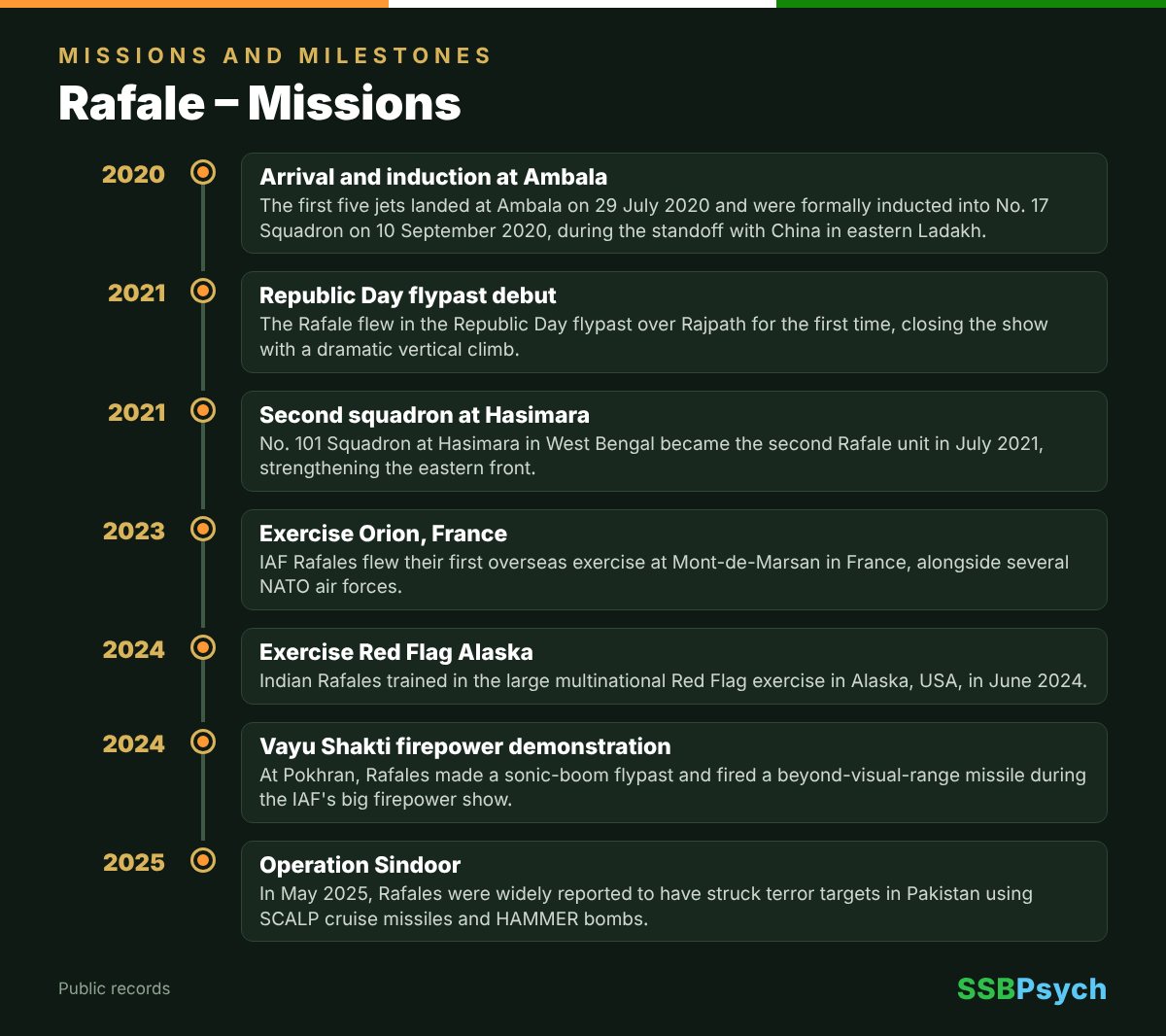
- 2020 – Arrival and induction at Ambala: The first five jets landed at Ambala on 29 July 2020 and were formally inducted into No. 17 Squadron on 10 September 2020, during the standoff with China in eastern Ladakh.
- 2021 – Republic Day flypast debut: The Rafale flew in the Republic Day flypast over Rajpath for the first time, closing the show with a dramatic vertical climb.
- 2021 – Second squadron at Hasimara: No. 101 Squadron at Hasimara in West Bengal became the second Rafale unit in July 2021, strengthening the eastern front.
- 2023 – Exercise Orion, France: IAF Rafales flew their first overseas exercise at Mont-de-Marsan in France, alongside several NATO air forces.
- 2024 – Exercise Red Flag Alaska: Indian Rafales trained in the large multinational Red Flag exercise in Alaska, USA, in June 2024.
- 2024 – Vayu Shakti firepower demonstration: At Pokhran, Rafales made a sonic-boom flypast and fired a beyond-visual-range missile during the IAF’s big firepower show.
- 2025 – Operation Sindoor: In May 2025, Rafales were widely reported to have struck terror targets in Pakistan using SCALP cruise missiles and HAMMER bombs.

Where the Rafale Is Based and Who Flies It
As publicly reported, India’s Rafales are split between two bases: Ambala in Haryana, home of No. 17 Squadron “Golden Arrows”, which watches the western and northern fronts, and Hasimara in West Bengal, home of No. 101 Squadron, which covers the eastern sector. Each base is an Air Force Station led by a senior officer, usually of Air Commodore or Group Captain rank.
A fighter squadron is usually commanded by a Wing Commander, the squadron’s “CO”. Under him or her are flight commanders, typically Squadron Leaders, and a team of pilots who are Flight Lieutenants and Flying Officers, supported by engineers, technicians and air traffic controllers. Flight Lieutenant Shivangi Singh, widely reported as the first woman to fly the Rafale, was part of the IAF team for Exercise Orion in France in 2023.
How does someone become a Rafale pilot? Cadets join the flying branch through NDA, CDS or AFCAT, then train at the Air Force Academy, Dundigal. Broadly, they fly basic trainers such as the Pilatus PC-7 Mk II, then move to intermediate and advanced jet trainers like the Kiran and the Hawk, and get commissioned after roughly one and a half to two years. Only after several more years and hundreds of flying hours on frontline fighters are pilots usually selected for a top jet like the Rafale.
Strengths and Limitations of the Rafale
- Strength: Long-range weapons like Meteor and SCALP let it strike first and from a safe distance.
- Strength: The SPECTRA electronic warfare suite helps detect, jam and dodge enemy radars and missiles.
- Strength: Twin engines add safety over mountains and the sea, and it can fly many types of missions in one sortie.
- Strength: Combat-proven with France in Afghanistan, Libya, Mali and the Middle East before coming to India.
- Limitation: Only 36 jets in service, which is just two squadrons for a very large country.
- Limitation: Expensive to buy and operate, and weapons and spares come mainly from abroad.
- Limitation: It is a 4.5-generation jet, not a full stealth fighter, so it can be seen on radar more easily than a fifth-generation aircraft.
Future of the Rafale in India
The Rafale family in India is growing. In April 2025, India signed a deal for 26 Rafale Marine jets for the Indian Navy to fly from aircraft carriers like INS Vikrant. As part of the earlier plans, some IAF Rafales are also getting “buddy refuelling”, where one jet can pass fuel to another in mid-air.
Bigger news came on 12 February 2026, when India’s Defence Acquisition Council cleared a proposal to procure 114 more Rafale jets for the IAF, with final contract talks with France to follow. Dassault has also tied up with Tata Advanced Systems to make Rafale fuselages in India. If these plans move ahead, the Rafale could become one of the IAF’s main fighters for decades, alongside the Su-30MKI and the home-grown Tejas.
Why the Rafale Matters for SSB and AFCAT Aspirants
Questions on the Rafale pop up in AFCAT general awareness, CDS and NDA GAT papers, and in SSB interviews, group discussions and lecturettes. An interviewing officer may ask you about the Rafale’s weapons, why India bought it, or how it changed the balance of air power. Knowing a few clear facts and explaining them calmly shows awareness, which is an important quality the board looks for.
Most importantly, understanding the aircraft helps you answer the classic question, “Why do you want to join the Air Force?” with real passion. Saying you dream of flying a jet like the Rafale for your country, and knowing what it actually does, is far more convincing than a memorised answer.
Did You Know?
- The first Rafale was handed over to India on 8 October 2019, which is also Indian Air Force Day.
- Indian Rafale tail numbers start with “RB”.
- No. 17 Squadron “Golden Arrows” was revived specially to fly the Rafale.
- The Meteor missile uses a ramjet engine, so it keeps its energy right till the end of its flight.
- The Rafale can land after a ground run of only about 450 metres.
- The Indian Navy has ordered 26 Rafale Marine jets for its aircraft carriers.
- In 2024, IAF Rafales trained to shoot down balloon-like targets flying at around 55,000 feet.
Quiz: Test Your Knowledge of Rafale
Click an option to see if you are right. Your score updates live.
Rafale: Frequently Asked Questions
Dassault lists the Rafale’s top speed as Mach 1.8, which is about 1,900 km/h at high altitude. That is almost twice the speed of sound.
The IAF operates 36 Rafales, ordered in 2016 and delivered between 2020 and 2022. In February 2026 the Defence Acquisition Council cleared a proposal for 114 more.
As publicly reported, Rafales fly from Ambala in Haryana with No. 17 Squadron and from Hasimara in West Bengal with No. 101 Squadron.
Key weapons include the Meteor and MICA air-to-air missiles, the SCALP cruise missile and the HAMMER precision bomb, plus a 30 mm cannon.
The first five Rafales landed in India on 29 July 2020 and were formally inducted at Ambala on 10 September 2020.
This is part 1 of 50 in SSBPsych’s Indian Air Force aircraft series – a new aircraft every evening at 6 PM.
Sources: dassault-aviation.com, en.wikipedia.org, thestatesman.com, dtnext.in, etvbharat.com.
Preparing for NDA, CDS, AFCAT or your SSB? Join SSBPsych’s online and offline batches – explore our courses or call +91 8076540582.