Major Somnath Sharma, PVC: India’s First Param Vir Chakra – Full Story (with Quiz)
On the afternoon of 3 November 1947, a young company commander with a plaster cast on his left arm stood in an open field near the village of Badgam, a short distance from Srinagar airfield. In front of him was a raider force many times larger than his own company. Behind him was the only airstrip through which India could rush troops into the Kashmir Valley. He sent one last message to his brigade headquarters, promising that he would not pull back an inch. A few minutes later he was dead. His name was Major Somnath Sharma, and he became the first soldier ever to receive the Param Vir Chakra, India’s highest award for gallantry in the face of the enemy.
For anyone preparing for the NDA, CDS, AFCAT or the SSB interview, the story of Major Somnath Sharma is a must-know. It is asked about in general knowledge papers, it is a favourite topic in group discussions about leadership, and it gives you a real example of officer-like qualities in action. In this post you will read about his early life, his journey into the Army, the background of the 1947–48 war in Jammu and Kashmir, a detailed account of the fight at Badgam, his citation explained in simple words, and his legacy. At the end there is a 10-question quiz, WAT words and SRT situations to test yourself.
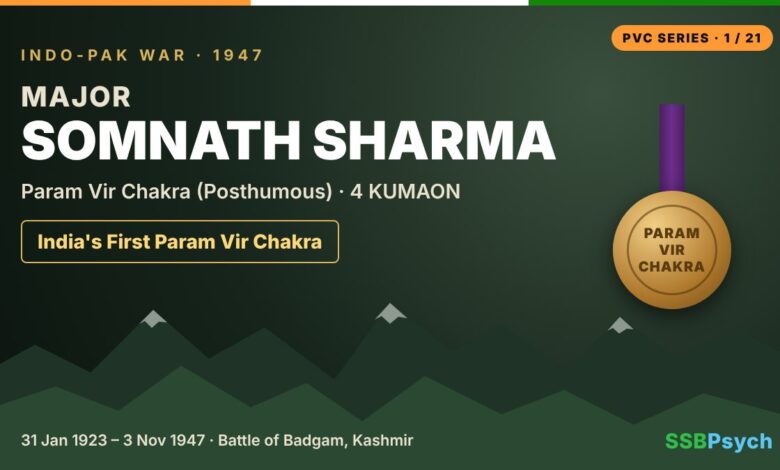
Major Somnath Sharma – Quick Facts
| Full name | Major Somnath Sharma |
| Born | 31 January 1923, Dadh, Kangra (now Himachal Pradesh) |
| Father | Amar Nath Sharma, an Army officer |
| Schooling | Sherwood College, Nainital; Prince of Wales Royal Military College, Dehradun |
| Commissioned | 22 February 1942, 19th Hyderabad Regiment (later Kumaon Regiment) |
| Unit at Badgam | D Company, 4th Battalion, Kumaon Regiment (4 Kumaon) |
| Battle | Battle of Badgam, near Srinagar, Jammu and Kashmir |
| Date of action | 3 November 1947 |
| Died | 3 November 1947, Badgam (aged 24) |
| Award | Param Vir Chakra (Posthumous) |
| Gazetted | 21 June 1950 – the first PVC ever awarded |
| Earlier recognition | Mentioned in Despatches, Burma campaign (Second World War) |
Early Life: A Family of Soldiers
Somnath Sharma was born on 31 January 1923 at Dadh in the Kangra district, which was then part of the Punjab Province of British India and is now in Himachal Pradesh. He came from a Dogra Brahmin family with deep roots in military service. His father, Amar Nath Sharma, was an Army officer, so young Somnath grew up around uniforms, discipline and the idea of duty.
The family’s link with the armed forces did not end with him. One of his brothers, Vishwa Nath Sharma, later rose to become the Chief of the Army Staff, and another brother retired as the Army’s Engineer-in-Chief. An uncle had died in the Malayan campaign of the Second World War while looking after the men under his command. With such examples at home, it is not surprising that Somnath chose the Army as his calling.
His grandfather introduced him to the teachings of the Bhagavad Gita, especially the idea of doing one’s duty without worrying about the result. This lesson stayed with him for the rest of his short life. He studied at Sherwood College in Nainital and then at the Prince of Wales Royal Military College in Dehradun (today’s RIMC), a school that has produced many senior officers.
Joining the Army and the Second World War
On 22 February 1942, in the middle of the Second World War, Somnath Sharma was commissioned into the 19th Hyderabad Regiment of the British Indian Army. After Independence this regiment was renamed the Kumaon Regiment, and his battalion became the 4th Battalion, Kumaon Regiment, usually written as 4 Kumaon.
He was soon sent to fight against the Japanese in Burma during the Arakan campaign. There he served under Colonel K. S. Thimayya, who would himself become Chief of the Army Staff years later. The jungle war in Arakan was harsh, with difficult terrain, disease and a determined enemy. Young Lieutenant Sharma earned a reputation for courage and care for his men, and he was Mentioned in Despatches for his service, a recognition that was published in early 1946.
Background: The 1947 Raid on Kashmir
When British India was partitioned in August 1947, the princely state of Jammu and Kashmir had not yet decided whether to join India or Pakistan. On 22 October 1947, thousands of tribal raiders, backed and guided from Pakistan, poured into the state. They moved quickly along the road towards Srinagar, looting and burning towns on the way.
Maharaja Hari Singh signed the Instrument of Accession to India, and on 27 October 1947 the first Indian troops were flown into Srinagar. Everything now depended on the small airfield at Srinagar. If the raiders captured it, India would have no quick way to bring in soldiers, weapons or supplies, and the Valley could fall.
Around 31 October, D Company of 4 Kumaon, commanded by Major Somnath Sharma, was airlifted to Srinagar. There was a problem: Major Sharma’s left hand was in a plaster cast because of an injury he had picked up on the hockey field. Most officers would have stayed back. He insisted on going with his company, and he was finally allowed to go.
The Battle of Badgam: 3 November 1947
A Patrol that Turned into a Last Stand
On 3 November 1947, three companies were sent towards Badgam to look for raiders who were reported to be moving towards Srinagar from the north. The area seemed quiet. By about 2 pm, two companies had returned, but Major Sharma’s D Company was told to stay in position until 3 pm.
At around 2:35 pm, shots were fired at D Company from houses in Badgam village. Major Sharma held back from firing at the houses because he did not want to harm innocent villagers. It soon became clear that the shooting was a trap to pin down his men. A large lashkar, or raiding force, had been moving in from the direction of Gulmarg. Within a short time his company was surrounded on three sides and was being hit by heavy mortar and small arms fire.
Leading from the Front
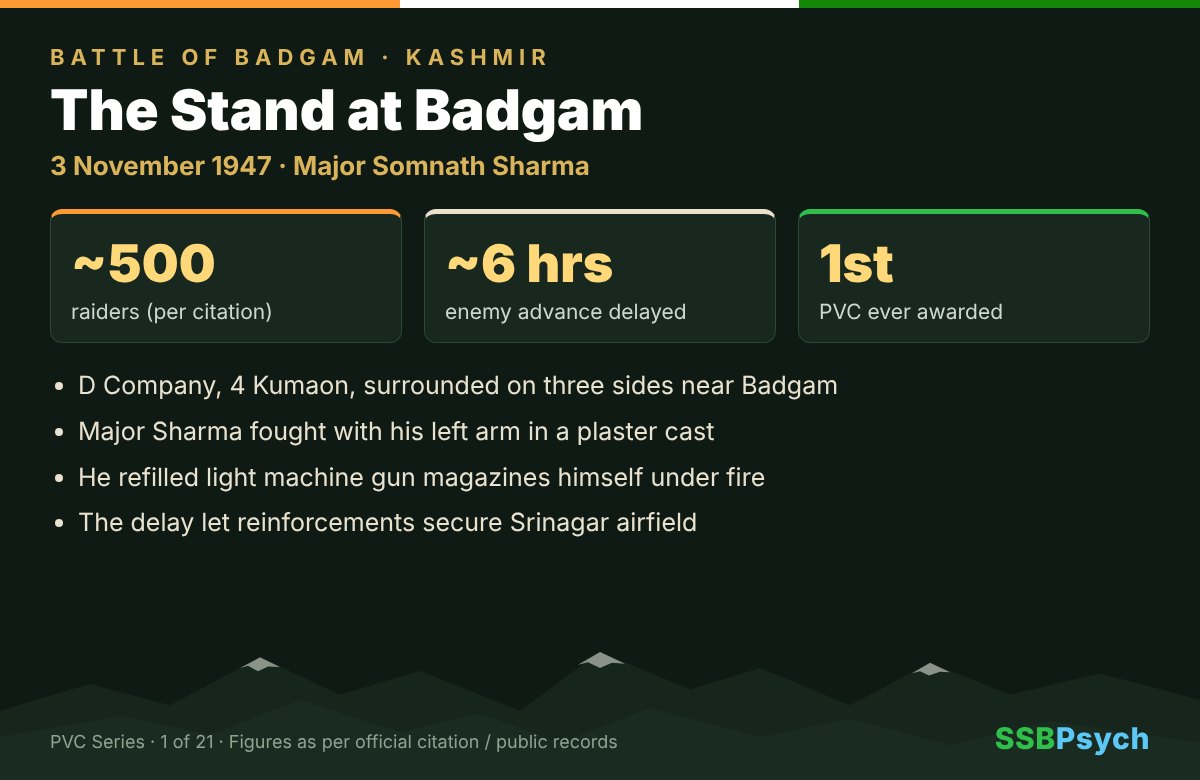
The odds against him were enormous. The official citation puts the enemy at about 500, and other accounts estimate even more, with the attackers outnumbering D Company by roughly seven to one. Major Sharma knew that if his company broke, the raiders would have an open path to the airfield.
Despite his plastered arm, he kept running from one trench to another under fire, encouraging his men and directing their fire. He also exposed himself in the open to lay out cloth strips that guided Indian aircraft onto the enemy positions. When casualties began to reduce the company’s firepower, he took on the job of filling magazines for the light machine gunners with his own hands, so that the guns would keep firing.
The Final Message
In his last report to brigade headquarters, Major Sharma made it clear that he would not withdraw. His message, as widely recounted, is one of the most famous lines in Indian military history:
The enemy are only 50 yards from us. We are heavily outnumbered. We are under devastating fire. I shall not withdraw an inch but will fight to our last man and our last round.
– Major Somnath Sharma, last message to brigade HQ, 3 November 1947 (as widely recounted)
Soon after this, a mortar bomb landed on a pile of ammunition close to him. The explosion killed him instantly. Along with Major Sharma, one junior commissioned officer and twenty other men of D Company gave their lives that day.
Why the Stand Mattered
By the time a relief company of 1 Kumaon reached Badgam, the position had been overrun. But the raiders had lost heavily, with around 200 casualties, and they had lost precious hours. That delay of about six hours gave India time to fly more troops into Srinagar airfield and close the approaches to the city. Military historians agree that the stand at Badgam played a key part in saving Srinagar and the airfield in those critical early days.
His body was found three days later. It was so badly damaged that it could only be identified by the leather holster of his pistol and a few pages of the Bhagavad Gita that he carried in his breast pocket, a moving reminder of the values his grandfather had taught him.
The Param Vir Chakra Citation
The Param Vir Chakra was instituted on 26 January 1950, and the first set of awards was published in the Gazette of India on 21 June 1950. Major Somnath Sharma’s name was the first on the list. In simple words, his citation says the following:
- His company was attacked by a raider force of about 500 near Badgam and was surrounded on three sides, under heavy mortar fire.
- He understood that if his position fell, both Srinagar and its airfield would be in danger.
- Under heavy fire, he kept going from post to post, encouraging his men to hold on, and exposed himself to lay out panels to guide aircraft onto the enemy.
- When his light machine gunners were hit, he helped fill their magazines himself, even though his arm was in plaster.
- He was killed by a mortar bomb, but his company held on long enough to delay the enemy for about six hours, allowing reinforcements to arrive.
- His leadership, gallantry and determined defence were described as an example rarely equalled in the history of the Indian Army.
A touching detail connects his family to the medal itself. The Param Vir Chakra was designed by Savitri Khanolkar, who was the mother-in-law of Major Sharma’s brother. The first medal of her design went to a member of the same extended family.
Legacy of Major Somnath Sharma
More than seven decades later, Major Somnath Sharma remains a symbol of selfless leadership. His legacy lives on in many ways:
- In 1984 the Shipping Corporation of India named a crude oil tanker MT Major Somnath Sharma, PVC in his honour; it served for about 25 years.
- His name is inscribed on the Balidan Stambh war memorial in Jammu along with other heroes of the Jammu and Kashmir operations.
- The 1988 Doordarshan series Param Vir Chakra opened with his story, with Farooq Sheikh playing him.
- His life has been told in graphic novels for young readers, including an Amar Chitra Katha story and a book by Major General Ian Cardozo.
- The Kumaon Regiment and 4 Kumaon remember the Battle of Badgam with great pride.
For a young officer, the most important part of his legacy is the way he chose to lead. He had a valid reason to stay behind, yet he went with his men. He could have fired into the houses at the first shot, yet he thought of the villagers. He could have withdrawn when surrounded, yet he understood that his small field was protecting the entire Valley. That clarity of purpose under pressure is exactly what the selection system looks for.
Lessons for SSB Aspirants: OLQs in Action
The SSB does not test whether you can recite history – it looks for the qualities of an officer. Here is how Major Somnath Sharma showed them:
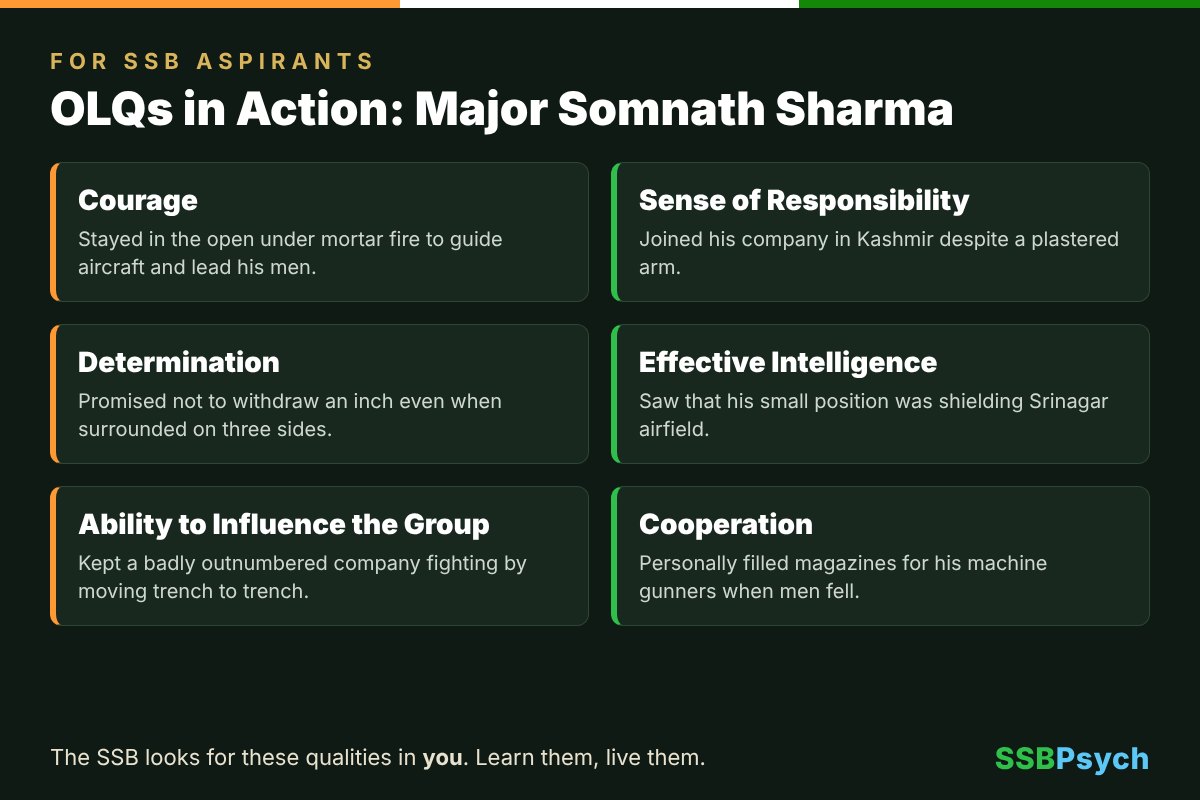
- Courage – Stayed in the open under mortar fire to guide aircraft and lead his men.
- Sense of Responsibility – Joined his company in Kashmir despite a plastered arm.
- Determination – Promised not to withdraw an inch even when surrounded on three sides.
- Effective Intelligence – Saw that his small position was shielding Srinagar airfield.
- Ability to Influence the Group – Kept a badly outnumbered company fighting by moving trench to trench.
- Cooperation – Personally filled magazines for his machine gunners when men fell.
Tip for your SSB interview: If the interviewing officer asks about a role model, do not just say ‘Major Somnath Sharma’. Explain one specific choice he made, such as going to Kashmir with a plastered arm, and link it to a real example of responsibility from your own life.
Practice Corner: WAT and SRT
Write your first spontaneous response to these before you scroll to the quiz. Keep WAT sentences short, positive and action-oriented.
WAT Words
- Duty
- Plaster
- Airfield
- Surrounded
- Last round
SRTs
- He is selected as team captain for an inter-college match but has a minor injury a day before. He…
- While leading a trekking group, he finds the group surrounded by bad weather and two members are scared. He…
- He is told to hold a position until a fixed time, but his friends suggest leaving early as nothing is happening. He…
Quiz: How Well Do You Know Major Somnath Sharma?
Test yourself! Click an option to see if you are right. Your score updates live.
Frequently Asked Questions
Who was the first Param Vir Chakra recipient?
Major Somnath Sharma of 4 Kumaon, awarded posthumously for his stand at Badgam on 3 November 1947. His award was the first PVC ever gazetted.
Why is the Battle of Badgam important?
His company delayed a large raider force for about six hours, which gave India time to fly in troops and secure Srinagar airfield and the city.
What was Major Somnath Sharma’s famous last message?
As widely recounted, he told headquarters that his company was heavily outnumbered but that he would not withdraw an inch and would fight to the last man and last round.
How old was Major Somnath Sharma when he died?
He was 24 years old. He was born on 31 January 1923 and died on 3 November 1947.
Is Major Somnath Sharma’s story useful for the SSB interview?
Yes. It is a clear example of responsibility, courage and leadership, and it is often discussed in GD, lecturettes and personal interviews.
The Param Vir Chakra Series on SSBPsych
This is part 1 of 21 in our series on every Param Vir Chakra awardee. A new hero goes live every morning at 7:30 AM. Also read the story of Captain Vikram Batra, PVC – the Sher Shah of Kargil.
Sources: en.wikipedia.org, en.wikipedia.org, www.esamskriti.com.
Preparing for your SSB? Join SSBPsych’s online and offline SSB batches and learn how to show your OLQs with confidence – explore our courses or call +91 8076540582.