Parachute Regiment: History, Para SF, Motto, Battles and Heroes
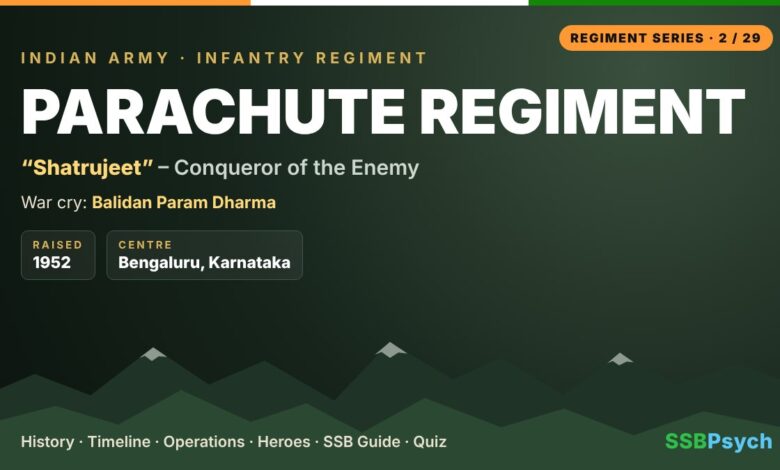
Few sights inspire young Indians like a soldier in a maroon beret. That beret belongs to the Parachute Regiment of the Indian Army, whose men jump from aircraft into battle and whose Special Forces battalions carry out some of the country’s most daring missions. Its motto is Shatrujeet, the Conqueror of the Enemy, and its war cry Balidan Param Dharma tells you how seriously its soldiers take their duty.
This guide for NDA, CDS, AFCAT, TES and SSB aspirants explains where the Parachute Regiment came from, how its airborne and Special Forces battalions differ, its major operations, its insignia, motto and war cry, its heroes, and what life in the regiment is really like. We end with SSB tips, likely interview questions and a 10-question quiz.
Parachute Regiment – Quick Facts
| Raised | 15 April 1952 as a regiment; airborne lineage from 1941 |
| Regimental Centre | Parachute Regiment Training Centre, Bengaluru, Karnataka |
| Motto | Shatrujeet (Conqueror of the Enemy) |
| War Cry | Balidan Param Dharma (Sacrifice is the Supreme Duty) |
| Headgear | Maroon beret |
| Recruitment | Volunteers from across the Army who pass para and probation tests |
| Battalion types | Airborne (Para) and Special Forces (Para SF) battalions, plus TA and RR units |
| Special Forces badge | Balidan badge, worn only by qualified Para SF personnel |
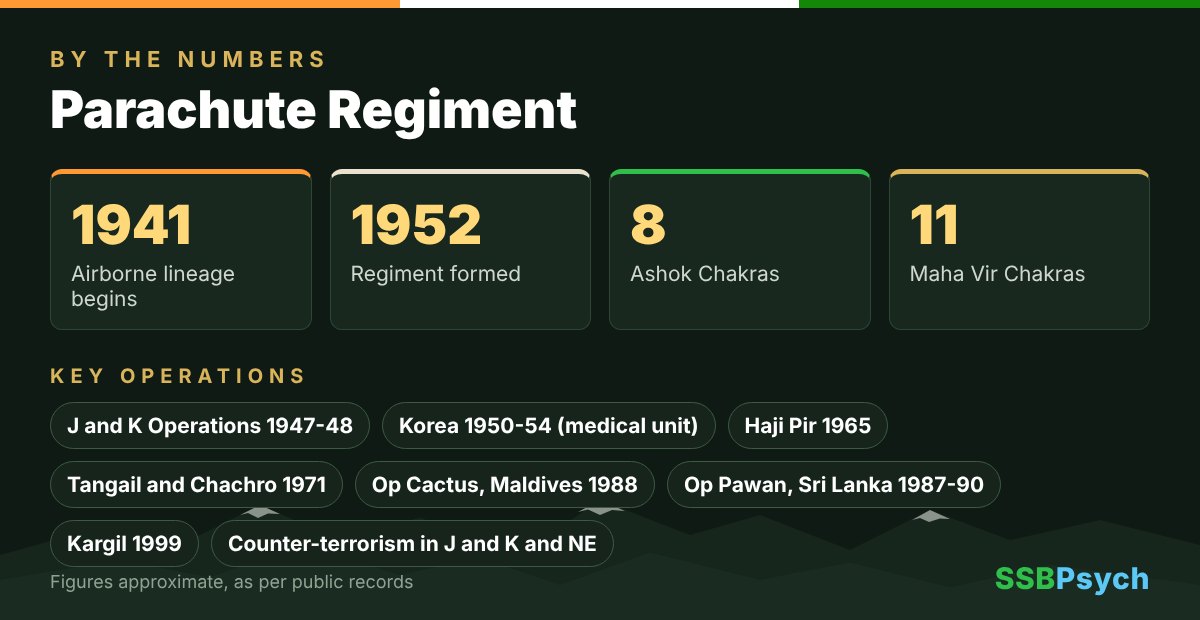
| Notable gallantry | Several Ashok Chakras and Maha Vir Chakras |
| Role | Airborne assault, special operations and counter-terrorism |
History of the Parachute Regiment
India’s airborne story began during the Second World War. On 29 October 1941, the British Indian Army raised the 50th Parachute Brigade, the first airborne formation of its kind in the subcontinent. Indian soldiers and officers volunteered for this new and risky way of fighting, learning to jump from aircraft and fight immediately on landing.
The brigade’s most famous early test came at Sangshak in Manipur in March 1944. Facing a much larger Japanese force advancing towards Imphal and Kohima, the paratroopers fought for several days and suffered very heavy losses before breaking out towards Imphal. Their stand bought precious time for the defence of Imphal and is remembered as one of the brigade’s proudest moments.
After Independence, the 50th Parachute Brigade fought in the Jammu and Kashmir operations of 1947-48. Under Brigadier Mohammad Usman, it fought at Jhangar and Naushera, and earned battle honours there and at Shelatang and Poonch. Brigadier Usman was killed in action on 3 July 1948 and was posthumously awarded the Maha Vir Chakra. During the Korean War, the 60th Parachute Field Ambulance served from 1950 to 1954 under Lt Col A. G. Rangaraj, treating thousands of wounded soldiers and civilians and earning wide respect for its work.
The Parachute Regiment as we know it today was formed on 15 April 1952. Three parachute battalions of the 50th Parachute Brigade came together: 1st Battalion Punjab Regiment became 1 Para, 3rd Battalion Maratha Light Infantry became 2 Para, and 1st Battalion Kumaon Regiment became 3 Para. More battalions followed over the years. The regiment’s training centre moved several times, from Agra to Gwalior and back, before settling in Bengaluru in the early 1990s.
The Birth of Para Special Forces
The 1965 war showed the need for small teams that could strike deep behind enemy lines. An improvised commando group of volunteers, led by Major Megh Singh, carried out raids during that war. Building on this experience, the Army raised 9 Para Commando at Gwalior on 1 July 1966, and 10 Para Commando was formed from it in 1967. These units later became known as Para (Special Forces).
Over the following decades, several existing Para battalions were converted to the Special Forces role, beginning with 1 Para from 1978-79, followed by others including 2, 3 and 4 Para in the 2000s. 21 Para (SF) joined in 1996 after being selected from the Maratha Light Infantry, and newer SF battalions were raised in later years. In 2022 some airborne battalions were also redesignated, so the exact list keeps evolving. What matters is this: Para SF is part of the Parachute Regiment, not a separate regiment, and all its men are volunteers who have passed a demanding selection.
Parachute Regiment Timeline: From Raising to Today
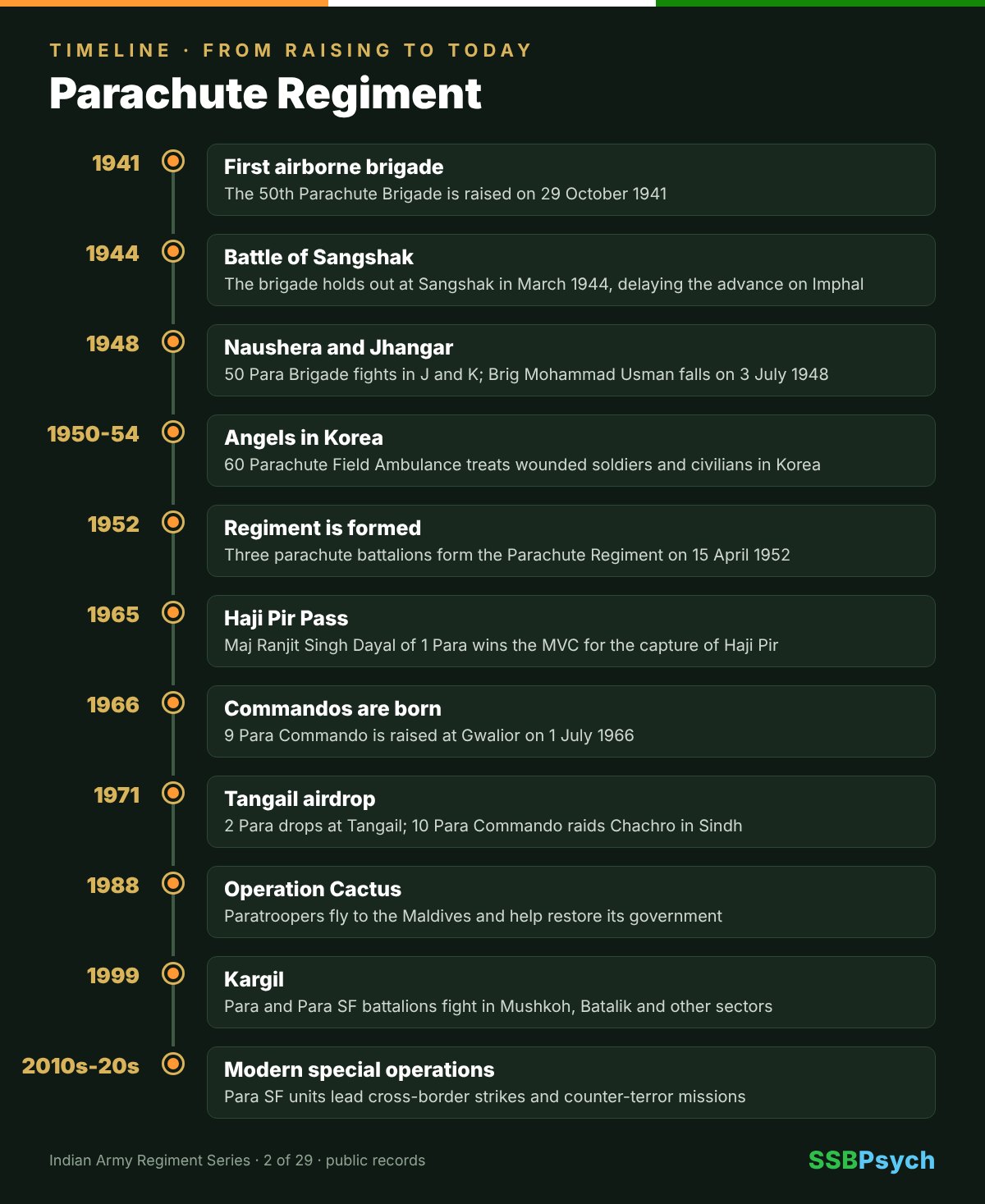
- 1941 – First airborne brigade: The 50th Parachute Brigade is raised on 29 October 1941
- 1944 – Battle of Sangshak: The brigade holds out at Sangshak in March 1944, delaying the advance on Imphal
- 1948 – Naushera and Jhangar: 50 Para Brigade fights in J and K; Brig Mohammad Usman falls on 3 July 1948
- 1950-54 – Angels in Korea: 60 Parachute Field Ambulance treats wounded soldiers and civilians in Korea
- 1952 – Regiment is formed: Three parachute battalions form the Parachute Regiment on 15 April 1952
- 1965 – Haji Pir Pass: Maj Ranjit Singh Dayal of 1 Para wins the MVC for the capture of Haji Pir
- 1966 – Commandos are born: 9 Para Commando is raised at Gwalior on 1 July 1966
- 1971 – Tangail airdrop: 2 Para drops at Tangail; 10 Para Commando raids Chachro in Sindh
- 1988 – Operation Cactus: Paratroopers fly to the Maldives and help restore its government
- 1999 – Kargil: Para and Para SF battalions fight in Mushkoh, Batalik and other sectors
- 2010s-20s – Modern special operations: Para SF units lead cross-border strikes and counter-terror missions
Major Operations and Battle Honours
Across these decades, the Parachute Regiment and its battalions have collected honours from the Second World War, the 1947-48 operations, the 1965 and 1971 wars, and the Kargil conflict, along with a large number of individual gallantry awards. The sections below look at the operations most often discussed by defence aspirants.
1965: Haji Pir Pass
In the 1965 war, 1 Para played a key role in capturing the strategic Haji Pir Pass in Jammu and Kashmir. Major Ranjit Singh Dayal led his men up difficult heights through the night to seize the pass, and he was awarded the Maha Vir Chakra. The capture was one of the most celebrated actions of that war.
1971: Tangail and Chachro
During the 1971 war, 2 Para was dropped at Tangail in what was then East Pakistan, the first airborne operation of independent India’s Army. The drop cut off retreating Pakistani troops, and elements of the battalion were among the first Indian troops to reach Dhaka. On the western front, 10 Para Commando under Lt Col Sawai Bhawani Singh raided deep into Sindh, reaching Chachro. He received the Maha Vir Chakra, and the regiment earned the Chachro battle honour.
Sri Lanka and the Maldives
Para battalions served with the Indian Peace Keeping Force in Sri Lanka during Operation Pawan from 1987, including a difficult helicopter-borne operation at Jaffna University. In November 1988, under Operation Cactus, Indian paratroopers flew to the Maldives at very short notice after a coup attempt, secured the airport and helped restore the legitimate government within hours.
Kargil and Beyond
In the Kargil War of 1999, most of the regiment’s battalions were deployed. Para units fought in the Mushkoh Valley and the Batalik sector, while Para SF teams carried out tasks on difficult ridgelines. In 2000, Indian Special Forces took part in Operation Khukri in Sierra Leone, rescuing Indian peacekeepers who had been surrounded. In 2015, 21 Para (SF) carried out a cross-border strike against insurgent camps along the Myanmar border, and in September 2016 Para SF teams were reported to have crossed the Line of Control to destroy terrorist launch pads.
Parachute Regiment Insignia, Motto and War Cry
Paratroopers wear para wings on their uniform after completing the basic parachute course, a mark that every man in the regiment has jumped from an aircraft. Their famous maroon beret is shared with airborne troops in many armies around the world, and Sikh personnel of the regiment wear a maroon turban. For many young soldiers, earning the right to wear this beret is the proudest day of their service.
Para SF soldiers wear an additional badge called the Balidan badge, which means badge of sacrifice. It can be earned only after completing Special Forces training and proving oneself in operations, so it is one of the most respected badges in the Army.
The motto Shatrujeet means Conqueror of the Enemy. The war cry Balidan Param Dharma means Sacrifice is the Supreme Duty. Together they express the paratrooper’s attitude: go in first, fight against the odds, and put the mission before oneself.
Heroes of the Parachute Regiment
- Brigadier Mohammad Usman, Maha Vir Chakra (posthumous) – commander of 50 Para Brigade, killed in action on 3 July 1948 in J and K.
- Major Ranjit Singh Dayal, Maha Vir Chakra – 1 Para, capture of Haji Pir Pass, 1965.
- Lt Col Sawai Bhawani Singh, Maha Vir Chakra – commanded 10 Para Commando in the 1971 raid on Chachro.
- Captain Arun Singh Jasrotia, Ashok Chakra (posthumous) – 9 Para Commando, counter-terrorist operation in J and K.
- Captain Harshan R, Ashok Chakra (posthumous) – 2 Para (SF), counter-terrorist operation in J and K, 2007.
- Major Mohit Sharma, Ashok Chakra (posthumous) – 1 Para (SF), counter-terrorist operation in Kupwara, 2009.
- Lance Naik Mohan Nath Goswami, Ashok Chakra (posthumous) – 9 Para (SF), counter-terrorist operations in J and K.
- Colonel Avtar Singh Cheema – Para officer and the first Indian to stand on top of Mount Everest, in 1965.
Many of the regiment’s Ashok Chakras were won by young officers and soldiers of Para SF in counter-terrorist operations. Their stories show that peacetime gallantry awards can demand the same supreme courage as war.
Role and Life in the Parachute Regiment
The regiment has two broad kinds of battalions. Airborne (Para) battalions are trained to drop by parachute and seize key objectives such as bridges, airfields and passes ahead of the main army. Special Forces (Para SF) battalions work in small teams for deep raids, hostage rescue, counter-terrorism and other high-risk missions. Both also serve in regular infantry roles on the borders and in counter-insurgency.
Everyone in the regiment is a volunteer. Soldiers and officers must first pass a probation period that tests their fitness, endurance and mental strength, and complete the basic parachute course at Agra, which includes training jumps from aircraft. Those who volunteer for Para SF face a further, much tougher probation of about three months, with long marches, little sleep, stress tests and weapons training. Only a small share of volunteers succeed.
Paratroopers also work closely with the Indian Air Force, which flies the transport aircraft and helicopters they jump from. Planning a drop means studying weather, terrain, aircraft loads and timings in fine detail, so officers of the regiment quickly learn to think about operations from more than one service’s point of view.
Once in, life involves constant training: free-fall and combat jumps, mountain and jungle warfare, diving for some teams, and close-quarter battle skills. The pace is demanding, but the pride of wearing the maroon beret keeps the regiment’s morale famously high. The regiment also has a strong tradition in adventure sports and mountaineering.
Why the Parachute Regiment Matters for SSB Aspirants
Many candidates tell the SSB board that they want to join Para SF. That is a fine ambition, but the board will look for maturity and knowledge, not just excitement. Know that you cannot join Para SF directly from an academy as a guaranteed choice; you join the Army, perform well, and then volunteer and pass the probation. Showing that you understand this, and that you are ready to work hard for it, makes a much better impression than dramatic claims.
The regiment’s history also offers excellent material for group discussions. Topics such as the role of Special Forces in modern warfare, cross-border strikes and deterrence, India’s help to neighbouring countries in crises, and the importance of joint operations with the Air Force can all be supported with examples from the Parachute Regiment. Operation Cactus, for example, shows how speed and coordination between the Army and the Air Force allowed India to act within hours. The Tangail airdrop shows how airborne forces can change the course of a campaign. Use such examples briefly and accurately, and always link them back to the larger point you are making.
Parachute Regiment for SSB Candidates: What You Should Know
How officers join
- Officers enter the Army through NDA, the IMA (via CDS, TES or TGC) or the OTA Chennai (Short Service Commission) after clearing the SSB and medicals.
- Arm and regiment allotment happens during academy training, based on choice, merit and vacancies; a Para posting is never guaranteed.
- Officers from other units can also volunteer for the Parachute Regiment and must pass its probation and the basic parachute course.
- Para SF requires a further volunteer selection and a tough probation of about three months.
How soldiers join
- Since 2022, soldiers join the Army through the Agnipath scheme as Agniveers; the regiment’s soldiers come from across India.
- Soldiers volunteer for para duty and must pass physical and mental probation before joining a battalion.
- Those aiming for Para SF must clear an additional, much harder selection.
Questions you may face in the SSB interview, GD or lecturette
- Why do you want to join the Parachute Regiment or Para SF?
- What is the difference between a Para battalion and a Para SF battalion?
- Tell us about the Tangail airdrop of 1971.
- What was Operation Cactus and why was it important for India?
- How do you prepare yourself physically and mentally for a demanding unit?
SSBPsych tip: If you mention Para SF in your SSB interview, back it with a real fitness routine you follow and an honest understanding of the volunteer probation; boards value grounded ambition over bravado.
The Parachute Regiment’s history is full of stories that can strengthen your lecturettes and group discussions, from Sangshak to Tangail and Operation Cactus. Learn a few of them accurately, then test yourself with the quiz below.
Quiz: How Well Do You Know the Parachute Regiment?
Test yourself! Click an option to see if you are right. Your score updates live.
Parachute Regiment: Frequently Asked Questions
The motto is Shatrujeet, meaning Conqueror of the Enemy.
The Parachute Regiment Training Centre is in Bengaluru, Karnataka.
No. Para (Special Forces) battalions are part of the Parachute Regiment. Their personnel are volunteers who pass a separate, very tough selection and probation.
The war cry is Balidan Param Dharma, meaning Sacrifice is the Supreme Duty.
Join the Army through NDA, CDS, TES or SSC entries after the SSB. You may be allotted to the regiment or volunteer later, and you must pass its probation and the basic parachute course.
Indian Army Regiments Series on SSBPsych
This is part 2 of 29 in our series on every infantry regiment of the Indian Army – a new regiment every day at 11 AM. Previous in the series: Brigade of the Guards. Also follow our Param Vir Chakra series.
Sources: en.wikipedia.org, en.wikipedia.org, en.wikipedia.org, aviation-defence-universe.com.
Preparing for NDA, CDS, AFCAT or your SSB? Join SSBPsych’s online and offline batches – explore our courses or call +91 8076540582.