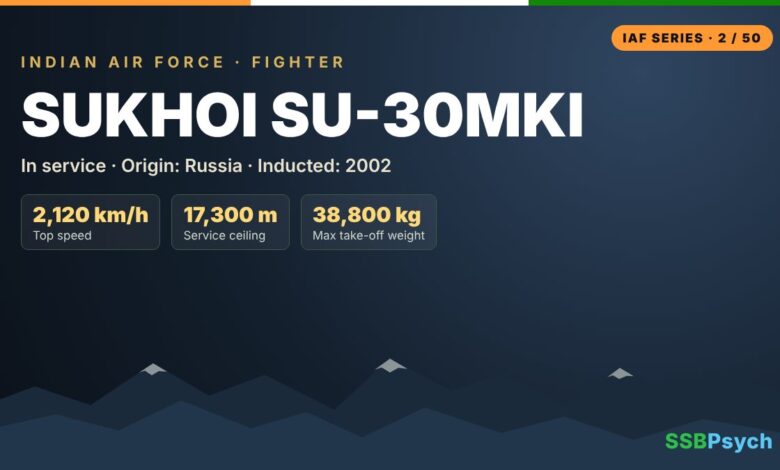
Su-30MKI in Indian Air Force: Specs, BrahMos, Speed, History
If the Indian Air Force had a backbone, it would be shaped like the Su-30MKI. With around 260 of these big, powerful fighters in service, the “Sukhoi” is the most numerous combat jet in the IAF and the aircraft that guards India’s skies from Ladakh to the Andaman Sea. It can climb twice as high as Mount Everest, fly at twice the speed of sound and launch the mighty BrahMos missile.
In this guide we explain the Su-30MKI in simple words: its full specifications, what makes it so agile, the weapons it carries, its history in the IAF, the missions it has flown, where it is based and the big “Super Sukhoi” upgrade on the way. Finish with the 10-question quiz and FAQ to test yourself before your AFCAT, CDS, NDA or SSB interview.

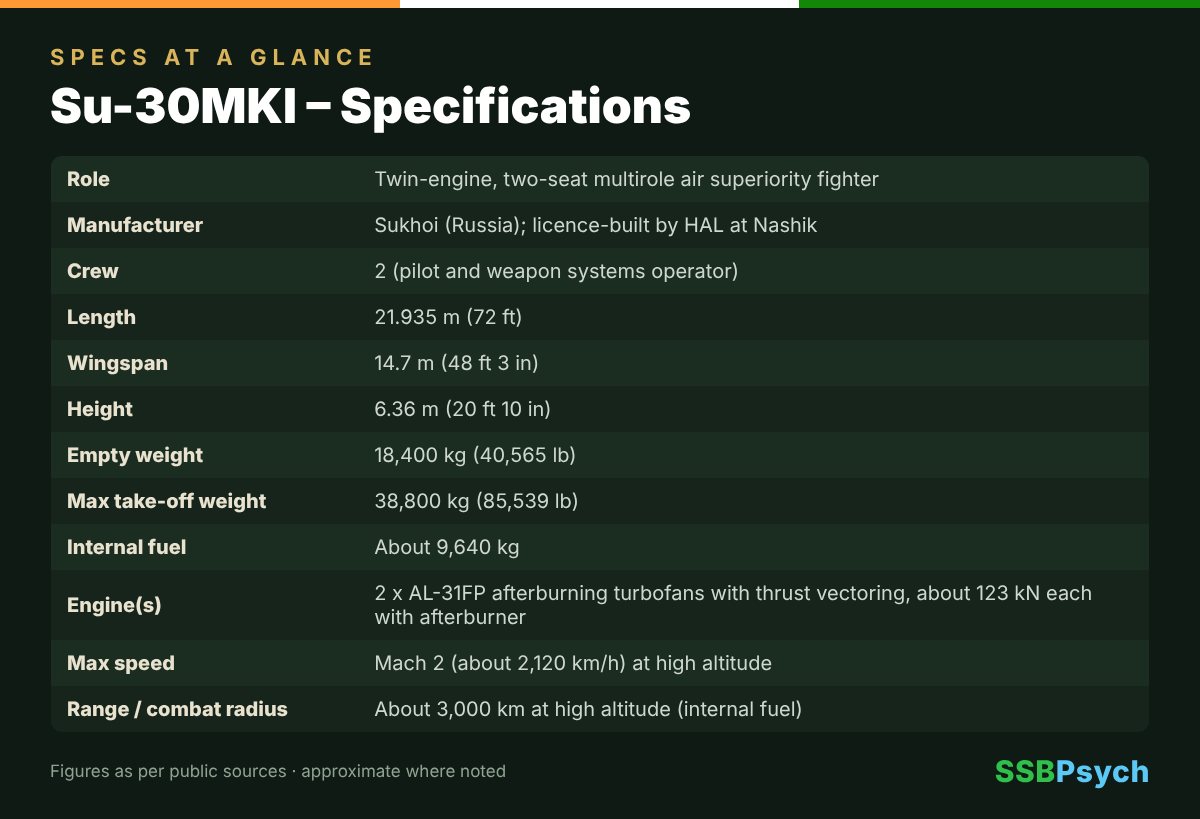
Su-30MKI Specifications
| Role | Twin-engine, two-seat multirole air superiority fighter |
| Manufacturer | Sukhoi (Russia); licence-built by HAL at Nashik |
| Crew | 2 (pilot and weapon systems operator) |
| Length | 21.935 m (72 ft) |
| Wingspan | 14.7 m (48 ft 3 in) |
| Height | 6.36 m (20 ft 10 in) |
| Empty weight | 18,400 kg (40,565 lb) |
| Max take-off weight | 38,800 kg (85,539 lb) |
| Internal fuel | About 9,640 kg |
| Engine(s) | 2 x AL-31FP afterburning turbofans with thrust vectoring, about 123 kN each with afterburner |
| Max speed | Mach 2 (about 2,120 km/h) at high altitude |
| Range / combat radius | About 3,000 km at high altitude (internal fuel) |
| Service ceiling | 17,300 m (56,800 ft) |
| Hardpoints | 12, carrying up to about 8,000 kg of weapons |
| First flight | 1 July 1997 (Su-30MK prototype) |
| Inducted in IAF | 27 September 2002 |
| Number in IAF | About 260 in service; 12 more ordered in 2024 |
What Is the Su-30MKI?
The Su-30MKI is a two-seat, twin-engine fighter developed by Russia’s Sukhoi design bureau specially for India, based on the famous Su-27 “Flanker” family. The letters MKI stand for Modernizirovannyi Kommercheskiy Indiyskiy, roughly “Modernised Commercial for India”. NATO calls the type “Flanker-H”.
What makes the MKI special is its mix of the best from many countries. The airframe and engines are Russian, but the jet carries Indian, French and Israeli electronics and is built under licence in India by Hindustan Aeronautics Limited (HAL). It has small extra wings near the nose called canards, and engine nozzles that can swivel, called thrust vectoring. Together they let the jet twist, turn and point its nose in ways normal fighters cannot. This is called super-manoeuvrability, and it makes the Sukhoi a crowd favourite at air shows.
In its nose sits the Bars radar, a passive electronically scanned array that can track several targets at once and guide missiles at more than one of them. Think of it as a powerful searchlight that never switches off, except it uses radio waves instead of light and can see enemy jets long before the pilot could spot them with the naked eye. Add a targeting pod, an electronic jammer and chaff and flares for self-defence, and the Sukhoi becomes a flying command post as much as a fighter.
Why India Needed the Su-30MKI
In the 1990s, the IAF needed a long-range fighter that could fly deep, carry heavy loads and beat any enemy jet in the air. Most Indian fighters of that era, like the MiG-21, had short legs and small weapon loads. India chose the Sukhoi family and signed its first deal with Russia in 1996. The plan grew step by step, from buying ready jets to building them at home, until the IAF had ordered 272 Su-30MKIs.
History of the Su-30MKI in the IAF
The story began with the simpler Su-30K. The first eight arrived in kits at Lohegaon (Pune) and joined No. 24 Squadron, the “Hawks”, on 11 June 1997. These early jets were later retired. The true MKI arrived on 27 September 2002, when the first ten joined No. 20 Squadron, the “Lightnings”, at Pune.
Under a 2000 agreement with Russia, India received full technology transfer, and HAL set up an assembly line at its Nashik division in Maharashtra, while HAL’s Koraput division builds the AL-31FP engines. HAL handed over its first locally built Su-30MKI on 29 November 2004. Over the next decade and a half, Nashik rolled out jet after jet, and squadrons across India converted to the Sukhoi.
The jet earned global attention in 2004, when IAF fighters, including Sukhois, did surprisingly well against US Air Force F-15s in Exercise Cope India. In 2017 it became the launch platform for the air version of BrahMos, and in 2020 the IAF raised No. 222 Squadron, the “Tigersharks”, at Thanjavur, armed with BrahMos-carrying Sukhois to guard the Indian Ocean. On 12 December 2024, the Ministry of Defence signed a contract with HAL for 12 more Su-30MKIs, worth about Rs 13,500 crore, with 62.6 per cent indigenous content, to replace jets lost over the years.
Engine and Performance Explained Simply
The Su-30MKI has two AL-31FP turbofan engines, each producing about 123 kilonewtons of thrust with afterburner. To picture it, together they push harder than the weight of many loaded trucks. The “P” in AL-31FP stands for the swivelling nozzles that give the jet its thrust vectoring, like a rocket that can steer by pointing its flame.
Top speed: About Mach 2, or 2,120 km/h at high altitude. Mach 1 is the speed of sound, so Mach 2 is twice that. A bullet train running at 320 km/h is more than six times slower. At low level, where the air is thick, it can still touch about 1,350 km/h.
Service ceiling: The service ceiling is the highest height where a jet can still fly and climb usefully. For the Sukhoi it is 17,300 metres (56,800 feet), almost twice the height of Mount Everest. From up there, the curve of the Earth starts to show.
Fuel and range: The Sukhoi carries close to 9.6 tonnes of fuel inside, more than many small fighters weigh empty. That gives it a range of about 3,000 km at high altitude, roughly the distance from Kashmir to Kanyakumari, and it can be refuelled in mid-air by IAF tankers to go much further.
Size and weight: At almost 22 metres long, the Su-30MKI is as long as about five hatchback cars in a line. It weighs 18.4 tonnes empty and up to 38.8 tonnes at take-off, so the jet can lift roughly its own empty weight again in fuel and weapons. “Payload” is the word for that useful load: missiles, bombs, pods and fuel tanks.
Weapons and Missiles
- BrahMos-A supersonic cruise missile
- Astra Mk1 beyond-visual-range air-to-air missile (Indian, DRDO)
- R-77 beyond-visual-range air-to-air missile
- R-73 close-combat air-to-air missile
- R-27 medium-range air-to-air missile
- KAB-500L and KAB-1500L laser-guided bombs
- Sudarshan laser-guided bomb kit (Indian)
- 30 mm GSh-30-1 internal cannon
The headline weapon is the BrahMos-A, the air-launched version of the Indo-Russian supersonic cruise missile. It is heavy, around 2.5 tonnes, so the Sukhoi carries one under its belly. For air combat, the jet carries the Indian Astra and Russian R-77 for long-range fights, the R-73 for close dogfights, plus a 30 mm cannon. For ground attack it uses laser-guided bombs, including India’s own Sudarshan kit.
Su-30MKI Missions and Operations
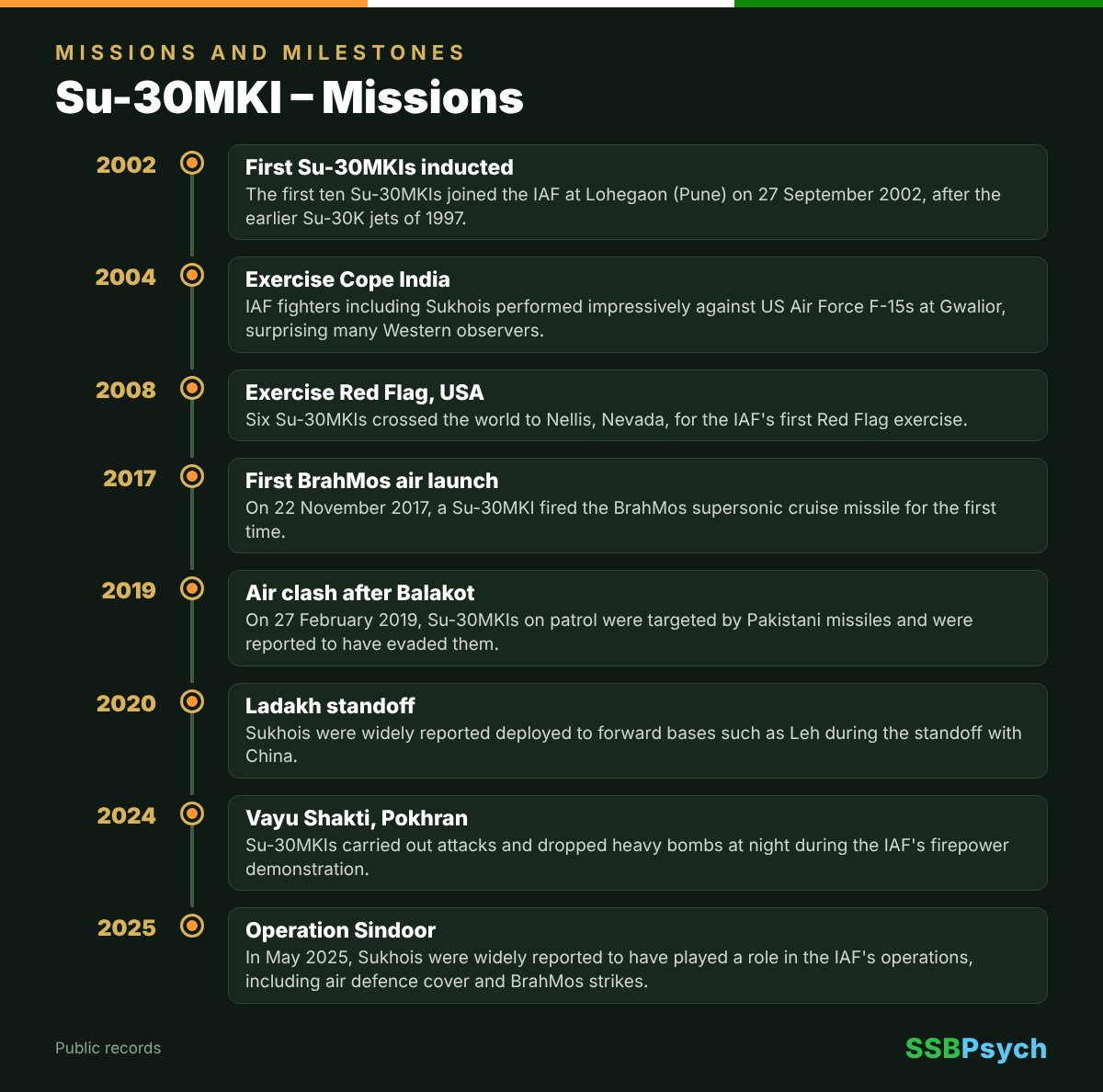
- 2002 – First Su-30MKIs inducted: The first ten Su-30MKIs joined the IAF at Lohegaon (Pune) on 27 September 2002, after the earlier Su-30K jets of 1997.
- 2004 – Exercise Cope India: IAF fighters including Sukhois performed impressively against US Air Force F-15s at Gwalior, surprising many Western observers.
- 2008 – Exercise Red Flag, USA: Six Su-30MKIs crossed the world to Nellis, Nevada, for the IAF’s first Red Flag exercise.
- 2017 – First BrahMos air launch: On 22 November 2017, a Su-30MKI fired the BrahMos supersonic cruise missile for the first time.
- 2019 – Air clash after Balakot: On 27 February 2019, Su-30MKIs on patrol were targeted by Pakistani missiles and were reported to have evaded them.
- 2020 – Ladakh standoff: Sukhois were widely reported deployed to forward bases such as Leh during the standoff with China.
- 2024 – Vayu Shakti, Pokhran: Su-30MKIs carried out attacks and dropped heavy bombs at night during the IAF’s firepower demonstration.
- 2025 – Operation Sindoor: In May 2025, Sukhois were widely reported to have played a role in the IAF’s operations, including air defence cover and BrahMos strikes.
Two of these moments deserve special mention. At Red Flag in 2008, held in the Nevada desert, Indian crews flew alongside and against some of the world’s best-trained pilots and returned with valuable lessons on large, complex air battles. And on 27 February 2019, a day after the Balakot air strike, Sukhoi crews on combat air patrol found themselves facing long-range missiles fired by Pakistani fighters. The IAF said the Sukhois manoeuvred and used their electronic systems to defeat the incoming missiles, a real-life test of the jet’s agility and self-protection.

Where the Su-30MKI Is Based and Who Flies It
Because it is the IAF’s most common fighter, the Sukhoi flies from many bases. Publicly reported Su-30MKI bases include Pune (Lohegaon), Bareilly, Jodhpur, Sirsa, Halwara, Gwalior and Uttarlai in the west and north, Tezpur and Chabua in the north-east, and Thanjavur in the south, home of the BrahMos-armed “Tigersharks”. This spread lets the IAF cover both western and eastern borders and the sea.
A Sukhoi squadron is usually commanded by a Wing Commander, with Squadron Leaders as flight commanders and Flight Lieutenants and Flying Officers as line pilots and weapon systems operators. The rear-seat officer, often called the WSO, manages radar, weapons and electronic warfare so the pilot can focus on flying. Air Force Stations are usually led by an Air Commodore or Group Captain.
Working as a two-person crew is a skill of its own. The pilot and the WSO must trust each other completely and communicate in short, clear calls while pulling heavy g-forces, often at night or in bad weather. This kind of teamwork, calm communication and quick decision-making is exactly what SSB assessors look for in group tasks and interviews.
Future Sukhoi pilots join the flying branch through NDA, CDS or AFCAT. At the Air Force Academy, Dundigal, and other training units they progress broadly from basic trainers like the Pilatus PC-7 Mk II to jet trainers like the Kiran and the Hawk, and are commissioned after roughly one and a half to two years. They then go through more conversion training before joining a frontline squadron like a Sukhoi unit.
Strengths and Limitations of the Su-30MKI
- Strength: Huge range and a big weapon load, so it can strike deep without many tankers.
- Strength: Thrust vectoring and canards make it extremely agile in a close dogfight.
- Strength: Two crew members share the workload on long, complex missions.
- Strength: Built in India, so HAL can support the fleet at home, and it carries the BrahMos.
- Limitation: Its large size gives a big radar signature, so enemy radars can spot it more easily.
- Limitation: Many of its sensors and electronics are now ageing and need modernisation.
- Limitation: Some parts still come from Russia, which can cause spare-part delays.
Future of the Su-30MKI: The Super Sukhoi Upgrade
The IAF plans to keep the Sukhoi flying for decades through a major upgrade often called “Super Sukhoi”. In November 2023 the government gave initial approval for the programme. Planned changes include an Indian-made AESA radar, a new indigenous electronic warfare suite, a modern cockpit and integration of newer weapons like longer-range BrahMos and Astra missiles. HAL is also building 240 new AL-31FP engines for the fleet.
Together with the 12 new jets from Nashik, the upgrade aims to keep the Su-30MKI as the IAF’s workhorse well into the 2050s, while newer aircraft like the Tejas Mk1A, Rafale and the future AMCA stealth fighter join the fleet.
Why the Su-30MKI Matters for SSB and AFCAT Aspirants
The Su-30MKI is the jet you are most likely to see at an IAF base, air show or Republic Day flypast, and it is a favourite topic in AFCAT, CDS and NDA general knowledge. At the SSB, it is excellent material for lecturettes on air power or “Make in India” in defence, because it shows how India moved from buying jets to building them. Knowing facts like “BrahMos on Sukhoi” or “built at HAL Nashik” shows you follow your future service closely.
Did You Know?
- The IAF ordered 272 Su-30MKIs, its largest fighter fleet.
- The first Su-30MKIs joined the IAF on 27 September 2002 at Pune.
- HAL builds the jets at Nashik and the AL-31FP engines at Koraput.
- A Su-30MKI fired the air-launched BrahMos for the first time on 22 November 2017.
- No. 222 Squadron “Tigersharks” at Thanjavur flies BrahMos-armed Sukhois.
- Its service ceiling of 17,300 m is almost twice the height of Mount Everest.
- Six Su-30MKIs took part in the IAF’s first Red Flag exercise in the USA in 2008.
Quiz: Test Your Knowledge of Su-30MKI
Click an option to see if you are right. Your score updates live.
Su-30MKI: Frequently Asked Questions
The Su-30MKI can fly at about Mach 2, or around 2,120 km/h at high altitude. At low altitude its top speed is about 1,350 km/h.
India ordered 272 Su-30MKIs, and about 260 are in service. Twelve more were ordered from HAL in December 2024.
It was designed by Sukhoi of Russia and is built under licence by HAL at Nashik, with engines made at HAL Koraput.
Yes. A Su-30MKI first fired the air-launched BrahMos on 22 November 2017, and specially modified Sukhois carry it in service.
Super Sukhoi is a planned upgrade that would give the jets an Indian AESA radar, a new electronic warfare suite, a modern cockpit and newer weapons.
This is part 2 of 50 in SSBPsych’s Indian Air Force aircraft series – a new aircraft every evening at 6 PM.
Sources: en.wikipedia.org, bharat-rakshak.com, globalsecurity.org, etvbharat.com.
Preparing for NDA, CDS, AFCAT or your SSB? Join SSBPsych’s online and offline batches – explore our courses or call +91 8076540582.