Naik Jadunath Singh, PVC: The Hero of Taindhar, Naushera 1948 – Full Story (with Quiz)
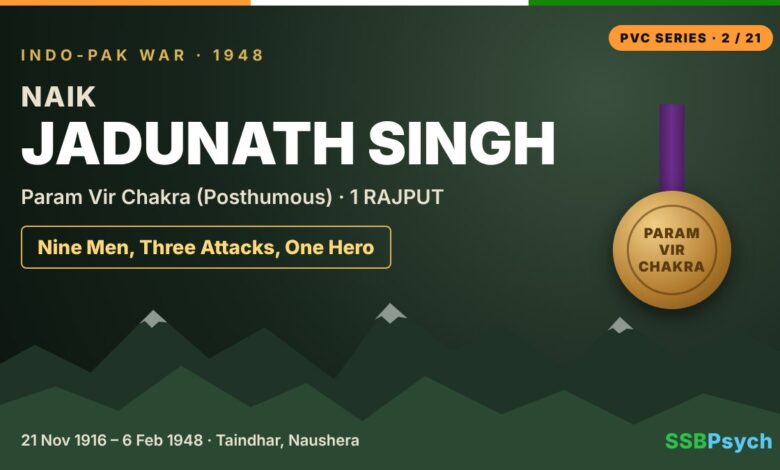
At dawn on 6 February 1948, a thick fog lay over the ridge of Taindhar, north of the town of Naushera in Jammu and Kashmir. Hidden in that fog, a large enemy force was creeping up towards a tiny forward post held by just nine Indian soldiers. Their section commander was a quiet, deeply religious wrestler from Uttar Pradesh who had never married and who was known in his village as a devotee of Lord Hanuman. By the end of that morning, Naik Jadunath Singh of the 1st Battalion, The Rajput Regiment, had beaten back three attacks, charged the enemy alone, and earned the Param Vir Chakra at the cost of his life.
If you are preparing for the NDA, CDS, AFCAT or SSB, his story is worth knowing in detail. It shows how leadership is not only about rank. A Naik commanding a section can change the course of a battle through courage and clear thinking. In this post you will learn about his early life, his Army career, the fight for Naushera, the action at Taindhar, his citation in simple words and his legacy. A 10-question quiz, WAT words and SRT situations follow at the end.
Naik Jadunath Singh – Quick Facts
| Full name | Naik Jadunath Singh |
| Born | 21 November 1916, Khajuri village, Shahjahanpur, Uttar Pradesh |
| Parents | Birbal Singh Rathore (farmer) and Jamuna Kanwar |
| Enlisted | 21 November 1941, Rajput Regiment (Fatehgarh) |
| Unit | 1st Battalion, The Rajput Regiment (1 Rajput) |
| Battle | Defence of Taindhar, Naushera sector, Jammu and Kashmir |
| Date of action | 6 February 1948 |
| Post strength | Nine men |
| Died | 6 February 1948, Taindhar (aged 31) |
| Award | Param Vir Chakra (Posthumous) |
| Earlier service | Burma (Arakan) campaign, Second World War |
Early Life in Shahjahanpur
Jadunath Singh was born on 21 November 1916 in Khajuri, a village in the Shahjahanpur district of Uttar Pradesh. He belonged to a Rathore Rajput family. His father, Birbal Singh Rathore, was a farmer and his mother was Jamuna Kanwar. He was the third of eight children, with six brothers and one sister.
Money was always short at home. Jadunath studied up to the fourth class at the village school and then had to leave so that he could work on the family farm. Hard physical work made him strong, and he became the wrestling champion of his village. He was known for his good character and his devotion to Lord Hanuman. Because he chose not to marry, people affectionately called him Hanuman Bhagat Bal Brahmachari. Simplicity, self-discipline and faith were the foundations of his personality.
Joining the Army
On 21 November 1941, his 25th birthday, Jadunath Singh enlisted in the British Indian Army at the Fatehgarh regimental centre of the Rajput Regiment. After training he was posted to the regiment’s 1st Battalion.
Service in Burma
Late in 1942 his battalion was sent to the Arakan region of Burma to fight the Japanese. It formed part of the 47th Indian Infantry Brigade. The fighting around the Mayu Range and Donbaik was part of an effort to recapture Akyab Island. In April 1943 Japanese counter-attacks cut off the brigade, and the survivors had to fight their way back in small groups through the jungle. This was a tough school for a young soldier, teaching him how to fight when cut off and outnumbered.
In 1945 the battalion was sent to the Andaman and Nicobar Islands, where the Japanese garrison surrendered later that year. After returning to India, Jadunath Singh was promoted to Naik, the rank at which he would lead a section of about ten men. When India was partitioned in 1947, the Rajput Regiment was allotted to India and he stayed with 1 Rajput.
Background: The Battle for Naushera
After raiders and Pakistani forces entered Jammu and Kashmir in October 1947, the fighting spread to the Jammu region. Naushera was an important town on the route to Poonch and Rajouri. On 24 December 1947, the enemy captured the nearby position of Jhangar, which was a serious setback for India. The next target was clearly Naushera.
The defence of Naushera was the task of the 50th Parachute Brigade, commanded by Brigadier Mohammad Usman, and 1 Rajput was one of its battalions. The battalion held a series of pickets, or small defensive posts, on the ridges around Taindhar, north of Naushera. These pickets were the eyes and the shield of the town. If they fell, the enemy could look down on and attack Naushera itself.
The Action at Taindhar: 6 February 1948
The Fog Attack
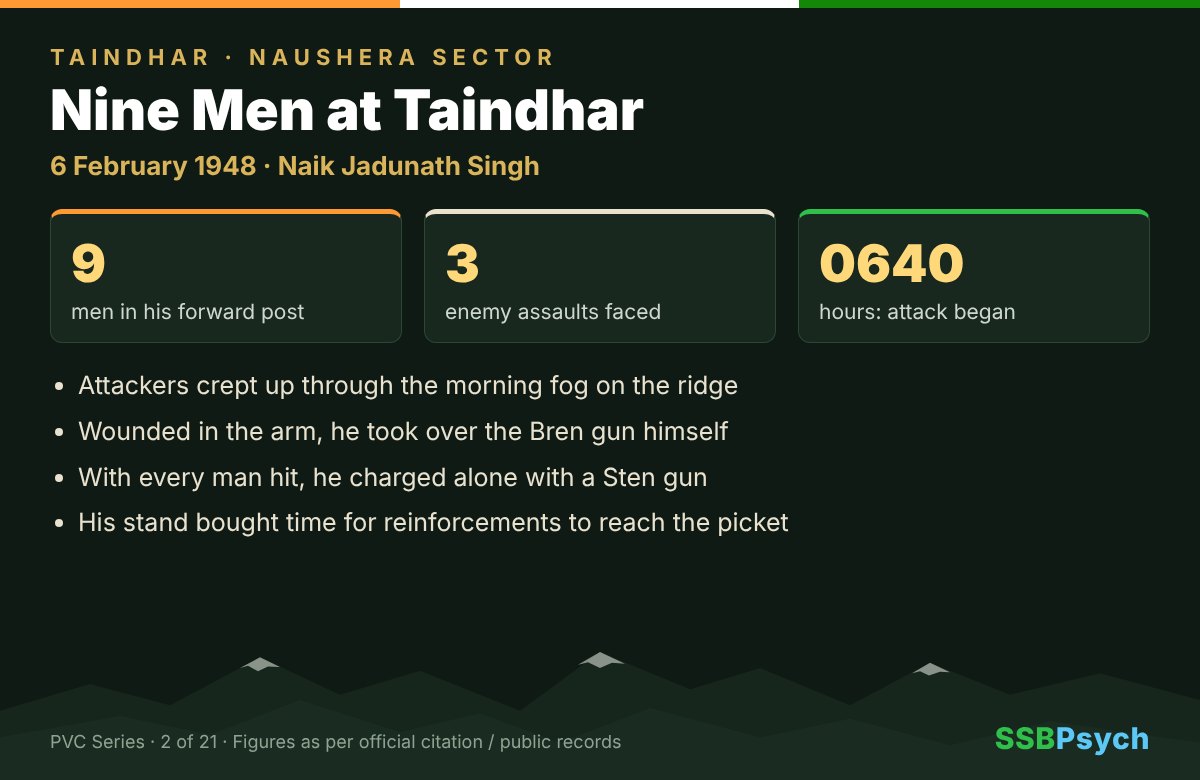
At about 6:40 in the morning on 6 February 1948, the enemy opened fire on the pickets of 1 Rajput along the Taindhar ridge. Under the cover of darkness and fog, a large force had moved very close to the Indian positions without being seen. Naik Jadunath Singh was commanding the forward section post of one of these pickets. He had only nine men with him.
The First Attack
The enemy rushed the post in great numbers. Jadunath Singh placed his men so well, and controlled their fire so calmly, that the attackers were driven back in confusion. Four of his nine men were wounded. Without wasting a moment, he reorganised the post, moved men to where they were most needed and prepared for the next wave.
The Second Attack
The second attack came quickly and with even greater force. By now his Bren gunner had been wounded. Jadunath Singh, himself hit in the right arm, took over the Bren light machine gun personally and kept up such accurate fire that the enemy reached the very edge of the post but could not get in. Once again the attack broke. However, by the end of this fight, every man in the post, including the section commander, had been wounded.
The Third Attack and the Final Charge
The enemy gathered for a third assault. Jadunath Singh, bleeding and alone in fighting condition, made a decision that would define his place in history. Instead of waiting for the enemy to overrun his trench, he came out of his sangar (a stone-walled fighting position) with a Sten gun and charged straight at the attackers. His sudden, fierce charge surprised them, and they fled in disorder.
During this charge he was hit by two bullets, one in the head and one in the chest, and he fell dead on the ridge he had defended. He was 31 years old.
The Result
His stand did much more than save one small post. The time he bought allowed a company of the 3rd (Para) Battalion of the Rajput Regiment to reach the picket and reinforce it. Historians who have studied the battle point out that without his resistance, holding or regaining these pickets would have been extremely difficult. The defence of Naushera held, and the battle on 6 February 1948 became one of the important Indian victories of that war.
The Param Vir Chakra Citation
Naik Jadunath Singh was awarded the Param Vir Chakra after his death. Explained in simple words, his citation records these points:
- He was commanding a forward section post of nine men at Taindhar when a large enemy force attacked in waves.
- In the first attack he handled his small force so skilfully that the enemy was forced back, even though four of his men were wounded.
- In the second attack, though wounded himself, he took over the Bren gun from his injured gunner and kept the enemy out of the post.
- When all his men had become casualties, he charged out alone with a Sten gun against the third attack and scattered the enemy.
- He was killed in this final charge, but by his gallantry and self-sacrifice he saved his section and his picket from being overrun.
- The citation praises his outstanding leadership and courage of the highest order.
What makes this citation special is the steady build-up of courage. In each round he faced worse odds, and in each round he found a new way to fight: first through leadership, then through personal firepower, and finally through a lone charge.
Legacy of Naik Jadunath Singh
His village, his regiment and the nation continue to honour him:
- The Shipping Corporation of India named a crude oil tanker MT Naik Jadunath Singh, PVC, delivered in 1984, which served for about 25 years.
- A sports stadium in Shahjahanpur carries his name, a fitting tribute to a village wrestling champion.
- His name is inscribed on the Balidan Stambh war memorial in Jammu, which honours the heroes of the Jammu and Kashmir operations.
- The 1988 Doordarshan series Param Vir Chakra told his story, with Puneet Issar playing him.
- Graphic novels by Amar Chitra Katha and by Major General Ian Cardozo have brought his story to young readers.
For SSB aspirants, Naik Jadunath Singh is a powerful reminder that leadership is shown at every level. He did not have a large command, education beyond primary school, or a famous family name. What he had was character, physical toughness built over years of hard work, and a deep sense of duty to the men beside him. Those are qualities every candidate can build, starting today.
Lessons for SSB Aspirants: OLQs in Action
The SSB does not test whether you can recite history – it looks for the qualities of an officer. Here is how Naik Jadunath Singh showed them:
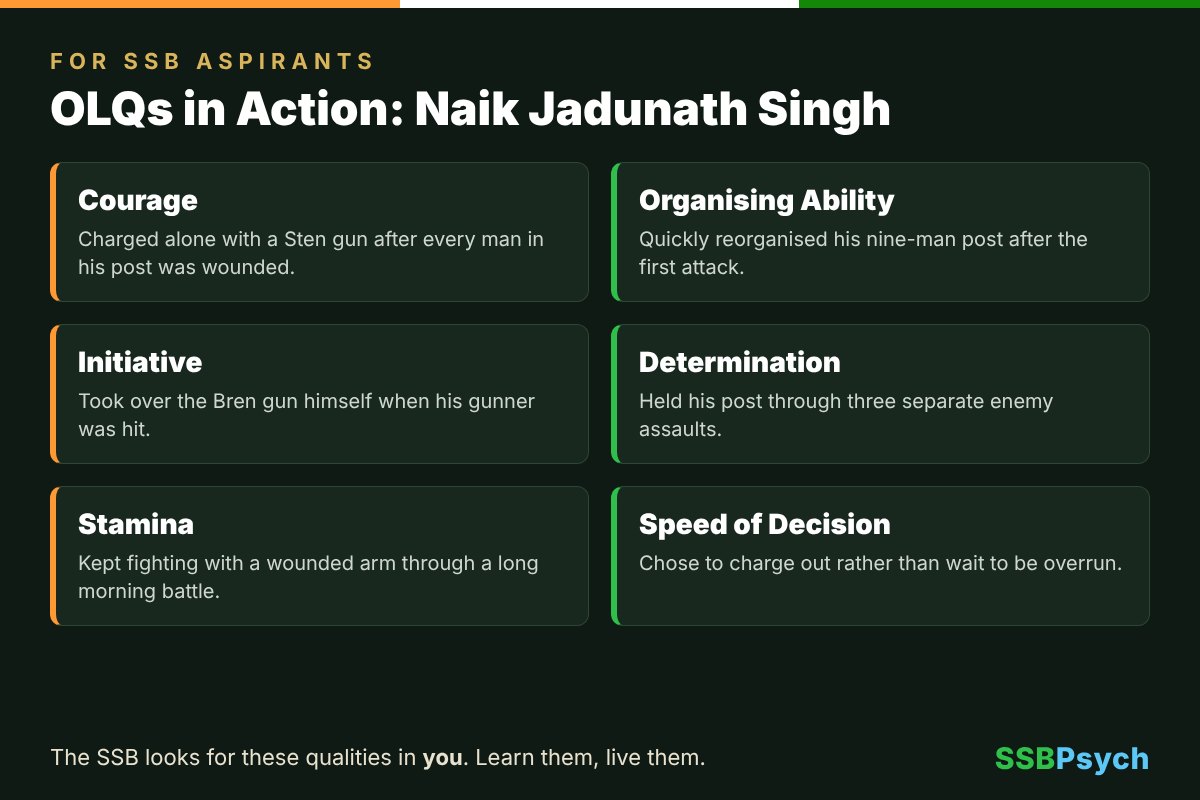
- Courage – Charged alone with a Sten gun after every man in his post was wounded.
- Organising Ability – Quickly reorganised his nine-man post after the first attack.
- Initiative – Took over the Bren gun himself when his gunner was hit.
- Determination – Held his post through three separate enemy assaults.
- Stamina – Kept fighting with a wounded arm through a long morning battle.
- Speed of Decision – Chose to charge out rather than wait to be overrun.
Tip for your SSB interview: Interviewing officers often ask about your hobbies and sports. Like Jadunath Singh, who was a village wrestling champion, show how your sport built your stamina and discipline, and give one real example rather than general claims.
Practice Corner: WAT and SRT
Write your first spontaneous response to these before you scroll to the quiz. Keep WAT sentences short, positive and action-oriented.
WAT Words
- Fog
- Section
- Bren gun
- Wrestler
- Picket
SRTs
- He is leading a small team in a college event and half his members fall sick on the day of the event. He…
- During a night camp, he notices that the person on watch duty has fallen asleep and a storm is approaching. He…
- He is the only one left uninjured after a road accident in a remote area with three hurt friends. He…
Quiz: How Well Do You Know Naik Jadunath Singh?
Test yourself! Click an option to see if you are right. Your score updates live.
Frequently Asked Questions
Why was Naik Jadunath Singh awarded the Param Vir Chakra?
For holding his nine-man post at Taindhar against three enemy attacks on 6 February 1948 and charging alone in the final attack, which saved his picket from being overrun.
Where is Taindhar?
Taindhar is a ridge area north of Naushera in the Rajouri district of Jammu and Kashmir, where 1 Rajput held pickets protecting the town.
What was Naik Jadunath Singh’s nickname?
He was called Hanuman Bhagat Bal Brahmachari because of his devotion to Lord Hanuman and his decision not to marry.
How old was Naik Jadunath Singh when he died?
He was 31. He was born on 21 November 1916 and died on 6 February 1948.
The Param Vir Chakra Series on SSBPsych
This is part 2 of 21 in our series on every Param Vir Chakra awardee. A new hero goes live every morning at 7:30 AM. Also read the story of Captain Vikram Batra, PVC – the Sher Shah of Kargil.
Sources: en.wikipedia.org, bharat-rakshak.com, honourpoint.in.
Preparing for your SSB? Join SSBPsych’s online and offline SSB batches and learn how to show your OLQs with confidence – explore our courses or call +91 8076540582.