History of Indian Navy Submarines: Kalvari to Arihant
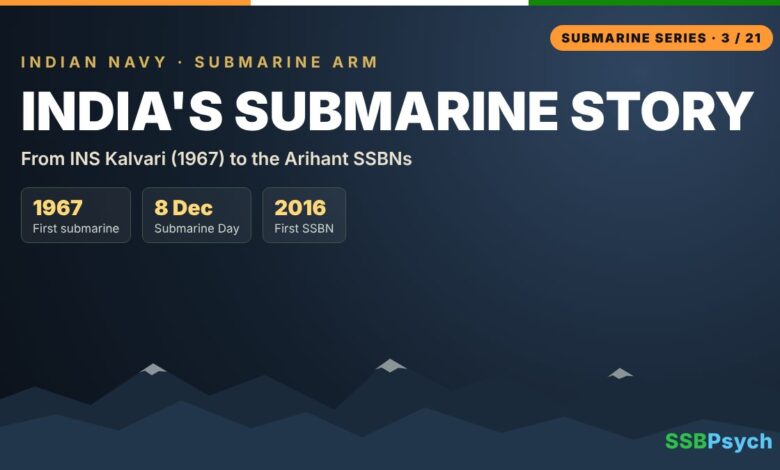
On 8 December 1967, far away in the Soviet port of Riga, the Indian naval ensign was hoisted on a grey submarine named INS Kalvari. That single boat was the start of an exciting journey. The history of Indian Navy submarines runs from those first Soviet-built boats to home-built nuclear submarines carrying long-range missiles, and every defence aspirant should know it.
In this post we walk through every submarine class the Indian Navy has operated, the big milestones and painful lessons, how the fleet looks today, and why 8 December is celebrated as Submarine Day. It is perfect revision material for NDA, CDS and AFCAT general knowledge and for SSB interview questions on the Navy.

Why India Wanted Submarines
After independence, India had a long coastline, island territories in the Bay of Bengal and Arabian Sea, and busy sea trade routes, but no submarines. A navy without submarines can be watched easily by an enemy and cannot easily threaten enemy fleets. Indian planners wanted a hidden force that could gather intelligence, guard the sea lanes and make any enemy think twice. In the 1960s India turned to the Soviet Union, which agreed to supply submarines and train Indian crews.
History of Indian Navy Submarines: The First Generation
Kalvari class (1967 to 2003)
India’s first four submarines were INS Kalvari, INS Khanderi, INS Karanj and INS Kursura, all variants of the Soviet Foxtrot design. They were commissioned between December 1967 and December 1969. Each displaced roughly 1,950 tonnes on the surface and had a crew of around 75 men, according to published data. Kalvari is the Malayalam name for the tiger shark.
These boats served for decades. INS Kursura, decommissioned in 2001, was turned into a museum on Ramakrishna Beach in Visakhapatnam, where visitors can walk through the narrow compartments and see how sailors lived. The sail (tower) of the first INS Kalvari is also preserved in Visakhapatnam.
Vela class (from 1973)
The next four boats, INS Vela, INS Vagir, INS Vagli and INS Vagsheer, were improved Foxtrot-type submarines from the Soviet Union and entered service from 1973. All were later decommissioned, the last of them around 2010.
The 1971 war at sea
The 1971 war showed both sides of submarine warfare. The Pakistani submarine PNS Ghazi, sent towards India’s east coast, sank off Visakhapatnam in early December 1971. On the western side, the Indian frigate INS Khukri was torpedoed by the Pakistani submarine PNS Hangor, with heavy loss of life. The lesson was clear: India needed both strong submarines of its own and better anti-submarine warfare.
The Second Generation: Kilos and Type 209s
Sindhughosh class (1986 to 2000)
In the mid-1980s, India began inducting the Russian Kilo-class design, known in India as the Sindhughosh class. Ten boats joined between 1986 and 2000. They are around 3,000 tonnes when submerged and have a published test depth of about 300 metres. Over the years they were upgraded, and several were later fitted to fire Klub anti-ship missiles.
The class also saw India’s worst submarine tragedy. Shortly after midnight on 14 August 2013, an explosion and fire tore through INS Sindhurakshak while it was berthed at the naval dockyard in Mumbai. The boat sank at its berth and 18 crew members lost their lives. It was later raised and finally sunk in deep water in the Arabian Sea in 2017. In 2020, India transferred another boat of this class, INS Sindhuvir, to the Myanmar Navy.
Shishumar class (1986 to 1994)
At the same time, India bought the German HDW Type 209 design, called the Shishumar class. INS Shishumar and INS Shankush were built in Kiel, Germany, and commissioned in 1986. The next two, INS Shalki (1992) and INS Shankul (1994), were built at Mazagon Dock Limited in Mumbai under technology transfer. Shalki thus became the first submarine built in India, a huge step towards self-reliance.
Learning Nuclear Power: The INS Chakra Leases
Operating a nuclear submarine needs skills that cannot be learnt from books. So India leased a Soviet Charlie-class nuclear attack submarine from 1988 and named it INS Chakra. Later, in 2012, India inducted a Russian Akula-class nuclear attack submarine on a 10-year lease, also named INS Chakra. It was based at Visakhapatnam and trained Indian crews in nuclear operations, a vital step for the Arihant programme. It returned to Russia in 2021, before the lease period ended.

The Nuclear Era: Arihant-Class SSBNs
Under the secret Advanced Technology Vessel (ATV) project, India designed and built its own nuclear-powered ballistic missile submarines at the Ship Building Centre in Visakhapatnam. INS Arihant, launched in 2009, was commissioned in August 2016 and completed its first deterrence patrol in November 2018, making India’s nuclear triad operational.
Its sister INS Arighaat was commissioned on 29 August 2024 in the presence of Defence Minister Rajnath Singh. A third, larger boat, INS Aridhaman, with eight missile tubes instead of four, was reported commissioned on 3 April 2026, and a fourth boat was launched in October 2024 for trials. Many details of these submarines, such as diving depth and patrol areas, remain classified.
Project 75: The Kalvari Class Returns
In 2005, India signed a deal for six submarines based on the French Scorpene design, to be built at Mazagon Dock Limited in Mumbai with French help. In a lovely tribute to history, they carry the names of the old Soviet-era boats: Kalvari, Khanderi, Karanj, Vela, Vagir and Vagsheer.
- INS Kalvari: commissioned 14 December 2017
- INS Khanderi: 28 September 2019
- INS Karanj: 10 March 2021
- INS Vela: 25 November 2021
- INS Vagir: 23 January 2023
- INS Vagsheer: 15 January 2025
These boats are about 67.5 metres long with a crew of around 43, and can fire heavyweight torpedoes and Exocet anti-ship missiles from underwater. DRDO’s home-grown fuel cell AIP system is planned to be fitted to them during refits, starting with INS Khanderi.
History of Indian Navy Submarines Timeline
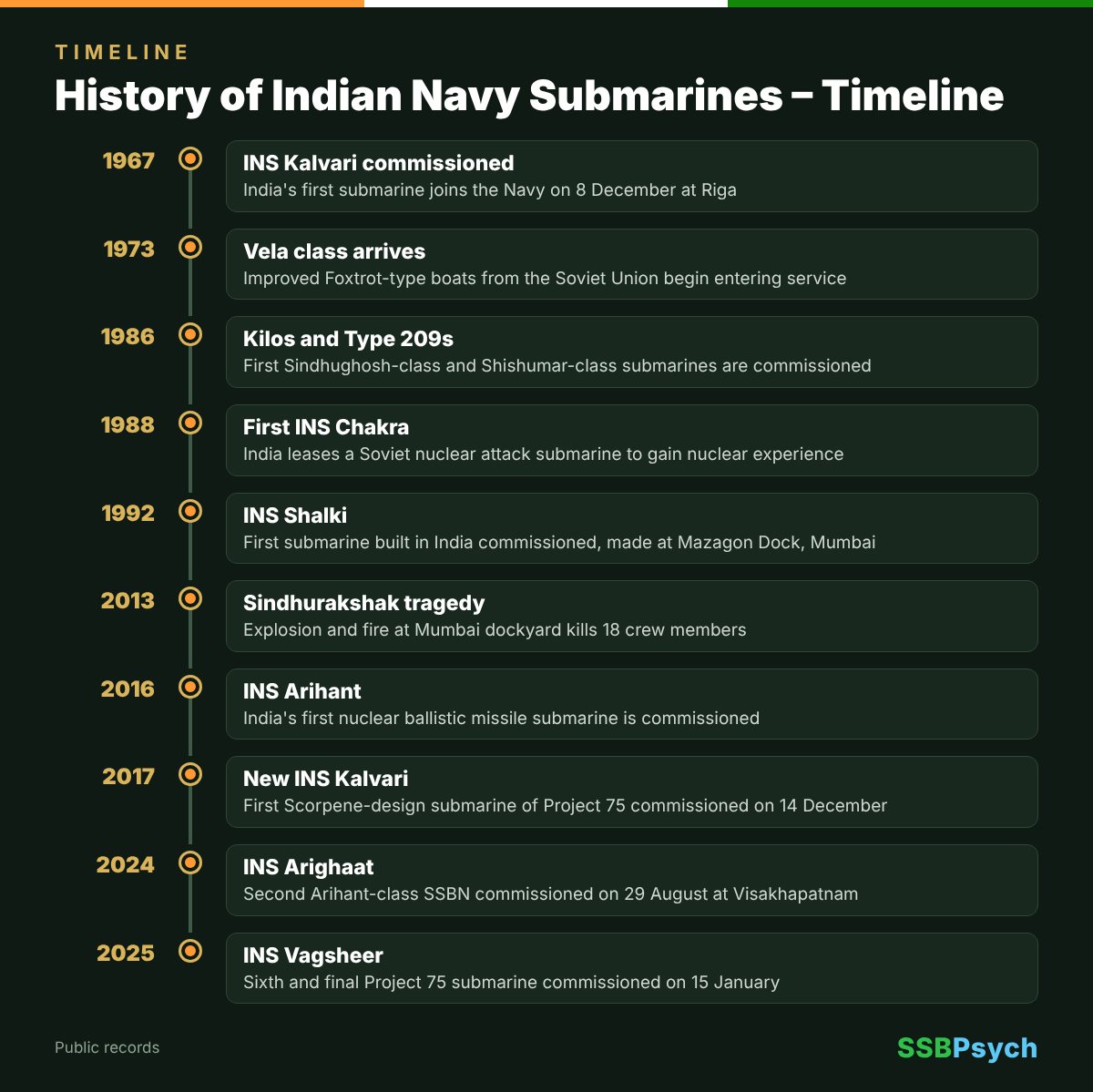
- 1967 – INS Kalvari commissioned: India’s first submarine joins the Navy on 8 December at Riga
- 1973 – Vela class arrives: Improved Foxtrot-type boats from the Soviet Union begin entering service
- 1986 – Kilos and Type 209s: First Sindhughosh-class and Shishumar-class submarines are commissioned
- 1988 – First INS Chakra: India leases a Soviet nuclear attack submarine to gain nuclear experience
- 1992 – INS Shalki: First submarine built in India commissioned, made at Mazagon Dock, Mumbai
- 2013 – Sindhurakshak tragedy: Explosion and fire at Mumbai dockyard kills 18 crew members
- 2016 – INS Arihant: India’s first nuclear ballistic missile submarine is commissioned
- 2017 – New INS Kalvari: First Scorpene-design submarine of Project 75 commissioned on 14 December
- 2024 – INS Arighaat: Second Arihant-class SSBN commissioned on 29 August at Visakhapatnam
- 2025 – INS Vagsheer: Sixth and final Project 75 submarine commissioned on 15 January
Indian Navy Submarine Fleet Today
As per public reports, the Indian Navy today operates around 16 conventional submarines from the Kalvari, Sindhughosh and Shishumar classes, along with its Arihant-class SSBNs. Many of the older boats are more than 30 years old and have been kept going with refits and life extensions, which is why new submarine programmes are a hot topic.
- Main bases: submarines operate from Mumbai on the west coast and Visakhapatnam on the east coast. INS Virbahu at Visakhapatnam is a well-known submarine base.
- Training: submariners are trained at INS Satavahana, the Navy’s submarine school in Visakhapatnam.
- Rescue: two Deep Submergence Rescue Vehicle systems, inducted in 2018 and 2019, are based at Mumbai and Visakhapatnam.
- Nuclear base: a dedicated base called INS Varsha is reported to be under development near Visakhapatnam for nuclear submarines.
Why does an ageing fleet matter so much? A submarine spends a large part of its life in dockyards for refits, so a navy never has all its boats at sea at once. As older boats retire, new ones must arrive on time, otherwise the number of submarines available for patrols falls. Building a modern submarine takes many years from contract to commissioning, which is why planners must think a decade or more ahead. This simple maths of retirements, refits and new builds is the reason submarine numbers are so often discussed in Parliament and in the news.
The Road Ahead
The Navy has long planned Project 75 India (P-75I) for six larger conventional submarines with AIP, to be built in India with a foreign partner. In October 2024 the government was also widely reported to have cleared the building of India’s own nuclear-powered attack submarines. Together with more Arihant-class boats, these programmes will decide how strong India’s underwater force will be in the 2030s.
How Indian Submarines Changed Across Generations
Looking at the whole story, you can see four big shifts in the Indian submarine arm over nearly six decades.
- From buying to building: the first boats came ready-made from the Soviet Union. Then came licence building of the Shishumar class, then the Scorpene-based Kalvari class built in Mumbai, and finally the Arihant class designed and built in India.
- From noisy to quiet: each new generation was designed to make less noise, because in submarine warfare the quieter boat usually wins.
- From torpedoes to missiles: early boats relied on torpedoes. Later classes could fire anti-ship missiles from underwater, and the Arihant class carries ballistic missiles.
- From diesel to nuclear: the leased Chakra boats and then the Arihant class took India into the small group of nations that operate nuclear-powered submarines.
Each shift needed new skills in shipyards, laboratories and training schools. That is why submarine programmes take so long: India is not just buying machines, it is building an entire ecosystem of designers, welders, engineers and highly trained crews.
How to use this in your SSB interview
If you are a naval aspirant, interviewing officers may ask why you want to join the Navy, or what you know about it. Instead of general answers, show real awareness: mention that India’s first submarine was commissioned on 8 December 1967, that INS Shalki was the first Indian-built submarine, and that the Arihant class completed India’s nuclear triad. Keep your facts accurate and simple, and admit honestly if you do not know something. Officers value honesty far more than bluffing, and genuine interest in the service always shows.
Submarine Day: Why 8 December Matters
Every year on 8 December, the Indian Navy celebrates Submarine Day to mark the commissioning of the first INS Kalvari in 1967. The day honours the courage of submariners, who live and work in some of the toughest conditions in the armed forces, and remembers those who lost their lives at sea. In 2017 the submarine arm completed 50 years, and fittingly the new INS Kalvari joined the fleet that very month.
History of Indian Navy Submarines: Quick Revision
- First submarine: INS Kalvari, 8 December 1967, at Riga.
- First submarine built in India: INS Shalki, 1992, at Mazagon Dock.
- First SSBN: INS Arihant, commissioned 2016.
- Worst peacetime tragedy: INS Sindhurakshak, 2013, 18 killed.
- Submarine museum: INS Kursura, Visakhapatnam.
Did You Know?
- The names Kalvari, Khanderi, Karanj, Vela, Vagir and Vagsheer have each been used twice in Indian Navy history.
- INS Khanderi is named after Khanderi island fort, linked to the Maratha navy of Chhatrapati Shivaji Maharaj.
- India has leased nuclear submarines from Moscow twice, and both were called INS Chakra.
- The second INS Chakra was an Akula-class submarine of over 8,000 tonnes.
- The Kilo-class boats in India got names starting with Sindhu, meaning sea or ocean.
Quiz: Test Your Knowledge of History of Indian Navy Submarines
Click an option to see if you are right. Your score updates live.
History of Indian Navy Submarines: Frequently Asked Questions
INS Kalvari, a Soviet Foxtrot-type submarine, was the first. It was commissioned on 8 December 1967 at Riga.
Because INS Kalvari, the Navy’s first submarine, was commissioned on 8 December 1967. The day honours submariners and the start of the submarine arm.
As per public reports, it operates the Kalvari (Scorpene), Sindhughosh (Kilo) and Shishumar (Type 209) conventional classes, plus the Arihant-class nuclear ballistic missile submarines.
On 14 August 2013 an explosion and fire on board at Mumbai’s naval dockyard sank the submarine and killed 18 crew members. It was later raised and sunk in deep water in 2017.
India first operated a nuclear submarine in 1988 by leasing INS Chakra from the Soviet Union. Its first home-built nuclear submarine, INS Arihant, was commissioned in 2016.
This is part 3 of 21 in SSBPsych’s submarine series – a new post every morning at 10 AM.
Sources: en.wikipedia.org, en.wikipedia.org, en.wikipedia.org, en.wikipedia.org, en.wikipedia.org.
Preparing for NDA, CDS, AFCAT or your SSB? Join SSBPsych’s online and offline batches – explore our courses or call +91 8076540582.