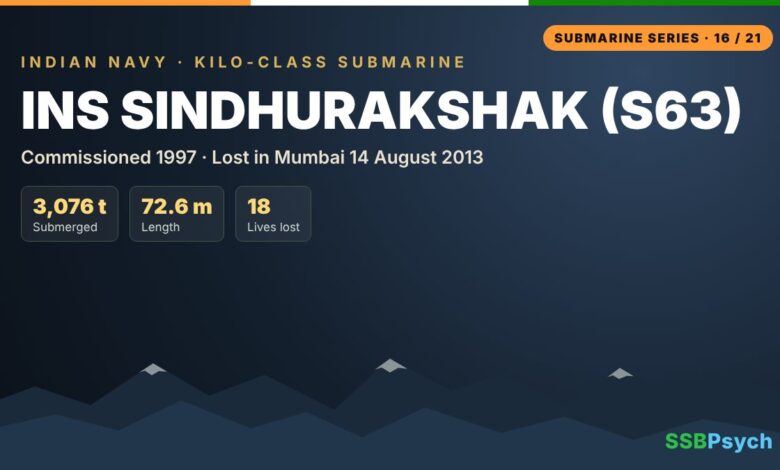
INS Sindhurakshak: History and the 2013 Mumbai Submarine Tragedy
Some stories from India’s naval history are told with pride, and some with a heavy heart. INS Sindhurakshak, whose name means protector of the sea, carries both. For over 15 years this Russian-built Kilo-class submarine guarded India’s waters. Then, just after midnight on 14 August 2013, a series of explosions tore through the boat at the naval dockyard in Mumbai. Eighteen brave naval personnel lost their lives.
This article respectfully tells the full story: what kind of submarine Sindhurakshak was, the upgrades it received, the 2013 tragedy, the salvage, what official inquiries were publicly reported to have found, and the lessons the Navy took forward. It is written in simple words for NDA, CDS, AFCAT and SSB aspirants and for every Indian who wants to remember those who served.

What Was INS Sindhurakshak?
INS Sindhurakshak, pennant S63, was a diesel-electric attack submarine of the Sindhughosh class, the Indian Navy’s version of the Russian Kilo class (Project 877EKM). It was the ninth of ten Kilo boats bought by India. Built at the Admiralty Shipyard in St Petersburg, Russia, it was launched in June 1997 and commissioned on 24 December 1997.
Diesel-electric means the boat used diesel generators to charge large batteries, then ran quietly underwater on battery power. Its job was to hunt enemy ships and submarines, gather intelligence and, if needed, lay mines. Like its sister boats, it was rugged, well armed and suited to the warm waters of the Indian Ocean.
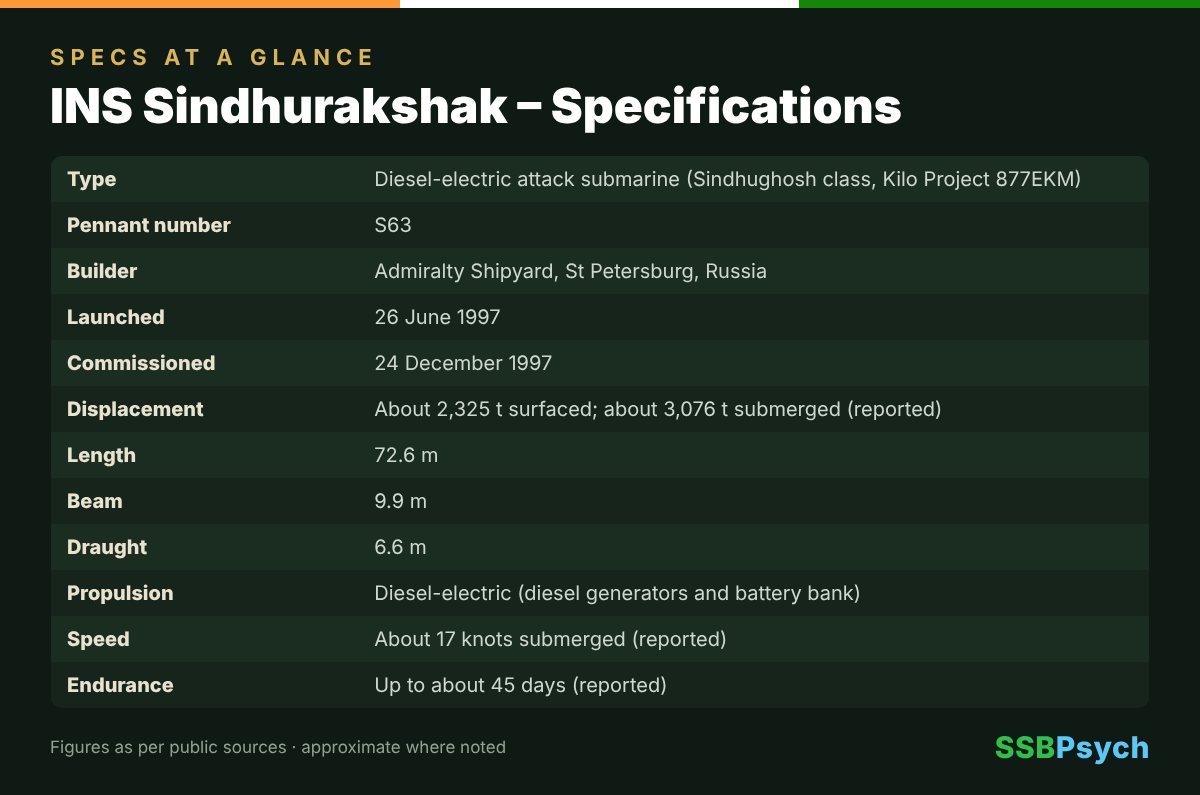
INS Sindhurakshak Specifications
| Type | Diesel-electric attack submarine (Sindhughosh class, Kilo Project 877EKM) |
| Pennant number | S63 |
| Builder | Admiralty Shipyard, St Petersburg, Russia |
| Launched | 26 June 1997 |
| Commissioned | 24 December 1997 |
| Displacement | About 2,325 t surfaced; about 3,076 t submerged (reported) |
| Length | 72.6 m |
| Beam | 9.9 m |
| Draught | 6.6 m |
| Propulsion | Diesel-electric (diesel generators and battery bank) |
| Speed | About 17 knots submerged (reported) |
| Endurance | Up to about 45 days (reported) |
| Crew | Around 50 or more (reported) |
| Weapons | Six 533 mm tubes: torpedoes, Klub-S missiles after refit, mines |
| Fate | Sank after explosions in Mumbai on 14 August 2013; raised 2014; sunk in deep sea 2017 |
Size and Capability in Simple Terms
Sindhurakshak was about 72.6 metres long, roughly the length of six city buses in a line, and about 9.9 metres wide. Submerged, it displaced around 3,076 tonnes, about as heavy as 2,400 small cars. It had a double hull: a strong inner pressure hull to protect the crew from the sea’s crushing weight, and an outer hull holding ballast tanks that were flooded to dive and emptied with compressed air to surface.
Open sources report a maximum diving depth of around 300 metres for Kilo-class boats, with a shallower normal operating depth. Reported endurance was about 45 days at sea. The Navy does not publish exact operational limits for its submarines.
Aircraft, Weapons and Sensors
- Six 533 mm bow torpedo tubes
- Type 53-series heavyweight torpedoes (reported)
- TEST-71/76 anti-submarine torpedoes (reported)
- 3M-54 Klub-S anti-ship cruise missiles, added during the 2010 to 2013 refit
- Sea mines in place of torpedoes
- Upgraded sonar, electronic warfare and weapon control systems from the Russian refit
INS Sindhurakshak Timeline
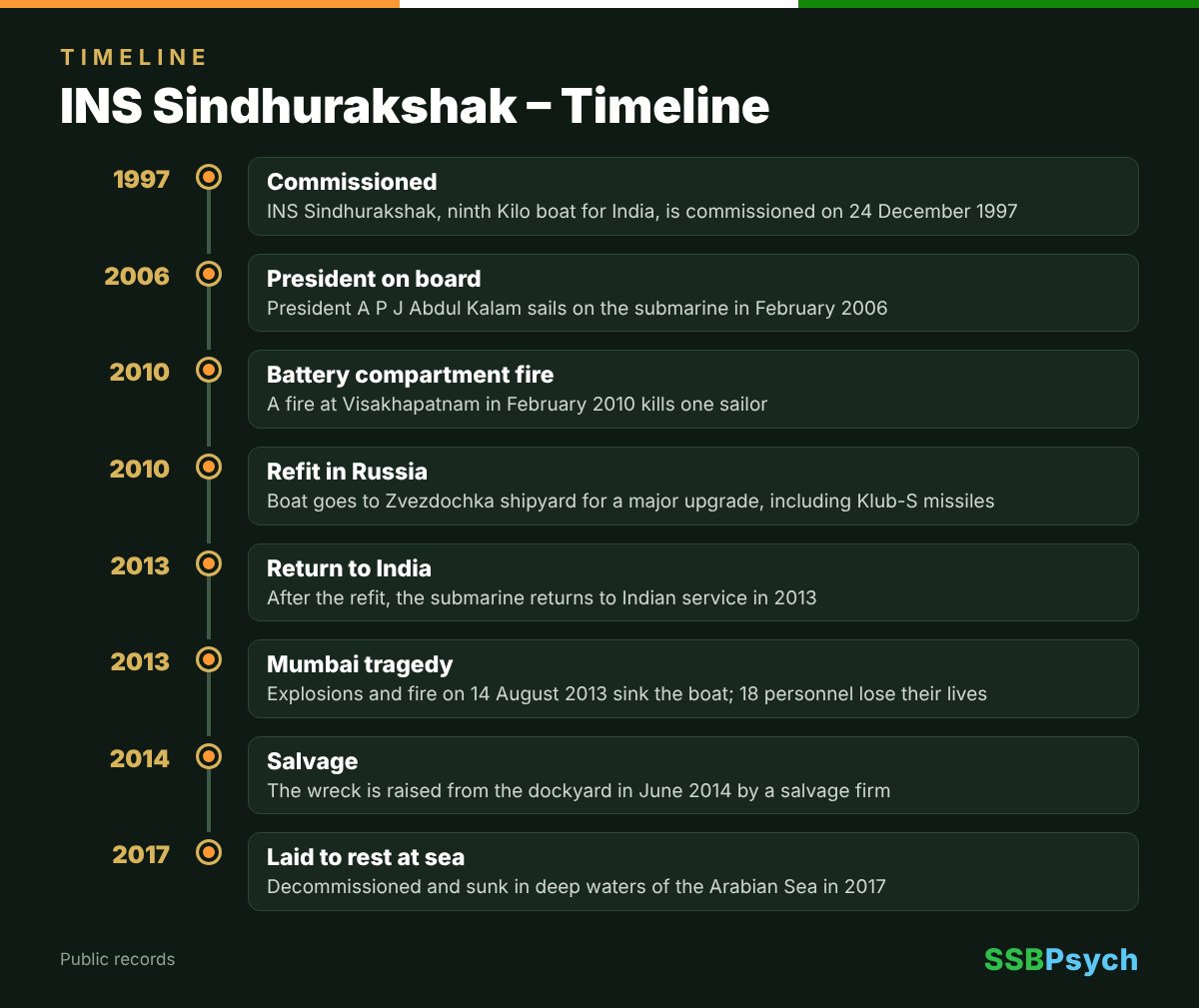
- 1997 – Commissioned: INS Sindhurakshak, ninth Kilo boat for India, is commissioned on 24 December 1997
- 2006 – President on board: President A P J Abdul Kalam sails on the submarine in February 2006
- 2010 – Battery compartment fire: A fire at Visakhapatnam in February 2010 kills one sailor
- 2010 – Refit in Russia: Boat goes to Zvezdochka shipyard for a major upgrade, including Klub-S missiles
- 2013 – Return to India: After the refit, the submarine returns to Indian service in 2013
- 2013 – Mumbai tragedy: Explosions and fire on 14 August 2013 sink the boat; 18 personnel lose their lives
- 2014 – Salvage: The wreck is raised from the dockyard in June 2014 by a salvage firm
- 2017 – Laid to rest at sea: Decommissioned and sunk in deep waters of the Arabian Sea in 2017
Years of Service and a Proud Moment
Through the late 1990s and 2000s, Sindhurakshak was part of India’s frontline submarine force, training crews and carrying out patrols whose details stay classified. A memorable public moment came on 13 February 2006, when President A P J Abdul Kalam, the much-loved scientist and Supreme Commander of the Armed Forces, sailed on board Sindhurakshak. It was widely reported as the first time an Indian President had gone to sea in a submarine.
Operations and Missions
- 2006 – Sortie with the President: President A P J Abdul Kalam spent time at sea on Sindhurakshak on 13 February 2006
- 2010-13 – Modernisation in Russia: Major refit at Zvezdochka, Severodvinsk, adding Klub-S and new electronics
The 2010 Fire and the Russian Refit
Trouble first struck in February 2010. While the submarine was at Visakhapatnam, an explosion and fire in the battery compartment killed one sailor and injured others. Public reports linked it to a faulty battery valve that allowed hydrogen gas to leak. Hydrogen is released naturally by large submarine batteries during charging, and if it builds up it can ignite.
Later in 2010, the boat was carried to Russia on a heavy-lift ship for a major refit at the Zvezdochka shipyard in Severodvinsk. The contract was reported at about US$80 million. The upgrade added Klub-S anti-ship cruise missiles, new electronic warfare systems, an improved weapon control system and other modern equipment. After sea trials, the submarine was handed back to the Indian Navy in early 2013 and sailed home, returning to Indian waters by mid-2013. It was, in many ways, a renewed boat, ready for many more years of service.

14 August 2013: The INS Sindhurakshak Tragedy
Just a few months after its return, on the night of 14 August 2013, the eve of Independence Day, INS Sindhurakshak was berthed at the naval dockyard in Mumbai. Shortly after midnight, a fire broke out on board, followed by a series of explosions linked to the weapons the submarine was carrying. The blasts lit up the night sky over the harbour and were heard across the area.
Firefighters and naval teams battled the blaze, which was brought under control within about two hours. But the damage was devastating. The submarine sank at its berth in shallow water, with only part of its fin visible above the surface. A few sailors on deck managed to jump to safety, but 18 naval personnel who were on board lost their lives. A neighbouring submarine, INS Sindhughosh, suffered minor damage.
Navy divers worked for days in dark, debris-filled water inside the twisted hull to recover their fallen comrades. It was slow, dangerous and heartbreaking work. Independence Day 2013 was marked with deep sorrow across the Navy and the nation.
Remembering the fallen
The eighteen who died were officers and sailors who had chosen one of the toughest careers in uniform. They served in silence, as submariners always do. The Navy honours their memory, and their sacrifice is a reminder that service at sea carries real risk even in harbour.
Salvage: Raising INS Sindhurakshak
Raising a sunken, damaged submarine full of unexploded ordnance from a busy dockyard is a very complex job. In early 2014, the Navy awarded the salvage contract to Resolve Marine Group, a specialist international salvage company, working through its Indian arm. After months of careful planning and work, the wreck was raised in June 2014. Once afloat, it was examined to help investigators understand what happened.
What the Inquiries Reported
The Navy set up a Board of Inquiry, as it does after every major incident. Only parts of the findings have been made public through official statements, parliamentary records and media reports. Here is what was publicly reported, without speculation:
- Early official statements pointed to the possibility of an accident or inadvertent mishandling of ammunition.
- In late 2014, media reports on the inquiry’s findings said human error was the likely cause, citing crew fatigue and violation of standard operating procedures at several levels.
- A 2017 report of the Comptroller and Auditor General (CAG) noted that crew fatigue had not been properly assessed and that the submarine had been carrying ammunition that was nearing the end of its life, according to media coverage of the report.
The full Board of Inquiry report has not been released to the public, so this article does not go beyond these reported points.
Aftermath and Lessons for the Navy
The loss of Sindhurakshak came amid a series of naval mishaps in 2013 and early 2014. After a fire on another Kilo-class boat, INS Sindhuratna, on 26 February 2014, which killed two officers, the then Chief of the Naval Staff, Admiral D K Joshi, resigned, taking moral responsibility. It was a rare step that showed how seriously the Navy viewed these accidents.
Lessons were taken forward across the fleet: stricter weapon and ammunition handling rules, closer checks on battery safety, more attention to crew rest and workload, and safety audits of ageing platforms. The tragedy also strengthened the case for faster induction of new submarines and better submarine rescue capability, which India later acquired.
Why Weapon Safety Is So Critical on a Submarine
A submarine carries its entire arsenal inside its hull. Torpedoes contain powerful warheads and fuel, and missiles have rocket motors and explosives. On a surface warship, weapons can be stored in separate magazines away from living spaces; on a submarine, they sit only a short distance from where the crew eats, sleeps and works. If a fire starts and reaches the weapon stowage area, the consequences can be catastrophic within minutes.
That is why loading, unloading and storing weapons on a submarine follows detailed step-by-step procedures, with checks by more than one person. Weapons also have a shelf life, after which they must be inspected, refurbished or retired. The Sindhurakshak tragedy reminded navies everywhere that these rules are written to protect lives and must never be treated as routine paperwork.
Impact on India’s submarine strength
The loss also hurt the Navy’s numbers. In 2013, India’s submarine fleet was already ageing, and the Scorpene boats of Project 75 were still years away from service. Losing a freshly upgraded boat with long-range missiles was a serious blow to fleet strength. Defence experts at the time used the tragedy to argue for faster decisions on new submarine programmes, a debate that continued for years.
Decommissioning and Final Journey
After the salvage, the Navy decided the boat could not be returned to service. INS Sindhurakshak was formally decommissioned in 2017. In June 2017 it was towed out to the Arabian Sea and sunk in very deep water, reported at around 3,000 metres, laying the submarine to rest in the ocean it had once guarded.
Life and Risks on a Kilo-Class Submarine
To understand the tragedy, it helps to know how submariners live. A Kilo boat carried a crew of around 50 or more in a narrow steel tube packed with batteries, fuel, high-pressure air and weapons. Sailors worked in shifts around the clock, slept in tight bunks and lived without daylight for weeks while at sea. Indian submarines of this type are commanded by an officer of Commander rank, supported by a small team of specialist officers and highly trained sailors.
Fire, hydrogen from batteries, flooding and explosive ordnance are the biggest dangers. That is why submariners drill constantly and why safety rules are so strict. Running costs for such a boat are driven by fuel, battery replacement, refits like the US$80 million Russian upgrade, weapons and crew training.
Why INS Sindhurakshak Matters to Defence Aspirants
For exams, remember: S63, Sindhughosh class (Kilo), commissioned 24 December 1997, refitted in Russia 2010 to 2013 with Klub-S missiles, lost in Mumbai on 14 August 2013 with 18 lives lost, raised in 2014 and sunk at sea in 2017. In an SSB interview, the story can help you discuss safety culture, responsibility, leadership and the human cost of military service with maturity and respect.
Did You Know?
- Sindhurakshak means protector of the sea.
- It was the ninth of ten Kilo-class submarines inducted by India.
- President A P J Abdul Kalam sailed on board in February 2006.
- Its 2010 to 2013 refit in Russia added Klub-S cruise missiles.
- The salvage was carried out by a specialist international firm in 2014.
- The submarine was finally laid to rest in deep water in the Arabian Sea in 2017.
Quiz: Test Your Knowledge of INS Sindhurakshak
Click an option to see if you are right. Your score updates live.
INS Sindhurakshak: Frequently Asked Questions
Shortly after midnight on 14 August 2013, a fire and a series of explosions struck INS Sindhurakshak while it was berthed at the naval dockyard in Mumbai. The submarine sank at its berth and 18 naval personnel lost their lives.
The full inquiry report is not public. Publicly reported findings pointed to human error, including crew fatigue and lapses in procedures, and a 2017 CAG report noted ammunition nearing the end of its life.
It was commissioned on 24 December 1997 after being built at the Admiralty Shipyard in St Petersburg, Russia.
Yes. A specialist salvage firm, Resolve Marine Group, raised the wreck in June 2014. The boat was later decommissioned and sunk in deep water in the Arabian Sea in 2017.
It belonged to the Sindhughosh class, the Indian Navy’s version of the Russian Kilo-class diesel-electric submarine (Project 877EKM).
This is part 16 of 21 in SSBPsych’s submarine series – a new post every morning at 10 AM.
Sources: en.wikipedia.org, en.wikipedia.org, en.wikipedia.org, business-standard.com.
Preparing for NDA, CDS, AFCAT or your SSB? Join SSBPsych’s online and offline batches – explore our courses or call +91 8076540582.