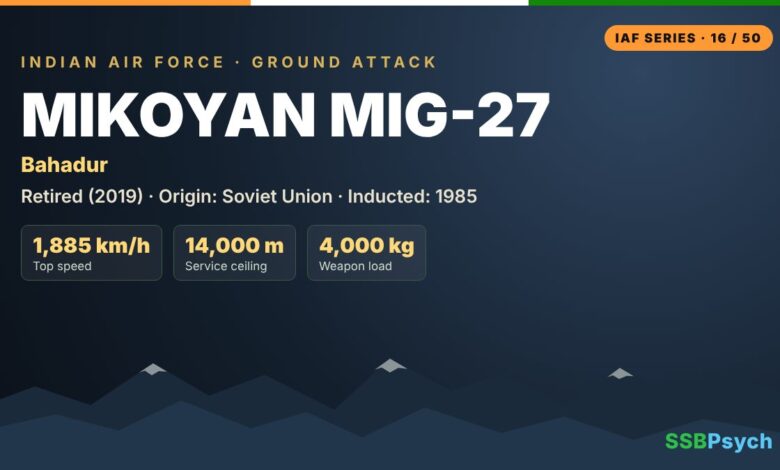
MiG-27 Bahadur in Indian Air Force: Specs, Weapons, Kargil Role
Imagine a jet that could fold its wings back like a falcon diving for prey, scream across the desert just above the sand dunes, and hit a target with a six-barrel cannon before the enemy even heard it coming. That was the MiG-27, which the Indian Air Force proudly called the Bahadur, meaning ‘the brave one’. For about 35 years it was one of India’s main ground-attack jets, and it flew its last sorties over Jodhpur in December 2019.
In this guide you will learn what made the MiG-27 special, how its swing wings worked, its key specifications explained in plain words, the weapons it carried, its role in the Kargil War, where it was based, its strengths and weaknesses, and why this retired warrior still shows up in SSB interviews and AFCAT general awareness questions. Stay till the end for a quick 10-question quiz.

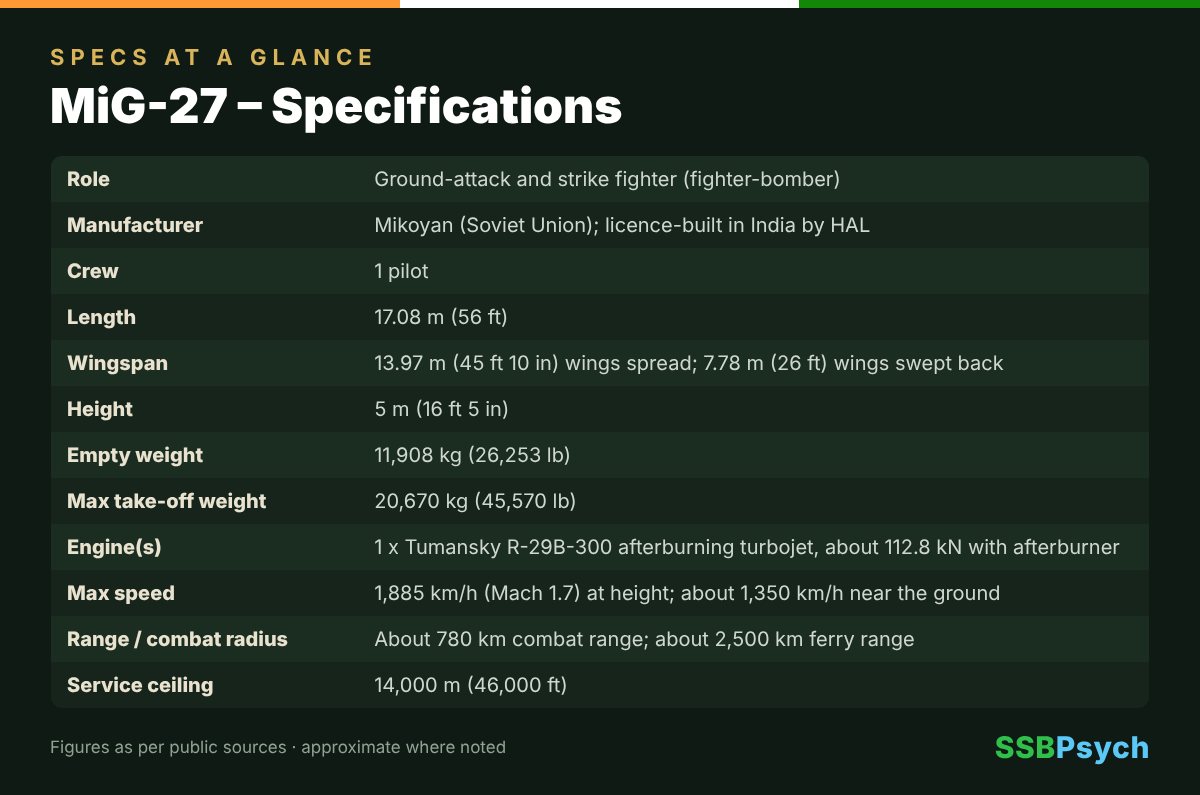
MiG-27 Specifications
| Role | Ground-attack and strike fighter (fighter-bomber) |
| Manufacturer | Mikoyan (Soviet Union); licence-built in India by HAL |
| Crew | 1 pilot |
| Length | 17.08 m (56 ft) |
| Wingspan | 13.97 m (45 ft 10 in) wings spread; 7.78 m (26 ft) wings swept back |
| Height | 5 m (16 ft 5 in) |
| Empty weight | 11,908 kg (26,253 lb) |
| Max take-off weight | 20,670 kg (45,570 lb) |
| Engine(s) | 1 x Tumansky R-29B-300 afterburning turbojet, about 112.8 kN with afterburner |
| Max speed | 1,885 km/h (Mach 1.7) at height; about 1,350 km/h near the ground |
| Range / combat radius | About 780 km combat range; about 2,500 km ferry range |
| Service ceiling | 14,000 m (46,000 ft) |
| Weapon load | Up to 4,000 kg (8,800 lb) on 7 hardpoints |
| First flight | 20 August 1970 (MiG-27 type) |
| Inducted in IAF | 1985 |
| Retired from IAF | 27 December 2019 (No. 29 Squadron, Jodhpur) |
| Number in IAF | About 165 licence-built by HAL |
Why India Needed the MiG-27 Bahadur
By the late 1970s and early 1980s the IAF wanted a modern jet whose main job was not dogfighting but ground attack: hitting enemy tanks, bunkers, bridges, supply depots and airfields. Older types such as the Su-7 and the Hunter were ageing. India also wanted to build combat jets at home so that it was not fully dependent on imports for spares and repairs.
The MiG-27 fitted this need well. It was developed in the Soviet Union from the MiG-23 fighter, but its nose, engine intakes, cockpit and landing gear were redesigned for flying low and fast over the battlefield. The nose was sloped down so the pilot could see the ground better, the cockpit had armour protection, and the landing gear was made strong enough to handle rougher runways.
India chose to licence-produce the MiG-27ML version. Hindustan Aeronautics Limited (HAL) built about 165 of them in India, with production running into the 1990s. That made the Bahadur one of the most important ‘Make in India’ combat aircraft of its time, long before that phrase became popular.
History of the MiG-27 in the Indian Air Force
The MiG-27 joined the IAF in 1985. Several squadrons flew it over the years, mostly from bases in the western and eastern sectors where a fast ground-attack jet would be needed in a war. Pilots loved its raw speed close to the ground, which was exactly where it was meant to fight.
Its biggest test came in the 1999 Kargil War. Pakistani intruders had occupied high mountain peaks in Ladakh, and the IAF launched Operation Safed Sagar to support the Indian Army. MiG-27s attacked enemy positions on steep slopes with rockets, bombs and cannon fire. This was very hard flying: the targets were small, the mountains were over 5,000 metres high, the thin air reduced engine power, and enemy soldiers carried shoulder-fired missiles.
On 27 May 1999, Flight Lieutenant K. Nachiketa was firing 80 mm rockets at enemy positions near Batalik when his MiG-27’s engine flamed out. He could not restart it and ejected over enemy-held territory. He was captured but was returned to India on 3 June 1999. His courage made him a household name, and his story is still told to young cadets.
In the 2000s the IAF carried out an upgrade on part of the fleet, adding newer avionics such as better navigation and attack systems to keep the jets useful. The fleet also had a worrying accident record, partly linked to engine problems, and several jets were lost over the years. As newer aircraft such as the Su-30MKI, Jaguar upgrades and the Tejas arrived, the MiG-27 squadrons were gradually closed down.
The first upgraded batch was retired in December 2017. The final unit, No. 29 Squadron ‘Scorpions’ at Jodhpur, flew the last sorties on 27 December 2019. The squadron itself was number-plated (closed) on the same day. With that, India became the last air force in the world to say goodbye to the MiG-27.
Engine and Performance Explained Simply
The MiG-27 was powered by a single Tumansky R-29B-300 turbojet engine. With the afterburner on, it produced about 112.8 kilonewtons of thrust. An afterburner is like a turbo boost: extra fuel is sprayed into the hot exhaust and burned again, giving a big kick of power at the cost of guzzling fuel very fast.
Its top speed was about 1,885 km/h at height, which is roughly Mach 1.7. Mach 1 is the speed of sound, so Mach 1.7 means 1.7 times faster than sound. Compare that with a bullet train at about 320 km/h: the MiG-27 was nearly six times faster. Close to the ground, where thick air creates more drag, it could still reach about 1,350 km/h, which is what really mattered for a low-level attack jet.
The service ceiling was about 14,000 metres. Service ceiling simply means the highest height at which the aircraft can still climb usefully. 14,000 metres is about one and a half times the height of Mount Everest. But the Bahadur rarely went that high in combat. Its favourite place was just a few dozen metres above the ground, hiding below enemy radar coverage.
The jet was about 17 metres long, roughly as long as four family cars parked bumper to bumper. Fully loaded, it could weigh over 20 tonnes at take-off, about as much as fifteen cars. It could carry up to about 4,000 kg of weapons on seven hardpoints (attachment points under the body and wings). Its combat range was around 780 km, and with extra fuel tanks it could be ferried about 2,500 km.
The Magic of Swing Wings
The most famous feature of the MiG-27 was its variable-sweep wing, often called ‘swing wings’. For take-off and landing, the pilot spread the wings wide (about 14 metres tip to tip). Wide wings create more lift at low speed, so the jet could use shorter runways while carrying heavy bombs. For a high-speed dash, the wings swung back to about 7.8 metres, making the aircraft slimmer like an arrowhead, cutting drag and giving a smoother ride in bumpy low-level air.
Weapons and Missiles
- GSh-6-30 six-barrel 30 mm rotary cannon
- Unguided general-purpose and fragmentation bombs
- 80 mm unguided rockets in pods (used in Kargil)
- R-60 short-range air-to-air missiles for self-defence
- External drop tanks for extra range
The star of the Bahadur’s arsenal was its GSh-6-30 rotary cannon, a six-barrel 30 mm gun mounted under the belly. It fired shells at an enormous rate and was famous for its loud roar. Pilots used it for strafing, which means firing the gun at ground targets during a low pass. For bigger targets it carried bombs and rocket pods, and it could carry short-range missiles for self-defence.
MiG-27 Missions and Operations
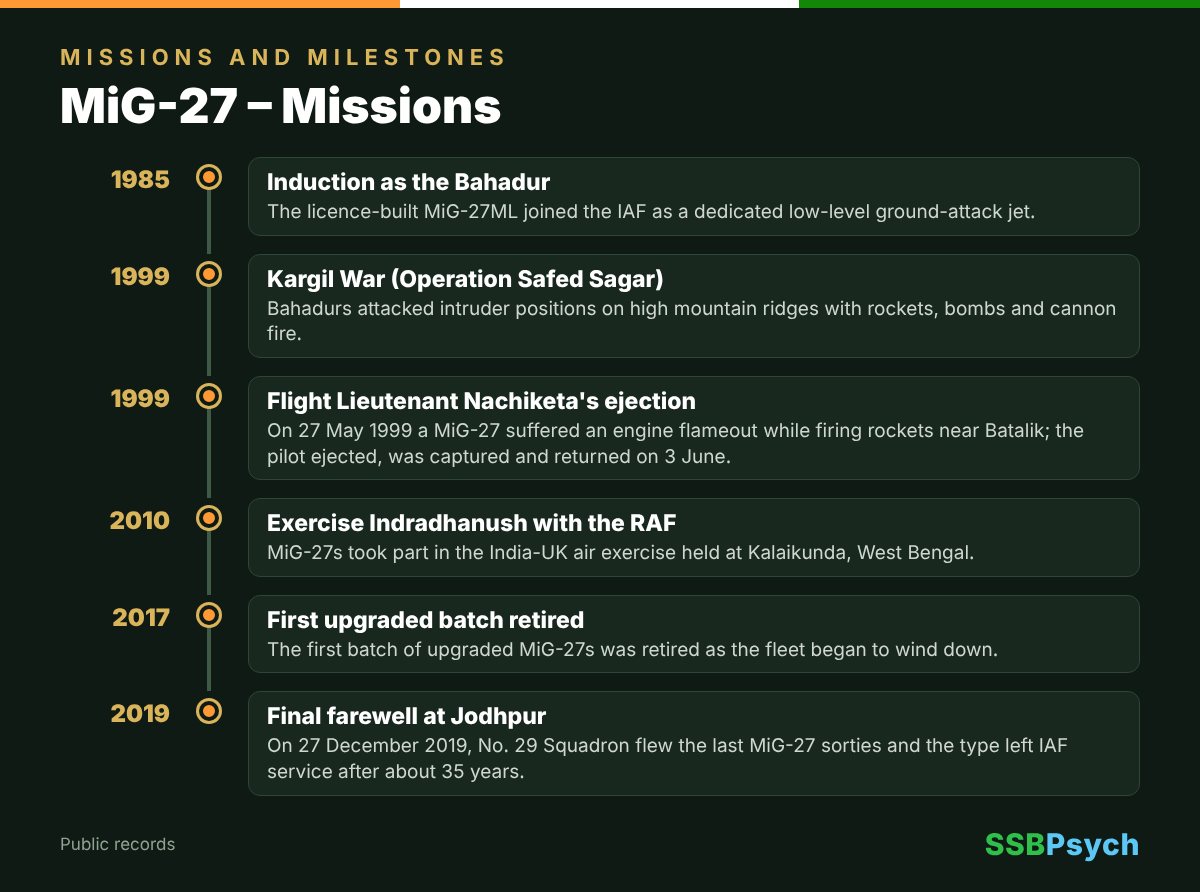
- 1985 – Induction as the Bahadur: The licence-built MiG-27ML joined the IAF as a dedicated low-level ground-attack jet.
- 1999 – Kargil War (Operation Safed Sagar): Bahadurs attacked intruder positions on high mountain ridges with rockets, bombs and cannon fire.
- 1999 – Flight Lieutenant Nachiketa’s ejection: On 27 May 1999 a MiG-27 suffered an engine flameout while firing rockets near Batalik; the pilot ejected, was captured and returned on 3 June.
- 2010 – Exercise Indradhanush with the RAF: MiG-27s took part in the India-UK air exercise held at Kalaikunda, West Bengal.
- 2017 – First upgraded batch retired: The first batch of upgraded MiG-27s was retired as the fleet began to wind down.
- 2019 – Final farewell at Jodhpur: On 27 December 2019, No. 29 Squadron flew the last MiG-27 sorties and the type left IAF service after about 35 years.

Where It Was Based and Who Flew It
As a ground-attack jet, the MiG-27 was based where it would be needed most in a conflict. The last unit, No. 29 Squadron ‘Scorpions’, operated from Air Force Station Jodhpur in Rajasthan, as publicly reported at its retirement. Other squadrons flew it from different bases over its long career, including stations in the east such as Kalaikunda in West Bengal.
An IAF fighter squadron is usually commanded by a Wing Commander, who is both the leader and an experienced pilot. Under him or her are Squadron Leaders, who often lead flights, and younger Flight Lieutenants and Flying Officers. A whole air force station is usually headed by a Group Captain or an Air Commodore.
To fly a jet like the MiG-27, a young officer first trained at the Air Force Academy, Dundigal, on basic trainer aircraft, then moved to jet trainers for advanced flying, and finally converted to the operational type in the squadron. The whole journey from cadet to a fully operational fighter pilot usually takes several years and hundreds of flying hours, with tough tests at every stage.
Strengths and Limitations of the MiG-27
- Strength: Very fast at low level, ideal for surprise attacks below enemy radar.
- Strength: Swing wings gave short take-offs with heavy loads and a stable high-speed ride.
- Strength: Powerful six-barrel 30 mm cannon for strafing ground targets.
- Strength: Built in India by HAL, which helped with spares and support.
- Limitation: Single engine, so one engine failure could mean losing the aircraft.
- Limitation: Engine problems and a high accident rate in later years.
- Limitation: Not designed for air-to-air combat against modern fighters.
- Limitation: Older electronics compared with modern multirole jets, even after upgrades.
Legacy of the MiG-27 Bahadur
The MiG-27 is retired, but its story is far from forgotten. A MiG-27 is displayed at the Indian Air Force Museum at Palam in New Delhi, where visitors can see its swing wings and drooping nose up close. Its role in Kargil is part of the proud history taught to every IAF cadet.
Its job of hitting targets on the ground has now passed to modern multirole fighters like the Su-30MKI, Rafale and Tejas, which can drop precision-guided weapons from a safer distance. The Bahadur’s retirement also reminded India how important it is to keep new squadrons coming, because every old type that leaves reduces the total number of fighter squadrons.
Why It Matters for SSB and AFCAT Aspirants
Questions about retired aircraft, Kargil heroes and squadron history appear often in AFCAT and CDS general awareness papers. In the SSB interview, an officer may ask about the IAF’s fleet, why older jets are retiring, or what you know about Operation Safed Sagar. Knowing the MiG-27’s story shows that you understand not only today’s aircraft but also the journey of the Air Force.
It is also a great topic for group discussions on self-reliance in defence. The MiG-27 was licence-built by HAL decades ago, and you can link that to today’s push for indigenous aircraft like the Tejas. Use it to show depth and balanced thinking. You could also mention how the IAF balances keeping old jets flying against the cost and risk of ageing fleets, a theme that comes up again and again in defence news.
Did You Know?
- Bahadur means ‘brave one’, the Indian name for the MiG-27.
- Its NATO reporting name was ‘Flogger’, the same family name as the MiG-23.
- The MiG-27’s wings could change shape in flight, from about 14 m wide to under 8 m.
- HAL built about 165 MiG-27s in India under licence.
- Flight Lieutenant K. Nachiketa ejected from a MiG-27 during the Kargil War and was returned to India after about a week in captivity.
- The last MiG-27 squadron was No. 29 ‘Scorpions’ at Jodhpur, retired on 27 December 2019.
- India was the last air force in the world to fly the MiG-27.
Quiz: Test Your Knowledge of MiG-27
Click an option to see if you are right. Your score updates live.
MiG-27: Frequently Asked Questions
The MiG-27 could reach about 1,885 km/h (around Mach 1.7) at height and about 1,350 km/h close to the ground.
Bahadur means ‘brave one’. It was the name the Indian Air Force gave to its licence-built MiG-27s.
The last MiG-27s retired on 27 December 2019 at Jodhpur, when No. 29 Squadron flew its final sorties.
During Operation Safed Sagar in 1999, MiG-27s attacked enemy positions on high mountain ridges with rockets, bombs and cannon fire to support the Army.
A MiG-27 is displayed at the Indian Air Force Museum at Palam, New Delhi.
This is part 16 of 50 in SSBPsych’s Indian Air Force aircraft series – a new aircraft every evening at 6 PM.
Sources: en.wikipedia.org, en.wikipedia.org, theaviationist.com, ainonline.com, nationalinterest.org.
Preparing for NDA, CDS, AFCAT or your SSB? Join SSBPsych’s online and offline batches – explore our courses or call +91 8076540582.