Dhruv helicopter and Rudra in IAF: Specs, Weapons, Sarang
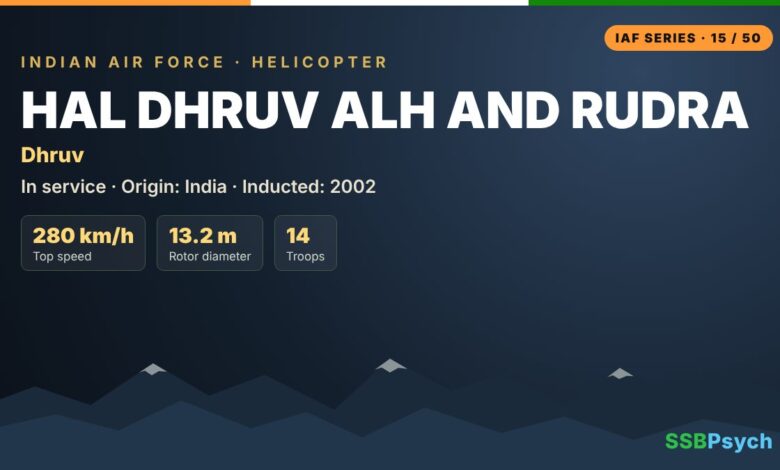
When a flood traps villagers on a rooftop, or an earthquake cuts off a mountain town, the sound of rotor blades often means help has arrived. In India, that helicopter is very often the Dhruv helicopter, built by HAL in Bengaluru. Its armed cousin, the Rudra, carries guns, rockets and missiles. Together they show how far India has come in designing and building its own military helicopters.
In this guide you will learn why India built the Dhruv, how it grew into Mk I, II, III and the armed Rudra, what its Shakti engines do, what both versions carry, the IAF’s Sarang display team, famous rescue missions, where these helicopters serve and what lies ahead. A short quiz at the end will test your memory.
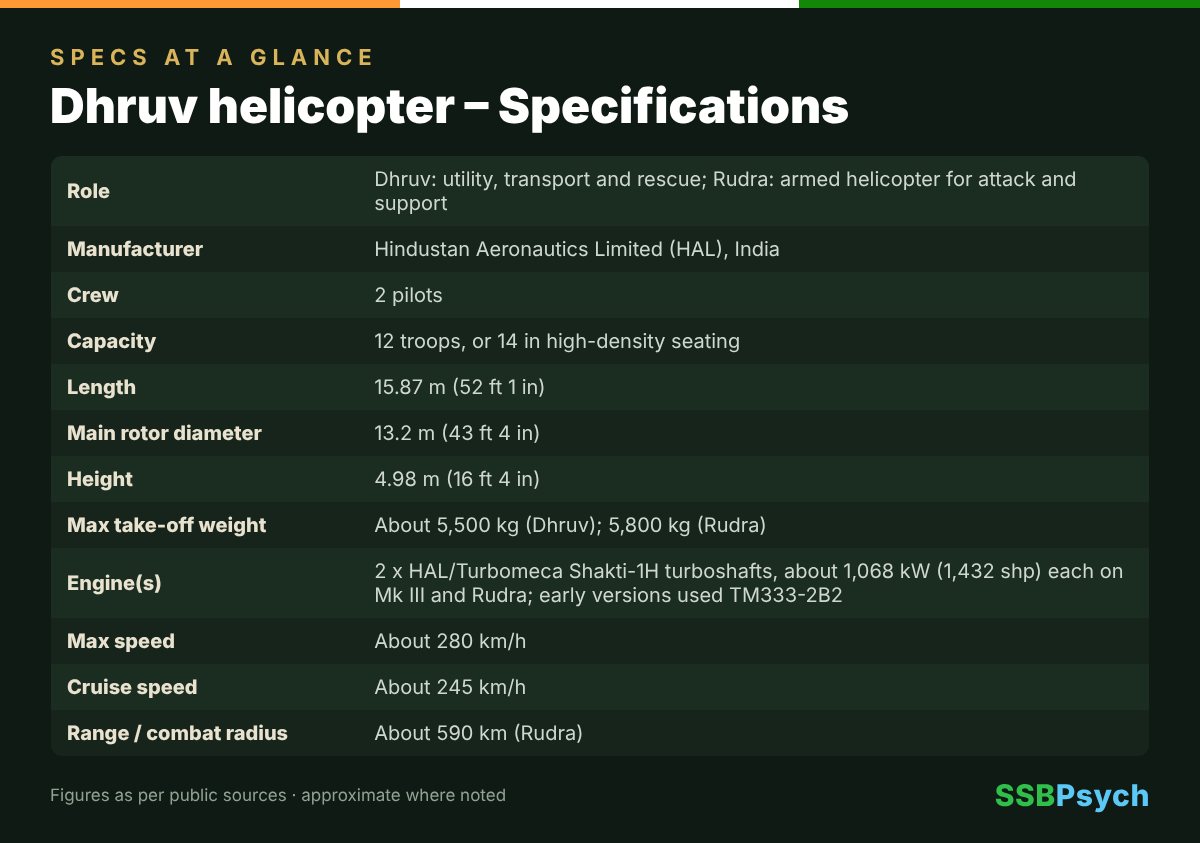
Dhruv helicopter Specifications
| Role | Dhruv: utility, transport and rescue; Rudra: armed helicopter for attack and support |
| Manufacturer | Hindustan Aeronautics Limited (HAL), India |
| Crew | 2 pilots |
| Capacity | 12 troops, or 14 in high-density seating |
| Length | 15.87 m (52 ft 1 in) |
| Main rotor diameter | 13.2 m (43 ft 4 in) |
| Height | 4.98 m (16 ft 4 in) |
| Max take-off weight | About 5,500 kg (Dhruv); 5,800 kg (Rudra) |
| Engine(s) | 2 x HAL/Turbomeca Shakti-1H turboshafts, about 1,068 kW (1,432 shp) each on Mk III and Rudra; early versions used TM333-2B2 |
| Max speed | About 280 km/h |
| Cruise speed | About 245 km/h |
| Range / combat radius | About 590 km (Rudra) |
| Endurance | About 3.8 hours (Rudra) |
| Service ceiling | About 6,000 m (20,000 ft) |
| First flight | Dhruv: 20 August 1992; Rudra prototype: 16 August 2007 |
| Inducted in IAF | Dhruv: 30 March 2002 (first pair) |
| Number in IAF | Dhruv: roughly 90-plus (approx.); Rudra: a small number, as publicly reported |
Why India Needed the Dhruv Helicopter
For decades the Indian armed forces flew helicopters designed abroad, such as the French-origin Chetak and Cheetah, and Russian Mi-8 and Mi-17 types. India wanted its own modern, twin-engine helicopter that could work across its vast range of terrain, from hot deserts to the icy heights of the Himalayas, and over the sea. Having two engines matters: if one fails, the other can still bring the helicopter home safely.
HAL began developing the Advanced Light Helicopter, or ALH, and named it Dhruv, after the pole star. The first prototype flew on 20 August 1992 in Bengaluru. After a long development and testing phase, deliveries began in 2002 to the Army, Navy, Air Force and Coast Guard. The IAF received its first pair on 30 March 2002.
History of the Dhruv and Rudra in the IAF
The Dhruv has grown through several versions. The Mk I had a traditional cockpit with dial gauges and TM333 engines. The Mk II brought a glass cockpit with digital screens. The Mk III added the more powerful Shakti engines, a new electronic warfare suite and better vibration control. The first batch of ten Mk III helicopters joined the IAF at Bareilly with No. 111 Helicopter Unit in February 2012. The Mk IV is the armed Rudra.
The Dhruv has proved itself in disaster relief again and again. After the 2011 Sikkim earthquake, Dhruvs flew rescue missions in the mountains. During the devastating 2013 floods in North India, Dhruvs flew hundreds of hours of search and rescue under Operation Rahat, plucking stranded pilgrims and villagers to safety from narrow valleys. They also carry out casualty evacuation, troop transport and supply missions on a daily basis.
The road has not always been smooth. Like many new designs, the Dhruv has faced accidents and fleet groundings for safety checks. Engineers have found and fixed problems such as control rod issues, for example by replacing some aluminium parts with steel. Each fix makes the helicopter safer and more reliable.
Rudra: the armed Dhruv helicopter
The Rudra, named after a fierce form of Lord Shiva, is a Dhruv turned into a fighting machine. Its prototype first flew on 16 August 2007, and it received initial operational clearance in February 2013. A gun turret sits under the nose, weapon stubs carry rockets and missiles, and a thermal sight lets the crew find targets by day and night. A Saab defensive aids suite warns the crew of incoming missiles and fires flares and chaff to confuse them. The Army is the biggest user of the Rudra, while public reports indicate the IAF also operates a smaller number.
Engine and Performance Explained Simply
Later Dhruvs and the Rudra use two Shakti turboshaft engines, developed jointly by HAL and France’s Turbomeca (now Safran). A turboshaft is a jet engine that, instead of blasting out exhaust for thrust, turns a shaft that spins the rotor. Each Shakti produces about 1,068 kW, or about 1,432 horsepower, which is roughly ten to fifteen family cars’ worth of power per engine.
Why does more power matter? Thin mountain air gives rotor blades less to push against, so helicopters lose lifting power at height. The Shakti engines were introduced to fix exactly this problem. In 2007 a Mk III Dhruv reached about 27,500 ft over the Siachen region, showing it could reach the world’s highest battlefield.
Top speed is about 280 km/h, slightly slower than a bullet train at full speed, and it cruises at around 245 km/h. The main rotor is 13.2 m across, wider than three cars parked side by side, and the helicopter is 15.87 m long. Its service ceiling, the highest height at which it can still climb usefully, is about 6,000 m, higher than most mountain passes in Ladakh.
The Rudra can fly about 590 km, or stay in the air for nearly four hours, which lets it patrol a large area or escort troop helicopters on long missions. The Dhruv can lift up to 12 troops, or 14 in tight seating, or carry stretchers, relief stores and slung loads under its belly.
One clever feature is the hingeless rotor system with composite blades and an anti-resonance vibration system, which reduces shaking and makes the helicopter agile. That agility is put on show by the Sarang team.
What It Carries
- Dhruv: 12 to 14 troops or passengers
- Dhruv: stretchers for casualty evacuation and rescue work
- Dhruv: underslung loads and relief supplies for flood and earthquake zones
- Rudra: 20 mm M621 cannon in a nose turret
- Rudra: 70 mm rockets
- Rudra: Mistral air-to-air missiles
- Rudra: Helina (Dhruvastra) anti-tank missiles, being inducted
- Rudra: Saab integrated defensive aids suite with missile warning, chaff and flares
- Rudra: day and night thermal imaging sight with laser ranging
Dhruv helicopter Missions and Operations
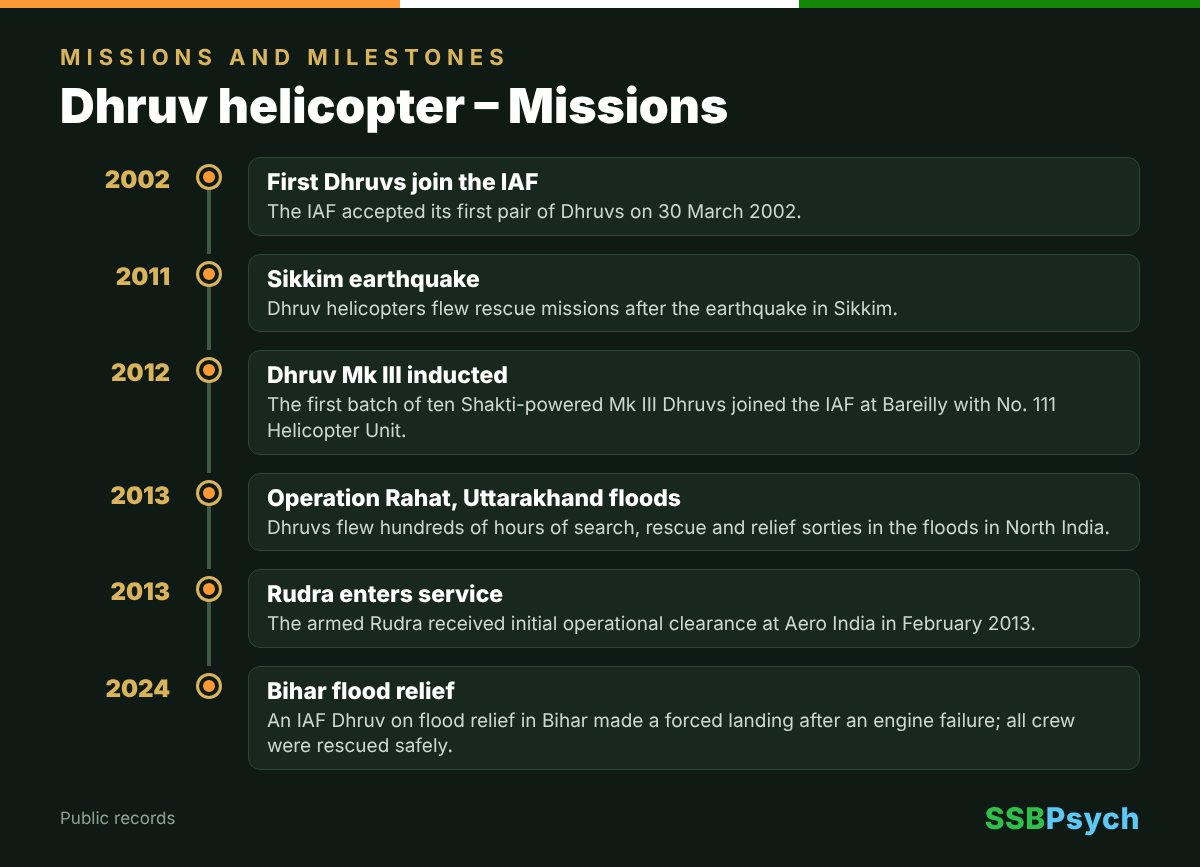
- 2002 – First Dhruvs join the IAF: The IAF accepted its first pair of Dhruvs on 30 March 2002.
- 2011 – Sikkim earthquake: Dhruv helicopters flew rescue missions after the earthquake in Sikkim.
- 2012 – Dhruv Mk III inducted: The first batch of ten Shakti-powered Mk III Dhruvs joined the IAF at Bareilly with No. 111 Helicopter Unit.
- 2013 – Operation Rahat, Uttarakhand floods: Dhruvs flew hundreds of hours of search, rescue and relief sorties in the floods in North India.
- 2013 – Rudra enters service: The armed Rudra received initial operational clearance at Aero India in February 2013.
- 2024 – Bihar flood relief: An IAF Dhruv on flood relief in Bihar made a forced landing after an engine failure; all crew were rescued safely.
How a Dhruv Helicopter Rescue Works
Rescue flying is where the Dhruv truly shines, so let us walk through a typical flood rescue in simple steps. First, the crew receives the location of stranded people from ground teams or the local administration. They plan the route, check the weather and calculate how much fuel and how many people they can carry, because every extra kilogram matters when hovering.
Arriving over the area, the pilots look for a safe way to pick people up. If there is open, firm ground, the helicopter may land briefly. If people are stuck on rooftops, trees or small islands of land, the crew uses a hoist, a winch with a strong cable, to lower a rescuer and lift survivors up one by one. Holding a steady hover just above rooftops, power lines and swirling water demands great skill and calm nerves from the pilots.
Once on board, survivors are flown to a relief camp or hospital, and the helicopter returns for the next group. On busy days a single crew may fly many such sorties, stopping only to refuel. Weather, darkness and fatigue are constant dangers, which is why rescue crews train hard for exactly these conditions.
The same skills help in the mountains, where Dhruvs carry supplies to remote posts and bring back sick or injured soldiers. Thin air, strong winds and tiny helipads make every landing a test, and the Shakti engines’ extra power gives crews a vital margin of safety.
Sarang: The Dhruv Helicopter Display Team
Sarang, meaning peacock in Sanskrit, is the IAF’s helicopter aerobatic display team and it flies the Dhruv. Its helicopters wear a bright paint scheme with a peacock design, and the team performs tight formations, crossovers and mirror manoeuvres at air shows in India and abroad. Watching four helicopters fly just metres apart is a breathtaking sight, and it also advertises an Indian-made helicopter to the world.
Where It Is Based and Who Flies It
Public sources report IAF Dhruv units at Yelahanka in Bengaluru, Sarsawa in Uttar Pradesh and Bareilly, where No. 111 Helicopter Unit received the first Mk IIIs. Helicopters are frequently detached to other stations for relief and support work.
An IAF helicopter unit is usually commanded by a Wing Commander, with Squadron Leaders, Flight Lieutenants and Flying Officers as pilots. Every Dhruv flies with two pilots who share flying and navigation, and on rescue missions crew members operate the winch and look after survivors.
Future helicopter pilots join through NDA, CDS or AFCAT and begin with basic flying on the Pilatus PC-7 Mk II at the Air Force Academy, Dundigal. Those selected for the helicopter stream then learn helicopter flying at a dedicated training school, before converting to types like the Dhruv. Mountain flying, night flying and rescue techniques are learnt step by step over several years of squadron service.
Strengths and Limitations
- Strength: designed and built in India, so spares and upgrades are under Indian control
- Strength: two engines give extra safety over mountains and the sea
- Strength: Shakti engines give good performance at high altitude
- Strength: versatile, from troop transport and rescue to armed attack in the Rudra form
- Strength: proven in countless rescue and relief operations
- Limitation: smaller load than medium helicopters like the Mi-17
- Limitation: past accidents and fleet groundings have dented confidence and availability
- Limitation: Rudra is a converted utility helicopter, not a purpose-built gunship like the Apache or Prachand
Future of the Dhruv Helicopter and Rudra
The Dhruv family will stay in service for many years as the backbone of India’s light utility helicopter fleet. The Rudra is getting new weapons, such as the Helina (Dhruvastra) anti-tank missile, which is being inducted after user trials. Lessons from the Dhruv also helped HAL develop the Light Combat Helicopter Prachand and the Light Utility Helicopter, as well as a civil version called Dhruv NG.
The Dhruv has also been exported to friendly countries, showing that Indian helicopter technology can compete abroad. Each new version builds on the last, which is exactly how a strong defence industry grows.
Why It Matters for SSB and AFCAT Aspirants
Dhruv and Rudra questions are common in AFCAT, CDS and NDA papers: who makes them (HAL), what Dhruv means (pole star), what Sarang flies (Dhruv) and which engine powers them (Shakti). For candidates interested in the helicopter stream, knowing about these helicopters and their rescue role shows real motivation in the SSB interview.
The Dhruv story is also a great example for group discussions on Make in India in defence. It shows both sides of the journey: the pride of building a world-class helicopter at home and the hard work needed to fix problems along the way. A balanced view like this impresses assessors.
Did You Know? Dhruv Helicopter Facts
- Dhruv means pole star, a symbol of steadiness and guidance.
- Rudra is named after a fierce form of Lord Shiva.
- The IAF’s Sarang display team, meaning peacock, flies Dhruv helicopters.
- The Shakti engine was developed jointly by HAL and France’s Turbomeca.
- A Mk III Dhruv reached about 27,500 ft over the Siachen region in 2007.
- The Dhruv serves with the Army, Navy, Air Force and Coast Guard.
- The Rudra’s gun sits in a turret under the nose and can swivel to aim.
Quiz: Test Your Knowledge of Dhruv helicopter
Click an option to see if you are right. Your score updates live.
Dhruv helicopter: Frequently Asked Questions
The Dhruv is an Indian twin-engine Advanced Light Helicopter built by HAL. It is used by the Army, Navy, Air Force and Coast Guard for transport, rescue and utility roles.
The Rudra is the armed version of the Dhruv. It adds a 20 mm nose gun, rockets, missiles, a thermal sight and a defensive aids suite.
The Dhruv has a top speed of about 280 km/h and cruises at about 245 km/h.
The IAF’s Sarang helicopter display team flies the HAL Dhruv.
Later Dhruvs (Mk III) and the Rudra use two Shakti turboshaft engines developed by HAL and Turbomeca; earlier versions used the TM333.
This is part 15 of 50 in SSBPsych’s Indian Air Force aircraft series – a new aircraft every evening at 6 PM.
Sources: en.wikipedia.org, en.wikipedia.org, en.wikipedia.org.
Preparing for NDA, CDS, AFCAT or your SSB? Join SSBPsych’s online and offline batches – explore our courses or call +91 8076540582.