Garhwal Rifles: History, Motto, War Cry, Battles and Heroes
Very few regiments can say that two of their soldiers won the Victoria Cross within months of arriving on a foreign battlefield. The Garhwal Rifles can. Raised in the hills of Uttarakhand in 1887, this regiment of tough, cheerful Garhwali soldiers has fought in France, Africa, Burma, Italy, the high Himalayas and Kargil. Its story is full of quiet courage – and it has some of the most loved heroes in Indian military history.
In this guide we cover the history of the Garhwal Rifles, a simple timeline, the major operations and battle honours, the meaning of its motto, war cry and insignia, its famous heroes and what life in the regiment is like. There is also a section for NDA, CDS and SSB aspirants and a quiz at the end.
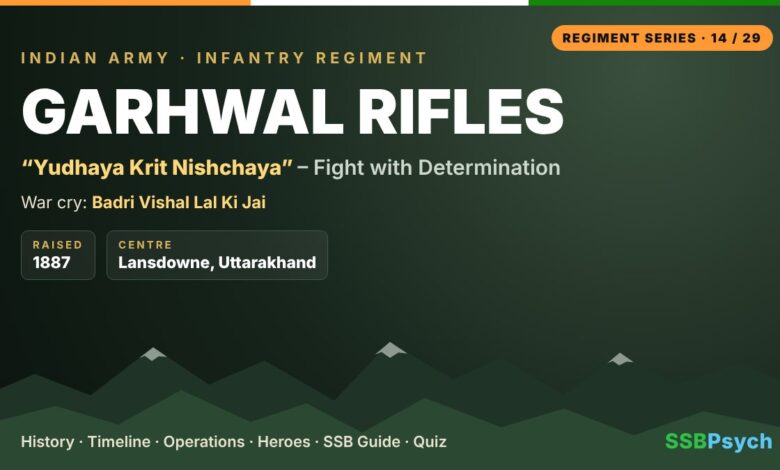
Garhwal Rifles – Quick Facts
| Raised | 5 May 1887, at Almora |
| Regimental Centre | Lansdowne, Pauri Garhwal, Uttarakhand |
| Motto | Yudhaya Krit Nishchaya (Fight with Determination) |
| War Cry | Badri Vishal Lal Ki Jai |
| Recruitment | Garhwali soldiers from the districts of the Garhwal division, Uttarakhand |
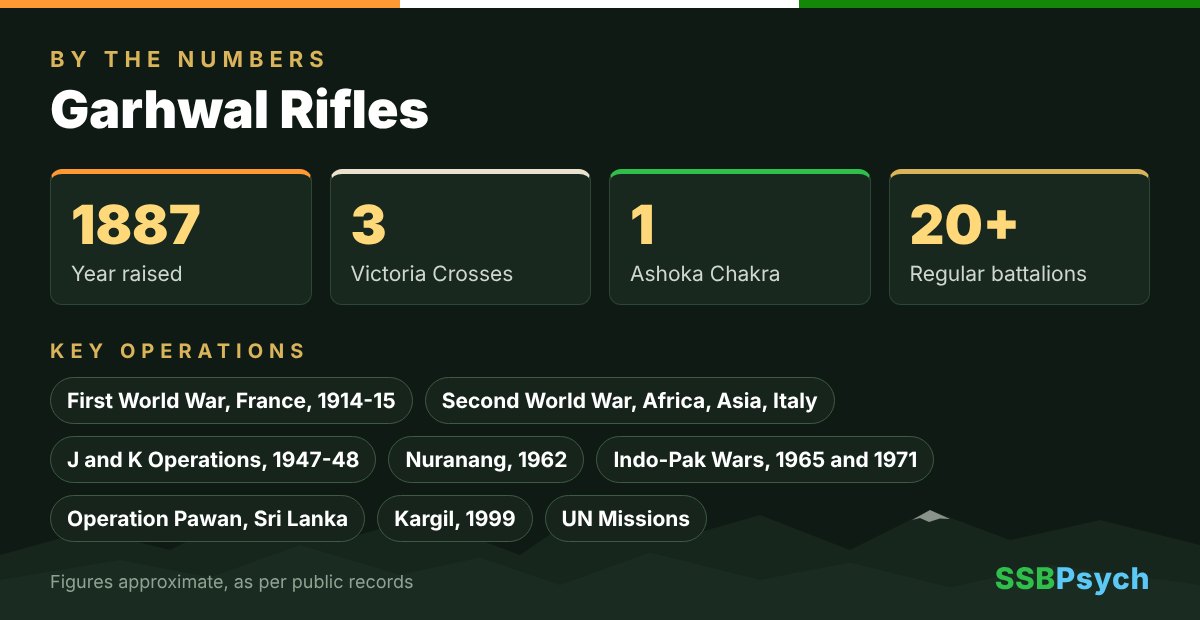
| Battalions | Over 20 regular battalions, plus Garhwal Scouts, RR and TA units |
| Insignia | Maltese cross with the Ashoka Lion Capital |
| Victoria Crosses | 3, including Naik Darwan Singh Negi and Rifleman Gabar Singh Negi |
| Notable gallantry | Ashoka Chakra (Nk Bhawani Datt Joshi), Maha Vir Chakras including Rfn Jaswant Singh Rawat |
| Famous battle | Nuranang, 1962 |
History of the Garhwal Rifles
Garhwali men had long served in the Gurkha regiments of the British Indian Army, and their officers noticed how well they performed. This led to the idea of a separate Garhwali unit. On 5 May 1887, the first battalion was raised at Almora under Lieutenant Colonel E P Mainwaring. Later that year the battalion marched to Kaludanda, a ridge in Pauri Garhwal. The place was soon renamed Lansdowne after the Viceroy of the time, and it has been the home of the regiment ever since.
In 1891 the unit became the 39th (Garhwali) Regiment of Bengal Infantry, and in 1892 it received the title of Rifles. Rifle regiments traditionally wear dark uniforms and move fast and light, and the Garhwalis took pride in this identity.
After the First World War, in which the Garhwalis fought with great distinction, the regiment was honoured with the title Royal and became the 18th Royal Garhwal Rifles in the reorganisation of 1921–22. The regimental centre was set up at Lansdowne. After India became a republic in 1950, the Royal title was dropped, but the regiment still wears a scarlet cord, a reminder of that honour.
The Peshawar Incident of 1930
In April 1930, a platoon of the 2nd Battalion, Royal Garhwal Rifles, was ordered to fire on unarmed protesters at the Qissa Khwani Bazaar in Peshawar. Havildar Chandra Singh Garhwali and his men refused. They were court-martialled and punished, but the incident became a powerful symbol in the freedom movement. It shows that Garhwali soldiers always had a strong sense of right and wrong.
Garhwal Rifles Timeline: From Raising to Today
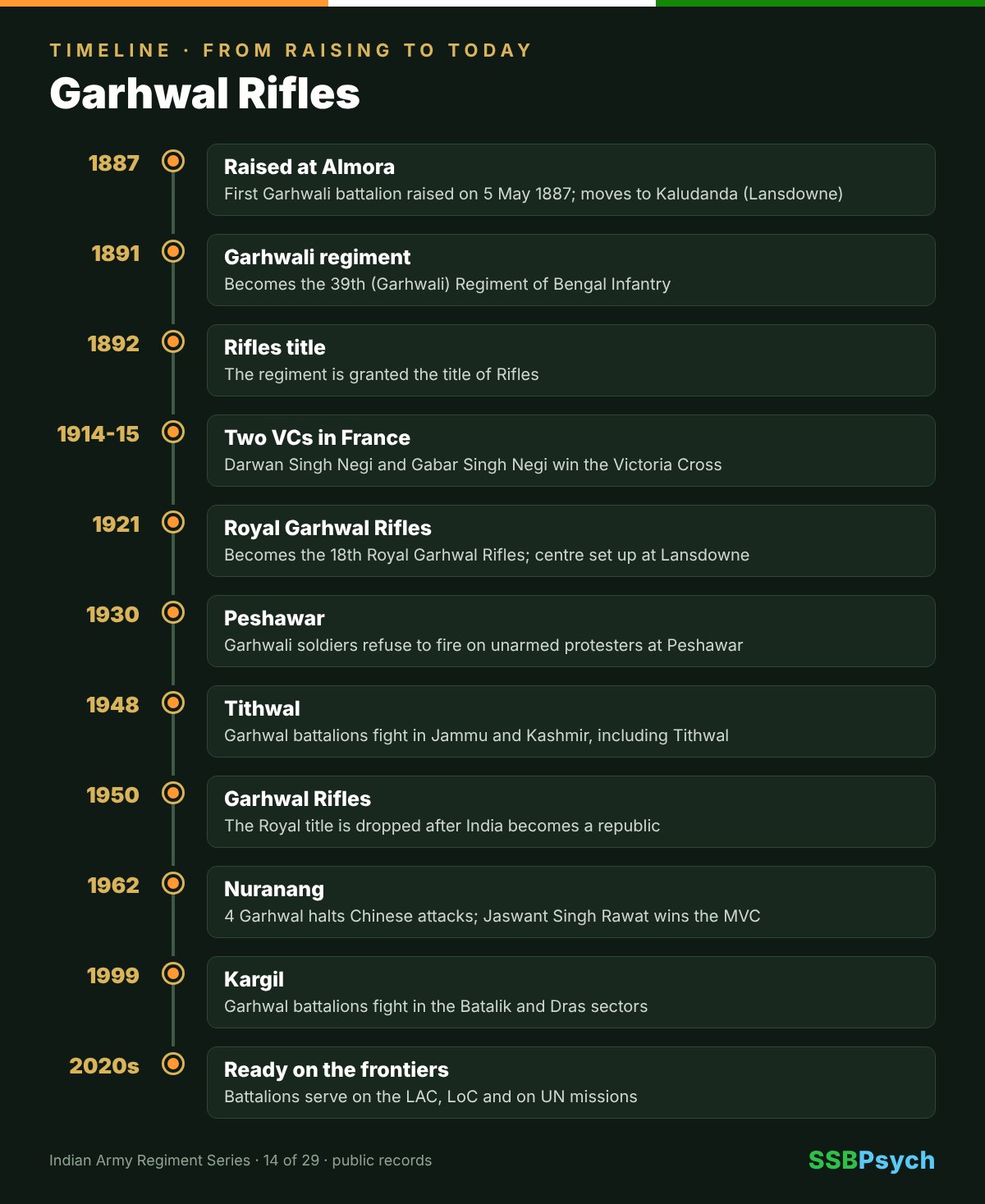
- 1887 – Raised at Almora: First Garhwali battalion raised on 5 May 1887; moves to Kaludanda (Lansdowne)
- 1891 – Garhwali regiment: Becomes the 39th (Garhwali) Regiment of Bengal Infantry
- 1892 – Rifles title: The regiment is granted the title of Rifles
- 1914-15 – Two VCs in France: Darwan Singh Negi and Gabar Singh Negi win the Victoria Cross
- 1921 – Royal Garhwal Rifles: Becomes the 18th Royal Garhwal Rifles; centre set up at Lansdowne
- 1930 – Peshawar: Garhwali soldiers refuse to fire on unarmed protesters at Peshawar
- 1948 – Tithwal: Garhwal battalions fight in Jammu and Kashmir, including Tithwal
- 1950 – Garhwal Rifles: The Royal title is dropped after India becomes a republic
- 1962 – Nuranang: 4 Garhwal halts Chinese attacks; Jaswant Singh Rawat wins the MVC
- 1999 – Kargil: Garhwal battalions fight in the Batalik and Dras sectors
- 2020s – Ready on the frontiers: Battalions serve on the LAC, LoC and on UN missions
Major Operations and Battle Honours of the Garhwal Rifles
First World War: France and Mesopotamia
The Garhwalis reached France in late 1914 and were thrown into the cold, muddy trenches of Flanders. At Festubert in November 1914, Naik Darwan Singh Negi helped clear enemy trenches despite being wounded several times. At Neuve Chapelle in March 1915, Rifleman Gabar Singh Negi led a bayonet party along German trenches and was killed in the action. Both received the Victoria Cross. The regiment later fought in Mesopotamia, earning honours such as Khan Baghdadi and Sharqat.
Second World War
In the Second World War Garhwal battalions fought across three continents. They were at Gallabat and Keren in East Africa, in Malaya and Burma against the Japanese, and in Italy against the Germans. Few Indian regiments have such a wide spread of honours from a single war.
1947-48: Jammu and Kashmir
After Independence, Garhwal battalions were sent to Jammu and Kashmir. They fought in the Tithwal sector, where Lieutenant Colonel Kaman Singh won the Maha Vir Chakra. A bridge in the area, Kaman Setu, carries his name to this day.
1962: The Legend of Nuranang
In November 1962, 4 Garhwal Rifles held positions near Nuranang in the Tawang sector of what is now Arunachal Pradesh. When Chinese troops attacked, the Garhwalis beat back wave after wave. Rifleman Jaswant Singh Rawat and two comrades crawled forward to silence a deadly enemy machine gun. Jaswant Singh fought on and gave his life. He was awarded the Maha Vir Chakra posthumously, and the place is now called Jaswantgarh, where soldiers still honour his memory. The battalion’s Commanding Officer, Lieutenant Colonel B M Bhattacharjea, also received the Maha Vir Chakra. The battalion was awarded the battle honour Nuranang, a rare honour from that difficult war.
1965, 1971 and Sri Lanka
In 1965 Garhwal battalions fought on the western front in Rajasthan and Punjab, earning honours such as Gadra Road and Buttur Dograndi. In 1971 they took part in hard fighting in East Pakistan, including the bitter battle for Hilli, where Indian troops faced strong, well-prepared defences and had to clear them position by position. In the late 1980s Garhwal units served with the Indian Peace Keeping Force in Sri Lanka during Operation Pawan, operating in thick jungle against a hidden enemy. Rifleman Kuldeep Singh Bhandari won the Vir Chakra there in 1988.
Kargil 1999
During Operation Vijay, Garhwal battalions fought in the Batalik and Dras sectors. Captain Jintu Gogoi of 17 Garhwal Rifles was killed while attacking enemy positions on Jubar Ridge in Batalik at the end of June 1999 and was awarded the Vir Chakra posthumously.
Insignia, Motto and War Cry
The insignia of the Garhwal Rifles is a Maltese cross carrying the Lion Capital of Ashoka. The Maltese cross is a traditional badge of rifle regiments and was adopted from a British rifle regiment, while the Ashoka Lion marks the regiment’s place in independent India.
The motto is Yudhaya Krit Nishchaya, which means Fight with Determination. It comes from the spirit of the Bhagavad Gita, where Arjuna is told to rise and fight with a firm mind. The war cry is Badri Vishal Lal Ki Jai, a call to Lord Badrinath, whose famous shrine sits in Chamoli district in the heart of Garhwal. Every Garhwali soldier grows up knowing this cry.
Heroes of the Garhwal Rifles
- Naik Darwan Singh Negi, Victoria Cross – Festubert, France, 1914; he received the medal in person from King George V in France.
- Rifleman Gabar Singh Negi, Victoria Cross (posthumous) – Neuve Chapelle, France, 1915.
- Lieutenant William David Kenny, Victoria Cross (posthumous) – Waziristan, 1920.
- Lt Col Kaman Singh, Maha Vir Chakra – Jammu and Kashmir, 1947–48.
- Rifleman Jaswant Singh Rawat, Maha Vir Chakra (posthumous) – Nuranang, 1962.
- Lt Col B M Bhattacharjea, Maha Vir Chakra – commanded 4 Garhwal at Nuranang, 1962.
- Naik Bhawani Datt Joshi, Ashoka Chakra (posthumous) – Operation Blue Star, Amritsar, 1984.
- Captain Jintu Gogoi, Vir Chakra (posthumous) – 17 Garhwal Rifles, Batalik, Kargil, 1999.
- Havildar Chandra Singh Garhwali – remembered for refusing to fire on unarmed protesters at Peshawar in 1930.
Role and Life in the Garhwal Rifles
The Garhwal Rifles is an infantry regiment that specialises in mountain warfare, though its battalions are trained for every type of terrain. Its men come mainly from the districts of the Garhwal division, such as Pauri, Tehri, Chamoli, Rudraprayag and Uttarkashi. Having grown up walking steep hill paths, Garhwali soldiers are naturally fit, patient and comfortable in high altitude and cold weather.
The regiment also has the Garhwal Scouts, a battalion trained for high-altitude border duties, along with Rashtriya Rifles and Territorial Army battalions. Its first battalion was converted to mechanised infantry, showing that the regiment’s traditions can adapt to modern warfare.
Lansdowne itself is part of the regiment’s soul. The quiet hill cantonment has a regimental museum, a war memorial and buildings that date back to the 19th century. Recruits who arrive there are trained not just in weapons and fieldcraft but also in the history and customs of their regiment. Many families in Garhwal have sent sons to the regiment for generations, and the bond between villages and battalions remains strong.
Officers who join a Garhwali battalion are expected to learn Garhwali phrases, take part in local festivals and know their soldiers personally. Garhwali soldiers are known for being simple, honest and cheerful, and for an extraordinary loyalty to officers who look after them. That trust is the secret behind the regiment’s long record of gallantry.
Garhwal Rifles in Counter-Insurgency and Peacekeeping
Like most infantry regiments, the Garhwal Rifles has spent many years on counter-insurgency duty in Jammu and Kashmir and the North-East. These tours demand a different kind of soldiering – patient intelligence work, careful use of force and building trust with local people while staying ready for sudden attacks. Garhwali soldiers, with their calm temperament and discipline, are well suited to this demanding work.
In 2003, Major Ajay Kothiyal of the regiment led an operation against terrorists in the Pulwama area of Kashmir and was later awarded the Kirti Chakra. He also became known for training young people from Uttarakhand for Army recruitment, a fine example of an officer serving his community even outside uniform.
The regiment has also served abroad under the United Nations flag. In 1953 a Garhwal battalion was part of the Indian force sent to Korea to look after prisoners of war after the fighting stopped, one of India’s earliest peacekeeping tasks. Since then Garhwal units and officers have served on several UN missions, carrying the reputation of the Indian soldier to many parts of the world.
Why the Hills Make Good Soldiers
Life in the Garhwal hills is hard. Children walk long distances to school, families farm small terraced fields and winters are harsh. This upbringing builds endurance, self-reliance and respect for elders – qualities that translate directly into good soldiering. It is no surprise that soldiering is one of the most respected careers in Garhwal, and that many villages have a proud list of serving and retired soldiers.
Lessons for Future Officers
The Garhwal Rifles teach three lessons. First, courage often comes from small teams: at Nuranang a few men changed the course of a battle. Second, character matters as much as skill, as the Peshawar incident shows. Third, determination – the regiment’s own motto – is what carries a soldier through cold, fatigue and danger. These are exactly the officer-like qualities the SSB tries to find.
Garhwal Rifles for SSB Candidates: What You Should Know
How officers join
- Officers from any state can be commissioned into the Garhwal Rifles; there is no regional quota for officers.
- Entry routes include NDA (after Class 12), IMA through CDS, TES, TGC or ACC, and OTA Chennai through Short Service Commission.
- Arm and regiment allotment is done at the academy based on your choices, order of merit and vacancies.
- Young officers attend courses at the Infantry School and then join their battalion, learning the language and traditions of their Garhwali men.
How soldiers join
- Soldiers are mainly Garhwalis from the districts of the Garhwal division of Uttarakhand.
- Since 2022, soldiers join as Agniveers under the Agnipath scheme through Army recruitment rallies; check joinindianarmy.nic.in for the latest rules.
Questions you may face in the SSB interview, GD or lecturette
- What do you know about the battle of Nuranang and Jaswant Singh Rawat?
- What is the motto of the Garhwal Rifles and how does it apply to your own life?
- Why do mountain regiments matter for India’s security today?
- What do you think about the soldiers who refused to fire at Peshawar in 1930?
- Give a two-minute lecturette on the Victoria Cross heroes of the Indian Army.
SSBPsych tip: If you are from Uttarakhand, be ready to talk about your region’s military tradition in the interview, but show you know facts – names, dates and places – rather than only emotion.
Conclusion
From the trenches of Festubert to the snows of Jaswantgarh and the ridges of Batalik, the Garhwal Rifles have proved their motto again and again. Their soldiers fight with determination and live with honour. Whether it is a rifleman holding a lonely post or an officer leading an assault up a steep ridge, the Garhwali spirit of grit, loyalty and good humour shines through every chapter of the regiment’s history. Test yourself with the quiz below, and keep preparing with SSBPsych so that one day you too can lead such men.
Quiz: How Well Do You Know the Garhwal Rifles?
Test yourself! Click an option to see if you are right. Your score updates live.
Garhwal Rifles: Frequently Asked Questions
The motto is Yudhaya Krit Nishchaya, meaning Fight with Determination.
The war cry is Badri Vishal Lal Ki Jai, a call to Lord Badrinath.
The regimental centre is at Lansdowne in Pauri Garhwal district, Uttarakhand, where the regiment has been based since 1887.
Three, by Naik Darwan Singh Negi, Rifleman Gabar Singh Negi and Lieutenant William David Kenny.
Rifleman Jaswant Singh Rawat of 4 Garhwal Rifles fought heroically at Nuranang in 1962 and was awarded the Maha Vir Chakra posthumously. The area is now called Jaswantgarh.
Indian Army Regiments Series on SSBPsych
This is part 14 of 29 in our series on every infantry regiment of the Indian Army – a new regiment every day at 11 AM. Previous in the series: Dogra Regiment. Also follow our Param Vir Chakra series.
Sources: en.wikipedia.org, en.wikipedia.org, aviation-defence-universe.com, globalsecurity.org.
Preparing for NDA, CDS, AFCAT or your SSB? Join SSBPsych’s online and offline batches – explore our courses or call +91 8076540582.