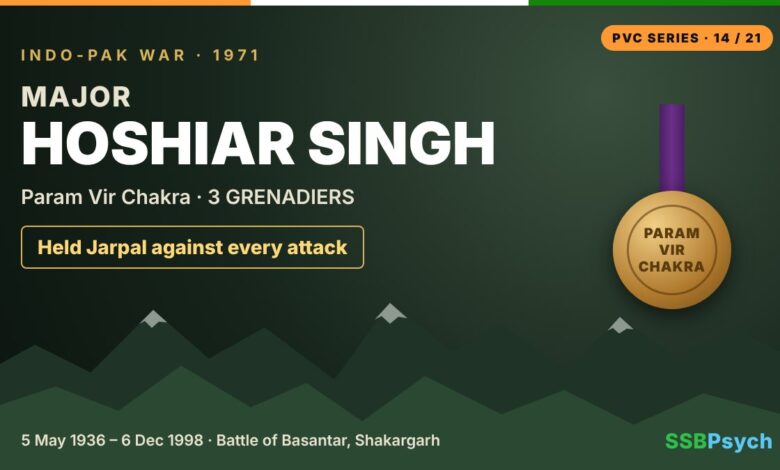
Major Hoshiar Singh, PVC: The Grenadier Who Held Jarpal, 1971 – Full Story (with Quiz)
Many Param Vir Chakra stories end with the hero’s death. This one does not. Major Hoshiar Singh of 3 Grenadiers captured a fortified enemy village called Jarpal in December 1971, and then held it for two more days while the enemy threw infantry, tanks and artillery at his company. Badly wounded, he kept moving from trench to trench, took over a machine gun when its crew went down, and refused to leave the battlefield until the guns fell silent. He lived to receive the Param Vir Chakra and went on to serve the Army for many more years.
For SSB aspirants, his story has an extra lesson: he began his Army life as a sepoy and rose to command a company in battle. Hard work, character and leadership can take you further than you imagine. In this post, the fourteenth in our 21 Param Vir Chakra heroes series, we look at his early life, his journey from the ranks to a commission, the 1971 war in the west, the Battle of Basantar in detail, his citation in plain words, his later life and legacy, and the officer-like qualities you can learn from him. A 10-question quiz waits at the end.
Major Hoshiar Singh – Quick Facts
| Full name | Hoshiar Singh Dahiya |
| Born | 5 May 1936, Sisana village, then Rohtak district (now Sonipat district), Haryana |
| Father | Choudhary Hira Singh |
| Early service | Joined the Jat Regiment as a sepoy |
| Commissioned | 30 June 1963, The Grenadiers |
| Unit | 3rd Battalion, The Grenadiers (3 Grenadiers) |
| War | Indo-Pakistan War of 1971 |
| Battle | Basantar River bridgehead, capture and defence of Jarpal, Shakargarh sector |
| Dates of action | 15 to 17 December 1971 |
| Award | Param Vir Chakra |
| Retired | 31 May 1988, honorary rank of Colonel |
| Died | 6 December 1998, Jaipur |
Early Life: A Farmer’s Son from Sisana
Hoshiar Singh was born on 5 May 1936 in the village of Sisana, then in Rohtak district of undivided Punjab and now in Sonipat district of Haryana. He came from a Jat family of the Dahiya clan; his father was Choudhary Hira Singh. Haryana has a proud tradition of sending its sons to the armed forces, and Sisana was no exception.
After finishing school, he studied for a year at Jat College, Rohtak. But the Army was calling him, and he chose to join it rather than continue in college.
From Sepoy to Officer
Hoshiar Singh first joined the Army as a sepoy in the Jat Regiment. Life in the ranks taught him what officers sometimes have to learn from books: how soldiers think, what they fear, what they value, and what makes them follow a leader into danger. His ability was noticed, and he went on to earn a commission.
On 30 June 1963, he was commissioned as an officer into The Grenadiers, one of the oldest infantry regiments of the Indian Army. He was promoted to lieutenant in 1965 and captain in 1969. In the 1965 war with Pakistan, he saw action in the Rajasthan sector and was mentioned in despatches for his work. By December 1971, he was commanding a company of 3 Grenadiers as a Major.
The 1971 War: The Shakargarh Bulge
When war broke out on 3 December 1971, India fought on two fronts. In the east, the aim was the liberation of Bangladesh. In the west, the task was to defend Indian territory and gain ground where possible. One of the most important western sectors was Shakargarh, a bulge of Pakistani territory jutting towards Jammu and Punjab. Pakistan could use it to threaten India’s road link to Jammu and Kashmir, so India decided to push into it.
The Indian advance in this sector led to the Battle of Basantar, named after the Basantar River. Indian forces had to cross the river, which was protected by thick minefields, and build a secure bridgehead on the far bank so that tanks could follow. Pakistan, knowing how dangerous this would be, prepared to counter-attack hard with infantry and armour.
The Battle of Basantar: Holding Jarpal
15 December: The Capture of Jarpal
On 15 December 1971, 3 Grenadiers was ordered to help establish the bridgehead across the Basantar. Major Hoshiar Singh commanded the battalion’s left forward company, and his objective was Jarpal, a strongly fortified enemy position.
As his men advanced, they came under intense shelling and crossfire from enemy machine guns. Major Hoshiar Singh pressed the attack all the same. The fight ended in hand-to-hand combat in the enemy trenches, and his company captured Jarpal. But taking a position is only half the battle. The real test was whether it could be held.
16 December: Three Counter-attacks
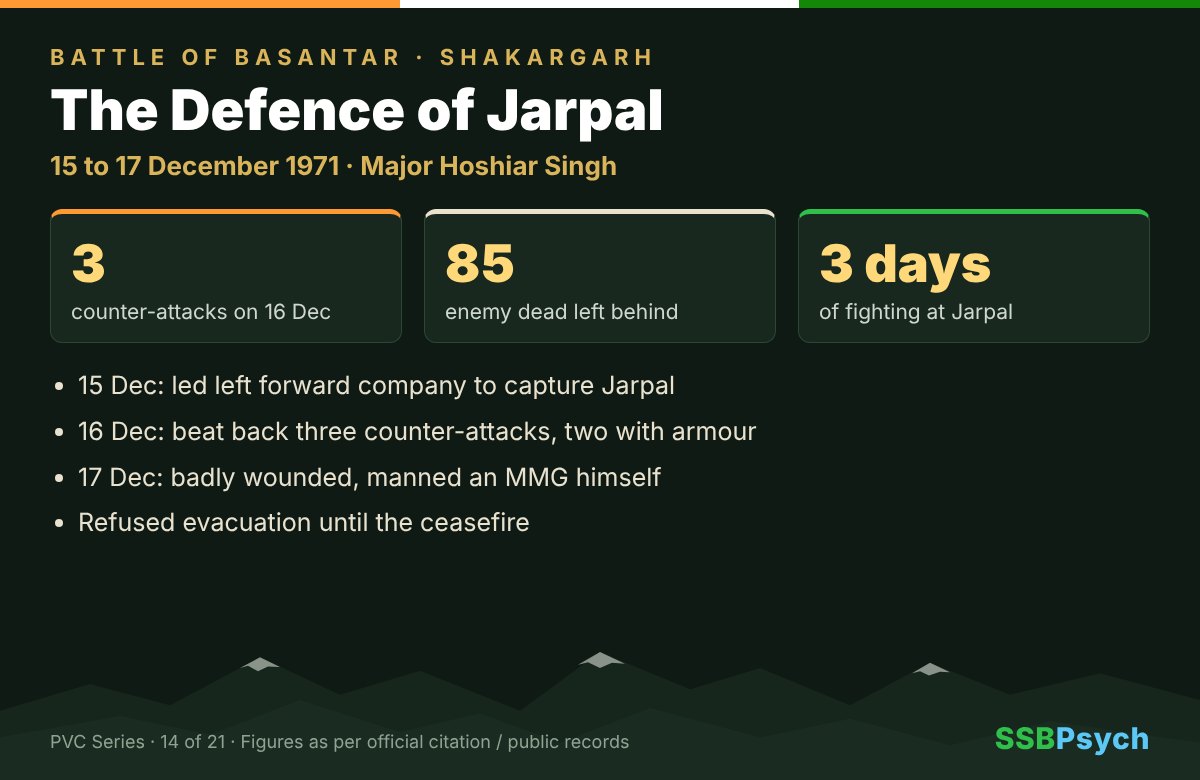
Pakistan reacted fiercely. On 16 December, the enemy launched three counter-attacks on Jarpal, two of them supported by tanks. For infantry in shallow trenches, facing tanks is terrifying. Major Hoshiar Singh did not stay in one safe spot. Ignoring the enemy fire, he moved from trench to trench, encouraging his men, steadying them and directing their fire. Every attack was beaten back.
That same day, the tanks of 17 Poona Horse were fighting a fierce armoured battle nearby to stop Pakistani armour from breaking through to the bridgehead, the battle in which Second Lieutenant Arun Khetarpal earned his Param Vir Chakra. Together, the infantry and the armour kept the bridgehead alive.
17 December: Wounded, but Still Fighting
On 17 December, the enemy tried again, this time with a full battalion attacking under heavy artillery fire. During this attack, Major Hoshiar Singh was seriously wounded. Then an enemy shell struck one of his medium machine gun posts, injuring its crew and silencing the gun at a critical moment.
Wounded as he was, Major Hoshiar Singh went to the gun and fired it himself, pouring fire into the attackers and causing heavy casualties. The enemy attack broke. When the Pakistani troops withdrew, they left behind 85 dead, including their commanding officer and three other officers.
His men urged him to be evacuated for treatment. He refused. He stayed with his company until the ceasefire came into effect on the evening of 17 December. Jarpal was still in Indian hands.
Why did Jarpal matter so much? A bridgehead is like a door pushed open into enemy territory. If the enemy recaptures the ground around it, the door slams shut, and every man and tank already across can be cut off. By holding Jarpal through three days of attacks, Major Hoshiar Singh and his Grenadiers kept that door open, and the Basantar bridgehead remained firmly in Indian hands when the war ended.
The Param Vir Chakra Citation
Major Hoshiar Singh was awarded the Param Vir Chakra. In simple language, his citation says:
- He commanded the left forward company in the task of establishing a bridgehead across the Basantar River and captured the fortified enemy position at Jarpal after fierce hand-to-hand fighting under heavy shelling and crossfire.
- When the enemy made three counter-attacks on 16 December, two of them backed by armour, he moved from trench to trench to inspire his men, and all the attacks were repulsed.
- On 17 December, when an enemy battalion attacked with heavy artillery support, he was seriously wounded, but he took over a machine gun whose crew had been hit and inflicted heavy losses on the enemy.
- The enemy retreated, leaving 85 dead, including their commanding officer and three other officers.
- He refused evacuation until the ceasefire, showing most conspicuous gallantry, an indomitable fighting spirit and outstanding leadership.
Later Life and Legacy
Unlike many Param Vir Chakra heroes, Hoshiar Singh had the chance to pass on his experience to the next generation. He served as an instructor at the Officers Training School in Madras (now Chennai) and later at the Indian Military Academy in Dehradun, where young gentlemen cadets could learn from a living PVC. He was promoted to lieutenant colonel in 1983 and went on to command his battalion. He retired on 31 May 1988 with the honorary rank of Colonel.
After retirement he settled in Jaipur but often returned to Sisana, where he encouraged many young people to join the armed forces. He died of a heart attack in Jaipur on 6 December 1998, aged 62, and was cremated with full military honours. His military tradition continued in his family: two of his sons became officers in the Grenadiers. His story was portrayed in the Doordarshan series Param Vir Chakra in the 1980s.
Note for students: do not confuse him with Brigadier Hoshiar Singh, a different officer who was killed in the 1962 war with China. The Param Vir Chakra hero of 1971 is Major (later Colonel) Hoshiar Singh Dahiya of 3 Grenadiers.
What This Means for You as an Aspirant
Major Hoshiar Singh’s battle shows that capturing an objective is not the end of a leader’s job. Holding it, keeping the men’s spirits up through fear, fatigue and wounds, and adjusting to each new threat is the harder part. In your GTO tasks, notice the same pattern: starting well matters, but assessors also watch who keeps the group going when the plan runs into trouble. And remember his journey from sepoy to Colonel. Wherever you start, steady effort and strong character can carry you far.
Lessons for SSB Aspirants: OLQs in Action
The SSB does not test whether you can recite history – it looks for the qualities of an officer. Here is how Major Hoshiar Singh showed them:
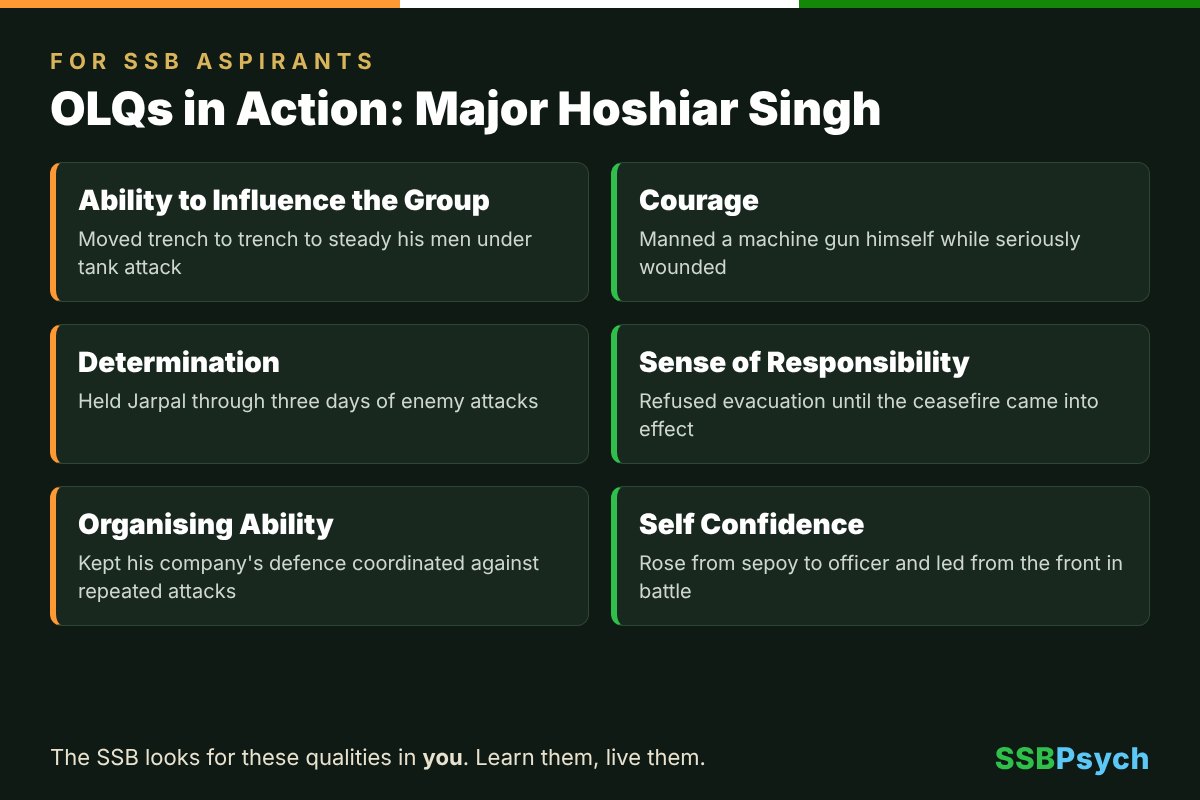
- Ability to Influence the Group – Moved trench to trench to steady his men under tank attack
- Courage – Manned a machine gun himself while seriously wounded
- Determination – Held Jarpal through three days of enemy attacks
- Sense of Responsibility – Refused evacuation until the ceasefire came into effect
- Organising Ability – Kept his company’s defence coordinated against repeated attacks
- Self Confidence – Rose from sepoy to officer and led from the front in battle
Tip for your SSB interview: If you have worked your way up in any field, such as from a junior player to team captain, speak about it honestly in the interview. Like Major Hoshiar Singh’s rise from sepoy to officer, a steady climb shows perseverance and earned leadership.
Practice Corner: WAT and SRT
Write your first spontaneous response to these before you scroll to the quiz. Keep WAT sentences short, positive and action-oriented.
WAT Words
- Trench
- Counter-attack
- Sepoy
- Grenadier
- Ceasefire
SRTs
- He has just won a hard inter-college debate round, but the next round starts in ten minutes and his team is exhausted and low. He…
- He is leading a relief camp after floods. Late at night a second wave of water threatens the camp and people begin to panic. He…
- He gets injured midway through a long expedition he is leading, and the doctor advises him to return. He…
Quiz: How Well Do You Know Major Hoshiar Singh?
Test yourself! Click an option to see if you are right. Your score updates live.
Frequently Asked Questions
Why was Major Hoshiar Singh awarded the Param Vir Chakra?
For capturing the fortified position of Jarpal in the Battle of Basantar on 15 December 1971 and holding it against repeated counter-attacks over the next two days, including manning a machine gun himself while seriously wounded and refusing evacuation until the ceasefire.
Did Major Hoshiar Singh survive the war?
Yes. He survived his wounds, continued to serve, commanded his battalion and retired as an honorary Colonel in 1988. He died in Jaipur on 6 December 1998.
Is he the same as Brigadier Hoshiar Singh of 1962?
No. Brigadier Hoshiar Singh was a different officer who was killed in the 1962 war with China. The PVC awardee is Major (later Colonel) Hoshiar Singh Dahiya of 3 Grenadiers.
What was the Battle of Basantar?
A major battle in the Shakargarh sector in December 1971 in which Indian forces crossed the Basantar River, built a bridgehead and defeated strong Pakistani counter-attacks by infantry and tanks. Two Param Vir Chakras were won there.
What can SSB aspirants learn from him?
That leadership means holding the team together through repeated setbacks, and that a person who starts in the ranks can rise high through effort and character.
The Param Vir Chakra Series on SSBPsych
This is part 14 of 21 in our series on every Param Vir Chakra awardee. A new hero goes live every morning at 7:30 AM. Also read the story of Captain Vikram Batra, PVC – the Sher Shah of Kargil.
Sources: en.wikipedia.org, theprint.in.
Preparing for your SSB? Join SSBPsych’s online and offline SSB batches and learn how to show your OLQs with confidence – explore our courses or call +91 8076540582.