Dogra Regiment: History, Motto, War Cry, Battles and Heroes
Among the infantry regiments of the Indian Army, the Dogra Regiment has a reputation that is rare and special. Its soldiers are known as the Gentlemen Warriors – men who fight with fierce courage in battle and yet stay calm, modest and well-mannered in everyday life. Drawn mostly from the hills of Himachal Pradesh, the Jammu region and the nearby districts of Punjab, the Dogras have fought on almost every front where Indian soldiers have served, from the trenches of France to the icy heights of Ladakh.
In this guide you will learn the history and lineage of the Dogra Regiment, see a clear timeline, read about its major operations and battle honours, meet its heroes, understand its motto and war cry, and find out what life in the regiment is like. At the end there is a special section for NDA, CDS and SSB aspirants and a quick quiz to test what you have learned.
Dogra Regiment – Quick Facts
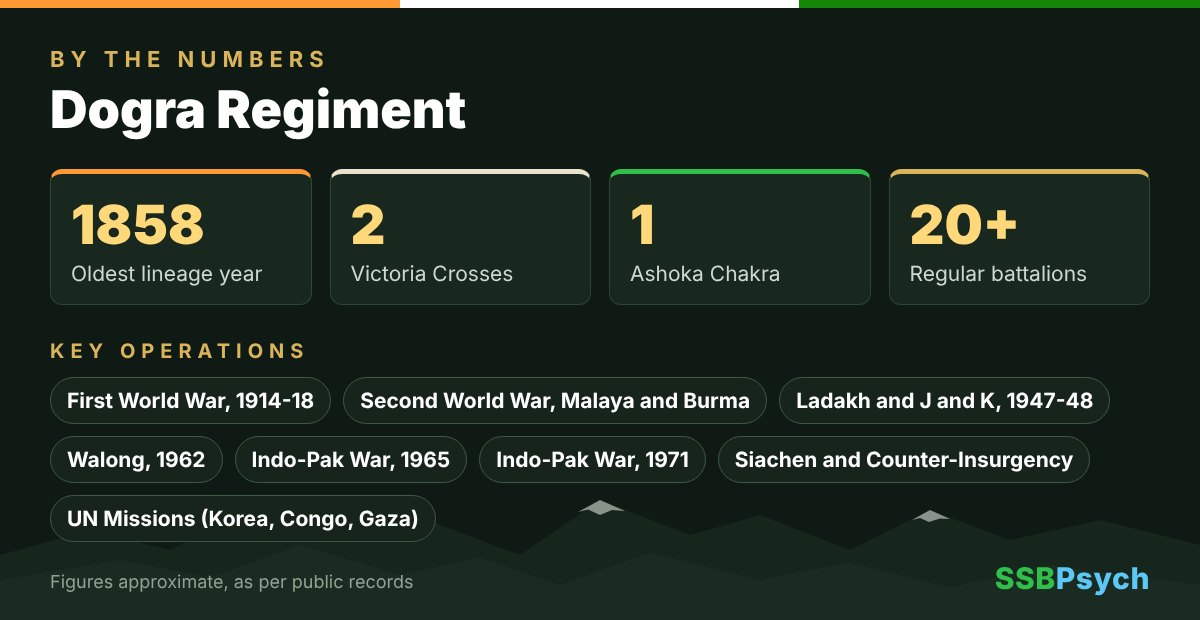
| Formed as a regiment | 1922, as the 17th Dogra Regiment (older battalions date to the 19th century) |
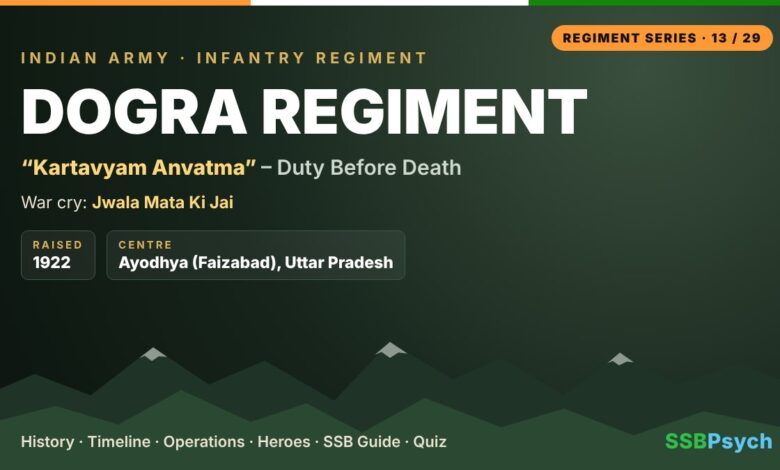
| Regimental Centre | Ayodhya (Faizabad Cantonment), Uttar Pradesh |
| Motto | Kartavyam Anvatma (Duty Before Death) |
| War Cry | Jwala Mata Ki Jai (Victory to Mother Jwala) |
| Nickname | The Gentlemen Warriors |
| Mascot | Tiger |
| Recruitment | Dogras of Himachal Pradesh, Jammu region and adjoining districts of Punjab |
| Battalions | About 20 regular battalions, plus Rashtriya Rifles and Territorial Army units |
| Pre-Independence gallantry | 2 Victoria Crosses |
| Notable gallantry | Ashoka Chakra (Capt Sandeep Sankhla) and several Maha Vir Chakras |
| Army Chief | General N C Vij |
History of the Dogra Regiment
The Dogras are a community from the hills and foothills of the Jammu region and the lower Himalayas of Himachal Pradesh. For centuries they had a strong tradition of soldiering, serving local rulers and later the Sikh and Dogra kingdoms. When the British began raising class-based battalions in the 19th century, the Dogras were recognised as hardy, disciplined and loyal soldiers who could fight well in mountains and plains alike.
The regiment traces its oldest lineage to 1858, when the Agra Levy was raised as part of the Bengal Army. This unit later became the 38th Dogras. In 1887 the 37th (Dogra) Bengal Infantry was raised, and in 1900 the 41st (Dogra) Bengal Infantry followed. These three units were the building blocks of today’s regiment. They earned honours in the North-West Frontier campaigns and then in the First World War.
In 1922 the British reorganised the Indian Army into large multi-battalion regiments. The 37th, 38th and 41st Dogras were brought together to form the 17th Dogra Regiment. In 1945 the number was dropped, and the regiment became simply the Dogra Regiment. At Independence in 1947 it was allotted to India. Its training centre, first set up during the Second World War, moved to Meerut after Independence and in 1976 shifted to Faizabad Cantonment, now in Ayodhya, Uttar Pradesh, where it remains today.
The Dogras in the World Wars
During the First World War, Dogra battalions fought in France in the bitter winter of 1914 and 1915, at places such as Festubert, Givenchy and Neuve Chapelle. They later fought in Mesopotamia (modern Iraq), Egypt and Palestine. Two Victoria Crosses were won by men of the Dogra battalions in Mesopotamia – a remarkable record for the time. In the Second World War the regiment fought in Malaya, Singapore and Burma, earning honours such as Kota Bharu, Nunshigum and Kennedy Peak.
Dogra Regiment Timeline: From Raising to Today
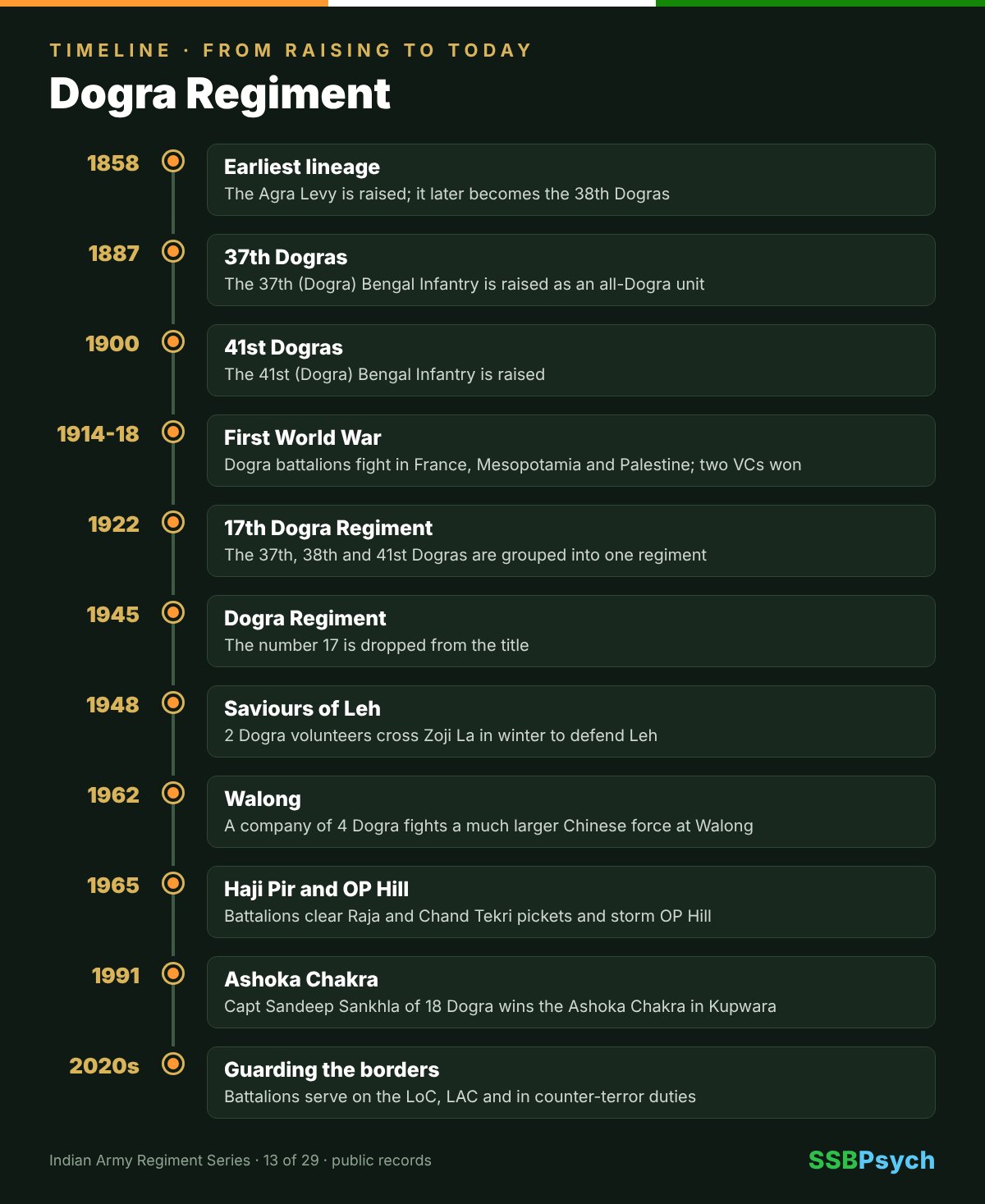
- 1858 – Earliest lineage: The Agra Levy is raised; it later becomes the 38th Dogras
- 1887 – 37th Dogras: The 37th (Dogra) Bengal Infantry is raised as an all-Dogra unit
- 1900 – 41st Dogras: The 41st (Dogra) Bengal Infantry is raised
- 1914-18 – First World War: Dogra battalions fight in France, Mesopotamia and Palestine; two VCs won
- 1922 – 17th Dogra Regiment: The 37th, 38th and 41st Dogras are grouped into one regiment
- 1945 – Dogra Regiment: The number 17 is dropped from the title
- 1948 – Saviours of Leh: 2 Dogra volunteers cross Zoji La in winter to defend Leh
- 1962 – Walong: A company of 4 Dogra fights a much larger Chinese force at Walong
- 1965 – Haji Pir and OP Hill: Battalions clear Raja and Chand Tekri pickets and storm OP Hill
- 1991 – Ashoka Chakra: Capt Sandeep Sankhla of 18 Dogra wins the Ashoka Chakra in Kupwara
- 2020s – Guarding the borders: Battalions serve on the LoC, LAC and in counter-terror duties
Major Operations and Battle Honours of the Dogra Regiment
Since Independence, the Dogra Regiment has taken part in every major war India has fought, as well as long counter-insurgency campaigns and peacekeeping missions abroad. Here are some of its most famous actions.
1947-48: The Saviours of Leh
In early 1948 the town of Leh in Ladakh was in grave danger as raiders advanced up the Indus valley. The only route from the Kashmir valley crossed the Zoji La pass, which was buried under deep winter snow. Major Thakur Prithi Chand of 2 Dogra volunteered to lead a small party of men across the pass in February 1948, an almost impossible journey at that time of year. Once in Leh, he organised local volunteers and State Forces troops, raised a militia and used raids and ambushes to hold the enemy until reinforcements arrived by air. Major Prithi Chand and his younger cousin, Major Kushal Chand, were both awarded the Maha Vir Chakra. Their stand played a key part in keeping Ladakh with India. The regiment also won honours in Jammu and Kashmir at places such as Jhangar, Rajauri and Uri.
1962: Walong
During the 1962 war with China, a company of 4 Dogra was deployed in the Walong sector in the far east of what is now Arunachal Pradesh. Facing a much larger force, the Dogras fought hard in difficult terrain with limited supplies. Walong is remembered as one of the places where Indian troops made the enemy pay a heavy price despite the odds.
1965: Raja Picket, Chand Tekri and OP Hill
In the 1965 war the regiment fought in Jammu and Kashmir and Punjab. 3 Dogra captured key heights, including the feature later called Chand Tekri, which helped open the Poonch area. In November 1965, 2 Dogra attacked the well-defended OP Hill in the Mendhar area in one of the toughest infantry assaults of the war. Other Dogra battalions fought on the Punjab front.
1971: Eastern and Western Fronts
In 1971 Dogra battalions fought on both fronts. In the east, units took part in the advance into what was then East Pakistan, earning honours such as Suadih and Siramani. In the west, battalions fought in Punjab, helping hold and push back Pakistani forces.
Siachen, Counter-Insurgency and UN Missions
4 Dogra is credited as one of the first battalions deployed on the Siachen Glacier after 1984, and Dogra units have served there many times since. The regiment has spent long tours on counter-terror duty in Jammu and Kashmir and the North-East. Abroad, Dogra battalions have served the United Nations in Korea, the Congo, the Gaza Strip and Sierra Leone, earning respect for their discipline and professionalism.
Insignia, Motto and War Cry
The regimental insignia shows a tiger. For the Dogras, the tiger has deep meaning because it is seen as the mount of Goddess Durga, who is widely worshipped in the Dogra hills. The tiger is also the regiment’s mascot and stands for strength, stealth and fearlessness.
The motto of the Dogra Regiment is Kartavyam Anvatma, which means Duty Before Death. It tells every soldier that the mission comes first, even above life itself. The war cry is Jwala Mata Ki Jai – Victory to Mother Jwala – a call to the goddess of the famous Jwalamukhi temple in Himachal Pradesh. When this cry rises before an assault, it unites the men in faith and resolve.
Heroes of the Dogra Regiment
The regiment’s honour roll includes Victoria Cross winners, Maha Vir Chakra awardees and an Ashoka Chakra hero. Here are some names every aspirant should know.
- Lance Naik Lala, Victoria Cross – 41st Dogras; rescued wounded men under heavy fire in Mesopotamia in 1916.
- Captain John Alexander Sinton, Victoria Cross – medical officer with the 37th Dogras who kept treating the wounded despite his own wounds in 1916.
- Major Thakur Prithi Chand, Maha Vir Chakra – led volunteers across Zoji La in winter 1948 and organised the defence of Leh.
- Major Kushal Chand, Maha Vir Chakra – fought alongside Prithi Chand in the defence of Ladakh, 1948.
- Subedar Bhim Chand, Vir Chakra and Bar – 2 Dogra veteran of the Ladakh campaign, decorated twice.
- Captain Sandeep Sankhla, Ashoka Chakra (posthumous) – 18 Dogra; fell fighting terrorists in Kupwara district on 8 August 1991.
- General N C Vij – Dogra officer who served as Chief of the Army Staff from 2002 to 2005.
Beyond these names, hundreds of Dogra soldiers have been decorated with the Kirti Chakra, Shaurya Chakra, Vir Chakra and Sena Medal for courage in war and counter-terror operations.
Role and Life in the Regiment
The Dogra Regiment is a line infantry regiment. Its battalions are trained to fight in high mountains, jungles, deserts and plains, and they rotate between peace stations and field areas such as the Line of Control, the Line of Actual Control and counter-insurgency zones. One of its original battalions was converted to mechanised infantry in 1981, showing how the regiment has adapted to modern warfare.
Life in a Dogra battalion is built on a close bond between officers and men. Most soldiers come from small hill villages, and many families have sent sons to the regiment for several generations. Officers learn some Dogri and Pahari phrases, take part in regimental festivals and come to know their men’s families. This family spirit is a big reason why Dogra units are known for strong discipline and high morale.
The regiment also has a Dogra Scouts battalion for high-altitude duties, Rashtriya Rifles battalions for counter-terror work in Jammu and Kashmir, and Territorial Army battalions. Its regimental song, written by Dr Karan Singh, celebrates the Dogra homeland and is sung with pride at every reunion.
The Dogra Soldier: Character and Traditions
Growing up in steep hill villages, the Dogra soldier is used to hard climbs, cold winters and simple living long before he joins the Army. This makes him naturally suited to mountain warfare, where stamina and patience matter as much as weapons. Field Marshal William Slim, who commanded Indian troops in Burma during the Second World War, is often quoted praising the Dogras for combining bravery with good manners.
Faith and family are central to regimental life. Battalions celebrate festivals together, and temples and gurdwaras in unit lines are cared for by the men themselves. Veterans stay connected through reunions at the regimental centre, and many retired soldiers return to their villages as respected community leaders. Young officers quickly learn that earning the trust of a Dogra platoon takes fairness, personal example and genuine care for the men and their families.
The regiment also keeps close links with other services and arms. It is affiliated with the Indian Navy destroyer INS Ranvijay and with artillery and armoured units, a reminder that modern battles are won by joint teamwork rather than by any single arm working alone.
Why the Dogra Regiment Inspires Young Aspirants
The story of the Dogra Regiment shows that true strength is not loud. The Gentlemen Warriors prove that a soldier can be polite, humble and kind while being utterly fearless in battle. The crossing of Zoji La in 1948 is a lesson in initiative: a small team, led by a determined officer, changed the fate of a whole region. For an officer candidate, these are exactly the qualities assessors look for – courage, responsibility, planning under pressure and the ability to inspire others.
Dogra Regiment for SSB Candidates: What You Should Know
How officers join
- Officers are not recruited by region or community; any Indian officer cadet can be commissioned into the Dogra Regiment.
- Cadets join through NDA (after Class 12), IMA via CDS, TES, TGC or ACC, or OTA Chennai via Short Service Commission.
- Arm and regiment allotment happens at the academy, based on the cadet’s choices, order of merit and available vacancies.
- After commissioning, a young officer joins a Dogra battalion and learns the language, customs and traditions of his men.
How soldiers join
- Soldiers are mainly Dogras from Himachal Pradesh, the Jammu region and adjoining districts of Punjab.
- Since 2022, new soldiers join as Agniveers under the Agnipath scheme through Army Recruiting Office rallies; check joinindianarmy.nic.in for current rules.
Questions you may face in the SSB interview, GD or lecturette
- Why are Dogra soldiers called the Gentlemen Warriors?
- What is the motto of the Dogra Regiment and what does it mean to you?
- Tell us about the defence of Leh in 1948. What leadership lessons do you take from it?
- Which infantry regiment would you like to join, and why?
- Give a short lecturette on the role of infantry in high-altitude warfare.
SSBPsych tip: In your SSB interview, link the Dogra idea of Gentlemen Warriors to your own conduct: show courtesy, calm and confidence together, and give a real example of taking initiative like Major Prithi Chand did.
Conclusion
From the Agra Levy of 1858 to the snow-bound posts of Siachen, the Dogras have lived up to their motto, Duty Before Death. Their story of quiet courage is one every future officer can learn from. Take the quiz below to check how much you remember, and keep preparing with SSBPsych for your own journey to the Indian Army.
Quiz: How Well Do You Know the Dogra Regiment?
Test yourself! Click an option to see if you are right. Your score updates live.
Dogra Regiment: Frequently Asked Questions
The motto is Kartavyam Anvatma, meaning Duty Before Death.
The war cry is Jwala Mata Ki Jai, which means Victory to Mother Jwala.
The Dogra Regimental Centre is at Faizabad Cantonment in Ayodhya, Uttar Pradesh. It moved there in 1976.
Soldiers are mainly recruited from the Dogra community of Himachal Pradesh, the Jammu region and nearby Punjab districts. Officers from any part of India can be commissioned into it after training at NDA, IMA or OTA.
It is famous for the defence of Leh in 1948, its Victoria Cross and Ashoka Chakra heroes, and for soldiers known as the Gentlemen Warriors.
Indian Army Regiments Series on SSBPsych
This is part 13 of 29 in our series on every infantry regiment of the Indian Army – a new regiment every day at 11 AM. Previous in the series: Sikh Light Infantry. Also follow our Param Vir Chakra series.
Sources: en.wikipedia.org, en.wikipedia.org, en.wikipedia.org, en.wikipedia.org, aviation-defence-universe.com.
Preparing for NDA, CDS, AFCAT or your SSB? Join SSBPsych’s online and offline batches – explore our courses or call +91 8076540582.