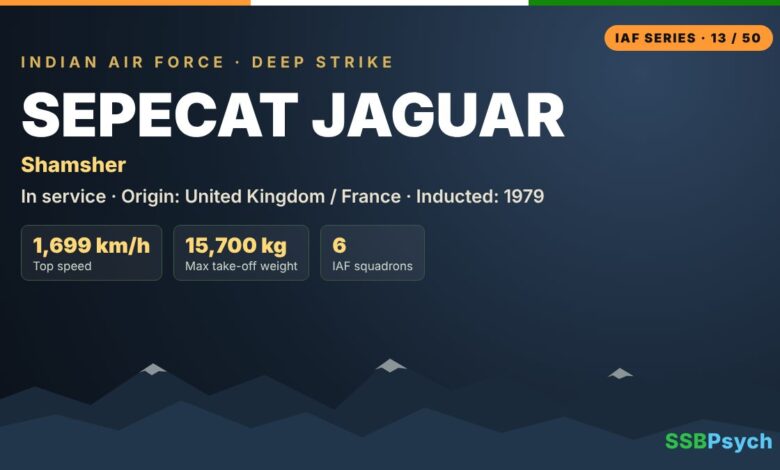
Jaguar in Indian Air Force: Shamsher Specs, Weapons, History
Picture a fighter screaming across the desert just a few dozen metres above the ground, so low that enemy radars struggle to see it, carrying bombs deep into hostile territory. That is the Jaguar, known in the Indian Air Force as Shamsher, meaning sword. For over four decades it has been the IAF’s dedicated deep penetration strike aircraft, and today India is the only air force in the world still flying it.
In this guide you will discover why India chose the Jaguar, how HAL built it at home, how its engines and speed compare with everyday things, what weapons it carries, its role in Sri Lanka and Kargil, where it is publicly reported to be based and what its future looks like. A 10-question quiz waits at the end.
Jaguar Specifications
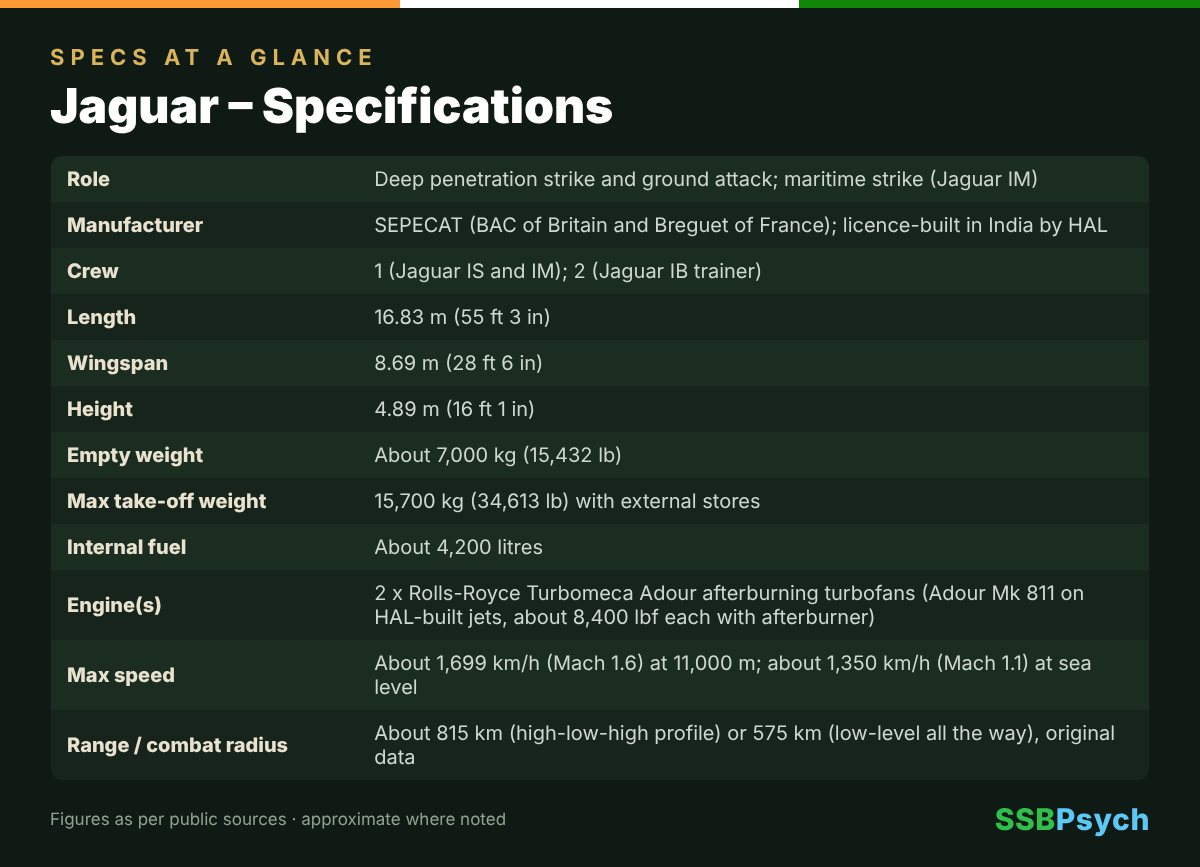
| Role | Deep penetration strike and ground attack; maritime strike (Jaguar IM) |
| Manufacturer | SEPECAT (BAC of Britain and Breguet of France); licence-built in India by HAL |
| Crew | 1 (Jaguar IS and IM); 2 (Jaguar IB trainer) |
| Length | 16.83 m (55 ft 3 in) |
| Wingspan | 8.69 m (28 ft 6 in) |
| Height | 4.89 m (16 ft 1 in) |
| Empty weight | About 7,000 kg (15,432 lb) |
| Max take-off weight | 15,700 kg (34,613 lb) with external stores |
| Internal fuel | About 4,200 litres |
| Engine(s) | 2 x Rolls-Royce Turbomeca Adour afterburning turbofans (Adour Mk 811 on HAL-built jets, about 8,400 lbf each with afterburner) |
| Max speed | About 1,699 km/h (Mach 1.6) at 11,000 m; about 1,350 km/h (Mach 1.1) at sea level |
| Range / combat radius | About 815 km (high-low-high profile) or 575 km (low-level all the way), original data |
| Service ceiling | About 14,000 m (46,000 ft) |
| Hardpoints | 7, including 2 unusual over-wing missile rails |
| First flight | 8 September 1968 |
| Inducted in IAF | July 1979 (first loaned RAF jets) |
| Number in IAF | Over 100 jets in six squadrons (approx., public estimates) |
Why India Needed the Jaguar
By the mid-1970s the IAF needed a modern strike aircraft. Its job would be to fly deep into enemy territory and hit important targets such as airfields, bridges, radar sites and supply depots. Such a mission is called deep penetration strike. The aircraft needed long range, a heavy bomb load, good navigation and, above all, the ability to fly fast and very low to stay under enemy radar cover.
The Anglo-French Jaguar, built by the SEPECAT consortium, was designed for exactly this role. In 1978 India placed a large order worth about one billion dollars. It was the biggest export order for the Jaguar, covering 40 jets built in Britain and a large number to be licence-built by Hindustan Aeronautics Limited in Bangalore. This gave HAL valuable experience in building a modern combat jet.
History of the Jaguar in the IAF
To get pilots started quickly, Britain loaned 18 Royal Air Force Jaguars. The first two became operational with the IAF in July 1979. No. 14 Squadron, the Bulls, became operational with loaned jets, and No. 5 Squadron, the Tuskers, began receiving British-built Jaguars from 1981. HAL-assembled aircraft followed, and over the years HAL built well over 100 Jaguars in India.
The IAF flies three main versions. The Jaguar IS is the single-seat strike jet. The Jaguar IB is the two-seat trainer. The Jaguar IM is a maritime strike version with a nose radar, built to hunt enemy warships with anti-ship missiles, a role that made it unusual among Jaguars worldwide.
The Jaguar saw action soon after joining. From 1987 to 1990, while the Indian Peace Keeping Force was deployed in Sri Lanka, Jaguars flew reconnaissance missions to support it. In 1999, during the Kargil War, Jaguars bombed enemy positions in the high Himalayas with both unguided and laser-guided bombs. Flying strike missions at those altitudes, among steep peaks and narrow valleys, was extremely demanding, and the Jaguar proved its worth.
DARIN upgrades: making an old jet smarter
HAL-built Jaguars came with an Indian avionics package called DARIN, short for Display Attack Ranging Inertial Navigation. It helps the pilot navigate and aim bombs accurately. Over the years this has been upgraded in stages. The latest, DARIN III, adds a modern multimode radar, an autopilot, new displays and computers. The IS version receives the Elta EL/M-2052 AESA radar, made in India by HAL under a technology transfer deal. By 2024, about 60 Jaguars had been upgraded to DARIN III.
Engine and Performance Explained Simply
The Jaguar uses two Adour turbofan engines, developed jointly by Rolls-Royce and Turbomeca. HAL-built jets use the Adour Mk 811, each giving about 8,400 pounds of thrust with afterburner. An afterburner sprays extra fuel into the exhaust for a sudden burst of power, which helps on take-off with heavy bombs.
At high altitude the Jaguar can reach about 1,699 km/h, or Mach 1.6, which means 1.6 times the speed of sound. That is over five times faster than a bullet train at 320 km/h. Down at sea level, where the air is thicker, its top speed is about 1,350 km/h, still faster than the speed of sound. Strike pilots usually fly fast and low rather than at maximum speed, because hiding from radar matters more than raw speed.
The jet is 16.83 m long, roughly the length of four cars parked in a line, but its wings are short at only 8.69 m. Short wings give a smooth, steady ride at low level, where long wings would bounce badly in turbulent air near the ground. The trade-off is that it needs a long runway when fully loaded.
Its service ceiling, the maximum height at which it can still climb usefully, is about 14,000 m, well above where airliners cruise. Fully loaded, it can weigh up to 15,700 kg at take-off, more than twice its empty weight of about 7,000 kg, so more than half its take-off weight can be fuel and weapons. On a typical high-low-high mission, cruising high to save fuel, diving low near the target and climbing again on the way home, it has a combat radius of around 815 km.
Weapons and Missiles
- Two 30 mm internal cannon
- R550 Magic short-range air-to-air missiles on over-wing rails for self-defence
- Laser-guided bombs, used in the Kargil War
- Unguided general-purpose bombs
- Sea Eagle anti-ship missile (Jaguar IM, earlier)
- AGM-84 Harpoon anti-ship missile (Jaguar IM)
- Litening targeting pod to guide laser bombs
- External drop tanks for longer missions
One quirk makes the IAF Jaguar easy to spot: its air-to-air missiles sit on rails above the wings. This keeps all the under-wing points free for bombs and fuel tanks while still giving the pilot missiles for self-defence. The IAF has moved to replace the old R550 Magic missiles with the British ASRAAM on upgraded Jaguars.
Jaguar Missions and Operations
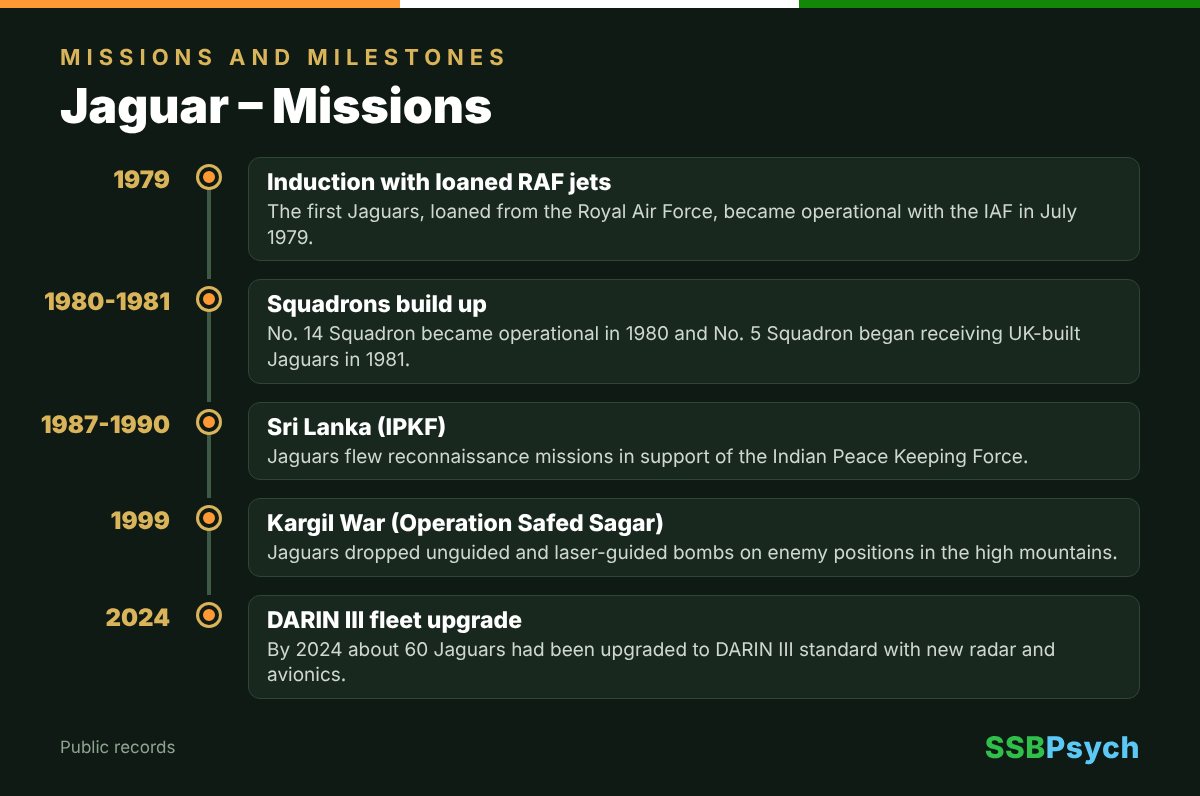
- 1979 – Induction with loaned RAF jets: The first Jaguars, loaned from the Royal Air Force, became operational with the IAF in July 1979.
- 1980-1981 – Squadrons build up: No. 14 Squadron became operational in 1980 and No. 5 Squadron began receiving UK-built Jaguars in 1981.
- 1987-1990 – Sri Lanka (IPKF): Jaguars flew reconnaissance missions in support of the Indian Peace Keeping Force.
- 1999 – Kargil War (Operation Safed Sagar): Jaguars dropped unguided and laser-guided bombs on enemy positions in the high mountains.
- 2024 – DARIN III fleet upgrade: By 2024 about 60 Jaguars had been upgraded to DARIN III standard with new radar and avionics.
How a Jaguar Strike Mission Works
To understand why the Jaguar is special, imagine a typical deep strike mission in simple steps. First, planners study the target and the enemy defences around it, and choose a route that uses hills, valleys and empty areas to hide the aircraft. The pilots then take off with full fuel tanks and a heavy load of bombs.
For the first part of the flight, the jets may cruise at medium or high altitude, where engines burn less fuel. As they near hostile territory, they drop down to very low level, sometimes only a few dozen metres above the ground. At that height, the curve of the Earth and the shape of the land block enemy radar beams, a little like ducking behind a wall to stay hidden. The navigation system and, on upgraded jets, the radar and autopilot help the pilot find the way even in poor weather.
Near the target, the pilot uses the targeting pod or the attack computer to release bombs precisely, then turns for home, staying low until out of danger before climbing again to save fuel. Every second at low level demands total concentration, because a small mistake near the ground leaves no time to recover. This is why Jaguar pilots train so hard on low flying.
Jaguar IM: the ship hunter
The maritime Jaguar IM brings the same low-flying skills over the sea. Its nose radar searches for ships, and it can fire anti-ship missiles from a distance, then turn away before the warship can respond. Flying fast and low over water is even harder than over land because there are no landmarks, so this role calls for very skilled crews.
Where the Jaguar Is Based and Who Flies It
Public sources list six Jaguar squadrons. Ambala in Haryana is home to No. 5 Squadron, the Tuskers, and No. 14 Squadron, the Bulls. Gorakhpur in Uttar Pradesh hosts No. 16 Squadron, the Cobras, and No. 27 Squadron, the Flaming Arrows. Jamnagar in Gujarat is reported as the base of No. 6 Squadron, the Dragons, which flies the maritime Jaguar IM, and No. 224 Squadron, the Warlords.
Each fighter squadron is usually commanded by a Wing Commander, supported by Squadron Leaders as flight commanders and younger Flight Lieutenants and Flying Officers. The squadrons sit at Air Force Stations commanded by Group Captains or Air Commodores.
A future Jaguar pilot joins through NDA, CDS or AFCAT, learns basic flying on the Pilatus PC-7 Mk II at the Air Force Academy, Dundigal, and then moves to the fighter stream for jet training, ending on the Hawk advanced jet trainer. After commissioning, he or she converts to the Jaguar and joins a squadron. Low-level strike flying is one of the most demanding skills in military aviation, so it takes years of steady practice before a pilot leads a strike package.
Strengths and Limitations
- Strength: designed for fast, low-level flight to sneak under enemy radar
- Strength: heavy bomb load for its size and good combat radius
- Strength: DARIN III gives modern radar, navigation and precision attack
- Strength: maritime Jaguar IM can attack ships with anti-ship missiles
- Strength: proven in combat during Kargil
- Limitation: modest engine power, so it needs long runways when fully loaded
- Limitation: weak in air-to-air combat compared with modern fighters
- Limitation: ageing fleet with spare-part challenges; several Jaguars were lost in accidents in 2025
Future of the Jaguar
Every other country has retired the Jaguar, which leaves India as its last operator. To keep the fleet flying, India has gathered spare parts from retired jets abroad, including a batch of retired Omani Jaguars acquired in 2025 and further airframes from Britain in 2026.
In 2024 the IAF announced plans to retire the oldest Jaguars between about 2028 and 2031, replacing them with modern aircraft such as the Tejas Mk1A. The rest are being upgraded with DARIN III and ASRAAM missiles so they stay useful for some years more. When the Shamsher finally retires, it will leave a legacy as the jet that built HAL’s skill in combat aircraft production and gave the IAF its first true deep-strike punch.
Why It Matters for SSB and AFCAT Aspirants
Jaguar questions appear often in AFCAT and CDS general knowledge: its Indian name Shamsher, its role as a deep penetration strike aircraft, its Anglo-French origin and the fact that HAL built it under licence. In SSB interviews, candidates who mention the Jaguar’s DARIN upgrades or its Kargil role show that they read beyond textbooks.
There is a deeper lesson too. India did not just buy jets; it insisted on building them at home and then kept improving them with Indian electronics. That approach of learning, building and upgrading is the heart of self-reliance in defence, a topic that comes up frequently in group discussions and lecturettes.
Did You Know? Jaguar Facts
- Shamsher means sword, a fitting name for a strike aircraft.
- SEPECAT was a joint company of British and French aircraft makers.
- India is now the only country still flying the Jaguar.
- IAF Jaguars carry their air-to-air missiles above the wings, an unusual layout.
- The Jaguar IM was built to attack ships with anti-ship missiles.
- DARIN stands for Display Attack Ranging Inertial Navigation.
- The first IAF Jaguars were on loan from Britain’s Royal Air Force.
Quiz: Test Your Knowledge of Jaguar
Click an option to see if you are right. Your score updates live.
Jaguar: Frequently Asked Questions
The IAF calls the SEPECAT Jaguar Shamsher, which means sword.
The Jaguar can reach about 1,699 km/h (Mach 1.6) at high altitude and about 1,350 km/h at sea level.
Yes. India is the last operator of the Jaguar, flying it with six squadrons, though the oldest jets are planned to retire between about 2028 and 2031.
It carries two 30 mm cannon, laser-guided and unguided bombs, R550 Magic air-to-air missiles above the wings, and anti-ship missiles on the maritime Jaguar IM.
DARIN III is an Indian avionics upgrade that adds a modern radar, autopilot, new displays and mission computers to the Jaguar.
This is part 13 of 50 in SSBPsych’s Indian Air Force aircraft series – a new aircraft every evening at 6 PM.
Sources: en.wikipedia.org, globalsecurity.org, en.wikipedia.org, tribuneindia.com.
Preparing for NDA, CDS, AFCAT or your SSB? Join SSBPsych’s online and offline batches – explore our courses or call +91 8076540582.