
Il-76 Gajraj in Indian Air Force: Specs, Payload, Missions
On the night of 3 November 1988, a coup erupted in the Maldives and its President urgently asked India for help. Within hours, giant Indian Air Force jets roared out of Agra carrying paratroopers, flew about 3,700 km non-stop across the ocean and landed at Male. The coup collapsed. Those jets were the Il-76, called Gajraj (king of elephants) in the IAF, and they have been India’s heavy lifters ever since.
In this guide you will learn why the IAF needed the Il-76, how big it really is, how its four engines and 20 wheels help it work from tough airfields, what it can carry, its most famous missions, where it is publicly reported to be based, and what will replace it one day. A quick quiz waits at the end to test you.
Il-76 Specifications
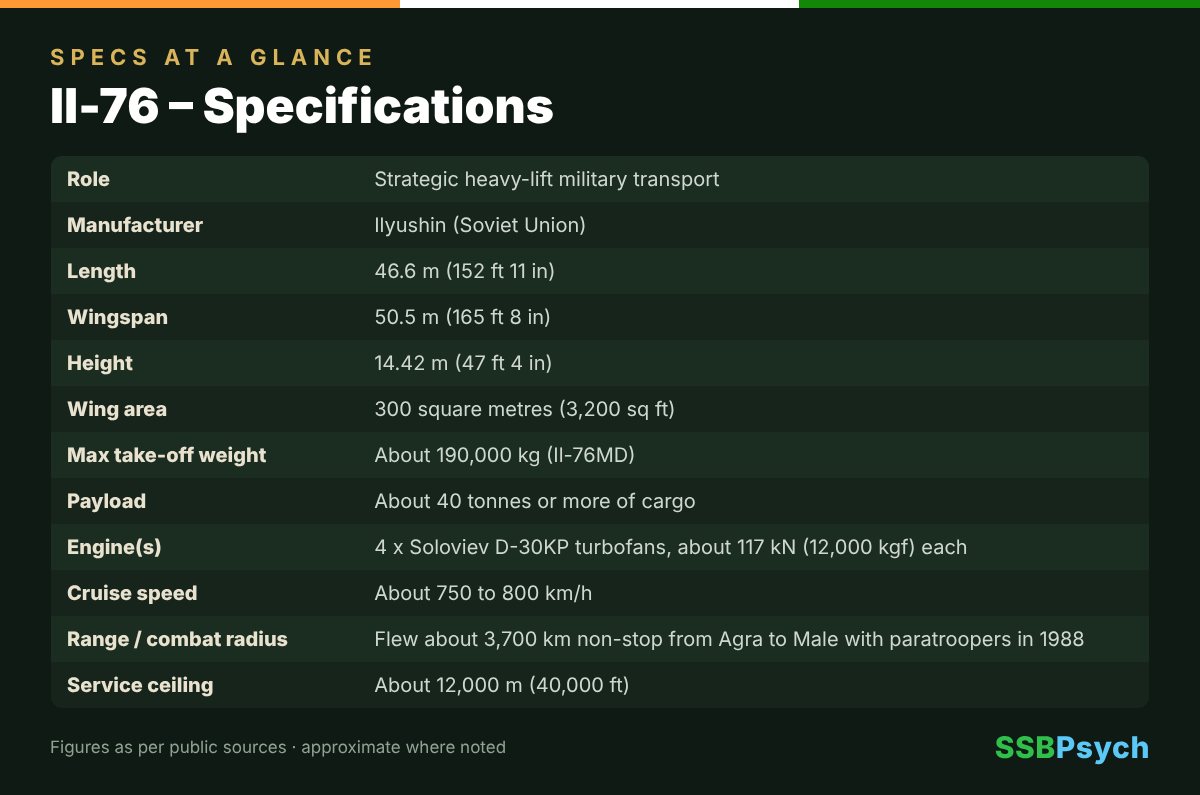
| Role | Strategic heavy-lift military transport |
| Manufacturer | Ilyushin (Soviet Union) |
| Length | 46.6 m (152 ft 11 in) |
| Wingspan | 50.5 m (165 ft 8 in) |
| Height | 14.42 m (47 ft 4 in) |
| Wing area | 300 square metres (3,200 sq ft) |
| Max take-off weight | About 190,000 kg (Il-76MD) |
| Payload | About 40 tonnes or more of cargo |
| Engine(s) | 4 x Soloviev D-30KP turbofans, about 117 kN (12,000 kgf) each |
| Cruise speed | About 750 to 800 km/h |
| Range / combat radius | Flew about 3,700 km non-stop from Agra to Male with paratroopers in 1988 |
| Service ceiling | About 12,000 m (40,000 ft) |
| Landing gear | 20 wheels, built for short and rough runways |
| First flight | 25 March 1971 |
| Inducted in IAF | 1985 |
| Number in IAF | About 17 (approx.) |
Why India Needed the Il-76
Before the Il-76, the IAF’s biggest transports were turboprops such as the Antonov An-12. They were reliable workhorses, but they were slower and carried less. India’s needs were growing. Troops had to be moved quickly to high mountain posts in Ladakh and the North East, heavy equipment had to reach remote bases, and India wanted the ability to send help far beyond its borders.
The Soviet-built Il-76 answered all of these needs. It is a jet-powered heavy transport, much faster than turboprop types, and it can carry heavy vehicles and big loads of cargo over long distances. Crucially, it was designed to land and take off from short, rough and even unpaved runways, which made it perfect for India’s mountain and forward airfields. The IAF inducted the Il-76MD in 1985 and gave it the proud name Gajraj.
History of the Il-76 Gajraj in the IAF
The Gajraj joined No. 44 Squadron, the Mighty Jets, which is publicly reported to be based at Chandigarh. This squadron has a remarkable history. In the 1971 war it used An-12 transports as makeshift bombers on the Western front, and it is the only IAF transport squadron to have received Battle Honours.
The Il-76’s moment of fame came in November 1988 with Operation Cactus. Mercenaries had attacked Male, the capital of the Maldives. The Maldivian President appealed to India for help. IAF Il-76s, escorted by Mirage 2000 fighters, flew paratroopers of the 50th Independent Parachute Brigade non-stop from Agra to Hulhule airport near Male. The first troops landed only about nine hours after the appeal, secured the airport and moved on to Male. The coup failed, and the operation is still praised worldwide as a model of fast, decisive action.
Since then, the Gajraj has been a quiet hero of countless missions. It has carried relief to disaster zones at home and abroad, including tsunami-hit Sri Lanka and Indonesia in 2004 and earthquake-hit Iran, and helped avalanche victims in Kashmir. Day after day it supplies troops in Ladakh and other remote areas with food, fuel, equipment and spare parts. During the 2020 stand-off with China in eastern Ladakh, Il-76s worked alongside C-17 and C-130J aircraft to rush troops and equipment to the mountains.
The Il-76 family in the IAF
The same basic airframe serves the IAF in three forms. The Il-76MD Gajraj is the transport. The Il-78MKI is an air-to-air refuelling tanker that tops up fighters in flight. The A-50EI carries an Israeli Phalcon radar in a large dome as an airborne early warning aircraft. Recognising this family is a common quiz question.
Engine and Performance Explained Simply
The Il-76 has four Soloviev D-30KP turbofan engines hanging under its high-mounted wings. Each produces about 117 kN of thrust, roughly the force needed to lift 12 tonnes straight up. Together they lift an aircraft that can weigh about 190 tonnes at take-off, about as heavy as a few dozen adult elephants. No wonder it is called Gajraj.
Its cruise speed is about 750 to 800 km/h, more than twice as fast as a bullet train running at 320 km/h. Delhi to Chennai, about 1,750 km by air, takes it a little over two hours. It cruises up to about 12,000 m, the same heights where airliners fly, above most bad weather.
Size-wise, it is a giant. At 46.6 m long, it is about as long as ten family cars parked bumper to bumper. Its wingspan of 50.5 m is roughly half the length of a football field, and its tail stands about 14.4 m tall, as high as a four-storey building.
The payload, meaning the useful load it carries, is about 40 tonnes or more. That could be military trucks, artillery guns, engineering equipment or hundreds of relief packages. A wide rear ramp lets vehicles drive straight in, and overhead cranes inside the hold help load heavy items without ground equipment, very useful at remote airfields.
Look at its landing gear and you will count 20 wheels. Spreading the weight across so many tyres stops the aircraft sinking into soft or rough runways, which is why it can operate from airfields that would be impossible for a normal jet of its size. The glazed nose, where a navigator sits, helps with precise navigation and airdrops.
Inside the Il-76: How an Airdrop Works
Airdrops are one of the Gajraj’s most important skills, because some places in the mountains have no runway at all. Before the flight, loadmasters strap cargo onto special platforms and attach large parachutes. Paratroopers check their equipment and sit in rows along the sides of the cavernous hold.
As the aircraft nears the drop zone, the navigator guides the pilots onto an exact line and height, and the speed is reduced. The big rear doors and ramp open, letting in a blast of cold air. For a cargo drop, the platforms roll out of the back one after another, their parachutes blooming open behind the aircraft. For a para drop, a signal light changes and the troops jump in quick order, each one’s parachute opening automatically on a static line clipped inside the aircraft.
Timing is everything. A delay of just a few seconds at a speed of a few hundred km/h can put loads hundreds of metres away from the target, perhaps on the wrong side of a ridge. That is why transport crews practise airdrops again and again, and why the navigator’s seat in the glass nose matters so much.
The same teamwork applies when the Il-76 flies relief missions. Crews must plan loads so the aircraft stays balanced, unload fast at crowded airports, and sometimes fly back with evacuees or injured people. In every case the aim is the same: get the right load to the right place at the right time, safely.
What It Carries
- No offensive weapons: it is a transport aircraft
- Up to about 40 tonnes or more of cargo in a huge pressurised hold
- Troops and paratroopers, dropped through side doors or the rear ramp
- Military vehicles, artillery guns and engineering equipment loaded via the rear ramp
- Heavy airdrops of supplies and equipment on platforms with parachutes
- Disaster relief material: tents, food, medicines and rescue teams
- Evacuation of civilians and casualties from crisis zones
Il-76 Missions and Operations
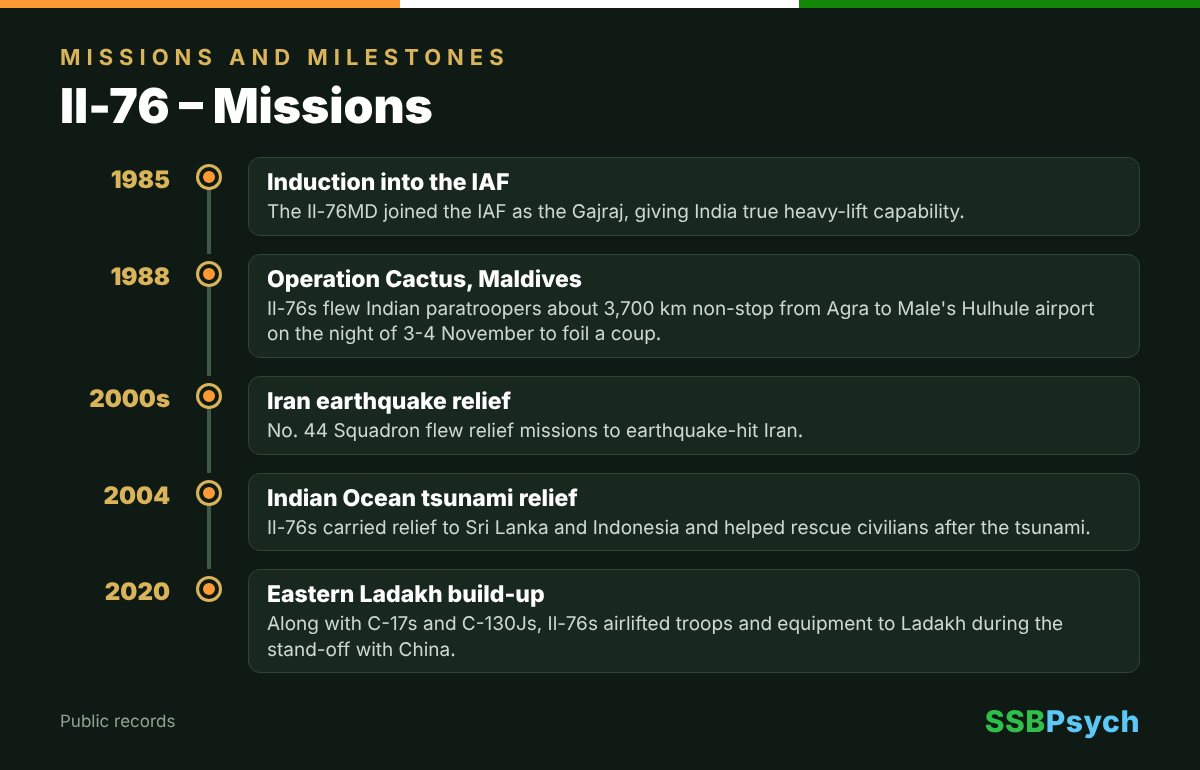
- 1985 – Induction into the IAF: The Il-76MD joined the IAF as the Gajraj, giving India true heavy-lift capability.
- 1988 – Operation Cactus, Maldives: Il-76s flew Indian paratroopers about 3,700 km non-stop from Agra to Male’s Hulhule airport on the night of 3-4 November to foil a coup.
- 2000s – Iran earthquake relief: No. 44 Squadron flew relief missions to earthquake-hit Iran.
- 2004 – Indian Ocean tsunami relief: Il-76s carried relief to Sri Lanka and Indonesia and helped rescue civilians after the tsunami.
- 2020 – Eastern Ladakh build-up: Along with C-17s and C-130Js, Il-76s airlifted troops and equipment to Ladakh during the stand-off with China.
Where the Il-76 Is Based and Who Flies It
The IAF’s Il-76MD fleet flies with No. 44 Squadron, the Mighty Jets, which public sources place at Air Force Station Chandigarh. From there it supports operations across the country, especially in the northern mountains.
A transport squadron is usually commanded by a Wing Commander. Each Il-76 needs a multi-person crew working as a team: pilots who fly the aircraft, a navigator, a flight engineer who manages engines and systems, and loadmasters who plan and secure the cargo or supervise paratroopers. Teamwork in such a crew is exactly the quality SSB assessors look for in group tasks.
A future Gajraj pilot joins through NDA, CDS or AFCAT, learns basic flying on the Pilatus PC-7 Mk II at the Air Force Academy, Dundigal, and is then streamed into transport flying. Transport trainees learn multi-engine flying on smaller aircraft before converting to heavy types like the Il-76. Typically a pilot first flies as a co-pilot and builds up experience over several years before becoming a captain, responsible for the aircraft, crew and mission.
Strengths and Limitations
- Strength: carries heavy loads of about 40 tonnes or more over long distances
- Strength: 20-wheel landing gear allows operations from short and rough airfields
- Strength: jet speed lets it react fast in emergencies, as in Operation Cactus
- Strength: rear ramp and onboard cranes allow quick loading of vehicles and heavy cargo
- Strength: proven over decades in war, peace and disaster relief
- Limitation: older-generation engines are noisy and burn a lot of fuel
- Limitation: ageing fleet needs more maintenance and spare parts
- Limitation: a larger crew is needed than on modern transports like the C-17
Future of the Il-76 in the IAF
The Gajraj has been joined by newer transports such as the American C-17 Globemaster III, which carries even more, and the C-130J Super Hercules. The Indian-built Airbus C-295 is replacing the old Avro, and the IAF is studying a new Medium Transport Aircraft for the future. As these types grow in number, the older Il-76s will gradually have less load to carry.
For now, though, the Il-76 remains a vital part of the IAF’s airlift fleet. Its rugged design suits India’s tough terrain, and its two siblings, the Il-78MKI tanker and the A-50EI radar aircraft, mean that the IAF will keep the skills and support for this family flying for years to come.
Why It Matters for SSB and AFCAT Aspirants
Operation Cactus is one of the most asked defence history topics in CDS, NDA and AFCAT general knowledge. Questions may ask which country it was in (Maldives), which year (1988) and which aircraft carried the troops (Il-76). In SSB interviews, describing how the IAF reacted within hours shows you understand the value of speed, planning and teamwork.
The Il-76 also reminds aspirants that the Air Force is not only about fighters. Transport and helicopter crews save lives in floods, earthquakes and evacuations, often under dangerous conditions. Showing respect for every branch in an interview reflects maturity and good officer-like qualities.
Did You Know? Il-76 Facts
- Gajraj means king of elephants, a perfect name for this giant.
- The Il-76 has 20 wheels to spread its weight on rough runways.
- In Operation Cactus, Il-76s flew about 3,700 km non-stop from Agra to the Maldives.
- No. 44 Squadron is the only IAF transport squadron with Battle Honours, earned in 1971.
- The IAF’s Il-78MKI tanker and A-50EI radar aircraft are based on the same airframe.
- Its wingspan of 50.5 m is about half the length of a football field.
- The navigator sits in a glass nose to help with precise navigation and airdrops.
Quiz: Test Your Knowledge of Il-76
Click an option to see if you are right. Your score updates live.
Il-76: Frequently Asked Questions
The IAF calls the Il-76MD Gajraj, meaning king of elephants. It is a four-engine heavy transport.
The Il-76 can carry about 40 tonnes or more of cargo, troops, paratroopers or vehicles, loaded through a large rear ramp.
In November 1988 IAF Il-76s flew paratroopers about 3,700 km non-stop from Agra to Male, helping India foil a coup in the Maldives within hours.
Public sources place No. 44 Squadron, the Mighty Jets, which flies the Il-76MD, at Air Force Station Chandigarh.
The Il-76 typically cruises at about 750 to 800 km/h, more than twice as fast as a bullet train.
This is part 14 of 50 in SSBPsych’s Indian Air Force aircraft series – a new aircraft every evening at 6 PM.
Sources: en.wikipedia.org, en.wikipedia.org, en.wikipedia.org, en.wikipedia.org.
Preparing for NDA, CDS, AFCAT or your SSB? Join SSBPsych’s online and offline batches – explore our courses or call +91 8076540582.