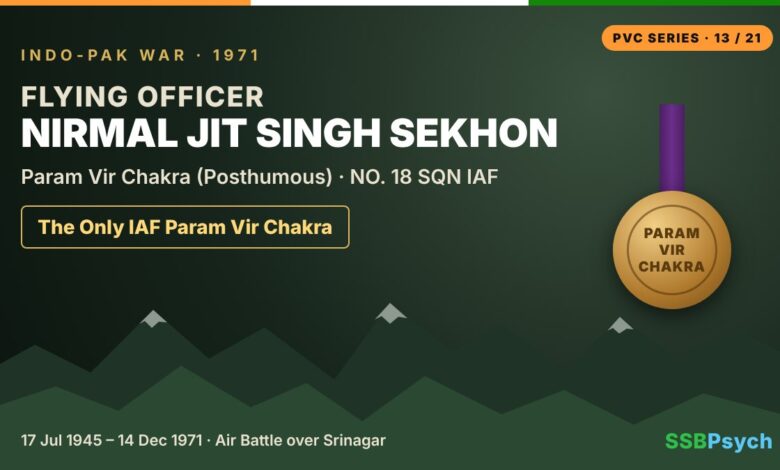
Flying Officer Nirmal Jit Singh Sekhon, PVC: The Only IAF Param Vir Chakra – Full Story (with Quiz)
On the cold morning of 14 December 1971, the people of Srinagar looked up to see a single small Indian fighter twisting and turning low over the valley among several larger enemy jets. The pilot was Flying Officer Nirmal Jit Singh Sekhon of No. 18 Squadron, the Flying Bullets. He had taken off while his own airfield was under attack and gone straight for the raiders, knowing he was badly outnumbered. He did not return, but he became the first and, to this day, the only member of the Indian Air Force to be awarded the Param Vir Chakra.
For aspirants preparing for AFCAT, the NDA air force stream or the Air Force Selection Board, Sekhon’s story is essential reading. Officers in uniform of every service share the same core qualities, and his short life shows them clearly. In this post, the thirteenth in our 21 Param Vir Chakra heroes series, we cover his early life, his path into the IAF, the background of the 1971 war in the west, a detailed account of the air battle over Srinagar, his citation in simple words, his legacy, and the officer-like qualities you can draw from him. Try the 10-question quiz at the end.
Flying Officer Nirmal Jit Singh Sekhon – Quick Facts
| Full name | Nirmal Jit Singh Sekhon |
| Born | 17 July 1945, Isewal village, Ludhiana district, Punjab |
| Father | Tarlochan Singh Sekhon, an IAF airman who rose to honorary Flight Lieutenant |
| Commissioned | 4 June 1967, Indian Air Force (fighter pilot) |
| Service number | 10877 F(P) |
| Squadron | No. 18 Squadron, the Flying Bullets |
| Aircraft | Folland Gnat |
| War | Indo-Pakistan War of 1971 |
| Battle | Defence of Srinagar airfield |
| Date of action | 14 December 1971 |
| Award | Param Vir Chakra (Posthumous) |
| Distinction | Only member of the Indian Air Force to receive the PVC |
Early Life: Born into an Air Force Family
Nirmal Jit Singh Sekhon was born on 17 July 1945 in the village of Isewal in Ludhiana district, Punjab, into a Sikh family. Aviation ran in the family. His father, Tarlochan Singh Sekhon, served in the Indian Air Force as an airman, rose to the rank of Master Warrant Officer and was given the honorary rank of Flight Lieutenant. Growing up around his father’s service, the boy saw the discipline and pride of the IAF at close quarters.
Like many young men of his generation who were stirred by the 1965 war with Pakistan, he chose a life in uniform. He went through the rigorous selection and training that every IAF officer faces, and he set his sights on the most demanding role of all: becoming a fighter pilot.
Joining the Indian Air Force: The Flying Bullets
Sekhon was commissioned into the Indian Air Force as a fighter pilot on 4 June 1967. He was posted to No. 18 Squadron, nicknamed the Flying Bullets, which flew the Folland Gnat. The Gnat was a small, light and very agile fighter. In the 1965 war, Indian Gnat pilots had done so well against Pakistan’s American-built F-86 Sabres that the little jet earned the nickname Sabre Slayer.
Colleagues remembered Sekhon as a warm, cheerful and generous young officer, popular in the squadron. By late 1971, he was a Flying Officer, still in his mid-twenties, flying from Srinagar, the only major airfield in the Kashmir Valley.
The 1971 War: Srinagar in the Firing Line
Full-scale war between India and Pakistan broke out on 3 December 1971, when Pakistan launched air strikes against several Indian air bases in the west. While the main Indian effort was in the east, where Bangladesh was being liberated, the western front saw intense fighting too.
Srinagar airfield was very important. It protected the Kashmir Valley and supported Indian troops in Jammu and Kashmir. It lay within easy reach of Pakistan Air Force bases such as Peshawar, and it was attacked several times during the war. No. 18 Squadron’s Gnats were based there to defend it. Pilots took turns on readiness duty, sitting in or near their aircraft so they could take off within moments of an alert.
The Air Battle over Srinagar
The Raid Begins
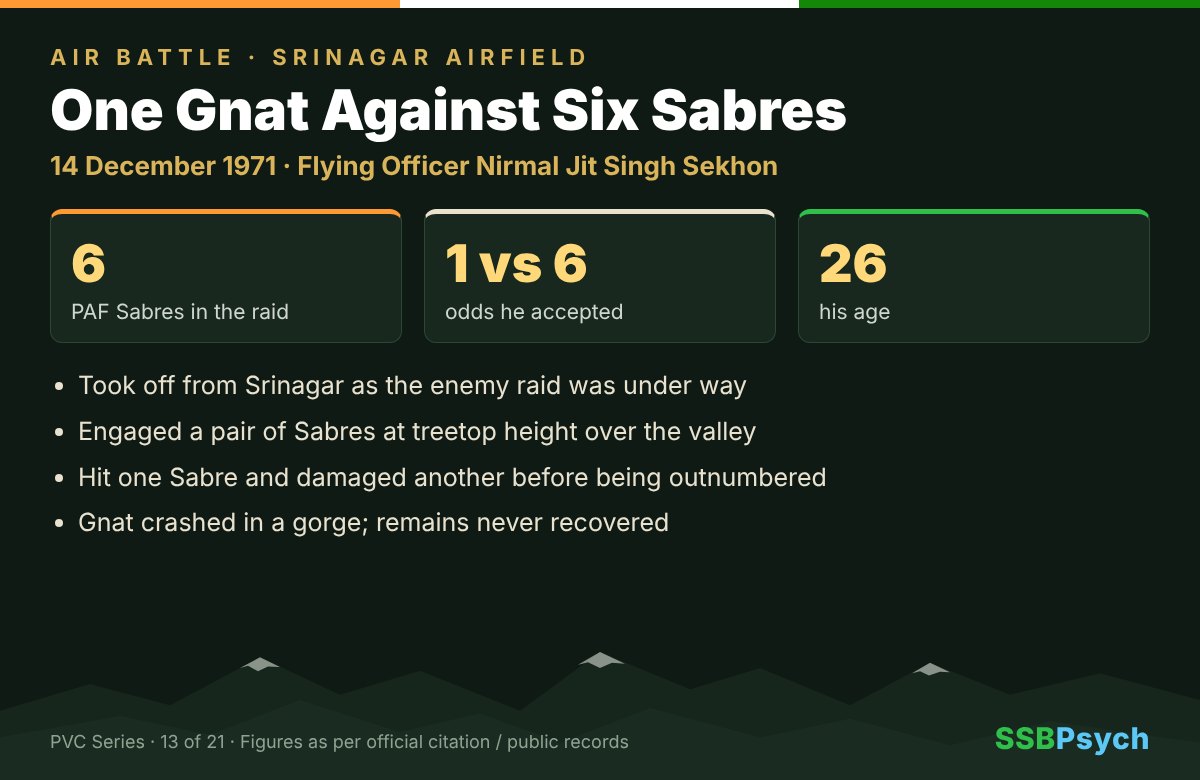
Early on the morning of 14 December 1971, six F-86 Sabres of the Pakistan Air Force, flying from Peshawar, swept in to attack Srinagar airfield. Flying Officer Sekhon was on readiness duty, paired with his leader, Flight Lieutenant B. S. Ghumman, in a two-aircraft formation.
The attackers were already over the base, bombing and strafing, when the two Gnats got airborne. Taking off from a runway under attack, with explosions and dust around, is one of the most dangerous things a fighter pilot can do. Sekhon did it anyway. Soon after take-off, in the poor visibility, the two Indian pilots lost sight of each other, and Sekhon found himself fighting alone.
Alone Against the Sabres
Sekhon went straight for the attackers and engaged a pair of Sabres. The fight took place at very low level, almost at treetop height over the valley, where one mistake could mean crashing into the ground. He scored hits on one Sabre and damaged another, which was seen trailing smoke as it headed away. As widely recounted, he told the ground controllers over the radio that he was behind two Sabres and would not let them get away.
More Sabres now turned on him. Sekhon was outnumbered heavily, at odds of about one against six by the reckoning of his citation, yet he kept fighting rather than breaking away to save himself. The air traffic controller at Srinagar advised him to come back towards the base, but by then he was locked in a battle he could not leave.
Why This Fight Was So Hard
To understand what Sekhon did, picture the situation. A fighter is most vulnerable just after take-off, when it is slow, low and heavy with fuel. The enemy, by contrast, was already at speed and ready to fight. Srinagar sits in a bowl surrounded by mountains, so there was little room to manoeuvre at low level. Visibility that morning was poor, and he had lost contact with his leader. Every one of these factors favoured the attackers. A pilot could have stayed low, avoided combat and waited for help, and no one would have blamed him. Sekhon chose to attack, because the Sabres were there to destroy his base and he was the one in a position to stop them.
The Final Moments
Finally, his Gnat was hit. Witnesses saw it fly level for a moment, then roll over and dive. Sekhon tried to eject at the last moment, but it was too late. His aircraft crashed into a gorge not far from the airfield. Because of the steep, mountainous terrain, his remains were never recovered.
Years later, the Pakistani pilot who shot him down, Salim Baig Mirza, wrote about the fight and spoke highly of Sekhon’s skill and fighting spirit. It is a rare tribute when an opponent remembers your courage with respect.
The Param Vir Chakra Citation
Flying Officer Sekhon was awarded the Param Vir Chakra posthumously. In simple words, his citation records that:
- Six enemy Sabres attacked Srinagar airfield, where he was on readiness duty.
- Despite the danger, he took off and engaged a pair of the attacking Sabres.
- He secured hits on one enemy aircraft and damaged another.
- Fighting at treetop height against odds of about one to six, he was finally overwhelmed by the enemy’s numbers.
- His heroism, flying skill and determination, far beyond the call of duty, set new heights in the traditions of the Indian Air Force.
Legacy: A Hero for Every Air Warrior
More than fifty years later, Nirmal Jit Singh Sekhon is still the only IAF officer to wear the Param Vir Chakra. Every young pilot in the Air Force learns his name. A statue of him, with a retired Gnat standing guard, stands at the district courts complex in Ludhiana. Another statue and a Gnat honour him at the Indian Air Force Museum at Palam, New Delhi.
In 2009, his name was inscribed at the Balidan Stambh war memorial in Jammu. In 2021, a bust was unveiled at the government school in his native village of Isewal, so that children there grow up knowing that a hero came from their own soil. A tanker ship was also named after him. His life was portrayed in the 1988 Doordarshan series Param Vir Chakra and in graphic novels on Param Vir Chakra heroes.
His story also reminds us that airpower is about people, not machines. The Gnat was small and the Sabres outnumbered it, but one determined pilot made sure the enemy could not attack Srinagar freely that morning.
What This Means for You as an Aspirant
If you are aiming for the flying branch, the Air Force Selection Board will test your aptitude, your psychology and your personality. Sekhon’s story shows what lies at the heart of a fighter pilot’s character: a willingness to act at once when duty calls, skill built through hard training, and the courage to keep fighting when the odds turn against you. Remember too that he was only 26. Leadership and courage are not reserved for senior officers; the young Flying Officer showed them when it mattered most.
Lessons for SSB Aspirants: OLQs in Action
The SSB does not test whether you can recite history – it looks for the qualities of an officer. Here is how Flying Officer Nirmal Jit Singh Sekhon showed them:
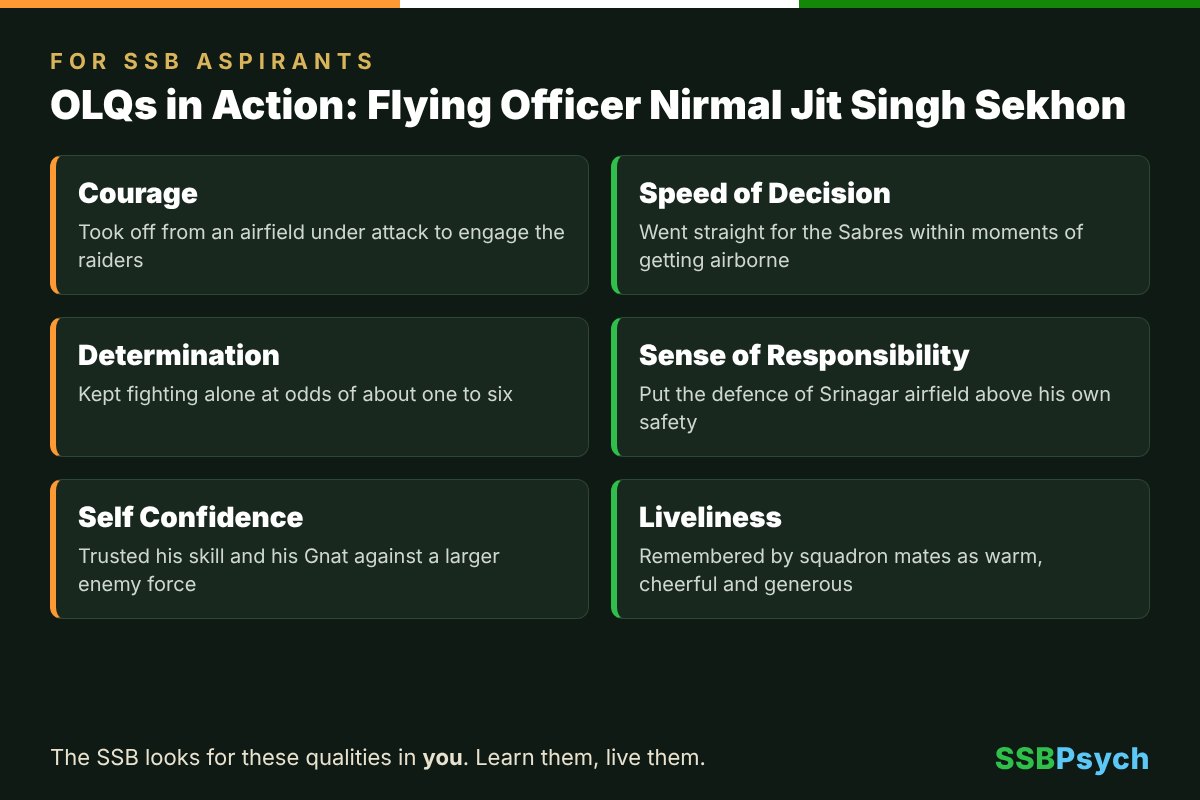
- Courage – Took off from an airfield under attack to engage the raiders
- Speed of Decision – Went straight for the Sabres within moments of getting airborne
- Determination – Kept fighting alone at odds of about one to six
- Sense of Responsibility – Put the defence of Srinagar airfield above his own safety
- Self Confidence – Trusted his skill and his Gnat against a larger enemy force
- Liveliness – Remembered by squadron mates as warm, cheerful and generous
Tip for your SSB interview: If you are applying for the flying branch, expect to be asked why you want to be a pilot. Avoid lines about uniforms and aircraft alone; explain your sense of duty with a real example, and know at least one IAF hero like Flying Officer Sekhon in detail.
Practice Corner: WAT and SRT
Write your first spontaneous response to these before you scroll to the quiz. Keep WAT sentences short, positive and action-oriented.
WAT Words
- Sky
- Runway
- Alone
- Pilot
- Odds
SRTs
- He is on duty at a hostel when a fire breaks out at night and most people are still asleep. He…
- He is leading a small team in a quiz final and his partner suddenly falls ill. He must face the strongest team alone. He…
- He is told that a task is very risky and others are reluctant to volunteer, but the task is urgent. He…
Quiz: How Well Do You Know Flying Officer Nirmal Jit Singh Sekhon?
Test yourself! Click an option to see if you are right. Your score updates live.
Frequently Asked Questions
Why was Flying Officer Nirmal Jit Singh Sekhon awarded the Param Vir Chakra?
On 14 December 1971, he took off from Srinagar airfield while it was being attacked by six PAF Sabres, engaged them alone, hit one and damaged another, and kept fighting until he was shot down.
Is Sekhon the only Air Force officer to get the Param Vir Chakra?
Yes. He is the only member of the Indian Air Force to have received India’s highest wartime gallantry award.
Which squadron did Sekhon belong to?
No. 18 Squadron of the IAF, known as the Flying Bullets, which flew Folland Gnat fighters from Srinagar in 1971.
How is Sekhon remembered today?
Through statues with Gnat aircraft in Ludhiana and at the IAF Museum, Palam, his name at the Balidan Stambh in Jammu, a bust in his village school at Isewal, and a tanker ship named after him.
What can AFCAT and NDA aspirants learn from him?
Quick decision-making, courage under pressure and a deep sense of duty, qualities that every service selection board looks for in a future officer.
The Param Vir Chakra Series on SSBPsych
This is part 13 of 21 in our series on every Param Vir Chakra awardee. A new hero goes live every morning at 7:30 AM. Also read the story of Captain Vikram Batra, PVC – the Sher Shah of Kargil.
Sources: en.wikipedia.org, www.bharat-rakshak.com, esamskriti.com.
Preparing for your SSB? Join SSBPsych’s online and offline SSB batches and learn how to show your OLQs with confidence – explore our courses or call +91 8076540582.