INS Vagsheer (S26): The Last Scorpene of Project 75 Explained
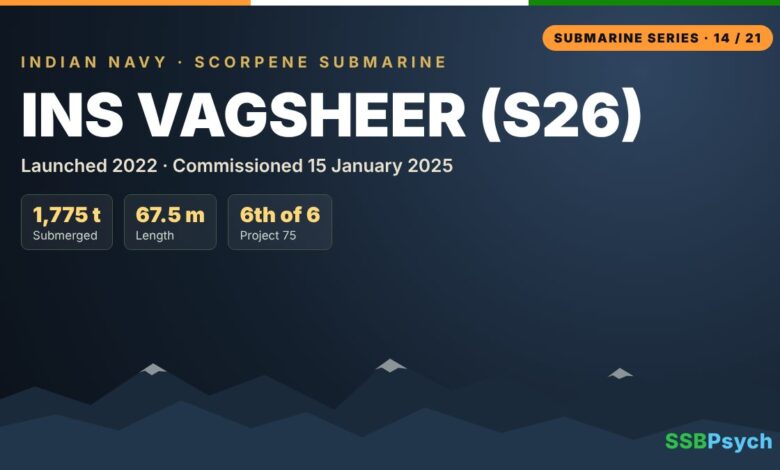
On 15 January 2025, history was made at the Naval Dockyard in Mumbai. Prime Minister Narendra Modi commissioned three frontline warships on a single day, and one of them was a silent hunter of the deep: INS Vagsheer, pennant S26. It is the sixth and final Kalvari-class Scorpene submarine, and its arrival completed Project 75, one of India’s longest and most important naval shipbuilding programmes.
In this guide, written for NDA, CDS, AFCAT and SSB aspirants, we explain INS Vagsheer in simple words: its size, weapons, crew, role, cost, dangers, life on board and the meaning of its name. Read till the end for the quiz and quick facts that make revision easy.

What Is INS Vagsheer?
INS Vagsheer is a diesel-electric attack submarine. It belongs to the Kalvari class, India’s version of the French Scorpene design developed by Naval Group. All six boats of the class were built by Mazagon Dock Shipbuilders Limited (MDL) in Mumbai under Project 75, with technology transfer from France. Vagsheer follows Kalvari, Khanderi, Karanj, Vela and Vagir.
The boat was launched on 20 April 2022 at Mazagon Dock. Following naval tradition, a woman named and launched it, with the then Defence Secretary attending as chief guest. Sea trials began in May 2023, and the submarine was delivered to the Navy in January 2025, just days before its commissioning.
INS Vagsheer Specifications
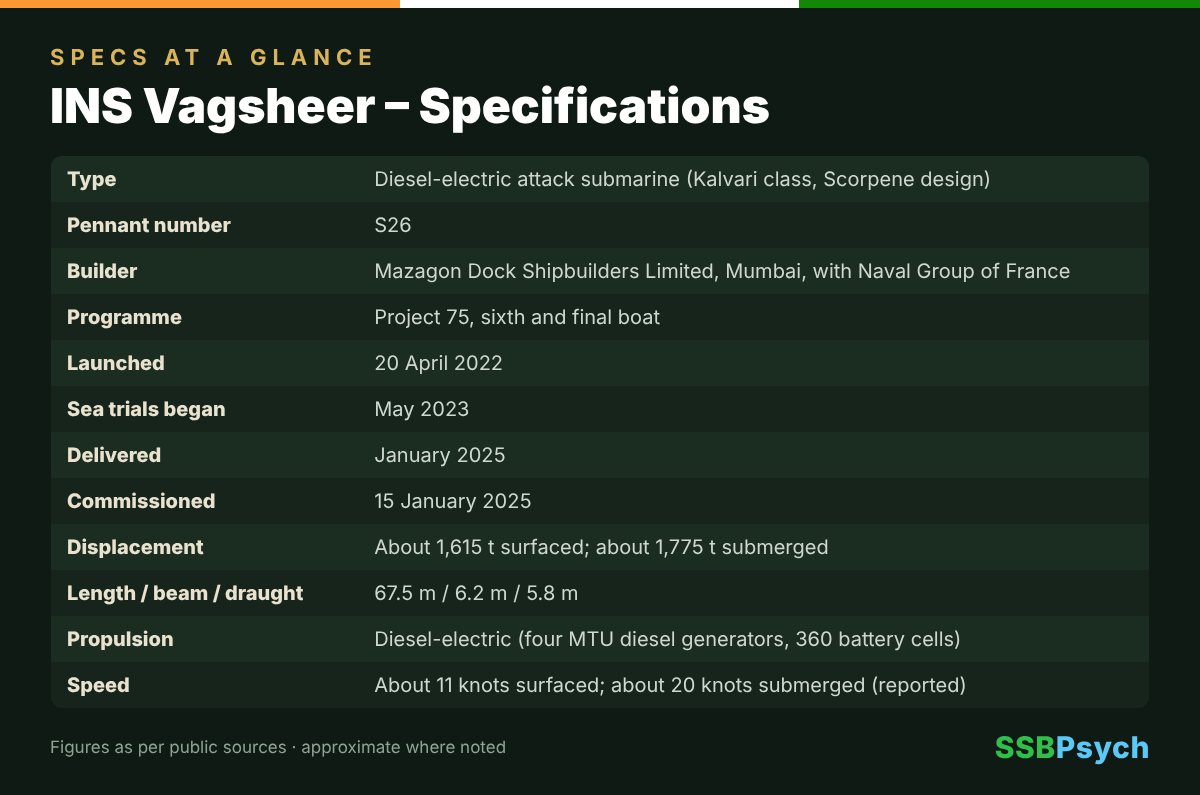
| Type | Diesel-electric attack submarine (Kalvari class, Scorpene design) |
| Pennant number | S26 |
| Builder | Mazagon Dock Shipbuilders Limited, Mumbai, with Naval Group of France |
| Programme | Project 75, sixth and final boat |
| Launched | 20 April 2022 |
| Sea trials began | May 2023 |
| Delivered | January 2025 |
| Commissioned | 15 January 2025 |
| Displacement | About 1,615 t surfaced; about 1,775 t submerged |
| Length / beam / draught | 67.5 m / 6.2 m / 5.8 m |
| Propulsion | Diesel-electric (four MTU diesel generators, 360 battery cells) |
| Speed | About 11 knots surfaced; about 20 knots submerged (reported) |
| Endurance | About 50 days at sea (reported) |
| Crew | About 43 (8 officers, 35 sailors, as reported) |
| Status | In active service |
The Day Three Warships Joined Together
The commissioning of INS Vagsheer was special because it shared the stage with two big surface warships: the destroyer INS Surat, last of the Project 15B class, and the frigate INS Nilgiri, first of the Project 17A class. Commissioning a destroyer, a frigate and a submarine together was widely described as a first for the Indian Navy. All three were built in India, sending a strong message about the country’s growing shipbuilding strength.
Size of INS Vagsheer in Everyday Terms
Vagsheer is 67.5 metres long, roughly the length of five or six city buses parked in a line, or more than three cricket pitches end to end. It is 6.2 metres wide and displaces about 1,775 tonnes when submerged. Displacement means the weight of water the boat pushes away, which is equal to its own weight. That is about as heavy as 1,400 small cars.
Compared with nuclear submarines, Vagsheer is compact. That suits it well for operating in shallower coastal waters, near choke points and along India’s long shoreline, where a smaller, quieter boat has the edge.
How Does INS Vagsheer Work?
Vagsheer is like a hybrid vehicle. Four diesel generators charge 360 battery cells when the boat is on the surface or at shallow depth with its snorkel raised to suck in air. Once it dives deep, the diesels are switched off and the boat runs on battery power through an electric motor. This makes it very quiet, which is the most valuable quality in submarine warfare.
Ballast tanks in one line
To dive, the crew floods ballast tanks with seawater to make the boat heavier; to rise, compressed air pushes the water out so the boat becomes lighter. Small fins called hydroplanes help control depth precisely.
INS Vagsheer Timeline
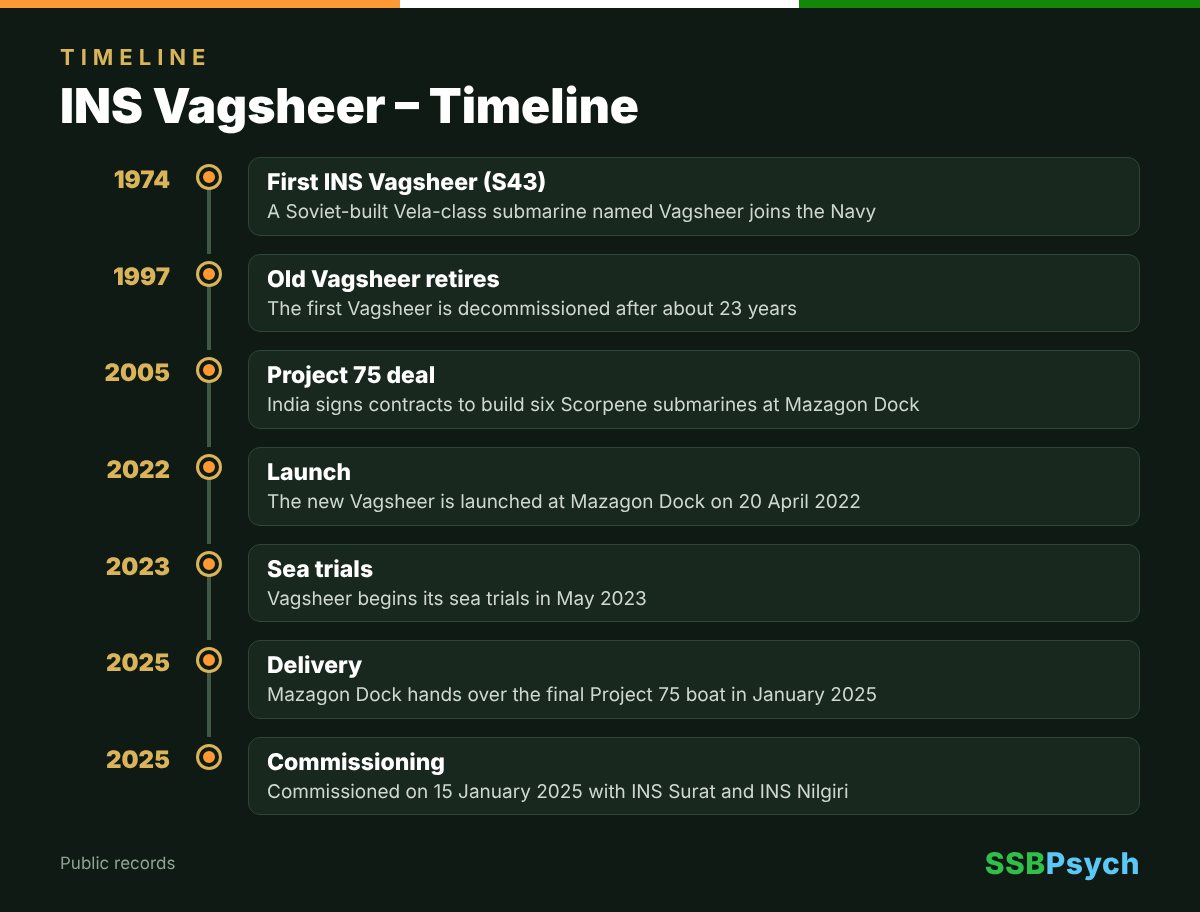
- 1974 – First INS Vagsheer (S43): A Soviet-built Vela-class submarine named Vagsheer joins the Navy
- 1997 – Old Vagsheer retires: The first Vagsheer is decommissioned after about 23 years
- 2005 – Project 75 deal: India signs contracts to build six Scorpene submarines at Mazagon Dock
- 2022 – Launch: The new Vagsheer is launched at Mazagon Dock on 20 April 2022
- 2023 – Sea trials: Vagsheer begins its sea trials in May 2023
- 2025 – Delivery: Mazagon Dock hands over the final Project 75 boat in January 2025
- 2025 – Commissioning: Commissioned on 15 January 2025 with INS Surat and INS Nilgiri
Duty and Role of INS Vagsheer
The Navy designed Kalvari-class boats to handle many kinds of missions. INS Vagsheer can be tasked with:
- Anti-surface warfare: attacking enemy ships with torpedoes and Exocet missiles.
- Anti-submarine warfare: detecting and tracking hostile submarines.
- Intelligence, surveillance and reconnaissance: watching and listening without being seen.
- Mine laying: quietly placing mines to block ports or routes.
- Area denial: making an enemy fleet think twice before entering Indian waters.
Aircraft, Weapons and Sensors
- Six 533 mm torpedo tubes
- SUT wire-guided heavyweight torpedoes (about 18 weapons, as reported)
- SM.39 Exocet anti-ship missiles launched underwater
- Sea mines (reported about 30) in place of torpedoes
- C303/S anti-torpedo decoy system
- Integrated sonar suite and combat management system
- Attack and search periscopes
The six bow torpedo tubes are the heart of Vagsheer’s firepower. The SUT torpedo is guided by a thin wire after launch. The SM.39 Exocet missile leaves the tube inside a capsule, reaches the surface and then flies low above the waves towards an enemy ship. For self-protection, decoys can be launched to confuse torpedoes fired at the submarine.
Operations and Missions
- 2022 – Launch ceremony: Launched in Mumbai with the Defence Secretary as chief guest
- 2025 – Triple commissioning: Commissioned by PM Narendra Modi with destroyer Surat and frigate Nilgiri

INS Vagsheer Name Origin
Vagsheer refers to a kind of sandfish, a deep-sea predator of the Indian Ocean. Like its sister Vagir, the name describes a hunter that waits patiently and strikes with surprise. It also keeps alive the memory of the first INS Vagsheer (S43), a Soviet-built Vela-class submarine that served the Indian Navy from 1974 to 1997. In the Navy, giving a new ship an old name is a way of saying that the spirit of the earlier crew sails on.
Why India Needed INS Vagsheer
India’s maritime interests stretch from the Gulf of Aden to the Strait of Malacca. A large part of the country’s trade and energy supplies travel through these waters. To protect them, the Navy needs enough submarines to patrol both coasts and the island territories while others are in maintenance. Older submarines had been retiring over the years, and Project 75 helped rebuild numbers with modern, quiet boats.
With Vagsheer, all six planned Scorpene boats are in service. The project also built deep skills at Mazagon Dock and among Indian suppliers, skills that matter for future submarine programmes that the Navy has been pursuing.
Project 75: A Journey of Almost Twenty Years
Vagsheer’s commissioning closed a long chapter. The Project 75 contracts were signed in October 2005. The first boat, INS Kalvari, joined the Navy only in December 2017, and the sixth, Vagsheer, in January 2025. Why so long? Building a modern submarine for the first time is extremely hard. Public reports point to several reasons for delays: some components and raw materials were not covered properly in the original deal and had to be arranged separately, the shipyard had to master new welding and outfitting techniques, and each boat needed long and careful trials before acceptance.
The good news is that the pace improved as the programme matured. Engineers and workers who struggled with the first hull were far more confident by the sixth. That learning curve is one of the most valuable outcomes of Project 75, because skills, not just steel, are what a nation needs to build its own submarines in the future.
What Comes Next for INS Vagsheer and Its Sisters?
A diesel-electric submarine has one big weakness: it must come close to the surface regularly to recharge its batteries, and that is when it is easiest to detect. To reduce this risk, India’s DRDO has developed an air independent propulsion (AIP) system based on fuel cells. AIP lets a non-nuclear submarine stay submerged for much longer without snorkelling. Public reports say the Navy plans to fit this system to Kalvari-class boats during their refits, starting with the earlier boats of the class.
Over the coming decades, Vagsheer will also receive planned maintenance periods and upgrades to sensors and weapons, as is normal for any submarine expected to serve for many years. Exact timelines for individual boats are not always public.
Crew and Command Structure
A Kalvari-class submarine is reported to have about 8 officers and 35 sailors. Such a boat is normally commanded by an officer of Commander rank, who has earned the role through years of submarine service and tough command training. An executive officer acts as second in command, and specialists manage navigation, weapons, sonar, engineering and electrical systems. Because the crew is small, everybody is trained to do more than one job.
Life on Board INS Vagsheer
A submarine is home, office and workshop rolled into one narrow tube. Crew members sleep in compact bunks, sometimes sharing them in shifts. There is no natural light underwater, so the day is measured by watch schedules. Fresh water and storage space are limited, and the smell of diesel and cooking becomes part of daily life.
- Watches rotate around the clock, so sleep comes in short blocks.
- Silent running means quiet movements and low voices.
- Constant drills keep everyone ready for fire, flooding or emergency surfacing.
- Contact with family is rare during long patrols.
- The bond among the crew becomes as strong as family.
These conditions explain why the services value calmness under pressure, adaptability and team spirit so highly, and why SSB assessors look for them.
How Deep Can INS Vagsheer Dive?
Open sources report a test depth of around 350 metres for the Scorpene design. The Navy does not publish the operating depth of its submarines, and that information is classified. Reported endurance is about 50 days, with a range of about 6,500 nautical miles at an economical speed while surfaced or snorkelling. Running fully submerged on batteries alone, the range is much shorter.
Cost of INS Vagsheer
No separate price for Vagsheer has been officially published. The publicly reported value of the whole Project 75 programme is about Rs 23,562 crore for six submarines, under contracts signed in 2005. That figure covered technology transfer, setting up production and building all six boats, so it cannot be neatly divided into one price per submarine.
Running cost drivers
There is no credible public figure for the yearly running cost. In general, the biggest expenses for a submarine like Vagsheer are diesel fuel, replacement of the large battery bank over its life, planned refits, costly torpedoes and missiles, and the long training and allowances of its specialised crew.
Dangers Submariners Face
The ocean is unforgiving. At depth, water pressure is enormous, so any hull breach is serious. Batteries can give off hydrogen gas, fuel and weapons add fire risks, and escape from a submerged boat is difficult. Submariners train repeatedly for every emergency, and the Navy maintains rescue capabilities, including deep submergence rescue vehicles, to help a submarine in distress.
Home Port and Operations
Vagsheer was built and commissioned in Mumbai, where the Kalvari boats are reported to be based under the Western Naval Command. As with all submarines, its patrol areas and operational movements are not made public.
INS Vagsheer for Exam Revision
Quick revision points: INS Vagsheer is S26, the sixth and last Kalvari-class submarine, built by Mazagon Dock under Project 75, launched on 20 April 2022 and commissioned on 15 January 2025 together with INS Surat and INS Nilgiri. It is named after a sandfish and after the Vela-class submarine Vagsheer that served from 1974 to 1997. In an SSB interview, you could connect it to the wider theme of Aatmanirbhar Bharat in defence shipbuilding.
Did You Know?
- Vagsheer was the last of the six Project 75 Scorpene submarines.
- It was commissioned on the same day as destroyer INS Surat and frigate INS Nilgiri.
- The first INS Vagsheer served the Navy from 1974 to 1997.
- Vagsheer and Vagir are both named after sandfish of the Indian Ocean.
- Project 75 contracts were signed in 2005, and the last boat joined almost 20 years later.
- The Kalvari class name refers to the tiger shark.
Quiz: Test Your Knowledge of INS Vagsheer
Click an option to see if you are right. Your score updates live.
INS Vagsheer: Frequently Asked Questions
INS Vagsheer (S26) is the sixth and last Kalvari-class diesel-electric attack submarine of the Indian Navy, built by Mazagon Dock in Mumbai under Project 75 based on the French Scorpene design.
It was commissioned on 15 January 2025 in Mumbai by Prime Minister Narendra Modi, along with destroyer INS Surat and frigate INS Nilgiri.
Vagsheer refers to a sandfish, a predator of the Indian Ocean. The name also honours the earlier INS Vagsheer (S43), which served from 1974 to 1997.
No separate price has been officially published. The full Project 75 programme for six submarines was reported at about Rs 23,562 crore under contracts signed in 2005.
A Kalvari-class submarine is reported to carry about 43 personnel, roughly 8 officers and 35 sailors.
This is part 14 of 21 in SSBPsych’s submarine series – a new post every morning at 10 AM.
Sources: en.wikipedia.org, pib.gov.in, pib.gov.in, thehindu.com, indiatoday.in.
Preparing for NDA, CDS, AFCAT or your SSB? Join SSBPsych’s online and offline batches – explore our courses or call +91 8076540582.