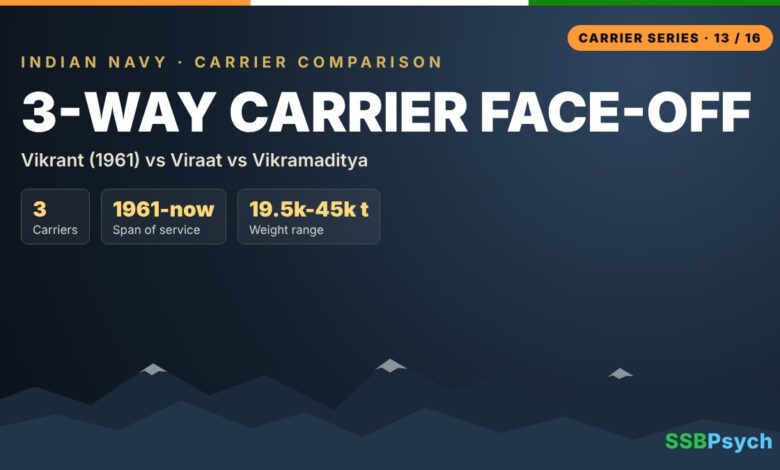
Vikrant vs Viraat vs Vikramaditya: 3-Way Carrier Face-Off
Imagine lining up three generations of Indian naval power on one sea. On the left, the 1971 war hero. In the middle, the Sea Harrier veteran. On the right, the MiG-29K giant. This is Vikrant vs Viraat vs Vikramaditya, or more precisely INS Vikrant (1961), INS Viraat and INS Vikramaditya, India’s three carriers that were all built abroad.
In this post we compare them side by side on size, weight, speed, range, crew, aircraft, launch method, origin and operations. We also explain which was better at what, and how carrier technology changed across 50 years. Perfect revision for NDA, CDS, AFCAT GK and SSB lecturettes.

Vikrant vs Viraat vs Vikramaditya: The Big Picture
All three carriers were second-hand buys. Vikrant (1961) and Viraat came from Britain, while Vikramaditya came from the former Soviet Union via Russia. Each was bigger than the one before. Vikrant weighed about 19,500 tonnes fully loaded, Viraat about 28,700 tonnes, and Vikramaditya about 45,000 tonnes. That means Vikramaditya is more than twice as heavy as the first Vikrant.
Each also used a different way of launching jets. Vikrant (1961) started with a steam catapult, Viraat used a ski-jump with Sea Harrier jump jets, and Vikramaditya uses a ski-jump with arrestor wires for normal fighters. Three ships, three launch systems: that alone tells you how fast naval aviation moved.
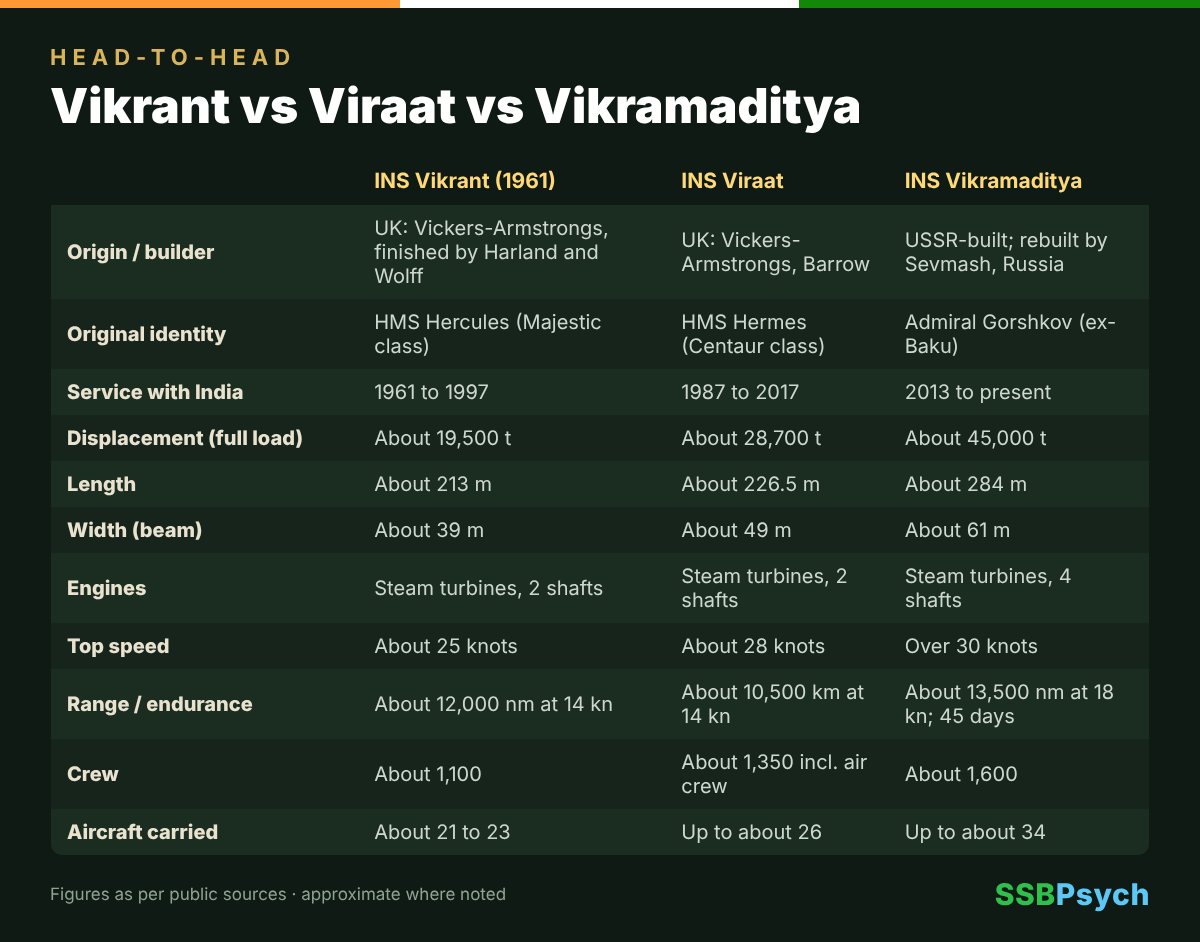
Vikrant vs Viraat vs Vikramaditya: Side-by-Side Comparison
| INS Vikrant (1961) | INS Viraat | INS Vikramaditya | |
|---|---|---|---|
| Origin / builder | UK: Vickers-Armstrongs, finished by Harland and Wolff | UK: Vickers-Armstrongs, Barrow | USSR-built; rebuilt by Sevmash, Russia |
| Original identity | HMS Hercules (Majestic class) | HMS Hermes (Centaur class) | Admiral Gorshkov (ex-Baku) |
| Service with India | 1961 to 1997 | 1987 to 2017 | 2013 to present |
| Displacement (full load) | About 19,500 t | About 28,700 t | About 45,000 t |
| Length | About 213 m | About 226.5 m | About 284 m |
| Width (beam) | About 39 m | About 49 m | About 61 m |
| Engines | Steam turbines, 2 shafts | Steam turbines, 2 shafts | Steam turbines, 4 shafts |
| Top speed | About 25 knots | About 28 knots | Over 30 knots |
| Range / endurance | About 12,000 nm at 14 kn | About 10,500 km at 14 kn | About 13,500 nm at 18 kn; 45 days |
| Crew | About 1,100 | About 1,350 incl. air crew | About 1,600 |
| Aircraft carried | About 21 to 23 | Up to about 26 | Up to about 34 |
| Main fighter | Sea Hawk, later Sea Harrier | Sea Harrier | MiG-29K |
| Launch method | Steam catapult, later ski-jump | Ski-jump (STOVL) | 14 deg ski-jump plus wires (STOBAR) |
| Reported cost | Not clearly reported | Not clearly reported | Refit about USD 2.35 bn (reported) |
| Key operations | 1961 Goa blockade; 1971 war | Falklands 1982 (as Hermes); Gulf of Aden 2009 | Fleet exercises; twin-carrier ops |
| Fate / status | Museum, scrapped 2014 to 2015 | Retired 2017, broken up at Alang | In service (Karwar) |
Carrier Jargon Made Easy
- Displacement: the weight of water a ship pushes aside when it floats. In simple words, how heavy the ship is. One tonne is about the weight of a small car.
- Knot: one nautical mile per hour, about 1.85 km per hour. So 28 knots is about 52 km per hour.
- Catapult launch (CATOBAR): a powerful catapult flings a plane off the deck, and wires catch it on landing.
- STOVL: Short Take-Off and Vertical Landing. Jump jets like the Sea Harrier take off from a short run and can land almost straight down.
- STOBAR: Short Take-Off But Arrested Recovery. Normal fighters run up a ski-jump ramp to take off and catch a steel wire with a tail hook to land.
- Ski-jump: a curved ramp at the bow that throws a jet upward, like a skier leaving a slope, so it needs a shorter run.
Meet the Three Contenders
INS Vikrant (1961): India’s First Carrier
India bought the unfinished British carrier HMS Hercules in January 1957. She had been laid down during the Second World War but was never completed for the Royal Navy. Harland and Wolff in Belfast finished her with an angled deck and a steam catapult, and she was commissioned as INS Vikrant on 4 March 1961. The name means courageous or mighty.
At about 19,500 tonnes fully loaded and about 213 metres long, she was a light carrier. Her early air wing had Hawker Sea Hawk fighter-bombers and French Breguet Alize anti-submarine planes. Her finest hour came in the 1971 war, when her Sea Hawks struck Chittagong, Cox’s Bazar, Khulna and Mongla, helping choke East Pakistan from the sea. Her crew earned two Maha Vir Chakras and twelve Vir Chakras. Later refits added a ski-jump and Sea Harrier jump jets, and she retired on 31 January 1997.
INS Viraat: The Grand Old Lady
INS Viraat started life as the British carrier HMS Hermes, commissioned into the Royal Navy in 1959. She was the flagship of the British task force in the 1982 Falklands War. India bought her in the mid-1980s and, after a refit in Britain, she was commissioned into the Indian Navy on 12 May 1987. Her name means giant.
Viraat was about 226.5 metres long and about 28,700 tonnes fully loaded, with a top speed of about 28 knots. She flew Sea Harrier jump jets and Sea King anti-submarine helicopters, using a ski-jump at the bow. She served India for about 30 years and was decommissioned on 6 March 2017. Counting her British years, she spent close to six decades in naval service, which makes her one of the longest-serving carriers in history. She was later broken up at Alang in Gujarat.
INS Vikramaditya: The Rebuilt Russian Giant
INS Vikramaditya was built in the Soviet Union as Baku, later renamed Admiral Gorshkov. She was a hybrid, part cruiser and part carrier, with large missiles on her front deck. India signed the deal for her on 20 January 2004. Russia’s Sevmash yard stripped out the missiles, added a 14-degree ski-jump and arrestor wires, and rebuilt most of her insides. She was commissioned on 16 November 2013.
She is about 284 metres long and about 45,000 tonnes fully loaded, can exceed 30 knots, and is reported to carry up to about 34 aircraft, led by the MiG-29K fighter. Her steam plant gives her long legs: about 13,500 nautical miles at 18 knots and about 45 days at sea. Her home port is Karwar in Karnataka.
Aircraft, Weapons and Sensors
- Hawker Sea Hawk fighter-bombers (Vikrant 1961)
- Breguet Alize anti-submarine and patrol planes (Vikrant 1961)
- Sea Harrier jump jets after the 1980s refits (Vikrant 1961)
- 40 mm Bofors anti-aircraft guns (Vikrant 1961)
- Sea Harrier FRS51 jump jets (Viraat)
- Sea King anti-submarine helicopters (Viraat)
- Chetak and Dhruv utility helicopters (Viraat)
- Barak surface-to-air missiles (Viraat)
- MiG-29K and MiG-29KUB fighters (Vikramaditya)
- Kamov Ka-31 early-warning helicopters (Vikramaditya)
Size and Speed Compared
In length, the three carriers grow steadily: about 213 metres for Vikrant (1961), about 226.5 metres for Viraat and about 284 metres for Vikramaditya. Put Vikramaditya next to the old Vikrant and she is longer by about 70 metres, which is more than half a football pitch.
Speed rose too. Vikrant (1961) could make about 25 knots, Viraat about 28 knots, and Vikramaditya over 30 knots. Speed matters for carriers because they turn into the wind during flying operations. More wind over the deck helps heavy aircraft get airborne and slows them down on landing.
Range and Crew
Vikrant (1961) was reported to cover about 12,000 nautical miles at an economical 14 knots, a surprisingly long reach for a light carrier. Viraat’s reported range was about 10,500 km at 14 knots. Vikramaditya is reported at about 13,500 nautical miles at 18 knots, with about 45 days of endurance. Crew sizes grew from about 1,100 on Vikrant to about 1,350 on Viraat including air crew, and about 1,600 on Vikramaditya.
Aircraft and Launch Methods: Three Eras of Naval Flying
Vikrant (1961) began as a classic catapult carrier. Her Sea Hawks were flung off the deck by a steam catapult and stopped by arrestor wires. In the 1980s the Navy bought Sea Harriers, and a refit completed in 1989 removed the catapult and added a ski-jump, so the old ship could fly the new jump jets.
Viraat was built around the Sea Harrier. Because the Harrier could swivel its engine nozzles downward, it could land vertically like a helicopter. Take-off used a short run up the ski-jump. Viraat could carry up to about 26 aircraft, including Sea Kings for hunting submarines.
Vikramaditya moved to STOBAR. Her MiG-29Ks are regular high-performance fighters, not jump jets. They need the 14-degree ski-jump to take off and the arrestor wires to land. The MiG-29K is faster, carries more weapons and has a stronger radar than the old Sea Harrier, so Vikramaditya’s punch is far bigger.

Operations and Missions
- 1961 – Goa liberation (Vikrant 1961): Helped enforce a sea blockade during Operation Vijay; no combat.
- 1971 – Strikes on East Pakistan (Vikrant 1961): Sea Hawks hit Chittagong, Cox’s Bazar, Khulna and Mongla in the Bay of Bengal.
- 1982 – Falklands War, as HMS Hermes (Viraat): Flagship of the British task force before India bought her.
- 2009 – Gulf of Aden deployment (Viraat): Sent to the anti-piracy zone after a refit.
- 2016 – International Fleet Review (Viraat): Took part in the review at Visakhapatnam in her final year.
- 2016 – First foreign visits (Vikramaditya): Port calls at Colombo and Male.
- 2020 – Naval Tejas landing (Vikramaditya): Hosted the first deck landing of the naval LCA Tejas.
- 2024 – Exercise with Italy (Vikramaditya): Sailed with the Italian carrier Cavour in the Arabian Sea.
Combat and Operations
Only one of the three has fought a full war under the Indian flag: Vikrant (1961). In December 1971 her aircraft hit ports and shipping in East Pakistan, supporting the naval blockade that helped create Bangladesh. That record makes her the most celebrated Indian carrier of all.
Viraat had seen war before India bought her, as HMS Hermes in the Falklands. In Indian service she spent three decades as the centre of fleet exercises, trained generations of naval pilots and was deployed to the Gulf of Aden in 2009. Vikramaditya has spent her career on exercises, port visits and twin-carrier operations alongside Vikrant (2022), and she hosted the first deck landing of the naval Tejas in January 2020.
Which Was Better at What?
- Combat record: Vikrant (1961) wins easily, thanks to the 1971 war.
- Longest service: Viraat, close to six decades counting her Royal Navy years, and about 30 years with India.
- Size and air power: Vikramaditya, with about 34 aircraft and MiG-29K fighters.
- Speed: Vikramaditya, at over 30 knots.
- Flexibility of design: Vikrant (1961), which switched from catapult jets to jump jets in mid-career.
- Pilot training legacy: Viraat, which trained Sea Harrier pilots for decades.
How Carrier Technology Evolved From Vikrant to Vikramaditya
The first Vikrant belonged to the era of propeller planes and early jets, when catapults and small light carriers were common. By the time Viraat arrived, the British had invented the ski-jump and the Sea Harrier, a clever way for smaller carriers to fly fast jets without catapults. Vikramaditya shows the next step: a much bigger hull and a ski-jump strong enough to launch full-size fighters, giving India real air superiority at sea.
Sensors and electronics changed just as much. The old Vikrant relied on basic radars and Bofors guns. Viraat added Barak missiles for self-defence. Vikramaditya uses Ka-31 early-warning helicopters that act as flying radar towers, spotting threats far beyond the horizon.
Vikrant vs Viraat vs Vikramaditya Timeline
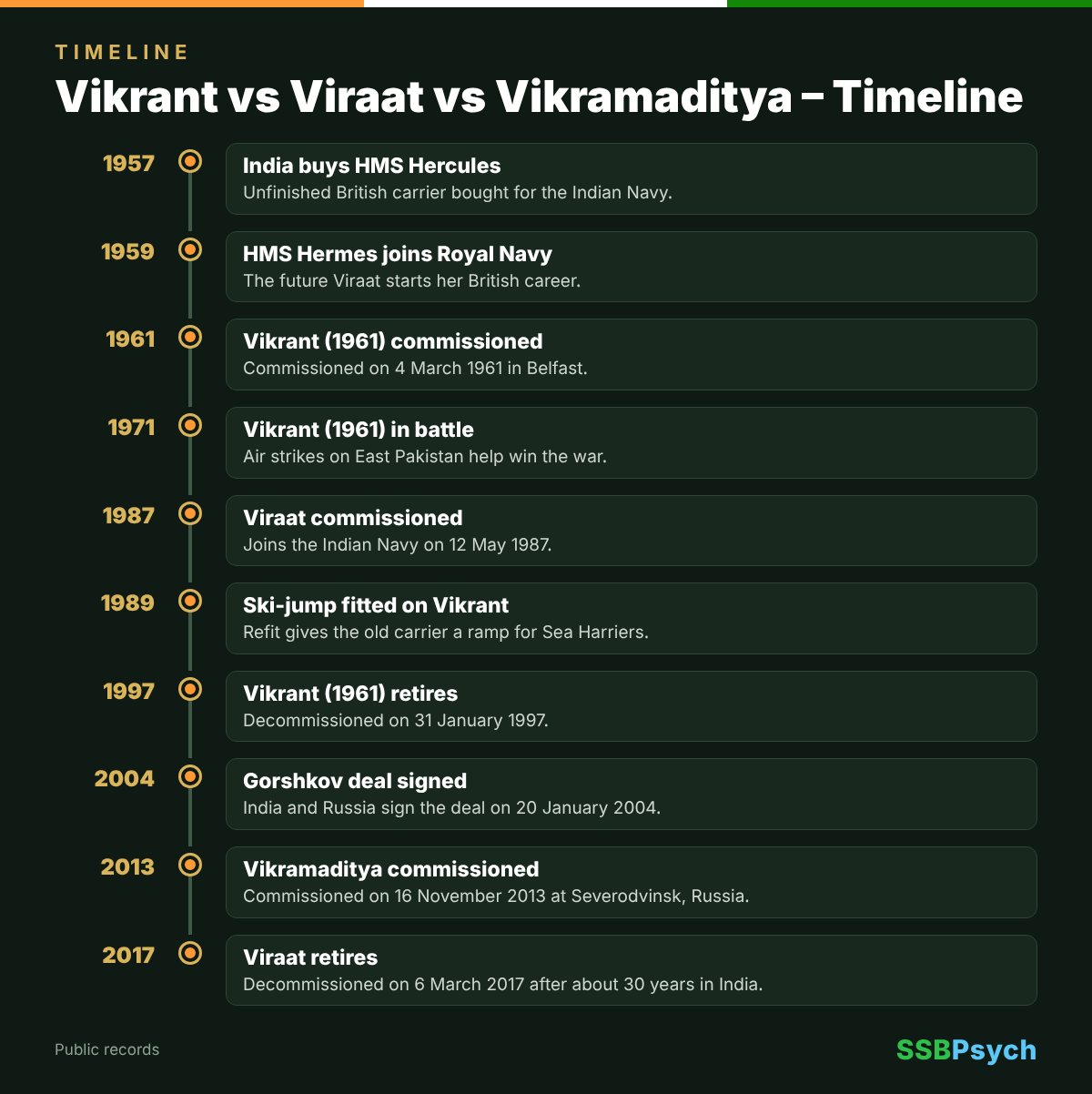
- 1957 – India buys HMS Hercules: Unfinished British carrier bought for the Indian Navy.
- 1959 – HMS Hermes joins Royal Navy: The future Viraat starts her British career.
- 1961 – Vikrant (1961) commissioned: Commissioned on 4 March 1961 in Belfast.
- 1971 – Vikrant (1961) in battle: Air strikes on East Pakistan help win the war.
- 1987 – Viraat commissioned: Joins the Indian Navy on 12 May 1987.
- 1989 – Ski-jump fitted on Vikrant: Refit gives the old carrier a ramp for Sea Harriers.
- 1997 – Vikrant (1961) retires: Decommissioned on 31 January 1997.
- 2004 – Gorshkov deal signed: India and Russia sign the deal on 20 January 2004.
- 2013 – Vikramaditya commissioned: Commissioned on 16 November 2013 at Severodvinsk, Russia.
- 2017 – Viraat retires: Decommissioned on 6 March 2017 after about 30 years in India.
Who Commands a Carrier?
An Indian aircraft carrier is commanded by an officer of Captain rank. Below the captain are heads of departments for navigation, engineering, electrical systems, weapons, logistics, medical care and aviation. More than a thousand sailors and officers live aboard, along with pilots and aircraft technicians. Every carrier is effectively a floating town with kitchens, a hospital, workshops and its own power station.
The Verdict: Vikrant vs Viraat vs Vikramaditya
If these three were cricketers, Vikrant (1961) would be the legend who won a famous series, Viraat the long-serving captain who played forever, and Vikramaditya the modern all-rounder who hits harder than both. In a straight fight, Vikramaditya wins on size, speed and firepower. But for history and heart, the 1971 hero Vikrant still holds a special place, and Viraat takes the medal for loyalty and longevity.
Remember for exams: Vikrant (1961) was ex-HMS Hercules, Viraat was ex-HMS Hermes, and Vikramaditya was ex-Admiral Gorshkov.
Did You Know?
- Vikrant (1961) was laid down in 1943 as HMS Hercules but was never finished for Britain.
- The first Sea Harrier landed on Vikrant (1961) on 20 December 1983.
- Metal from Vikrant (1961) was used by Bajaj to make the Bajaj V motorcycle in 2016.
- Viraat was the flagship of the British fleet in the Falklands War as HMS Hermes.
- Sea Harrier flying from Viraat ended in May 2016, before her retirement in 2017.
- Vikramaditya was a Soviet hybrid carrier-cruiser before her rebuild in Russia.
- Vikramaditya’s rebuild involved roughly 2,300 km of new cable.
Quiz: Test Your Knowledge of Vikrant vs Viraat vs Vikramaditya
Click an option to see if you are right. Your score updates live.
Vikrant vs Viraat vs Vikramaditya: Frequently Asked Questions
INS Vikrant (1961), the former HMS Hercules, commissioned on 4 March 1961.
Yes. Viraat was about 28,700 tonnes fully loaded and about 226.5 m long, against about 19,500 tonnes and 213 m for Vikrant (1961).
INS Vikrant (1961), whose aircraft struck East Pakistan in the 1971 war; her crew won two Maha Vir Chakras and twelve Vir Chakras.
The Sea Harrier fleet was ageing and small. The MiG-29K is a faster, better-armed fighter suited to the bigger STOBAR carrier Vikramaditya.
Only INS Vikramaditya. Vikrant (1961) retired in 1997 and Viraat in 2017.
This is part 13 of 16 in SSBPsych’s Indian Navy aircraft carrier series – a new post every day at 2 PM.
Sources: en.wikipedia.org, en.wikipedia.org, en.wikipedia.org.
Preparing for NDA, CDS, AFCAT or your SSB? Join SSBPsych’s online and offline batches – explore our courses or call +91 8076540582.