Sikh Light Infantry: History, Motto, War Cry and Heroes
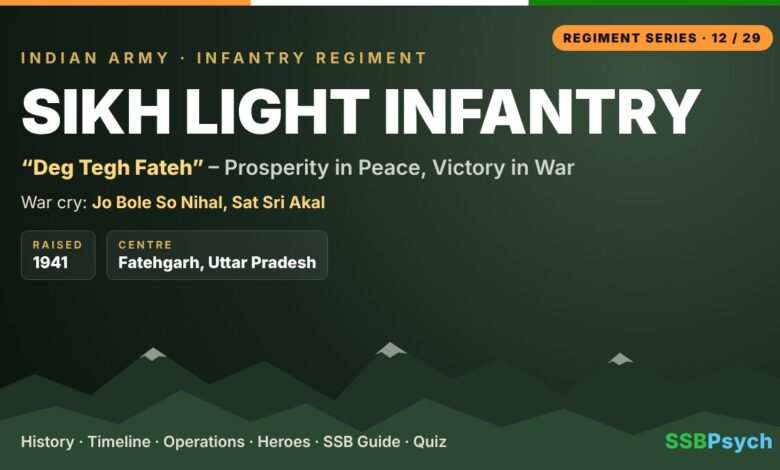
Very few regiments can say they have given the nation three Army Chiefs in just a few decades. The Sikh Light Infantry can. Raised in 1941 from the proud tradition of the old Sikh Pioneers, this regiment of Mazhabi and Ramdasia Sikhs has fought in Goa, NEFA, Kalidhar, OP Hill, Fatehpur and Jaffna, and its officers have risen to lead the entire Indian Army. Its motto, Deg Tegh Fateh, sums up its spirit: prosperity in peace and victory in war.
This guide is written for NDA, CDS, AFCAT, TES and SSB aspirants. It covers the history and lineage of the regiment, a visual timeline, major operations and battle honours, its insignia, motto and war cry, its heroes, life in the regiment, what it means for SSB candidates, and a 10-question quiz at the end.
Sikh Light Infantry – Quick Facts
| Raised | 1 October 1941 (lineage from the Sikh Pioneers of 1857) |
| Regimental Centre | Fatehgarh, Uttar Pradesh (since 1976) |
| Motto | Deg Tegh Fateh (Prosperity in peace, victory in war) |
| War Cry | Jo Bole So Nihal, Sat Sri Akal |
| Recruitment | Single class: Mazhabi and Ramdasia Sikhs, mainly from Punjab |
| Battalions | About 19 regular battalions, plus Rashtriya Rifles and Territorial Army units |
| Insignia | A chakram (quoit) with a kirpan mounted on it |
| Notable gallantry | 1 Ashoka Chakra and several Maha Vir Chakras, including an MVC and Bar |
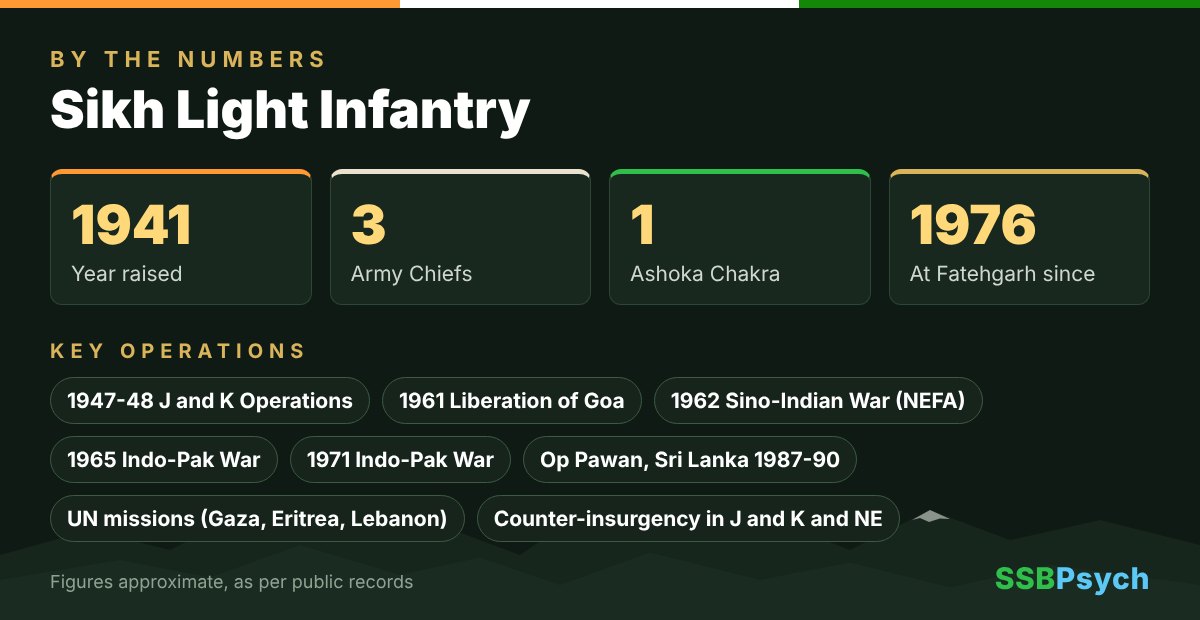
| Army Chiefs | Gen V.P. Malik, Gen Bikram Singh and Gen M.M. Naravane |
| Regimental colours | Dark blue, red and old gold |
History of the Sikh Light Infantry
The story of the regiment begins with the Sikh Pioneers of the British Indian Army. Pioneers were soldiers who could fight as infantry and also build roads, bridges and defences in difficult terrain. The 23rd, 32nd and 34th Sikh Pioneers traced their origins to 1857 and recruited Mazhabi and Ramdasia Sikhs. They served with distinction in China, Abyssinia, Afghanistan, on the North-West Frontier and in the First World War in Egypt and Palestine, earning many battle honours.
In 1922 the three pioneer regiments were merged into the 3rd Sikh Pioneers, later called the Corps of Sikh Pioneers. However, when the British decided to do away with pioneer units in the early 1930s, the corps was disbanded. This was a hard blow for the Mazhabi and Ramdasia communities, who were left with few opportunities to serve in the Army.
Raising in 1941
The Second World War created a need for more soldiers. On 1 October 1941 the 1st Battalion of a new regiment for Mazhabi and Ramdasia Sikhs was raised at Jullundur, now Jalandhar. More battalions followed in 1942 at Peshawar and Sialkot. On 23 June 1944, by royal proclamation, the regiment was named the Sikh Light Infantry. A committee had considered other names such as Sikh Fusiliers, Sikh Rifles and Sikh Grenadiers before choosing this one. The 1st Battalion fought in Burma, earning honours such as Defence of Meiktila and Sittang 1945.
In Burma, the 1st Battalion took part in the hard fighting of 1945, when the Fourteenth Army pushed the Japanese back towards Rangoon. The honours Defence of Meiktila, Rangoon Road, Pyawbwe and Sittang 1945 record its part in this campaign. Garrison battalions and companies of the regiment also served in the Middle East, Burma and the Cocos Islands before they were disbanded in 1946.
Inheriting the Pioneer Legacy
Although the regiment was new, it inherited the battle honours of the 23rd Sikh Pioneers, including Taku Forts, Pekin 1860, Abyssinia, Kabul 1879, Kandahar 1880, Chitral, Gaza and Megiddo. The regimental flag in dark blue, red and old gold was also adopted from the old pioneers, linking the soldiers of today to their forefathers.
The Journey to Fatehgarh
After independence the regiment was allotted to India. Its Regimental Centre moved several times: from Lahore to Ferozepur in 1947 and then to Meerut in 1951, where it shared a centre with the Punjab Regiment until 1963. It finally settled at Fatehgarh in Uttar Pradesh, where it was established on 7 May 1976.
Sikh Light Infantry Timeline: From Raising to Today
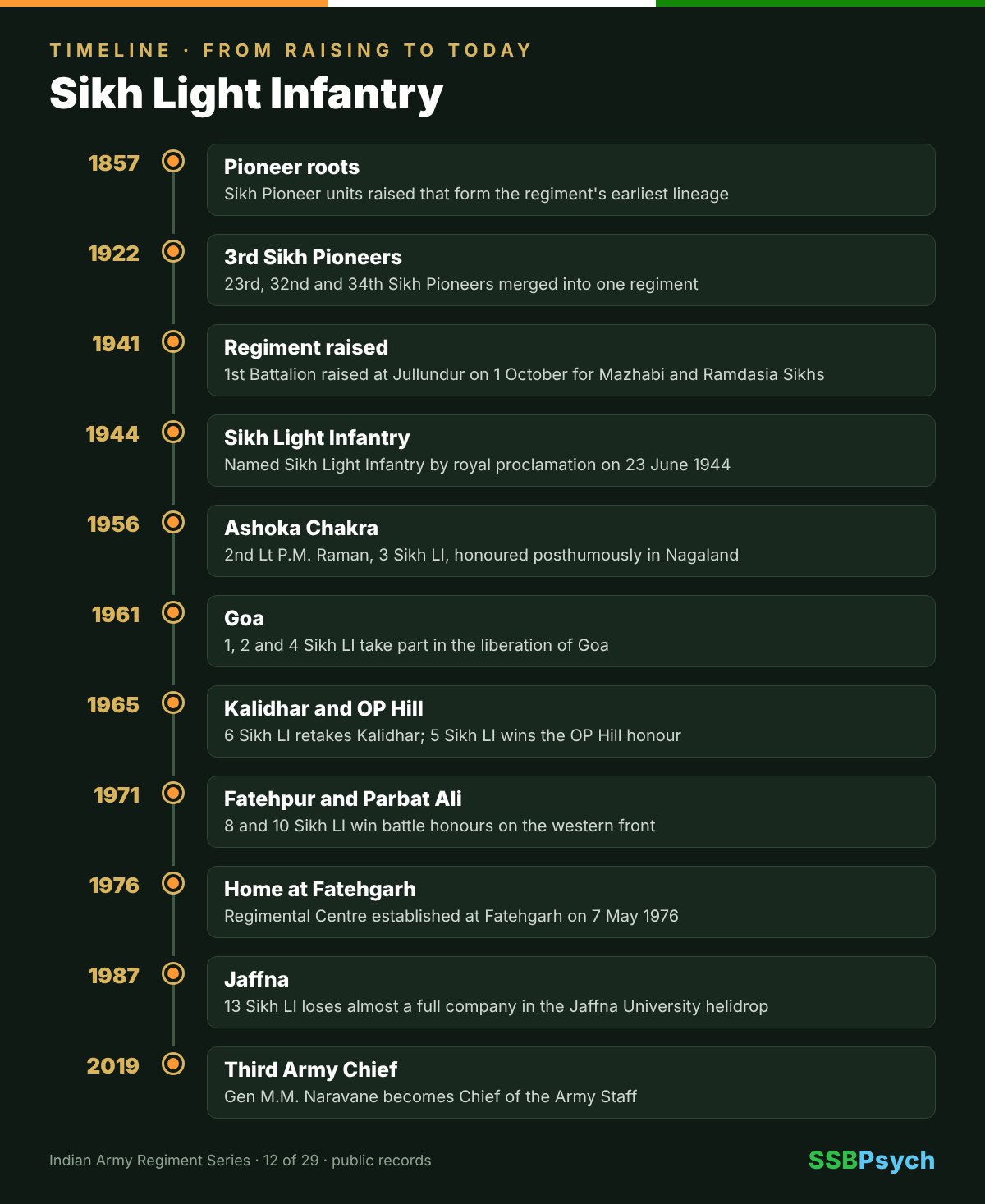
- 1857 – Pioneer roots: Sikh Pioneer units raised that form the regiment’s earliest lineage
- 1922 – 3rd Sikh Pioneers: 23rd, 32nd and 34th Sikh Pioneers merged into one regiment
- 1941 – Regiment raised: 1st Battalion raised at Jullundur on 1 October for Mazhabi and Ramdasia Sikhs
- 1944 – Sikh Light Infantry: Named Sikh Light Infantry by royal proclamation on 23 June 1944
- 1956 – Ashoka Chakra: 2nd Lt P.M. Raman, 3 Sikh LI, honoured posthumously in Nagaland
- 1961 – Goa: 1, 2 and 4 Sikh LI take part in the liberation of Goa
- 1965 – Kalidhar and OP Hill: 6 Sikh LI retakes Kalidhar; 5 Sikh LI wins the OP Hill honour
- 1971 – Fatehpur and Parbat Ali: 8 and 10 Sikh LI win battle honours on the western front
- 1976 – Home at Fatehgarh: Regimental Centre established at Fatehgarh on 7 May 1976
- 1987 – Jaffna: 13 Sikh LI loses almost a full company in the Jaffna University helidrop
- 2019 – Third Army Chief: Gen M.M. Naravane becomes Chief of the Army Staff
Major Operations and Battle Honours
Despite being one of the younger infantry regiments, the Sikh Light Infantry has taken part in every major war and operation of independent India.
1947-48 and Goa 1961
In 1948 the 1st Battalion moved to Jammu and Kashmir, the 2nd Battalion took part in the integration of Junagadh and the 3rd Battalion took part in the police action in Hyderabad. In December 1961, 1, 2 and 4 Sikh LI took part in Operation Vijay, which ended Portuguese rule in Goa. 2 Sikh LI entered Panjim on 19 December 1961.
1962: NEFA and Ladakh
In the Sino-Indian War of 1962, the 1st Battalion fought at Bomdila, the 2nd at Se La and the 4th at Jang in NEFA, while the 3rd Battalion was sent to Ladakh. The regiment suffered heavy casualties in this difficult war fought at high altitude.
1965: Kalidhar and OP Hill
In 1965, 6 Sikh LI recaptured the Kalidhar ridge in the Chhamb sector on 5 October. On 2 November, even after the ceasefire, 5 Sikh LI fought the battle of OP Hill near Naushera to clear Pakistani troops who had occupied the feature. Its Commanding Officer, Lieutenant Colonel Sant Singh, led the charge through minefields and artillery fire and was awarded the Maha Vir Chakra.
1971: All Battalions in Action
All ten battalions of the regiment took part in the 1971 war. 2 Sikh LI attacked Durgabarkati in the east on 6 December. In the west, 8 Sikh LI captured the Fatehpur post on the night of 11 December at a heavy cost, and 10 Sikh LI captured Parbat Ali in the Sindh desert on 12 to 13 December. Brigadier Sant Singh, now a sector commander on the eastern front, won a Bar to his Maha Vir Chakra for a rapid advance to Mymensingh.
Sri Lanka and Peacekeeping
Four battalions served with the Indian Peace Keeping Force in Sri Lanka. On 12 October 1987, D Company of 13 Sikh LI was landed by helicopter at Jaffna University and was surrounded by militants. Of the 30 soldiers who landed, 29 were killed fighting to the end. The regiment has also served in United Nations missions in Gaza, Ethiopia and Eritrea, and Lebanon, and has carried out long counter-insurgency tours in Jammu and Kashmir and the North East.
Sikh Light Infantry and Sikh Regiment: Know the Difference
Many aspirants mix up the Sikh Light Infantry and the Sikh Regiment. They are two different regiments. The Sikh Light Infantry was raised in 1941, recruits Mazhabi and Ramdasia Sikhs, uses the motto Deg Tegh Fateh and has its centre at Fatehgarh. The Sikh Regiment dates back to 1846, recruits Jat Sikhs, uses the motto Nischay Kar Apni Jeet Karon and has its centre at Ramgarh in Jharkhand. Both share the war cry Jo Bole So Nihal, Sat Sri Akal.
Sikh Light Infantry Insignia, Motto and War Cry
The regimental crest shows a chakram, the steel throwing quoit, with a kirpan mounted on it. Both are traditional weapons associated with the Akali Nihang warriors of Sikh history. Soldiers wear a reddish-orange lanyard and a curved brass shoulder title reading SIKH LI with a war bugle, the classic symbol of light infantry.
The motto is Deg Tegh Fateh, a phrase linked with Guru Gobind Singh. Deg refers to the cooking pot that feeds all, and Tegh to the sword that protects. Together they stand for prosperity in peace and victory in war. The war cry is Jo Bole So Nihal, Sat Sri Akal, the same cry used by the Sikh Regiment.
Heroes of the Sikh Light Infantry
Here are some of the regiment’s best known heroes and leaders.
- Second Lieutenant P.M. Raman, Ashoka Chakra (posthumous) – 3 Sikh LI, killed fighting insurgents at Chephema, Nagaland, on 3 June 1956.
- Brigadier Sant Singh, Maha Vir Chakra and Bar – won his first MVC leading the OP Hill attack in 1965 and the Bar in the 1971 war.
- Lt Col P.K. Nandagopal, Maha Vir Chakra – commanded 6 Sikh LI in the recapture of Kalidhar in 1965.
- Lt Col H.C. Pathak, Maha Vir Chakra – commanded 8 Sikh LI in the capture of Fatehpur in 1971.
- General V.P. Malik – Chief of the Army Staff from 1997 to 2000, who led the Army during the Kargil War.
- General Bikram Singh – Chief of the Army Staff from 2012 to 2014.
- General M.M. Naravane – Chief of the Army Staff from 2019 to 2022.
Role and Life in the Regiment
The Sikh Light Infantry is an infantry regiment with a light infantry tradition, built for speed, mobility and close combat. Its battalions serve in high-altitude areas, along the Line of Control, in counter-insurgency areas, in the deserts and plains of the west and in peace stations across India.
Soldiers are recruited from the Mazhabi and Ramdasia Sikh communities, mainly from Punjab and nearby states. For many families, service in the regiment has been a path of pride and opportunity across generations. Officers can come from any community and are expected to understand and respect the faith and customs of their men. Sikh traditions are part of daily life, with a gurdwara in the unit lines and the turban as part of uniform.
The Regimental Centre at Fatehgarh trains every recruit. The regiment’s uniform traditions, including the dark green turban and reddish-orange lanyard, were shaped under Lieutenant General Premindra Singh Bhagat, who became Colonel of the Regiment in 1966.
The regiment also has close links with the other two services. The Indian Navy frigate INS Teg was affiliated with the Sikh Light Infantry in 2013, and No. 17 Squadron of the Indian Air Force was affiliated in 2021. These ties help soldiers, sailors and air warriors understand each other’s work, an important idea as India’s armed forces move towards greater jointness.
Leadership at the highest level is a special source of pride. General V.P. Malik guided the Army through the Kargil War of 1999, when Indian troops evicted intruders from the heights of Kargil under very difficult conditions. Two more officers of the regiment, General Bikram Singh and General M.M. Naravane, later held the same post, an achievement that inspires every young officer who joins its battalions.
Why the Sikh Light Infantry Story Matters for SSB Aspirants
The history of the regiment is a story of resilience. A community that lost its place in the Army in the 1930s came back in 1941 and, within a few decades, produced battalions with outstanding war records and three Army Chiefs. For an SSB candidate this is a powerful example of how determination and opportunity can change destinies. The sacrifice at Jaffna in 1987 and the courage at OP Hill and Fatehpur also show the cost of duty. Use such examples to explain your own values clearly and honestly in the interview.
Sikh Light Infantry for SSB Candidates: What You Should Know
How officers join
- Officers join the infantry through the National Defence Academy (after Class 12), the Indian Military Academy (via CDS or entries such as TES after Class 12 with PCM) or the Officers Training Academy, Chennai (Short Service Commission).
- Every entry requires clearing the five-day SSB interview and a medical board.
- Arm and regiment are allotted near the end of academy training based on the cadet’s preferences, order of merit and vacancies, so no regiment is guaranteed in advance.
- Officers of any community can be commissioned into the Sikh Light Infantry.
How soldiers join
- The Sikh Light Infantry is a single class regiment that recruits Mazhabi and Ramdasia Sikhs, who must provide the required community certificates.
- Since 2022, soldiers join as Agniveers under the Agnipath scheme for four years, after which a portion (up to 25 percent as per the scheme) can be selected for regular service.
- Recruits are trained at the Sikh Light Infantry Regimental Centre at Fatehgarh.
Questions you may face in the SSB interview, GD or lecturette
- Why do you want to join the Sikh Light Infantry or the infantry?
- What is the difference between the Sikh Regiment and the Sikh Light Infantry?
- Which Army Chiefs came from the Sikh Light Infantry?
- What does Deg Tegh Fateh mean, and how does it apply to a soldier?
- Lecturette topic: The Indian Peace Keeping Force in Sri Lanka and its lessons.
SSBPsych tip: Know the clear differences between the Sikh Regiment and the Sikh Light Infantry (raising year, class composition, centre and motto); boards like to test whether your facts are precise.
From the Sikh Pioneers to the heroes of Kalidhar, Fatehpur and Jaffna, the Sikh Light Infantry has lived up to Deg Tegh Fateh. Remember its story and test yourself with the quiz below.
Quiz: How Well Do You Know the Sikh Light Infantry?
Test yourself! Click an option to see if you are right. Your score updates live.
Sikh Light Infantry: Frequently Asked Questions
The motto is Deg Tegh Fateh, meaning prosperity in peace and victory in war.
The Sikh Light Infantry Regimental Centre is at Fatehgarh in Uttar Pradesh, where it has been since 1976.
The war cry is Jo Bole So Nihal, Sat Sri Akal.
General V.P. Malik (1997 to 2000), General Bikram Singh (2012 to 2014) and General M.M. Naravane (2019 to 2022).
The Sikh Light Infantry was raised in 1941, recruits Mazhabi and Ramdasia Sikhs and has its centre at Fatehgarh. The Sikh Regiment dates to 1846, recruits Jat Sikhs and has its centre at Ramgarh, Jharkhand.
Indian Army Regiments Series on SSBPsych
This is part 12 of 29 in our series on every infantry regiment of the Indian Army – a new regiment every day at 11 AM. Previous in the series: Sikh Regiment. Also follow our Param Vir Chakra series.
Sources: en.wikipedia.org, en.wikipedia.org, en.wikipedia.org, allaboutsikhs.com.
Preparing for NDA, CDS, AFCAT or your SSB? Join SSBPsych’s online and offline batches – explore our courses or call +91 8076540582.