INS Vagir (S25): The Sandfish Submarine That Sailed to Australia
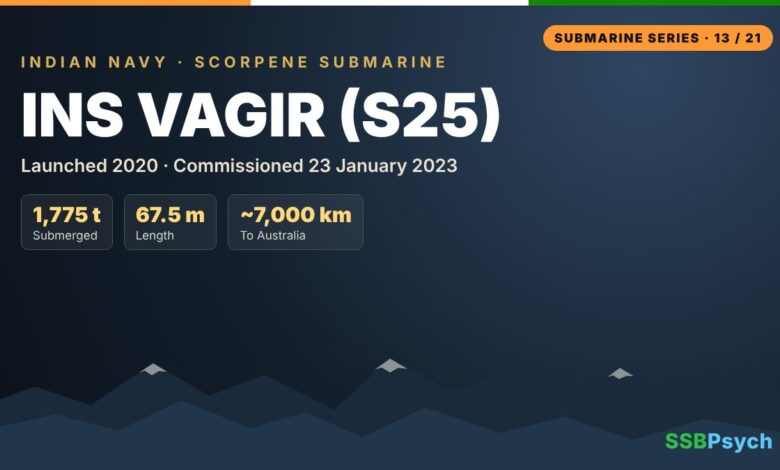
How far can a small diesel-electric submarine travel from home? In 2023, INS Vagir answered that question by sailing all the way from India to Fremantle in Western Australia, a journey of about 7,000 km. It was reported as the first long-range deployment by an Indian Scorpene-class boat. Vagir, pennant S25, is the fifth Kalvari-class submarine and was commissioned on 23 January 2023.
Here is a simple, fact-checked guide for NDA, CDS, AFCAT and SSB aspirants. We will look at what Vagir is, its size and weapons, how its crew lives, why India needs it, what it cost, how deep it is reported to dive, and the interesting story behind its name.

What Is INS Vagir?
INS Vagir is a diesel-electric attack submarine of the Kalvari class, India’s version of the French Scorpene design. It was built by Mazagon Dock Shipbuilders Limited (MDL), Mumbai, under Project 75, with design and technology transfer from France’s Naval Group. The six boats of this programme are Kalvari, Khanderi, Karanj, Vela, Vagir and Vagsheer.
Vagir was launched on 12 November 2020, in the middle of the Covid-19 pandemic. It started sea trials in February 2022, was delivered to the Navy on 20 December 2022 and commissioned barely a month later in Mumbai, in the presence of the then Chief of the Naval Staff, Admiral R Hari Kumar.
INS Vagir Specifications
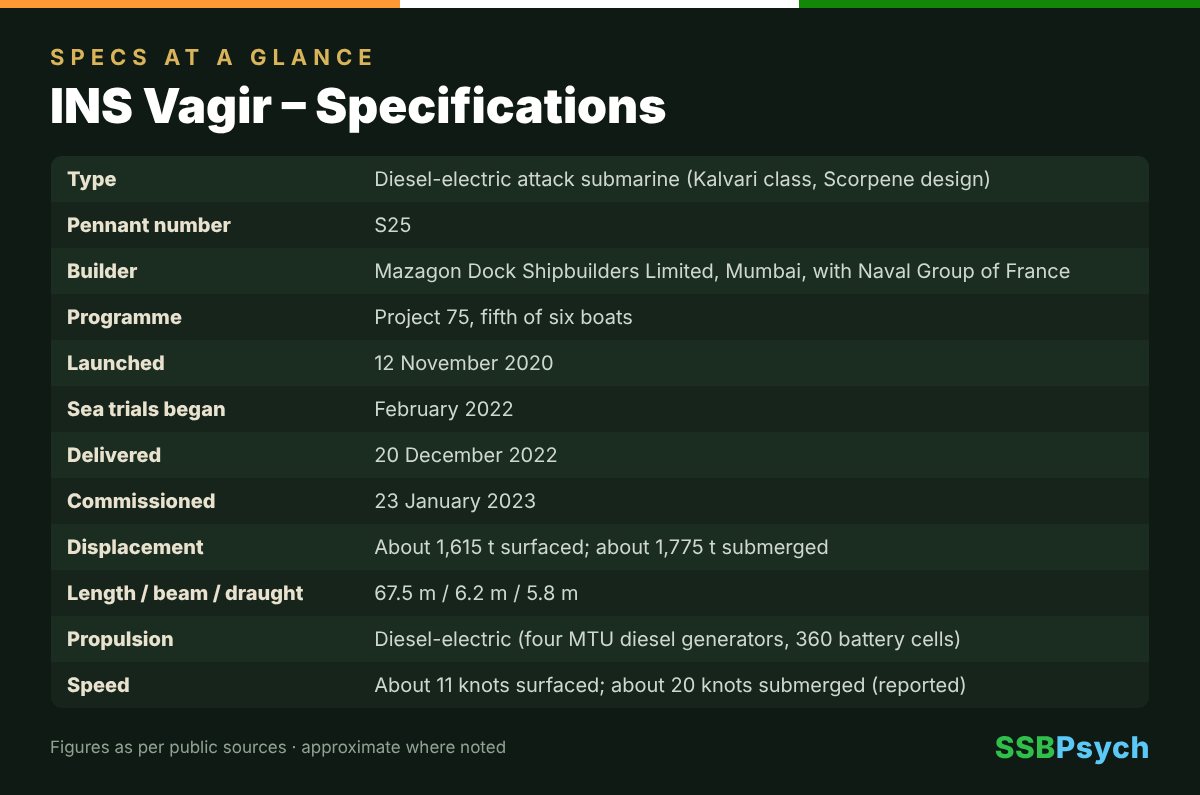
| Type | Diesel-electric attack submarine (Kalvari class, Scorpene design) |
| Pennant number | S25 |
| Builder | Mazagon Dock Shipbuilders Limited, Mumbai, with Naval Group of France |
| Programme | Project 75, fifth of six boats |
| Launched | 12 November 2020 |
| Sea trials began | February 2022 |
| Delivered | 20 December 2022 |
| Commissioned | 23 January 2023 |
| Displacement | About 1,615 t surfaced; about 1,775 t submerged |
| Length / beam / draught | 67.5 m / 6.2 m / 5.8 m |
| Propulsion | Diesel-electric (four MTU diesel generators, 360 battery cells) |
| Speed | About 11 knots surfaced; about 20 knots submerged (reported) |
| Endurance | About 50 days at sea (reported) |
| Crew | About 43 (8 officers, 35 sailors, as reported) |
| Home port | Mumbai (reported) |
| Status | In active service |
Understanding the Numbers
Specifications can look dry, so let us translate them. Vagir is 67.5 metres long, about as long as a 22-storey building lying on its side. It is 6.2 metres wide, so two cars could just about park side by side across it. Submerged, it displaces about 1,775 tonnes, roughly the weight of 1,400 hatchback cars.
Its reported top underwater speed of about 20 knots works out to roughly 37 km per hour. A knot is one nautical mile per hour, and a nautical mile is a little longer than a normal mile, about 1.85 km. But submarines rarely race. They usually creep along slowly and quietly, because speed creates noise and noise gives a submarine away.
How INS Vagir Stays Hidden
Vagir uses diesel generators to charge 360 battery cells when it is on the surface or at periscope depth with its snorkel mast raised. When it goes deep, the diesels shut down and an electric motor drives the propeller in near silence. Its hull is shaped to slip smoothly through water, and machinery is mounted on special supports to stop vibrations from reaching the sea. All of this lowers its acoustic signature, the unique sound pattern that enemy sonars try to detect.
INS Vagir Timeline
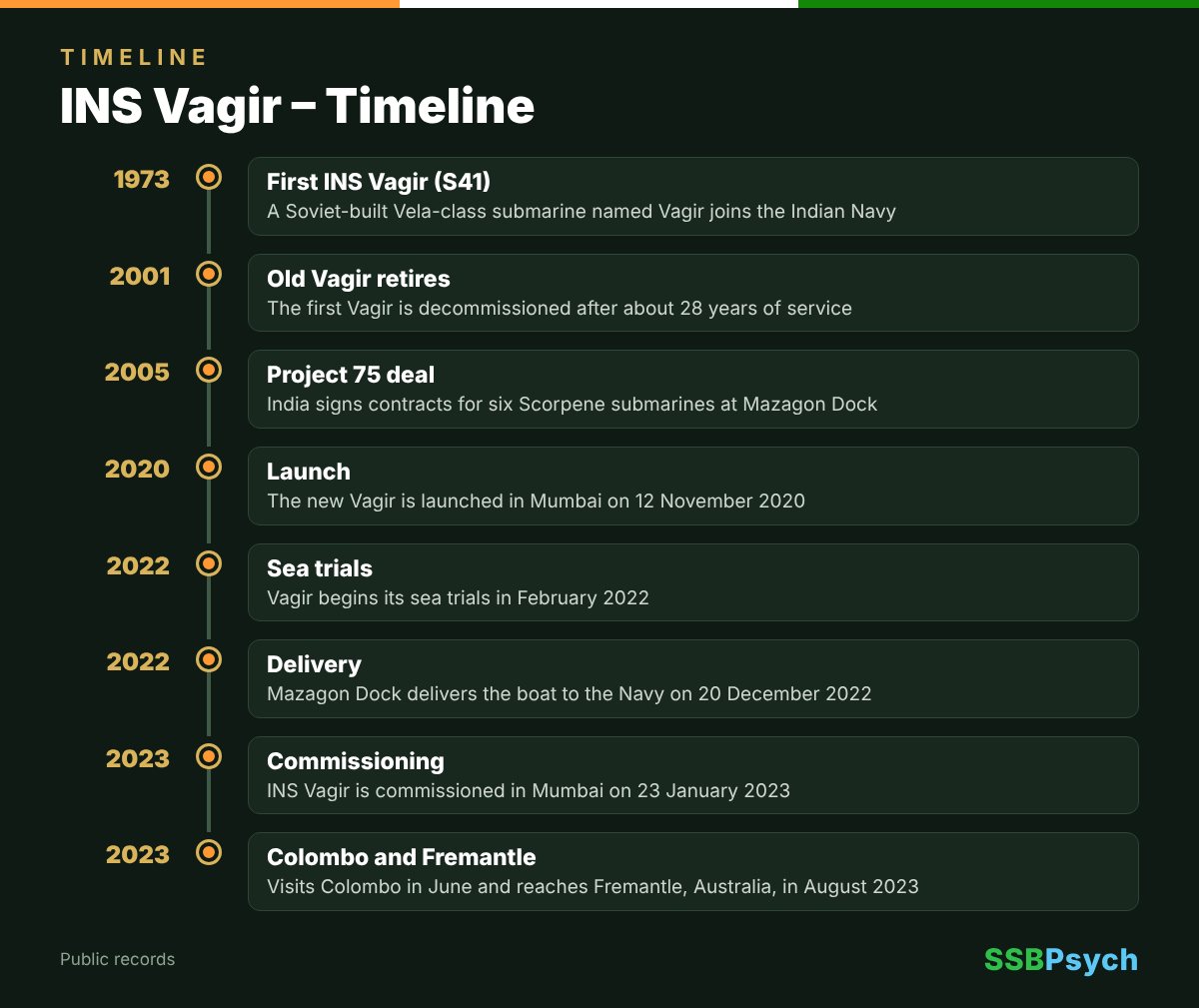
- 1973 – First INS Vagir (S41): A Soviet-built Vela-class submarine named Vagir joins the Indian Navy
- 2001 – Old Vagir retires: The first Vagir is decommissioned after about 28 years of service
- 2005 – Project 75 deal: India signs contracts for six Scorpene submarines at Mazagon Dock
- 2020 – Launch: The new Vagir is launched in Mumbai on 12 November 2020
- 2022 – Sea trials: Vagir begins its sea trials in February 2022
- 2022 – Delivery: Mazagon Dock delivers the boat to the Navy on 20 December 2022
- 2023 – Commissioning: INS Vagir is commissioned in Mumbai on 23 January 2023
- 2023 – Colombo and Fremantle: Visits Colombo in June and reaches Fremantle, Australia, in August 2023
From Launch to Commissioning: How INS Vagir Was Tested
Many readers think a submarine is ready the day it is launched. In reality, launching only means the hull is floated in water for the first time. After that comes outfitting, where pipes, cables, sensors and weapons systems are fitted and connected. Then come harbour trials, in which each system is switched on and checked while the boat is tied to the jetty.
Next are sea trials. For Vagir these began in February 2022. The crew and shipyard engineers take the boat out to sea, test its engines, batteries, steering, diving and surfacing, check its sonars, and fire test weapons. Every leak, noise or fault has to be fixed before the Navy accepts the boat. Only when all trials are passed is the submarine delivered, which for Vagir happened on 20 December 2022. Commissioning, the formal ceremony where the naval ensign is hoisted, followed in January 2023.
This careful process explains why there is usually a gap of two years or more between a submarine’s launch and its entry into service. Safety at depth leaves no room for shortcuts.
Vagir and its five sisters
The Kalvari family came into service one by one: Kalvari in 2017, Khanderi in 2019, Karanj and Vela in 2021, Vagir in 2023 and Vagsheer in 2025. Each later boat benefited from lessons learnt on the earlier ones, and Mazagon Dock’s workforce grew faster and more confident with every hull.
Role and Duties
Like its sisters, Vagir is a multi-role boat. Its main duties include:
- Sea denial: making it risky for enemy warships to enter an area.
- Anti-surface and anti-submarine warfare: hunting ships and submarines.
- Surveillance and intelligence: silently monitoring sea traffic and activity.
- Mine laying: placing mines to block ports and routes in wartime.
- Naval diplomacy: visiting friendly ports, as Vagir did in Sri Lanka and Australia.
Aircraft, Weapons and Sensors
- Six 533 mm torpedo tubes
- SUT wire-guided heavyweight torpedoes (about 18 weapons, as reported)
- SM.39 Exocet anti-ship missiles launched from underwater
- Sea mines (reported about 30) instead of torpedoes
- C303/S anti-torpedo decoy system
- Integrated sonar suite and combat management system
- Periscopes and electronic support measures
Every weapon leaves through the six bow tubes. The SUT heavyweight torpedo trails a thin wire so the crew can guide it toward a moving target. The SM.39 Exocet is launched in a waterproof capsule; once it pops out above the sea, its rocket motor fires and the missile flies low to strike a ship. The boat can also carry mines instead of torpedoes, and a decoy system protects it from incoming torpedoes.
Operations and Missions
- 2023 – Commissioning: Commissioned on 23 January 2023 by the then Navy chief Admiral R Hari Kumar
- 2023 – Colombo port call: Formal visit to Colombo, Sri Lanka, from 19 June 2023 (reported)
- 2023 – Long-range deployment: Reached Fremantle, Western Australia, on 20 August 2023 after about 7,000 km

The Big Voyage: INS Vagir in Australia
In mid-2023 Vagir set out on an extended patrol across the Indian Ocean. It first called at Colombo, Sri Lanka, in June 2023. Two months later, on 20 August 2023, it arrived at Fremantle, near Perth in Western Australia, after covering around 7,000 km. Reports described this as the first long-range deployment by a Kalvari-class submarine.
Why does that matter? A diesel-electric submarine must keep recharging its batteries, carry enough food and spares for a small crew, and keep machinery running smoothly for weeks without a dockyard. Completing such a voyage shows that the boat, its maintenance teams and its crew are ready to operate far from home. It also strengthens India’s naval partnership with Australia, an important friend in the Indo-Pacific.
INS Vagir Name Origin: The Sandfish
Vagir is the name of a sandfish, a predatory fish of the Indian Ocean. The new submarine also continues the legacy of the first INS Vagir (S41), a Soviet-built Vela-class submarine that served the Indian Navy from 1973 to 2001. Reusing names is a proud naval tradition. It tells the new crew that they carry the honour of the sailors who came before them.
Why India Needs Submarines Like Vagir
India’s seas carry most of its trade by volume and much of its energy imports. The country also has the Andaman and Nicobar Islands and the Lakshadweep group to protect. Submarines are among the most effective tools for guarding such a vast area because they can watch quietly, deter attackers and strike if needed. In the years before Project 75 boats arrived, the Navy’s submarine numbers had fallen as older boats retired. Vagir and its sisters helped close that gap with modern technology built in India.
Crew and Command
Vagir’s crew is reported at about 43 people, roughly 8 officers and 35 sailors. Indian submarines of this type are typically commanded by an officer of Commander rank who has passed tough command courses. Below the captain are an executive officer and department heads for operations, weapons, engineering and electrical systems. Each sailor is cross-trained so that the boat can keep fighting even if someone is unwell.
Life on Board INS Vagir
On a long patrol like the voyage to Australia, the crew lives in tight spaces for weeks. Bunks are small, privacy is close to zero, and there is no daylight while submerged. The boat’s air is purified by onboard systems, and water is used carefully. Sailors stand watches in rotation, train during spare time and keep the boat spotless because clutter can become a hazard in an emergency.
- Cooks prepare hot meals for the whole crew in a galley the size of a small kitchen.
- Birthdays and festivals are still celebrated, often with special meals.
- Silence drills mean soft voices and careful movement.
- Contact with family is very limited during deep patrols.
- Arriving in a foreign port after weeks at sea is a much-loved reward.
Diving Depth and Range
Open sources report a test depth of about 350 metres for the Scorpene design. The Navy does not disclose actual operating depths, and those details are classified. Reported endurance is about 50 days, and reported range is around 6,500 nautical miles at an economical speed on the surface or snorkelling. On batteries alone, a fully submerged Scorpene can travel only a few hundred nautical miles at very slow speed.
Cost and Running Expenses
No official price for Vagir alone has been released. The publicly reported cost of the whole Project 75 programme is about Rs 23,562 crore for six submarines, as per the contracts signed in 2005. That amount also paid for transfer of technology and building up India’s submarine-making ability.
There is no credible public figure for Vagir’s yearly running cost. The main cost drivers for a submarine of this type are diesel fuel, battery replacements, scheduled refits, expensive torpedoes and missiles, port support and the long training of its highly skilled crew. Long-range deployments like the Australia voyage add fuel, logistics and maintenance costs too.
Dangers Faced by the Crew
Submarines operate under crushing water pressure, carry powerful batteries, fuel and explosives, and have very limited escape routes. Fire, flooding and toxic gases are the biggest dangers. The Navy reduces these risks through relentless drills, strict rules and modern rescue capability, including deep submergence rescue vehicles that can mate with a stricken submarine and bring sailors out.
Where Is INS Vagir Based?
Vagir was commissioned in Mumbai and is reported to be based there under the Western Naval Command. Like all submarines, its patrol areas and day-to-day movements are kept secret, and only selected visits, such as Colombo and Fremantle, have been made public.
INS Vagir in Exams and the SSB Interview
For written exams, remember the core facts: S25, fifth Kalvari-class boat, Project 75, Mazagon Dock, commissioned 23 January 2023, named after a sandfish. For the SSB interview, the Australia voyage makes a great talking point. It links submarines to India’s wider Indo-Pacific outlook, its friendship with Australia and its growing confidence in operating far from home. Being able to explain why a long-range deployment matters shows the assessors that you read beyond headlines.
Did You Know?
- Vagir was launched during the Covid-19 pandemic in November 2020.
- Its Fremantle voyage covered around 7,000 km, roughly the road distance from Kashmir to Kanyakumari and back.
- The first INS Vagir served the Navy for about 28 years.
- A knot equals about 1.85 km per hour.
- Vagir was delivered to the Navy in December 2022 and commissioned in January 2023.
- The Kalvari class name means tiger shark.
Quiz: Test Your Knowledge of INS Vagir
Click an option to see if you are right. Your score updates live.
INS Vagir: Frequently Asked Questions
INS Vagir (S25) is the fifth Kalvari-class diesel-electric attack submarine of the Indian Navy, built by Mazagon Dock in Mumbai under Project 75 using the French Scorpene design.
INS Vagir was commissioned on 23 January 2023 in Mumbai, after being launched in November 2020 and delivered in December 2022.
Yes. During an extended Indian Ocean deployment in 2023, Vagir reached Fremantle, Western Australia, on 20 August 2023 after about 7,000 km, reported as the class’s first long-range deployment.
Vagir is a sandfish, a predatory fish of the Indian Ocean. The name also honours the earlier INS Vagir (S41), which served from 1973 to 2001.
A Kalvari-class submarine is reported to carry about 43 personnel, roughly 8 officers and 35 sailors.
This is part 13 of 21 in SSBPsych’s submarine series – a new post every morning at 10 AM.
Sources: en.wikipedia.org, en.wikipedia.org, pib.gov.in, indiannavy.nic.in.
Preparing for NDA, CDS, AFCAT or your SSB? Join SSBPsych’s online and offline batches – explore our courses or call +91 8076540582.