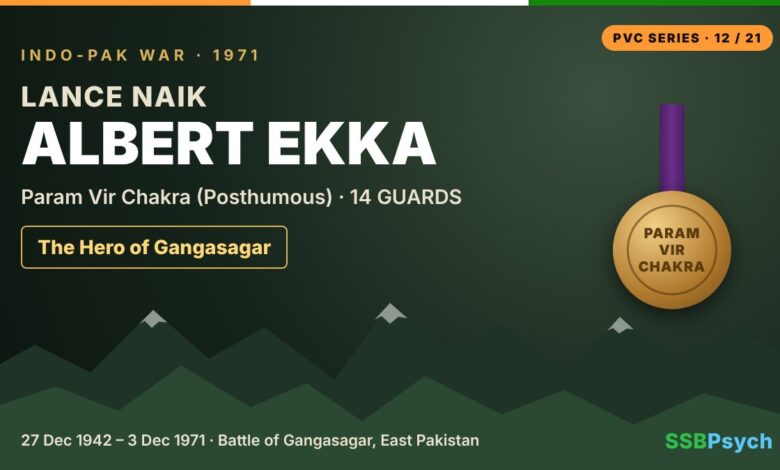
Lance Naik Albert Ekka, PVC: The Hero of Gangasagar, 1971 – Full Story (with Quiz)
Some acts of courage are planned in advance. Others are born in a single moment, when a soldier sees his friends falling and decides that he alone will stop it. On 3 December 1971, at a railway post called Gangasagar near the border town of Akhaura, Lance Naik Albert Ekka of 14 Guards made that decision again and again. Wounded, bleeding and short of breath, he charged one machine gun, then fought through bunker after bunker, and finally climbed a wall to silence a second gun. He did not live to see the sunset, but his battalion won its objective because of him.
Albert Ekka was a jawan, not an officer, and that makes his story especially valuable for SSB aspirants. Future officers must understand the men they will lead. In this post, the twelfth in our 21 Param Vir Chakra heroes series, we cover his early life in the forests of Jharkhand, his journey into the Army, the 1971 war in the east, a detailed account of the Battle of Gangasagar, his citation in plain words, his legacy, and the officer-like qualities you can learn from him. Test yourself with the 10-question quiz at the end.
Lance Naik Albert Ekka – Quick Facts
| Full name | Albert Ekka |
| Born | 27 December 1942, Zari (Jari) village, now Gumla district, Jharkhand |
| Parents | Julius Ekka and Mariam Ekka |
| Enlisted | 27 December 1962, The Bihar Regiment |
| Unit at time of action | 14th Battalion, The Brigade of The Guards (14 Guards) |
| Formation | IV Corps, eastern front |
| War | Indo-Pakistan War of 1971 |
| Battle | Gangasagar, near Akhaura (in present-day Bangladesh) |
| Date of action | 3 December 1971 |
| Age at death | 28 |
| Award | Param Vir Chakra (Posthumous) |
Early Life: A Hunter’s Eye from Jharkhand
Albert Ekka was born on 27 December 1942 in the village of Zari (also written Jari), which was then part of Ranchi district in Bihar and is now in Gumla district, Jharkhand. His parents, Julius and Mariam Ekka, were a Christian couple from the Kurukh (Oraon) Adivasi community.
Growing up among forests and hills, young Albert took to hunting, a common skill in his community. Hunting taught him patience, silent movement and the art of using the ground for cover. Years later, these same instincts would help him crawl unseen towards an enemy machine-gun post. He was also a keen sportsman, and his hockey skills are said to have caught the eye of an Army recruiter.
Joining the Army: From Bihar Regiment to the Guards
On 27 December 1962, on his twentieth birthday, Albert Ekka enlisted in the Army. He was enrolled in the Bihar Regiment, joining its 7th Battalion. As a young soldier he took part in counter-insurgency operations in India’s North East, gaining real experience of operations in difficult jungle terrain.
In January 1968, he was transferred to a newly raised battalion of the Brigade of the Guards. That battalion was redesignated 14 Guards in 1971. As the country prepared for war later that year, Ekka was promoted to Lance Naik, the first rung of leadership among soldiers, responsible for a small group of men within his section.
The 1971 War: The Road to Akhaura
By late 1971, East Pakistan was in crisis. A brutal military crackdown had driven millions of refugees across the border into India, and the people of the region were fighting for the freedom of what would become Bangladesh. As tensions boiled over, Indian forces prepared to move on the eastern front.
14 Guards was part of IV Corps, which was to advance from the Tripura side towards the heart of East Pakistan. One of the first hurdles on this route was Akhaura, an important railway junction close to the border near Agartala. To take Akhaura, the Indian forces first had to capture Gangasagar, a well-defended railway station area a few kilometres to its south. Pakistani troops had dug strong bunkers along the railway line and around the station buildings, protected by mines and covering fire.
The Battle of Gangasagar
The Attack Begins
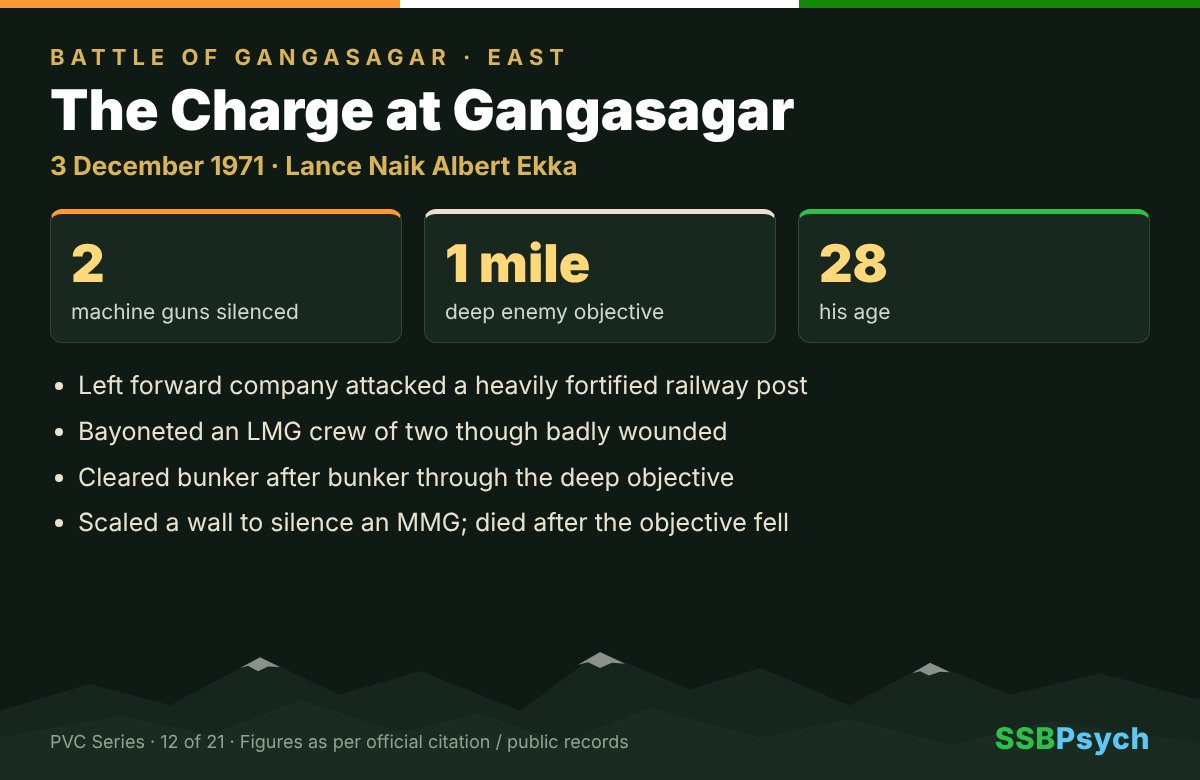
The attack on Gangasagar was launched in the dark early hours of 3 December 1971. Two companies of 14 Guards moved forward along the railway track towards the enemy defences. Albert Ekka was with the left forward company. As soon as the enemy realised it was under attack, it opened up with heavy shelling and intense small-arms fire. The fighting soon turned into close-quarter combat, with soldiers clearing trenches and bunkers at bayonet point.
The First Machine Gun
Ekka noticed that a light machine gun (LMG) firing from an enemy bunker was cutting down men of his company. Without waiting for orders, he rushed the bunker. He bayoneted the two enemy soldiers manning it and silenced the gun. In this charge he was seriously wounded. Most men would have stopped there and waited for the stretcher bearers. Albert Ekka did not.
Bunker After Bunker
The objective at Gangasagar was not a single post but a deep belt of defences stretching for more than a kilometre. Despite his wounds, Ekka kept moving forward with his comrades, clearing one bunker after another. His example kept the momentum of the attack going at a time when heavy losses could easily have stalled it.
The Last Gun
Near the northern end of the objective stood a fortified building. From its second floor, an enemy medium machine gun (MMG) was firing down on the attackers, and the whole advance came to a halt. Ekka, already badly hurt, crawled towards the building through the fire. He lobbed a grenade into the bunker, killing one enemy soldier and wounding another. The gun, however, kept firing.
So he did something extraordinary. He climbed the side wall of the building, got into the bunker and finished off the remaining gunner with his bayonet. The MMG fell silent at last, and the company could move again. But Albert Ekka had received fatal injuries in this final assault. He died of his wounds after the objective was captured, at the age of just 28.
Why Gangasagar Mattered
The fall of Gangasagar exposed the flanks of the enemy positions at Akhaura and threatened them from the rear. Within days the enemy had to give up Akhaura, opening the route for IV Corps’ advance westward. The war in the east ended on 16 December 1971 with the surrender of Pakistani forces in Dhaka and the birth of Bangladesh. Lance Naik Ekka’s courage on the very first day helped set that advance in motion.
The Param Vir Chakra Citation
Lance Naik Albert Ekka was awarded the Param Vir Chakra posthumously. In simple language, his citation records that:
- He was part of the left forward company in the attack on a strongly fortified enemy position at Gangasagar, which faced heavy shelling and small-arms fire.
- Seeing an enemy LMG causing heavy casualties, he charged the bunker, bayoneted two enemy soldiers and silenced the gun, even though he was seriously wounded.
- He continued fighting alongside his comrades through the deep objective, clearing bunker after bunker.
- When an MMG on the second floor of a building held up the attack, he crawled forward, threw a grenade, then climbed the wall into the bunker and silenced the gun with his bayonet.
- He was fatally wounded and died after the objective was captured. His action showed the most conspicuous bravery and determination, and he made the supreme sacrifice.
Legacy: Jharkhand’s Braveheart
Albert Ekka is honoured as one of the greatest sons of Jharkhand. A busy crossing in Ranchi is named Albert Ekka Chowk and has his statue. A block in Gumla district carries his name, and an eco park in Tripura, the state his battalion’s action helped protect, is named after him. A sports stadium in Kamptee cantonment near Nagpur also bears his name.
In 2000, the Government of India issued a commemorative postage stamp in his honour. The Army’s IV Corps, in whose ranks he fought, has placed a bust of him near the main gate of its headquarters at Tezpur. Every soldier and officer who passes it is reminded of what one determined Lance Naik achieved.
His story also carries a quiet message about India itself. A young man from a small Adivasi village in Jharkhand gave his life on foreign soil so that another people could be free. Courage does not depend on rank, region, religion or background. For the people of Tripura, who lived within range of enemy guns across the border in 1971, his name carries special gratitude, and for the Brigade of the Guards he remains a shining example of what the regiment expects from every soldier who wears its insignia.
What This Means for You as an Aspirant
As a future officer, you will lead soldiers like Albert Ekka: men who may not have your education but who carry immense skill, loyalty and courage. The SSB checks whether you can respect, understand and inspire such men. Ekka’s story also shows initiative in its purest form. Nobody ordered him to charge that LMG bunker. He saw a problem that was hurting his team and solved it himself, at great personal risk. That same instinct, in smaller forms, is what assessors look for in your GTO tasks and SRT responses.
Lessons for SSB Aspirants: OLQs in Action
The SSB does not test whether you can recite history – it looks for the qualities of an officer. Here is how Lance Naik Albert Ekka showed them:
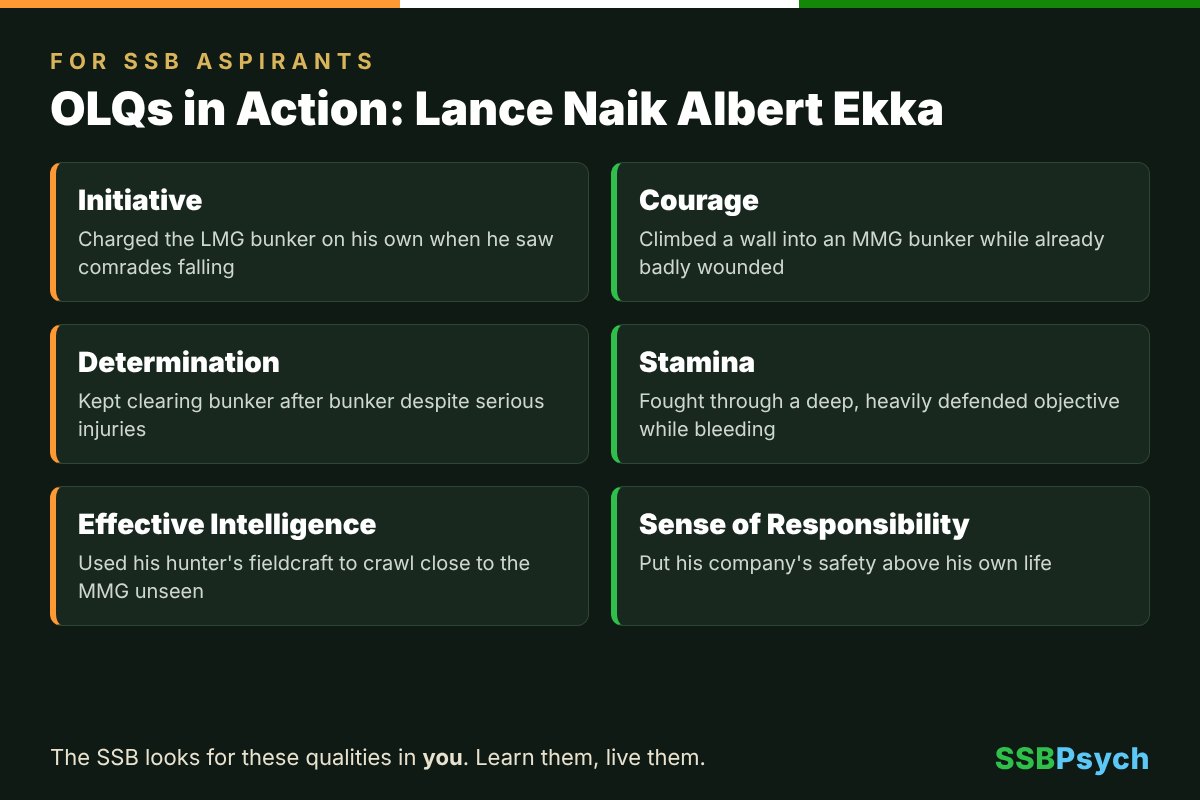
- Initiative – Charged the LMG bunker on his own when he saw comrades falling
- Courage – Climbed a wall into an MMG bunker while already badly wounded
- Determination – Kept clearing bunker after bunker despite serious injuries
- Stamina – Fought through a deep, heavily defended objective while bleeding
- Effective Intelligence – Used his hunter’s fieldcraft to crawl close to the MMG unseen
- Sense of Responsibility – Put his company’s safety above his own life
Tip for your SSB interview: Be ready to speak with genuine respect about the jawans you will one day lead. If asked about Albert Ekka or any soldier hero, explain what his action teaches an officer about leading men from different backgrounds, rather than just repeating the facts.
Practice Corner: WAT and SRT
Write your first spontaneous response to these before you scroll to the quiz. Keep WAT sentences short, positive and action-oriented.
WAT Words
- Bunker
- Wall
- Comrade
- Village
- Silence
SRTs
- He is part of a rescue team after a building collapse. A part of the structure is blocking the others, and no one is moving to clear it. He…
- He is injured during the first half of an important hockey match, and his team is losing. He…
- He sees that one problem in his group project is holding up the whole team, but it is not his assigned task. He…
Quiz: How Well Do You Know Lance Naik Albert Ekka?
Test yourself! Click an option to see if you are right. Your score updates live.
Frequently Asked Questions
Why was Lance Naik Albert Ekka awarded the Param Vir Chakra?
For charging and silencing an enemy LMG and then an MMG during the attack on Gangasagar on 3 December 1971, fighting on despite serious wounds until the objective was captured. He died of his injuries.
Where is Gangasagar?
Gangasagar is a railway station area a few kilometres south of Akhaura, close to the Tripura border, in present-day Bangladesh.
Which community did Albert Ekka belong to?
He was born into a Christian family of the Kurukh (Oraon) Adivasi community in what is now Gumla district, Jharkhand.
How is Albert Ekka remembered today?
Through Albert Ekka Chowk and his statue in Ranchi, a block in Gumla named after him, a park in Tripura, a stadium at Kamptee, a postage stamp issued in 2000 and a bust at IV Corps headquarters in Tezpur.
What can SSB aspirants learn from Albert Ekka?
Initiative, courage and a deep sense of responsibility towards the team, along with respect for the jawans whom every officer is privileged to lead.
The Param Vir Chakra Series on SSBPsych
This is part 12 of 21 in our series on every Param Vir Chakra awardee. A new hero goes live every morning at 7:30 AM. Also read the story of Captain Vikram Batra, PVC – the Sher Shah of Kargil.
Sources: en.wikipedia.org, bharat-rakshak.com, www.tribuneindia.com.
Preparing for your SSB? Join SSBPsych’s online and offline SSB batches and learn how to show your OLQs with confidence – explore our courses or call +91 8076540582.