
Netra aircraft: India’s Eye in the Sky, Radar, Specs, History
Fighter pilots say the side that sees first usually wins. The Netra aircraft is how the Indian Air Force sees first. Netra means eye in Sanskrit and Hindi, and this jet is exactly that: a flying radar station that watches hundreds of kilometres of sky, spots enemy aircraft, drones and missiles, and tells Indian fighters where to go. Best of all, its radar and mission systems were designed in India.
In this guide you will learn what an AEW and C aircraft actually does, why India spent decades building one, how Netra works, its key specifications, the missions it has flown from Balakot to Operation Sindoor, where it is publicly reported to be based, and what bigger Netra versions are coming next. Stay till the end for a quick quiz.
Netra aircraft Specifications
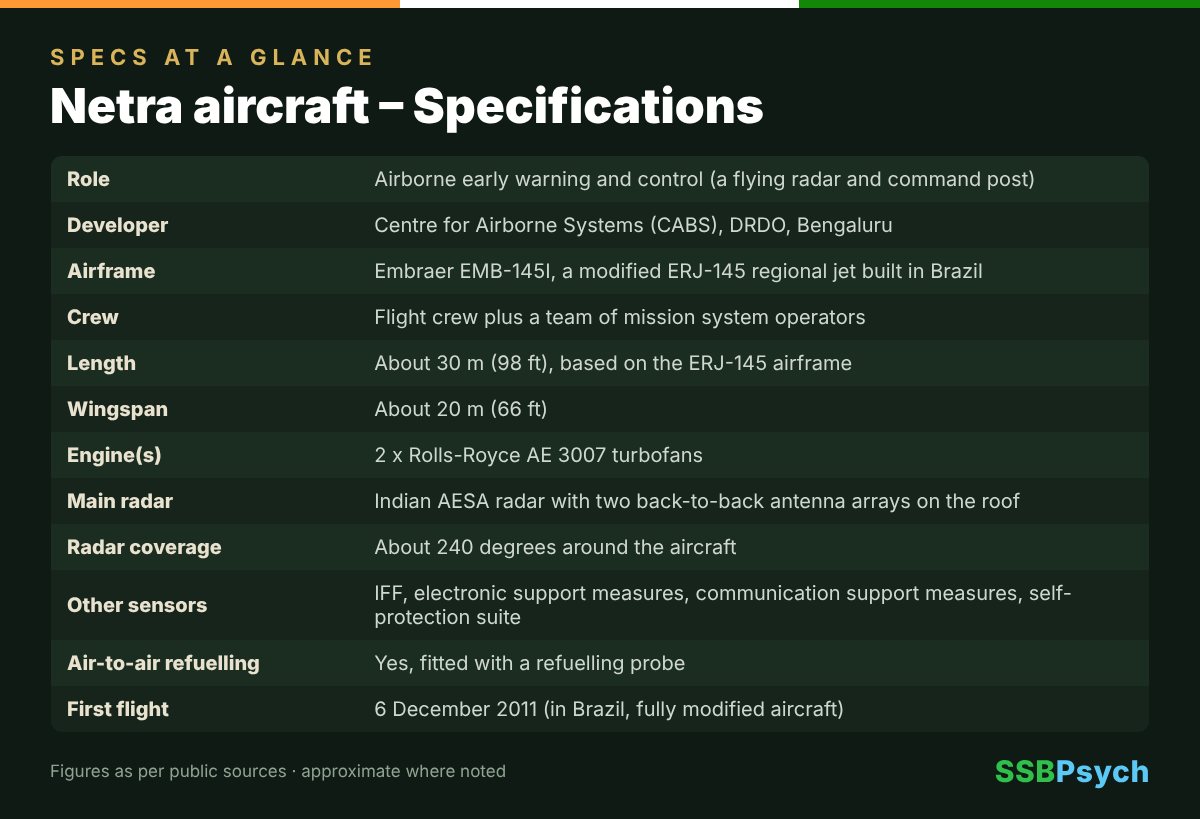
| Role | Airborne early warning and control (a flying radar and command post) |
| Developer | Centre for Airborne Systems (CABS), DRDO, Bengaluru |
| Airframe | Embraer EMB-145I, a modified ERJ-145 regional jet built in Brazil |
| Crew | Flight crew plus a team of mission system operators |
| Length | About 30 m (98 ft), based on the ERJ-145 airframe |
| Wingspan | About 20 m (66 ft) |
| Engine(s) | 2 x Rolls-Royce AE 3007 turbofans |
| Main radar | Indian AESA radar with two back-to-back antenna arrays on the roof |
| Radar coverage | About 240 degrees around the aircraft |
| Other sensors | IFF, electronic support measures, communication support measures, self-protection suite |
| Air-to-air refuelling | Yes, fitted with a refuelling probe |
| First flight | 6 December 2011 (in Brazil, fully modified aircraft) |
| Inducted in IAF | 14 February 2017 (handed over at Aero India) |
| Final operational clearance | 25 June 2026 |
| Number in IAF | 3 |
What Does an AEW and C Aircraft Do?
AEW and C stands for Airborne Early Warning and Control. A ground radar has a big problem: the Earth is curved. Low-flying aircraft and cruise missiles can hide below the horizon, behind hills and mountains, until they are very close. Put the radar on an aircraft flying high, and it can look much further and see low targets that ground radars miss. Think of standing on a rooftop instead of on the street: you see far more.
The second part of the name, Control, is just as important. Operators on board sort out the picture, decide which targets are threats and guide friendly fighters towards them. In effect Netra is an air traffic control tower and a war room combined, flying high above the battlefield.
Why India Needed the Netra Aircraft
Without airborne radar, India’s long borders with Pakistan and China would have gaps where low-flying intruders could slip through. India started working on its own airborne radar in the 1980s under a programme known as Project Guardian, using a modified HS-748 Avro transport with a large rotating dome on top. The project suffered a major setback when the test aircraft crashed near Arakkonam in 1999, and work slowed for several years.
The programme was revived and in 2004 the Cabinet Committee on Security approved a fresh project. DRDO’s Centre for Airborne Systems in Bengaluru would design the radar and mission systems, while Embraer of Brazil would supply and modify the aircraft. In parallel, the IAF bought three much larger A-50EI Phalcon aircraft from Israel and Russia, but those were expensive and few. Netra was meant to give India its own, home-grown capability that it could upgrade freely without depending on foreign suppliers for software and source codes.
History of Netra in the IAF
The first fully modified EMB-145I flew in Brazil on 6 December 2011. It was delivered to India in August 2012 and spent years in testing with DRDO and the IAF. On 14 February 2017, at the Aero India show in Bengaluru, the first Netra was formally handed over to the Indian Air Force. It received initial operational clearance later that year and was tested at Bathinda in Punjab.
Netra did not have to wait long for real action. During the Balakot air strike of 26 February 2019, Netra supported the IAF, marking its first combat use. A second aircraft arrived in September 2019 and was deployed to Bathinda, and a third followed after further trials. In 2025, during Operation Sindoor, Netra was again reported to have supported the IAF’s surveillance and network-centric operations.
Finally, on 25 June 2026, at a ceremony at CABS in Bengaluru, Netra received its Final Operational Clearance. This is the formal stamp that says the system is fully mature and cleared for all its intended roles. The IAF had been confident enough to use it in real operations years before this final clearance came.
How Netra Works and Performance Explained Simply
Look at Netra and you will notice a long, flat beam on top of the fuselage, a bit like a plank balanced on its roof. This is the antenna of the main radar. It is an AESA radar, which stands for Active Electronically Scanned Array. Instead of a dish that physically spins, an AESA uses hundreds of tiny transmit and receive modules that steer the radar beam electronically, in a fraction of a second. That makes it fast, reliable and hard to jam.
The antenna has two arrays placed back to back, one looking out to each side. Together they cover about 240 degrees around the aircraft, so only the areas directly ahead and behind are not covered. Pilots simply fly a racetrack pattern so that the radar sweeps the area that matters most.
Detection range depends on the size of the target and conditions, but Netra can watch hundreds of kilometres of airspace. To picture it, a single Netra flying over Punjab can watch a large stretch of sky deep beyond the border, far further than any tower on the ground could see.
The aircraft itself is a twin-engine Embraer regional jet, the kind of airliner that usually carries around 50 passengers. It is about 30 m long, roughly as long as seven family cars in a row, with a wingspan of about 20 m. Two Rolls-Royce AE 3007 turbofan engines power it, and it flies at speeds similar to small airliners. Inside, passenger seats are replaced by operator consoles, computers and communication gear. A refuelling probe lets it take on fuel from an IAF tanker so it can stay on watch longer.
Netra also listens. Its electronic support measures detect enemy radar signals and identify what kind of system is transmitting, while communication support measures monitor radio signals. Its IFF system asks every aircraft it sees, in effect, are you friend or foe? All this information is fused into one clear picture and sent by datalink to fighters and ground command centres.
What It Carries
- No weapons: Netra is an unarmed surveillance and command aircraft
- Indian-made AESA radar to detect aircraft, drones and missiles
- IFF system to tell friendly aircraft from hostile ones
- Electronic support measures to pick up and identify enemy radar signals
- Communication support measures to monitor radio traffic
- Secure datalinks to share the air picture with fighters and ground stations
- Self-protection suite against missile threats
- Air-to-air refuelling probe for longer missions
Netra aircraft Missions and Operations
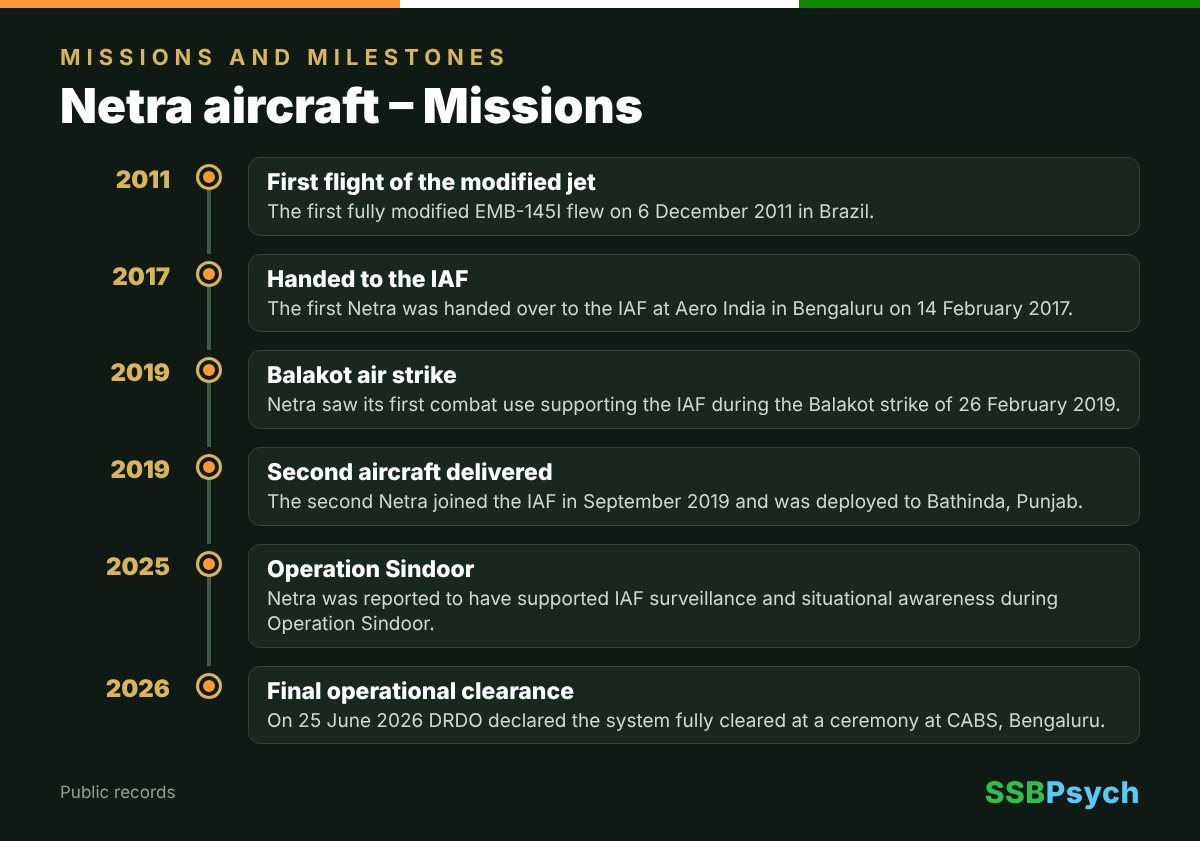
- 2011 – First flight of the modified jet: The first fully modified EMB-145I flew on 6 December 2011 in Brazil.
- 2017 – Handed to the IAF: The first Netra was handed over to the IAF at Aero India in Bengaluru on 14 February 2017.
- 2019 – Balakot air strike: Netra saw its first combat use supporting the IAF during the Balakot strike of 26 February 2019.
- 2019 – Second aircraft delivered: The second Netra joined the IAF in September 2019 and was deployed to Bathinda, Punjab.
- 2025 – Operation Sindoor: Netra was reported to have supported IAF surveillance and situational awareness during Operation Sindoor.
- 2026 – Final operational clearance: On 25 June 2026 DRDO declared the system fully cleared at a ceremony at CABS, Bengaluru.
Where Netra Is Based and Who Flies It
Public reports have named Bathinda Air Force Station in Punjab as a base for Netra, which places it close to the western border. As a mobile asset, it can move to wherever it is needed.
A Netra crew is a mix of two worlds. Up front sit transport-stream pilots who fly the aircraft. Behind them sit trained mission system operators who run the radar and electronic systems, track targets and control fighters. Units operating such aircraft are usually commanded by a Wing Commander or a more senior officer, depending on their size.
Pilots reach such a role by joining through NDA, CDS or AFCAT, training at the Air Force Academy on the Pilatus PC-7 Mk II, and then choosing the transport stream, where they train on multi-engine aircraft before converting to bigger types. Mission system operators come from the flying and ground duty branches and receive special training to read the radar picture and direct fighters. It takes several years of training and experience before an officer is trusted to run an air battle from the sky.
Netra Aircraft vs the A-50EI Phalcon
The IAF actually flies two kinds of airborne radar aircraft, and aspirants often mix them up. The A-50EI Phalcon is a big four-engine Russian Il-76 transport carrying an Israeli radar inside a large round dome on struts above the fuselage. Its dome gives full 360-degree coverage, and the huge aircraft has room for more operators and fuel. The downside is cost: such aircraft are very expensive to buy and to fly, so the IAF has only a few.
Netra is the smaller, lighter partner. It uses a regional jet, so it is cheaper to operate and can fly from more airfields. Its radar covers about 240 degrees instead of a full circle, but its biggest advantage is that the radar and software are Indian. That means India can upgrade it, change its software and connect it to Indian weapons and networks without asking anyone else for permission. Think of the Phalcon as a heavy, long-range watchtower and Netra as a nimble scout. Working together, they give the IAF a much clearer picture of the sky than either could alone.
Strengths and Limitations
- Strength: Indian-designed radar and software, so India controls upgrades and source codes
- Strength: AESA radar is fast, reliable and harder to jam than older rotating dishes
- Strength: smaller jet is cheaper to operate than big AEW aircraft
- Strength: air-to-air refuelling extends time on patrol
- Strength: combat-proven in Balakot and Operation Sindoor support
- Limitation: covers about 240 degrees, not a full 360-degree circle
- Limitation: only three aircraft, which is too few for India’s long borders
- Limitation: the small airframe limits how many operators and how much equipment it can carry, and Embraer no longer builds this model
Future of the Netra Aircraft
Netra is only the beginning. India has approved six Netra Mk1A aircraft, again based on Embraer jets, with an improved radar using modern gallium nitride modules. Even bigger is the Netra Mk2 project, which plans to fit an Indian radar on six Airbus A321 aircraft taken from Air India’s fleet. The larger airframe can carry a more powerful radar with much wider coverage, more operators and more fuel.
Once these aircraft join, the IAF will have many more eyes in the sky, which matters greatly when it must watch two long borders at the same time. The experience CABS gained on Netra is the foundation for all these future programmes.
Why It Matters for SSB and AFCAT Aspirants
Netra is a favourite topic in current affairs because it ties together defence, technology and Atmanirbhar Bharat. Expect questions on who developed it (CABS, DRDO), which aircraft it is based on (Embraer EMB-145I), and recent milestones like its final operational clearance in June 2026. In SSB group discussions on self-reliance in defence, Netra is a strong, factual example.
The story also carries a lesson about resilience. After the 1999 crash that set back India’s first airborne radar effort, the scientists did not give up. They rebuilt the programme and delivered a system that is now combat-proven. That never-give-up spirit is exactly what SSB assessors look for in candidates.
Did You Know? Netra Aircraft Facts
- Netra means eye, and the aircraft is often called India’s eye in the sky.
- Its radar has no spinning dish; the beam is steered electronically.
- The airframe is a Brazilian Embraer jet, but the radar and mission systems were developed in India.
- India’s earlier airborne radar effort, Project Guardian, used an HS-748 Avro with a rotating dome.
- Netra was used in real operations before it even received final operational clearance.
- The future Netra Mk2 will be built on Airbus A321 aircraft taken from Air India.
Quiz: Test Your Knowledge of Netra aircraft
Click an option to see if you are right. Your score updates live.
Netra aircraft: Frequently Asked Questions
Netra is India’s indigenous airborne early warning and control system, developed by DRDO’s CABS and mounted on an Embraer EMB-145I jet. It detects aircraft, drones and missiles and guides friendly fighters.
The IAF operates three Netra aircraft. Six improved Mk1A aircraft and six larger Mk2 aircraft on the Airbus A321 are planned.
Its AESA radar has two back-to-back arrays giving about 240 degrees of coverage around the aircraft.
Yes. Netra supported the IAF during the Balakot strike on 26 February 2019, its first combat use.
Netra received its Final Operational Clearance on 25 June 2026 at a ceremony at CABS in Bengaluru.
This is part 12 of 50 in SSBPsych’s Indian Air Force aircraft series – a new aircraft every evening at 6 PM.
Sources: en.wikipedia.org, theweek.in, drishtiias.com, en.wikipedia.org, tribuneindia.com.
Preparing for NDA, CDS, AFCAT or your SSB? Join SSBPsych’s online and offline batches – explore our courses or call +91 8076540582.