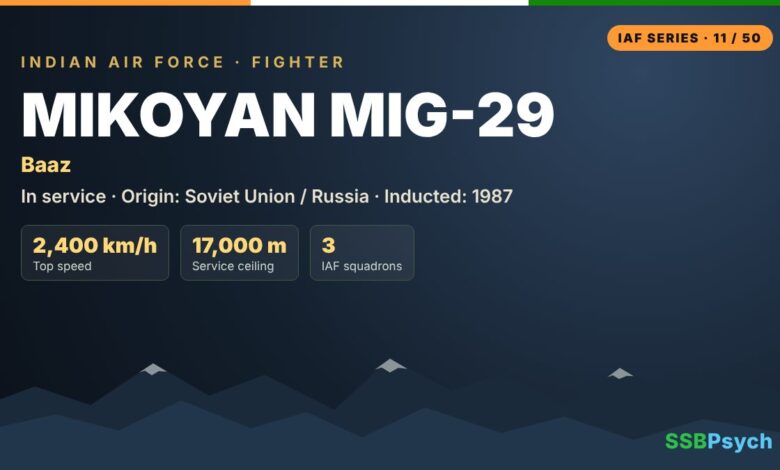
MiG-29 in Indian Air Force: Baaz Specs, Missiles, UPG, History
Imagine a fighter so agile that it can point its nose almost anywhere in a dogfight, climb like a rocket and still land on rough forward airstrips. That is the MiG-29, called Baaz (falcon or eagle) in the Indian Air Force. It arrived in 1987, guarded the skies during the Kargil War and, after a major upgrade, still sits on alert at some of India’s most sensitive bases.
In this guide you will learn why India bought the MiG-29, how the upgraded MiG-29UPG differs from the original, how fast and high it flies (explained in plain words), what missiles it carries, which famous missions it flew, where it is publicly reported to be based, and why every NDA, CDS and AFCAT aspirant should know this jet. There is a quiz at the end, so read carefully.
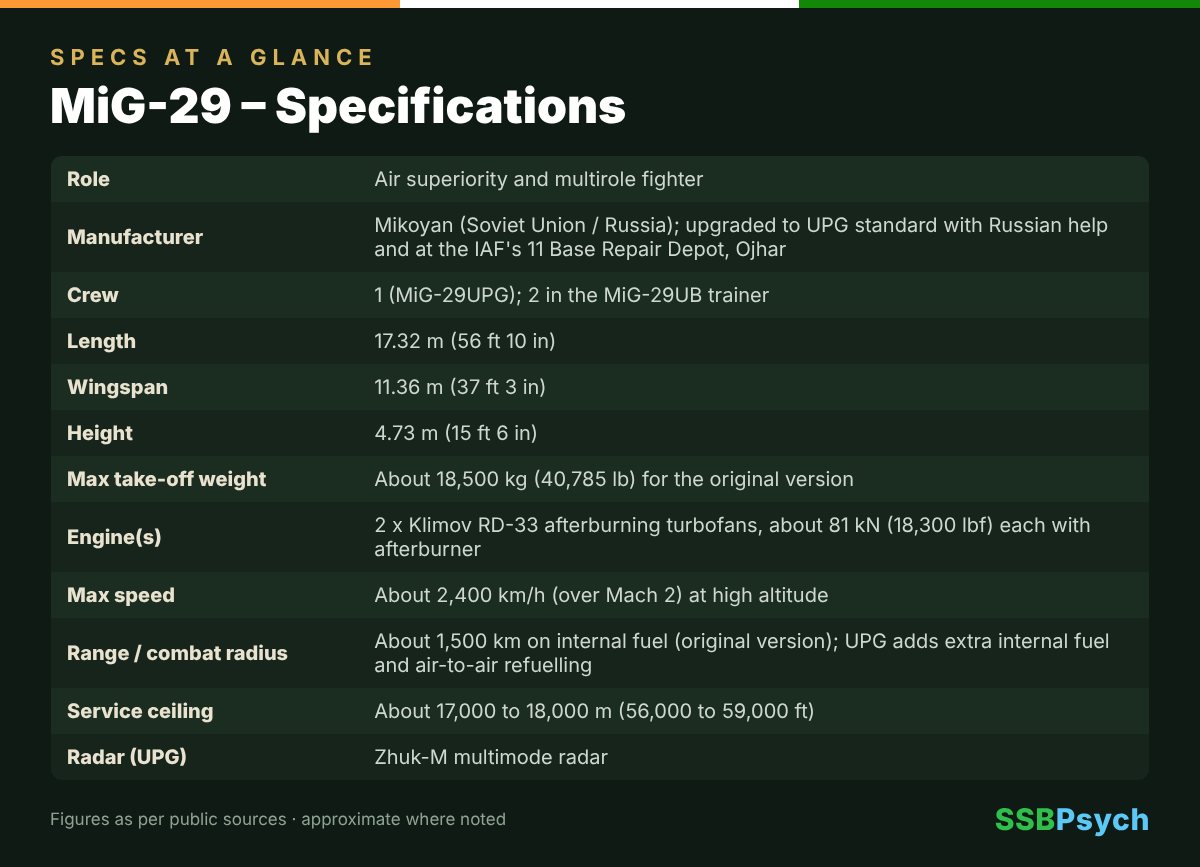
MiG-29 Specifications
| Role | Air superiority and multirole fighter |
| Manufacturer | Mikoyan (Soviet Union / Russia); upgraded to UPG standard with Russian help and at the IAF’s 11 Base Repair Depot, Ojhar |
| Crew | 1 (MiG-29UPG); 2 in the MiG-29UB trainer |
| Length | 17.32 m (56 ft 10 in) |
| Wingspan | 11.36 m (37 ft 3 in) |
| Height | 4.73 m (15 ft 6 in) |
| Max take-off weight | About 18,500 kg (40,785 lb) for the original version |
| Engine(s) | 2 x Klimov RD-33 afterburning turbofans, about 81 kN (18,300 lbf) each with afterburner |
| Max speed | About 2,400 km/h (over Mach 2) at high altitude |
| Range / combat radius | About 1,500 km on internal fuel (original version); UPG adds extra internal fuel and air-to-air refuelling |
| Service ceiling | About 17,000 to 18,000 m (56,000 to 59,000 ft) |
| Radar (UPG) | Zhuk-M multimode radar |
| Gun | 1 x 30 mm GSh-30-1 cannon |
| First flight | 6 October 1977 |
| Inducted in IAF | December 1987 |
| Number in IAF | Roughly 60-plus jets in three squadrons (approx., public estimates) |
Why India Needed the MiG-29
In the early 1980s the IAF faced a serious worry. Pakistan was receiving American F-16 fighters, which were modern, agile and well armed. Many IAF squadrons still flew older designs. India needed a fast, agile air superiority fighter, meaning a jet whose main job is to win control of the sky by beating enemy fighters.
The Soviet Union offered the brand-new MiG-29, which had first flown on 6 October 1977 and entered Soviet service only in 1983. India signed the deal in the mid-1980s and became one of the first foreign customers. For an air force that had flown many MiG types before, the MiG-29 was a big leap: two powerful engines, a look-down radar, an infrared search and track sensor and a helmet-mounted sight that let the pilot aim missiles simply by turning his head.
History of the MiG-29 in the IAF
The first jets were shipped by sea and assembled at Pune. On 6 December 1987 the MiG-29 was formally inducted with No. 28 Squadron, the First Supersonics, and No. 47 Squadron, the Black Archers. A third unit, No. 223 Squadron, the Tridents, followed in 1989. More aircraft were ordered in 1989 and again in 1994, along with two-seat MiG-29UB trainers.
The jet earned its battle reputation in 1999. During the Kargil War, MiG-29s flew escort and air defence missions so that Mirage 2000 bombers could drop laser-guided bombs on enemy positions high in the mountains without fear of interception. The R-73 dogfight missile, then new to the IAF, was going through trials when the fighting began, so the IAF had it ready for real combat.
By the 2000s the original jets were ageing. Their radar was dated, fuel capacity was short and they could not refuel in the air. So India signed a deal with Russia in 2008 for a deep upgrade of its fleet. The first six jets were upgraded in Russia, and the rest were upgraded in India, mainly at the IAF’s 11 Base Repair Depot at Ojhar near Nashik. The first three upgraded MiG-29UPGs were delivered in December 2012, and by September 2019 the whole fleet had been upgraded.
What the UPG upgrade changed
- A new Zhuk-M radar that can track several targets at once and guide modern missiles
- Ability to fire the R-77 active radar missile, a beyond-visual-range weapon
- A bigger fuel tank in the spine, plus a retractable probe for air-to-air refuelling
- A modern cockpit with multifunction displays and hands-on throttle and stick controls
- An Indian-developed D-29 electronic warfare suite to jam and confuse enemy radars
- Engine improvements with the RD-33 series 3, and a longer airframe life
In February 2019, a day after the Balakot air strike, Pakistan sent jets towards Indian territory. MiG-29s were among the fighters scrambled to intercept them. In 2020, during the stand-off with China in eastern Ladakh, MiG-29s were publicly reported operating from Leh, one of the highest airfields in the world. And in the May 2025 India-Pakistan conflict, the MiG-29 was again deployed at forward bases.
Engine and Performance Explained Simply
The MiG-29 has two Klimov RD-33 turbofan engines. A turbofan is a jet engine that sucks in air, squeezes it, burns it with fuel and blasts it out of the back. Each RD-33 has an afterburner, which sprays extra fuel into the hot exhaust for a huge burst of power, a bit like pressing a turbo button. With afterburner, each engine produces about 81 kN of thrust, roughly the push needed to lift about 8 tonnes straight up. Together the two engines can push the jet almost as hard as its own weight, which is why it can climb almost vertically.
Top speed is about 2,400 km/h at high altitude, more than twice the speed of sound. Mach 1 means the speed of sound, so Mach 2 is twice that. Put simply, the MiG-29 is about seven times faster than a bullet train running at 320 km/h. It could cross from Delhi to Mumbai, about 1,150 km by air, in under half an hour if it flew flat out the whole way.
Service ceiling is the highest altitude at which an aircraft can still climb usefully. For the MiG-29 it is roughly 17,000 to 18,000 m, which is about twice the height of Mount Everest. Airliners usually cruise at about 10,000 to 12,000 m, so the MiG-29 can fight well above them.
The jet is 17.32 m long, about as long as four family cars parked bumper to bumper, with a wingspan of 11.36 m. Fuel was always its weak point. The original version could fly about 1,500 km on internal fuel, which kept it close to home. The UPG fixed much of this with a larger spine tank and air-to-air refuelling, which lets it top up from an IAF tanker in flight, like a car refuelling on the highway without stopping.
One famous feature is the set of doors inside the engine air intakes. On the ground the main intakes can close and air enters through louvres on top of the wing roots instead, which keeps stones and debris from being sucked into the engines on rough runways. That made it ideal for forward bases.
Weapons and Missiles
- 30 mm GSh-30-1 internal cannon
- R-73 short-range infrared-guided air-to-air missile (dogfight missile)
- R-27 medium-range air-to-air missile
- R-77 (RVV-AE) active radar beyond-visual-range missile, added with the UPG upgrade
- R-60 short-range air-to-air missile (original fit)
- Unguided bombs and rockets for ground attack
- External drop tanks to stretch range
The R-73 is the star dogfight weapon. Combined with the helmet sight, a pilot can lock onto an enemy that is well off to one side just by looking at it. For longer fights, the R-27 and the newer R-77 let the pilot engage targets far beyond visual range, meaning the enemy is too far away to be seen with the naked eye. Reports in 2026 said the IAF was planning to fit the British ASRAAM missile in place of the R-73, but this is still a plan, not a finished fit.
MiG-29 Missions and Operations
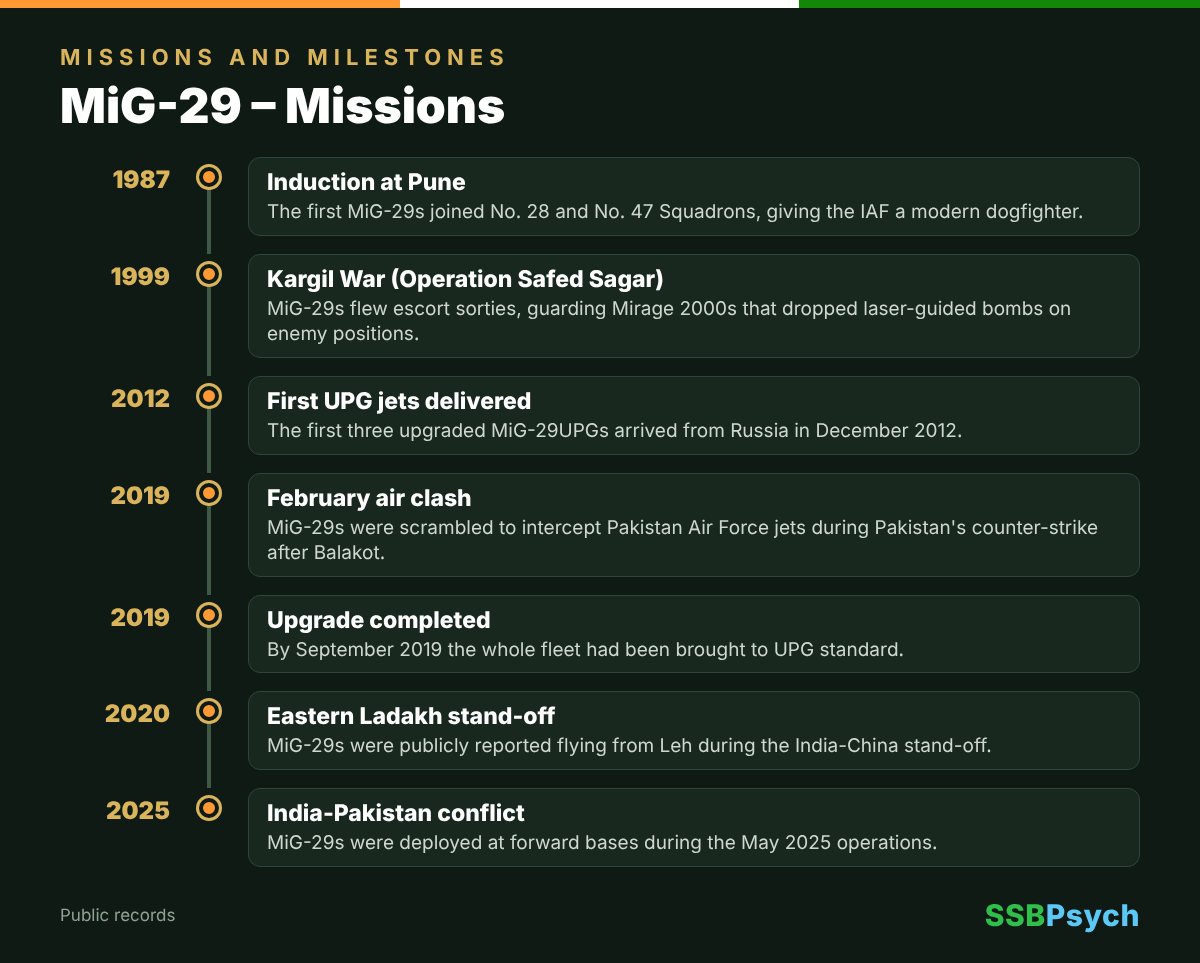
- 1987 – Induction at Pune: The first MiG-29s joined No. 28 and No. 47 Squadrons, giving the IAF a modern dogfighter.
- 1999 – Kargil War (Operation Safed Sagar): MiG-29s flew escort sorties, guarding Mirage 2000s that dropped laser-guided bombs on enemy positions.
- 2012 – First UPG jets delivered: The first three upgraded MiG-29UPGs arrived from Russia in December 2012.
- 2019 – February air clash: MiG-29s were scrambled to intercept Pakistan Air Force jets during Pakistan’s counter-strike after Balakot.
- 2019 – Upgrade completed: By September 2019 the whole fleet had been brought to UPG standard.
- 2020 – Eastern Ladakh stand-off: MiG-29s were publicly reported flying from Leh during the India-China stand-off.
- 2025 – India-Pakistan conflict: MiG-29s were deployed at forward bases during the May 2025 operations.
Where the MiG-29 Is Based and Who Flies It
The MiG-29 serves with three squadrons: No. 28 (First Supersonics), No. 47 (Black Archers) and No. 223 (Tridents). Adampur in Punjab is the best known MiG-29 base in public reporting, and the jets have also been publicly reported at Jamnagar in Gujarat and at Srinagar. Major overhauls and upgrades are carried out at 11 Base Repair Depot, Ojhar.
A fighter squadron in the IAF is usually commanded by a Wing Commander. Under him or her serve Squadron Leaders, Flight Lieutenants and Flying Officers, each with a growing number of flying hours. Squadrons sit at an Air Force Station led by a Group Captain or Air Commodore, which in turn reports to a regional command headed by an Air Marshal.
How does someone end up flying a MiG-29? A cadet joins through NDA, CDS or AFCAT and goes to the Air Force Academy at Dundigal. Basic flying training is done on the Pilatus PC-7 Mk II. Those chosen for the fighter stream move on to intermediate and then advanced jet training on the Hawk. After being commissioned as a Flying Officer, the young pilot joins a conversion course on the MiG-29 and then a squadron, where years of further training turn him or her into a fully operational fighter pilot. From joining to becoming fully operational on a frontline jet usually takes several years.
Strengths and Limitations
- Strength: excellent agility and climb rate, ideal for close dogfights
- Strength: two engines give a safety margin if one fails
- Strength: helmet sight and R-73 make it deadly at short range
- Strength: can operate from forward and rough airfields thanks to its intake design
- Strength: UPG brought a modern radar, R-77 missiles and air-to-air refuelling
- Limitation: the basic design dates back to the 1970s
- Limitation: shorter range than heavier jets like the Su-30MKI
- Limitation: smaller weapon load than newer multirole fighters, and an ageing fleet needs careful maintenance
Future of the MiG-29 in the IAF
The UPG upgrade extended the life of the fleet well into the future. The IAF continues to improve the jets. In 2020 the government cleared a proposal to buy 21 more MiG-29s from Russia. In 2024 the IAF sought a further upgrade so that some jets could carry modern high-speed bombs for ground attack, and in early 2026 the IAF moved to fit British ASRAAM missiles and new software-defined radios that let the jets share data with other aircraft and ground stations.
In the long run, Indian-built fighters such as the Tejas Mk1A and future Tejas Mk2 and AMCA are expected to replace older types. Until then, the MiG-29 remains an important part of India’s air defence, especially along the northern and western borders.
Why It Matters for SSB and AFCAT Aspirants
Questions on IAF aircraft appear in the AFCAT general awareness section, the CDS and NDA GAT papers and in SSB interviews and group discussions. An interviewing officer may ask a candidate who wants to join the flying branch which fighter he or she would like to fly and why. Knowing that the MiG-29 is called Baaz, that it flew in Kargil and that it was upgraded to UPG standard shows genuine interest and awareness.
The MiG-29 story also teaches a leadership lesson. Instead of throwing away good airframes, the IAF upgraded them with new radars, missiles and Indian electronic warfare systems, getting much more value from the same jets. Making the best use of available resources is exactly the kind of practical thinking assessors look for in group tasks.
Did You Know? MiG-29 Facts
- Baaz means falcon or eagle, a fitting name for a fast hunting fighter.
- India was one of the first countries outside the Soviet Union to fly the MiG-29.
- The Indian Navy flies a different carrier version, the MiG-29K, from INS Vikramaditya and INS Vikrant.
- The pilot can aim the R-73 missile simply by turning his or her head, using a helmet-mounted sight.
- Special intake doors close on the ground to stop stones being sucked into the engines.
- No. 28 Squadron is nicknamed the First Supersonics because it was the IAF’s first supersonic squadron, when it flew the MiG-21.
- The UPG upgrade added an Indian-designed D-29 electronic warfare suite.
Quiz: Test Your Knowledge of MiG-29
Click an option to see if you are right. Your score updates live.
MiG-29: Frequently Asked Questions
The MiG-29 can reach about 2,400 km/h at high altitude, which is more than twice the speed of sound.
Yes. The IAF flies the upgraded MiG-29UPG with three squadrons, and the fleet has been further upgraded with new weapons and radios.
The UPG has a new Zhuk-M radar, R-77 missile capability, more internal fuel, air-to-air refuelling, a modern cockpit and an Indian D-29 electronic warfare suite.
In 1999 MiG-29s flew escort and air defence missions, protecting Mirage 2000s that bombed enemy positions with laser-guided bombs.
Yes, but the Navy flies a different version called the MiG-29K, designed to take off from and land on aircraft carriers.
This is part 11 of 50 in SSBPsych’s Indian Air Force aircraft series – a new aircraft every evening at 6 PM.
Sources: en.wikipedia.org, bharat-rakshak.com, milavia.net, airpowerasia.com, oldain.ainonline.com.
Preparing for NDA, CDS, AFCAT or your SSB? Join SSBPsych’s online and offline batches – explore our courses or call +91 8076540582.