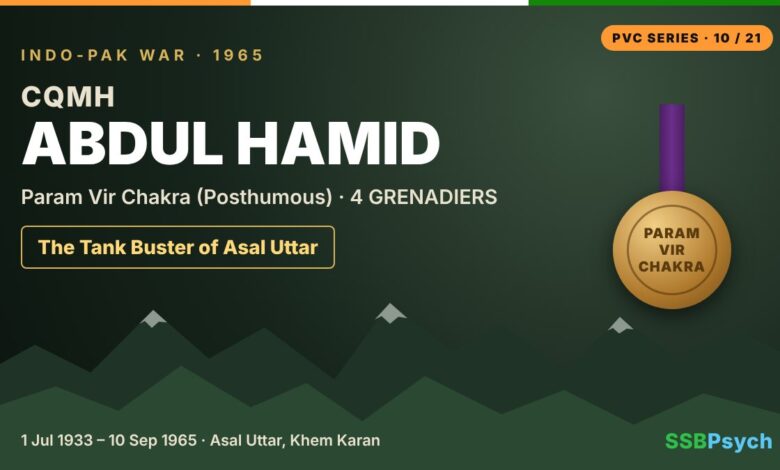
CQMH Abdul Hamid, PVC: The Tank Buster of Asal Uttar, 1965 – Full Story (with Quiz)
Imagine sitting in an open jeep, with no armour around you, while a column of heavy steel tanks rolls towards your position. Most people would think of escape. Company Quartermaster Havildar Abdul Hamid of 4 Grenadiers thought only of which tank to hit first. In September 1965, near the village of Asal Uttar in Punjab, his jeep-mounted recoilless gun became the nightmare of Pakistan’s prized Patton tanks.
CQMH Abdul Hamid is one of the best-loved heroes of the Indian Army. He was the son of a tailor from a small village, and he rose to become a legend through skill, nerve and an unshakeable sense of duty. In this post we cover his early life, his army career, the background of the 1965 war, the Battle of Asal Uttar in detail, his citation and his legacy. At the end you will find Officer Like Qualities to learn from him and a 10-question quiz.
CQMH Abdul Hamid – Quick Facts
| Full name | Abdul Hamid |
| Born | 1 July 1933, Dhamupur village, Ghazipur district, Uttar Pradesh |
| Parents | Mohammad Usman and Sakina Begum |
| Wife | Rasoolan Bibi |
| Enlisted | 27 December 1954, The Grenadiers |
| Unit | 4th Battalion, The Grenadiers (4 Grenadiers) |
| Rank | Company Quartermaster Havildar (CQMH) |
| Battle | Battle of Asal Uttar, Khem Karan sector, Punjab |
| Date of action | 8 to 10 September 1965 (killed on 10 September) |
| Weapon | Recoilless gun mounted on a jeep |
| Award | Param Vir Chakra (Posthumous) |
Early Life: The Tailor’s Son from Dhamupur
Abdul Hamid was born on 1 July 1933 in Dhamupur, a village in Ghazipur district of Uttar Pradesh. His father, Mohammad Usman, was a tailor, and his mother was Sakina Begum. As a boy, Hamid helped his father with stitching work. Life was simple and money was tight, but the young man wanted more than the village could offer. He dreamed of serving the country in uniform.
Joining the Army
Hamid enlisted in The Grenadiers on 27 December 1954 and was posted to the 4th Battalion, where he served for the rest of his life. Over the years his battalion moved through many stations, including Agra, Amritsar, Jammu and Kashmir, Delhi, NEFA and Ramgarh. He married Rasoolan Bibi, and by 1965 he had risen to the appointment of Company Quartermaster Havildar (CQMH), a senior non-commissioned post responsible for the supplies and stores of a company.
Tested in 1962
Hamid had already seen hard times in war. In 1962, 4 Grenadiers was part of the 7th Infantry Brigade at Namka Chu in NEFA, which bore the brunt of the Chinese offensive. Cut off and surrounded, the battalion broke out on foot through very difficult terrain, crossing into Bhutan before reaching Misamari in Assam. Experiences like this toughen a soldier, and they would serve Hamid well three years later.
The War Background: 1965
In August 1965, Pakistan launched Operation Gibraltar, sending armed infiltrators into Jammu and Kashmir. When that failed, it attacked in the Chhamb sector. India responded by opening new fronts in Punjab in early September. Pakistan, in turn, planned a powerful armoured thrust in the Khem Karan sector, aiming to drive deep into Indian Punjab with its US-built Patton tanks, which were then considered among the most advanced in the region.
Standing in the path of this thrust was India’s 4th Division, which took up a defensive position around Asal Uttar. The Indian commanders chose the ground well. Fields of sugarcane provided cover, and the area could be flooded to slow down tanks. 4 Grenadiers held a position near the village of Chima on the road from Khem Karan to Bhikhiwind. CQMH Abdul Hamid commanded the battalion’s recoilless gun (RCL) detachment, a powerful anti-tank weapon mounted on a jeep.
What Is a Recoilless Gun?
A recoilless gun is an anti-tank weapon designed so that much of the blast escapes out of the back of the barrel. This cancels most of the kick, or recoil, when it fires, which means a fairly large gun can be mounted on a light vehicle like a jeep without the vehicle being thrown backwards. The trade-off is a dangerous back-blast and a large flash that can give away the firer’s position. That is why RCL crews had to fire, then move quickly before the enemy could respond. Doing this against tanks, which could easily destroy an unarmoured jeep, demanded steady nerves, good judgement of ground and precise timing.
The Battle of Asal Uttar, 8 to 10 September 1965
8 September: First Blood
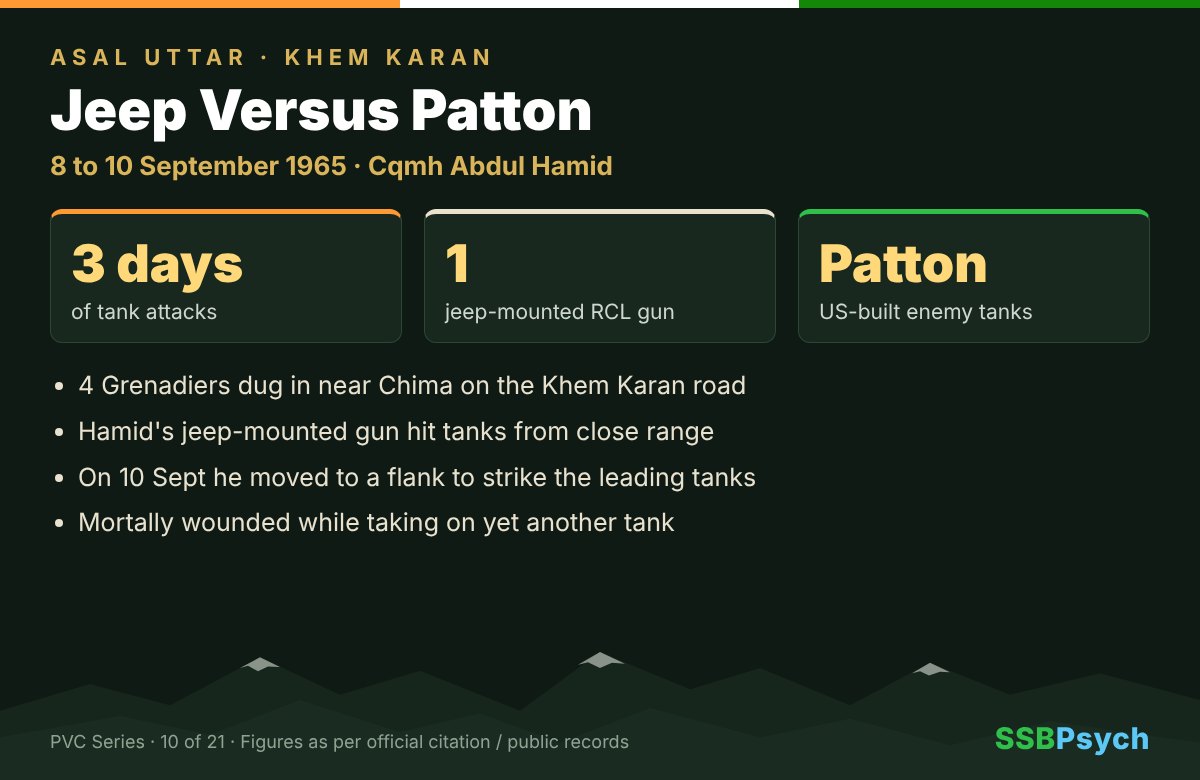
4 Grenadiers reached its position around midnight on 7 to 8 September and dug in quickly. When the first Pakistani tanks came forward on 8 September, Hamid was ready. Using the sugarcane for cover, he moved his jeep into position and knocked out the leading tank at very close range. Later that day, after an artillery barrage and another armoured push, he destroyed a second tank. The Patton was supposed to be nearly invincible. A single jeep had just proved otherwise.
9 September: Holding Firm Under Air Attack
The next morning, Pakistani Sabre jets attacked the Indian positions, and armoured attacks followed. Hamid and his crew kept moving their jeep, firing and then shifting position before the enemy could aim back. According to accounts of the battle, by evening his tally had grown further. The battalion was now short of its own tank support, and recoilless guns and mines were its main defence against armour.
10 September: The Final Duel
On 10 September the enemy came again, this time after heavy shelling and with a full regiment of Patton tanks. The tanks broke into the forward company area. Hamid realised that firing from the front would be suicidal, so he moved his jeep to a flanking position from where he could hit the tanks from the side. From there he knocked out the leading tank and then another.
Because his jeep was completely exposed, he ordered his crew to take cover while he carried on. As he lined up his gun on yet another tank, a high-explosive shell struck. He was mortally wounded, but his courage had already done its work. Inspired by his example, his comrades held their ground, and the Pakistani attack was beaten back.
How Many Tanks?
Accounts differ on the exact number of tanks Hamid destroyed over the three days. His citation describes his actions on 10 September, when he knocked out the leading tank and a second one before being hit while engaging a third. Popular and memorial accounts, including the plaque at his memorial, credit him with destroying as many as eight Patton tanks across the battle. Whatever the precise number, there is no doubt that he played a central role in breaking Pakistan’s armoured attack.
The Graveyard of Pattons
Asal Uttar turned into one of the largest tank battles fought since the Second World War, and it ended in a decisive Indian victory. Large numbers of Pakistani tanks were destroyed, abandoned or captured, many stuck in the flooded, muddy fields. The area near Khem Karan where captured Pattons were displayed came to be called Patton Nagar.
The Param Vir Chakra Citation (In Simple Words)
CQMH Abdul Hamid was awarded the Param Vir Chakra posthumously. In simple terms, his citation explains that on 10 September 1965, Pakistani forces attacked a vital area near Chima with a regiment of Patton tanks, after heavy shelling. When the enemy tanks broke into the forward company positions, Hamid, who commanded a recoilless gun detachment, moved to a flank with his jeep-mounted gun. Under intense fire, he knocked out the leading tank and then another. While engaging a third tank, he was mortally wounded by a high-explosive shell. The citation says his brave action inspired his comrades to fight off the attack, and it praises his complete disregard for his own safety.
Legacy of CQMH Abdul Hamid
- His grave and a battle memorial stand near Asal Uttar, on the Khem Karan-Bhikhiwind road, where an annual fair is held in his memory. Prime Minister Narendra Modi paid tribute there in 2015.
- India Post issued a commemorative stamp in his honour on 28 January 2000, showing a jeep with a recoilless gun.
- His bust stands at the Param Yodha Sthal of the National War Memorial, New Delhi.
- In January 2023, an island in the Andaman and Nicobar group was named Hamid Island.
- His memorial in Dhamupur was renovated, and Army Chief General Bipin Rawat unveiled a memorial in Ghazipur in 2017.
- Naseeruddin Shah played him in the 1988 TV series Param Vir Chakra.
Abdul Hamid’s story is loved across India because it shows that heroism has no connection with background, religion or rank. A tailor’s son, serving as a quartermaster, became the hero of one of India’s greatest tank battles. His name is still spoken with pride in his village, in his regiment and across the nation.
For aspirants, there is also a practical lesson. Hamid did not simply fire bravely. He thought about angles, cover and movement. He used the sugarcane to hide his jeep, struck from the flanks and kept shifting position. Courage won the day, but it was courage guided by sound tactical thinking.
Lessons for SSB Aspirants: OLQs in Action
The SSB does not test whether you can recite history – it looks for the qualities of an officer. Here is how CQMH Abdul Hamid showed them:
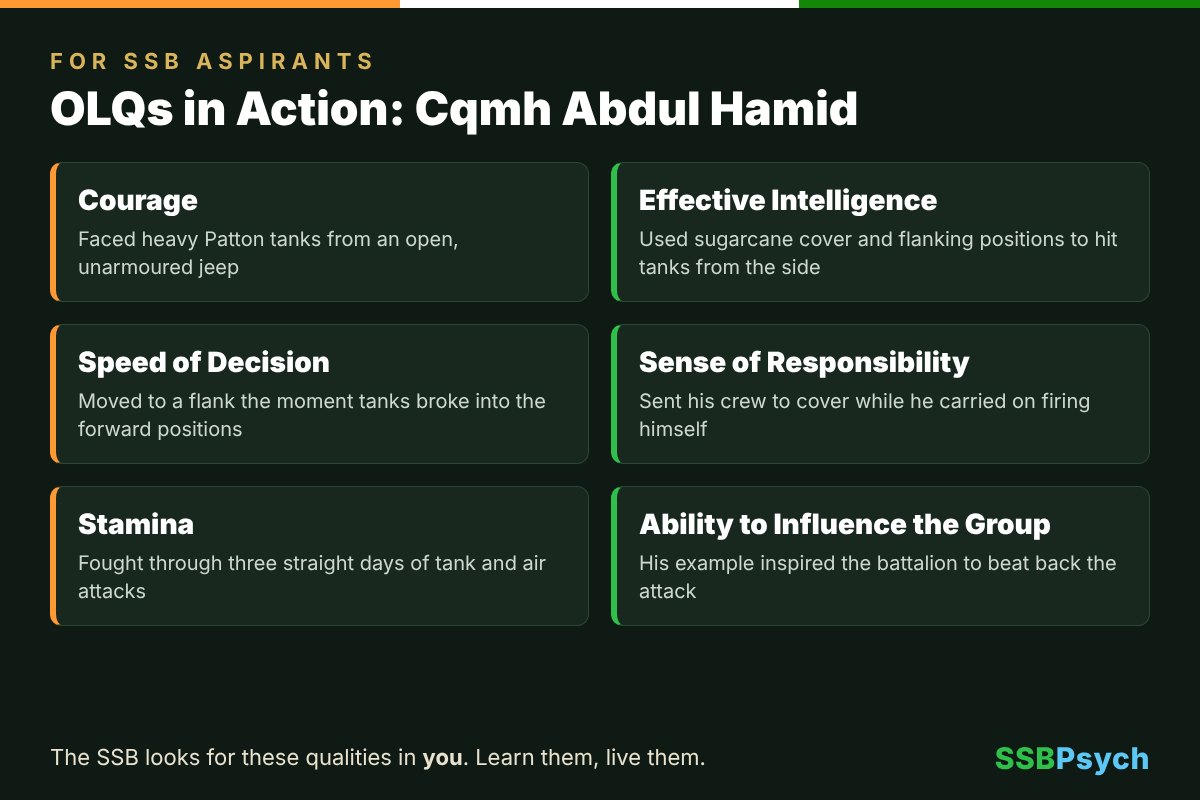
- Courage – Faced heavy Patton tanks from an open, unarmoured jeep
- Effective Intelligence – Used sugarcane cover and flanking positions to hit tanks from the side
- Speed of Decision – Moved to a flank the moment tanks broke into the forward positions
- Sense of Responsibility – Sent his crew to cover while he carried on firing himself
- Stamina – Fought through three straight days of tank and air attacks
- Ability to Influence the Group – His example inspired the battalion to beat back the attack
Tip for your SSB interview: If the IO asks about the 1965 war, do not stop at names and dates. Explain why Asal Uttar mattered, how terrain and flooding helped India, and how one soldier’s tactics made a difference. This shows you can think, not just remember.
Practice Corner: WAT and SRT
Write your first spontaneous response to these before you scroll to the quiz. Keep WAT sentences short, positive and action-oriented.
WAT Words
- Tank
- Jeep
- Flank
- Tailor
- Steel
SRTs
- He sees a much stronger rival team approaching and his own team wants to give up before trying. He…
- He is in charge of a group whose equipment is far weaker than the opposition’s. He…
- He finds his position exposed during an important task and his teammates are at risk. He…
Quiz: How Well Do You Know CQMH Abdul Hamid?
Test yourself! Click an option to see if you are right. Your score updates live.
Frequently Asked Questions
Why is Abdul Hamid called a tank buster?
Because during the Battle of Asal Uttar in September 1965 he destroyed several Pakistani Patton tanks using a recoilless gun mounted on a jeep.
How many tanks did Abdul Hamid destroy?
Accounts differ. His citation describes two tanks knocked out on 10 September before he was hit while engaging a third, while memorial and popular accounts credit him with up to eight tanks over the battle.
Where is the Battle of Asal Uttar?
Asal Uttar is a village in the Khem Karan sector of Punjab, near the border with Pakistan.
Where is CQMH Abdul Hamid buried?
His grave and memorial are near Asal Uttar, on the Khem Karan-Bhikhiwind road in Punjab.
What honours are named after him?
Hamid Island in the Andaman and Nicobar group, a commemorative India Post stamp from 2000, and memorials at Asal Uttar, Dhamupur and Ghazipur.
The Param Vir Chakra Series on SSBPsych
This is part 10 of 21 in our series on every Param Vir Chakra awardee. A new hero goes live every morning at 7:30 AM. Also read the story of Captain Vikram Batra, PVC – the Sher Shah of Kargil.
Sources: en.wikipedia.org, www.bharat-rakshak.com, honourpoint.in, thehitavada.com.
Preparing for your SSB? Join SSBPsych’s online and offline SSB batches and learn how to show your OLQs with confidence – explore our courses or call +91 8076540582.