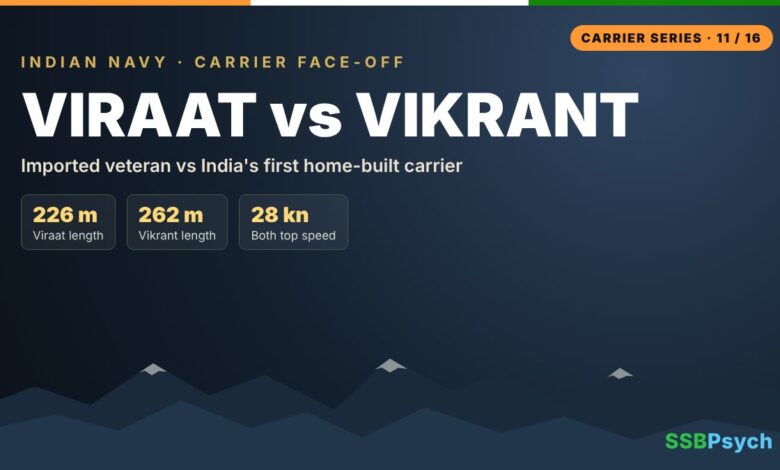
INS Viraat vs INS Vikrant: Old British Flagship vs Made in India
One ship was born in a British shipyard, fought in the Falklands War under the Royal Navy flag and then guarded India for 30 years. The other was designed by Indian naval architects and built in Kochi with Indian steel. Putting INS Viraat vs INS Vikrant side by side is like watching India’s journey from buying carriers to building them.
In this guide we compare INS Viraat with the new INS Vikrant commissioned in 2022. We cover size, weight, engines, speed, range, crew, aircraft, launch systems, cost and operations, explaining each difference in plain language. Then we look at what each did best, what India learned and our fun verdict. Great reading for NDA, CDS, AFCAT and SSB aspirants.

INS Viraat vs INS Vikrant: Comparison Table
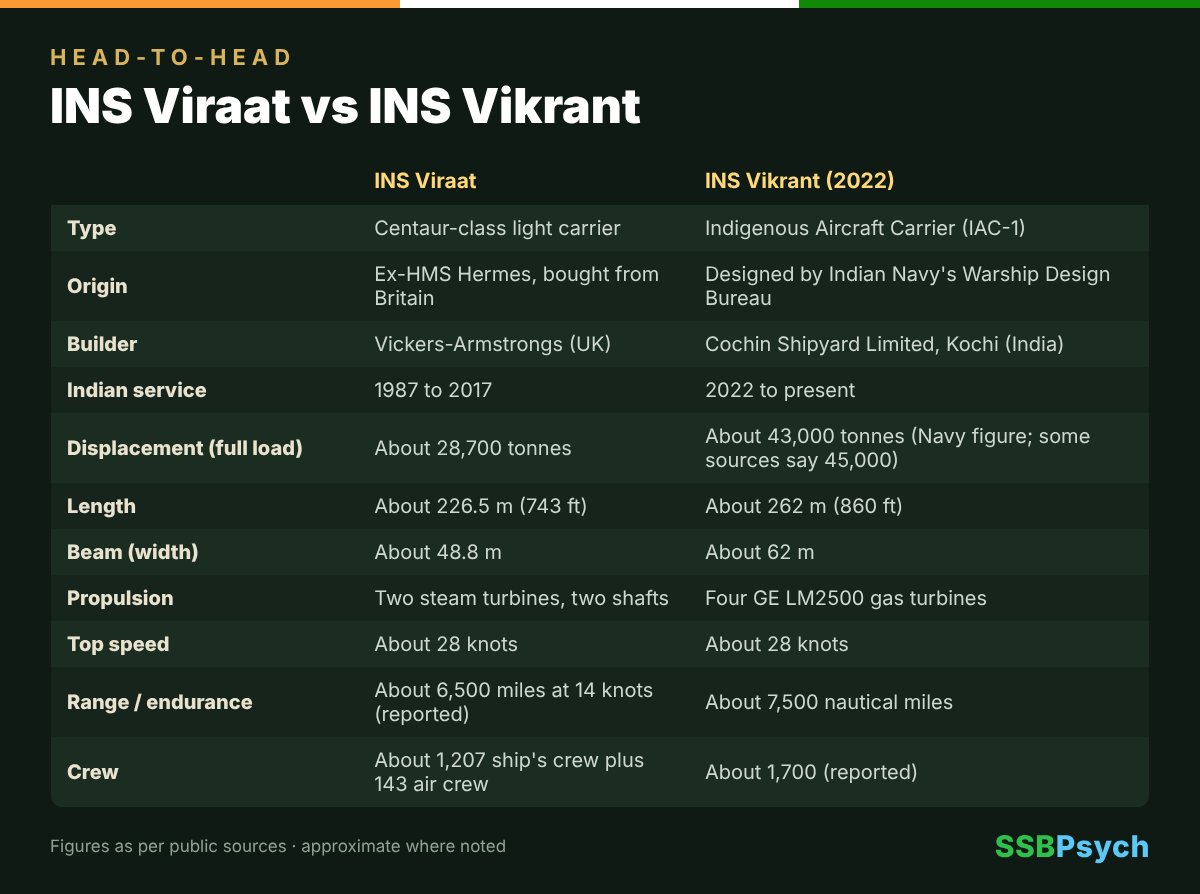
Here are the key figures from public and official sources, rounded. Where sources disagree, we say so.
INS Viraat vs INS Vikrant: Side-by-Side Comparison
| INS Viraat | INS Vikrant (2022) | |
|---|---|---|
| Type | Centaur-class light carrier | Indigenous Aircraft Carrier (IAC-1) |
| Origin | Ex-HMS Hermes, bought from Britain | Designed by Indian Navy’s Warship Design Bureau |
| Builder | Vickers-Armstrongs (UK) | Cochin Shipyard Limited, Kochi (India) |
| Indian service | 1987 to 2017 | 2022 to present |
| Displacement (full load) | About 28,700 tonnes | About 43,000 tonnes (Navy figure; some sources say 45,000) |
| Length | About 226.5 m (743 ft) | About 262 m (860 ft) |
| Beam (width) | About 48.8 m | About 62 m |
| Propulsion | Two steam turbines, two shafts | Four GE LM2500 gas turbines |
| Top speed | About 28 knots | About 28 knots |
| Range / endurance | About 6,500 miles at 14 knots (reported) | About 7,500 nautical miles |
| Crew | About 1,207 ship’s crew plus 143 air crew | About 1,700 (reported) |
| Aircraft | Up to about 26: Sea Harrier, Sea King, Chetak, Dhruv | About 30: MiG-29K, Ka-31, MH-60R, Dhruv; Rafale M on order |
| Launch method | STOVL: 12 degree ski-jump, vertical landing | STOBAR: ski-jump take-off, arrester wire landing |
| Cost (reported) | Purchase price not widely reported; scrap sale about Rs 38.5 crore (2020) | About Rs 20,000 crore (reported in 2022) |
| Operations | Op Jupiter 1989, Op Vijay 1999, Op Parakram 2001-02 | Twin-carrier drills 2023-24; Arabian Sea deployment 2025 (reported) |
| Status | Scrapped at Alang from 2020 | In service |
Meet the Two Ships
INS Viraat: The Second-Hand Hero
Viraat began as HMS Hermes, a Centaur-class carrier laid down in 1944 and commissioned into the Royal Navy in 1959. In 1982 she led the British fleet in the Falklands War. India bought her in the 1980s and commissioned her as INS Viraat, meaning ‘giant’, on 12 May 1987. She stayed in service until 6 March 2017 and was India’s flagship until 2013. In her final years she was the oldest serving aircraft carrier in the world.
INS Vikrant (2022): Made in India
The new Vikrant is India’s first home-designed and home-built aircraft carrier. The Indian Navy’s Warship Design Bureau designed her, and Cochin Shipyard Limited built her. Her keel was laid in 2009, she was floated out in 2013, and Prime Minister Narendra Modi commissioned her on 2 September 2022. She carries the proud name of India’s first carrier, the hero of the 1971 war.
Size: How Much Bigger Is the New Vikrant?
Warships are compared by displacement, the weight of water a ship pushes aside when it floats, which equals its own weight. Viraat weighed about 28,700 tonnes fully loaded. The new Vikrant weighs about 43,000 tonnes by the Navy’s figure, with some sources quoting about 45,000. That is about one and a half times Viraat’s weight. If a car weighs one tonne, it is like comparing 28,700 cars with 43,000 cars.
Viraat was about 226 metres long and about 49 metres wide. Vikrant is about 262 metres long and about 62 metres wide. That means a much larger flight deck and hangar. The new ship has 14 decks and around 2,300 compartments, a maze of rooms that new crew members take time to learn.
Winner on size: INS Vikrant.
Engines and Speed: Steam vs Gas Turbines
Here is a surprising fact: both ships have about the same top speed, around 28 knots, which is about 52 km per hour. One knot is one nautical mile per hour, roughly 1.85 km per hour. But they get there in very different ways.
Viraat used steam turbines. Boilers burned fuel to turn water into high-pressure steam, which spun turbines connected to two propeller shafts, like a giant pressure cooker pushing a fan. Steam plants take time to heat up and need many engineers to look after them, especially as they age.
Vikrant uses four gas turbines made by General Electric. A gas turbine is close to a jet engine fixed inside a ship. It starts quickly, gives power almost instantly and needs fewer people to run. For a carrier, this means faster response when an order comes to sail or speed up.
For range, Viraat’s listed figure was about 6,500 miles at 14 knots, while Vikrant’s official endurance is about 7,500 nautical miles. The new ship can also be refuelled at sea by Navy tankers, so in practice she can stay on patrol far longer than her tank size alone suggests.
Crew: Bigger Ship, Bigger Family
Viraat carried about 1,207 ship’s crew plus 143 air crew. The new Vikrant carries about 1,700 people according to reports, and she was designed with accommodation for women officers and sailors. Both ships are commanded by an officer of Captain rank, supported by heads of departments for aviation, engineering, weapons, logistics and medical care. Life on board is like a small town, with galleys, a medical centre, workshops and kitchens running round the clock.
Aircraft and Launch: Jump Jets vs Supersonic Fighters
This is the biggest difference in the INS Viraat vs INS Vikrant comparison.
Viraat flew the British Sea Harrier, a jump jet whose engine nozzles swivel downward so it can land vertically like a helicopter. This is called STOVL: Short Take-Off, Vertical Landing. A 12 degree ski-jump at the bow helped Harriers take off with more fuel and weapons. Her air group also included Sea King anti-submarine helicopters, Chetaks and later Dhruv helicopters, up to about 26 aircraft in all.
Vikrant uses STOBAR: Short Take-Off But Arrested Recovery. Her MiG-29K fighters cannot land vertically, so they race up a ski-jump to take off and land by catching an arrester wire with a hook. Picture a cyclist zooming off a ramp, then a strong rope catching the cycle’s back hook to stop it in a short distance.
Vikrant can operate about 30 aircraft. Today these include MiG-29K fighters, Kamov Ka-31 early warning helicopters with a large radar to spot threats far away, MH-60R multi-role helicopters and HAL Dhruv helicopters. In April 2025 India signed a deal with France for 26 Rafale M fighters for carrier use, with deliveries reported to begin around 2030. The Sea Harrier was nimble but subsonic; the MiG-29K flies faster than sound and carries more weapons farther.
Winner on air power: INS Vikrant, by a wide margin.
INS Viraat vs INS Vikrant Timeline
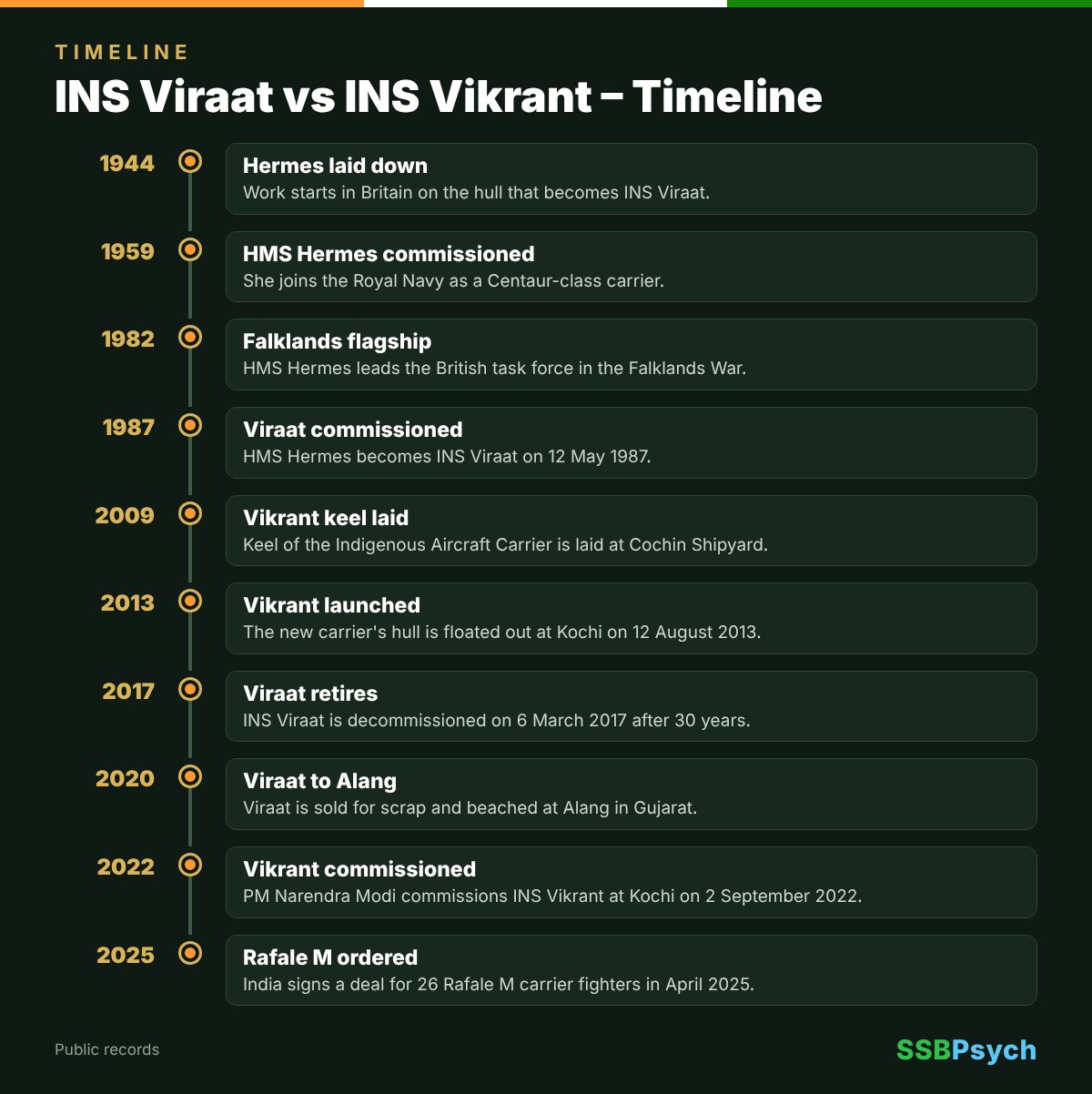
- 1944 – Hermes laid down: Work starts in Britain on the hull that becomes INS Viraat.
- 1959 – HMS Hermes commissioned: She joins the Royal Navy as a Centaur-class carrier.
- 1982 – Falklands flagship: HMS Hermes leads the British task force in the Falklands War.
- 1987 – Viraat commissioned: HMS Hermes becomes INS Viraat on 12 May 1987.
- 2009 – Vikrant keel laid: Keel of the Indigenous Aircraft Carrier is laid at Cochin Shipyard.
- 2013 – Vikrant launched: The new carrier’s hull is floated out at Kochi on 12 August 2013.
- 2017 – Viraat retires: INS Viraat is decommissioned on 6 March 2017 after 30 years.
- 2020 – Viraat to Alang: Viraat is sold for scrap and beached at Alang in Gujarat.
- 2022 – Vikrant commissioned: PM Narendra Modi commissions INS Vikrant at Kochi on 2 September 2022.
- 2025 – Rafale M ordered: India signs a deal for 26 Rafale M carrier fighters in April 2025.
Aircraft, Weapons and Sensors
- BAe Sea Harrier FRS51 jump jets (Viraat)
- Westland Sea King anti-submarine helicopters (Viraat)
- Chetak and HAL Dhruv helicopters (Viraat)
- MiG-29K supersonic carrier fighters (Vikrant)
- Kamov Ka-31 airborne early warning helicopters (Vikrant)
- MH-60R multi-role helicopters (Vikrant)
- HAL Dhruv advanced light helicopters (Vikrant)
- Rafale M fighters ordered in 2025 for carrier use, deliveries reported from 2030
Operations: Old Missions, New Missions
Viraat spent 30 years being ready for trouble. She supported the Indian Peace Keeping Force off Sri Lanka in Operation Jupiter in 1989, joined the naval build-up during the Kargil conflict (Operation Vijay, 1999), and was deployed during Operation Parakram in 2001-02. Under the British flag, as HMS Hermes, she had already led a real naval campaign in the Falklands.
The new Vikrant is writing her own story. In February 2023, MiG-29K and naval Tejas jets made their first landings on her deck, and in May 2023 a MiG-29K landed at night for the first time. She has trained alongside INS Vikramaditya in twin-carrier drills. After the Pahalgam terror attack in April 2025, she was reported to have led a carrier battle group forward in the Arabian Sea.
Operations and Missions
- 1982 – Falklands War (as HMS Hermes): Viraat, then HMS Hermes, was flagship of the British task force.
- 1989 – Operation Jupiter: Viraat supported Indian Peace Keeping Force operations off Sri Lanka.
- 1999 – Operation Vijay (Kargil): Viraat joined the naval build-up in the Arabian Sea.
- 2001-02 – Operation Parakram: Viraat deployed during the long India-Pakistan standoff.
- 2023 – First jet landings: MiG-29K and naval Tejas landed on Vikrant for the first time in February 2023.
- 2023-24 – Twin-carrier operations: Vikrant sailed with INS Vikramaditya in joint carrier drills.
- 2025 – Arabian Sea deployment: After the Pahalgam attack, Vikrant led a carrier group forward in the Arabian Sea (reported).

Which Was Better at What, and Why?
- Size and air power: Vikrant. A heavier hull and supersonic MiG-29Ks beat Viraat’s Sea Harriers.
- Top speed: A tie at about 28 knots, though Vikrant’s gas turbines respond faster.
- Battle experience: Viraat, thanks to her Falklands War record as HMS Hermes.
- Longevity: Viraat. Her career ran from 1959 to 2017, nearly 58 years across two navies.
- Self-reliance: Vikrant. Spares, upgrades and repairs can be handled largely in India.
- Cost: Vikrant was reported to cost about Rs 20,000 crore in 2022. Viraat’s purchase price is not widely reported, but a used carrier was much cheaper up front.
What India Learned Between Viraat and Vikrant
Viraat was a master class in keeping an old ship alive. Each refit brought new challenges, from tired boilers to hard-to-find British spares. Those years taught Indian engineers how carriers are built and maintained from the inside, knowledge that helped when designing a carrier from scratch.
She also taught the Navy how to run a carrier air wing day after day, how to protect a carrier with escort ships and submarines, and how important it is to have more than one carrier, so one can be at sea while the other is in refit.
The new Vikrant shows those lessons in action. Designing and building at home took time, about 13 years from keel to commissioning, but it created skills, jobs and a network of Indian suppliers. Future carriers can now be built faster, and India no longer has to wait for a foreign navy to sell an old ship.
Why the Switch From Jump Jets Matters
Moving from Viraat’s jump jets to Vikrant’s arrested-landing fighters is a bigger change than it sounds. Jump jets carried smaller loads and had shorter range because a lot of engine power was used just to hover. Conventional fighters like the MiG-29K, and the Rafale M in future, can fly farther, carry heavier weapons and fight on more equal terms with land-based enemy jets. That lets a carrier protect the fleet from a greater distance, which is the whole point of having one.
There is a safety side too. Landing a fast jet on a moving deck by catching a wire demands precise flying, strong training and a well-drilled deck team. The Navy built that skill first on INS Vikramaditya from 2014 onwards, so by the time Vikrant joined in 2022, pilots and deck crews were ready to start flying from her within months. That is a good example of how each Indian carrier has prepared the way for the next one.
The Fun Verdict: INS Viraat vs INS Vikrant
Imagine a hostel senior and a fresher. The senior, Viraat, has seen everything: a war, decades of duty and countless drills. He is wise but ageing. The fresher, Vikrant, is taller, fitter, carries the latest gadgets, and was raised entirely at home.
On almost every number, Vikrant wins: size, aircraft, technology and self-reliance, with equal top speed. Viraat wins the experience award for her Falklands record and 30 years of loyal service to India. Viraat kept the carrier flame burning; Vikrant carries it into the future.
Did You Know?
- Viraat and the new Vikrant share the same top speed of about 28 knots despite very different engines.
- Viraat was laid down in 1944; the new Vikrant’s keel was laid in 2009, 65 years later.
- The Navy’s new ensign was unveiled on the day Vikrant was commissioned in 2022.
- Viraat’s Sea Harriers could land vertically; Vikrant’s MiG-29Ks must catch an arrester wire.
- Vikrant has around 2,300 compartments spread over 14 decks.
- India retired its Sea Harriers in 2016, a year before Viraat herself retired.
- Viraat’s scrap sale in 2020 was reported at about Rs 38.5 crore.
Read our full profiles of both carriers in this series and try the quiz below. Questions on India’s aircraft carriers come up often in SSB interviews and GK papers, so this comparison can help you score.
Quiz: Test Your Knowledge of INS Viraat vs INS Vikrant
Click an option to see if you are right. Your score updates live.
INS Viraat vs INS Vikrant: Frequently Asked Questions
INS Vikrant is bigger. She displaces about 43,000 tonnes and is about 262 metres long, while Viraat displaced about 28,700 tonnes and was about 226 metres long.
No. Viraat retired in March 2017, while the new Vikrant was commissioned in September 2022.
Viraat was a smaller carrier set up for jump jets. Sea Harriers could take off from a short ski-jump and land vertically, so they suited her deck.
She operates MiG-29K fighters, Kamov Ka-31 early warning helicopters, MH-60R helicopters and Dhruv helicopters. Rafale M fighters have been ordered for carrier use.
She was designed by the Indian Navy and built by Cochin Shipyard, with a large share of Indian-made materials and systems. Some major parts, such as her GE gas turbines, are of foreign design.
This is part 11 of 16 in SSBPsych’s Indian Navy aircraft carrier series – a new post every day at 2 PM.
Sources: en.wikipedia.org, en.wikipedia.org, indiannavy.nic.in, pib.gov.in.
Preparing for NDA, CDS, AFCAT or your SSB? Join SSBPsych’s online and offline batches – explore our courses or call +91 8076540582.