Prachand LCH in Indian Air Force: Specs, Weapons, Siachen Record
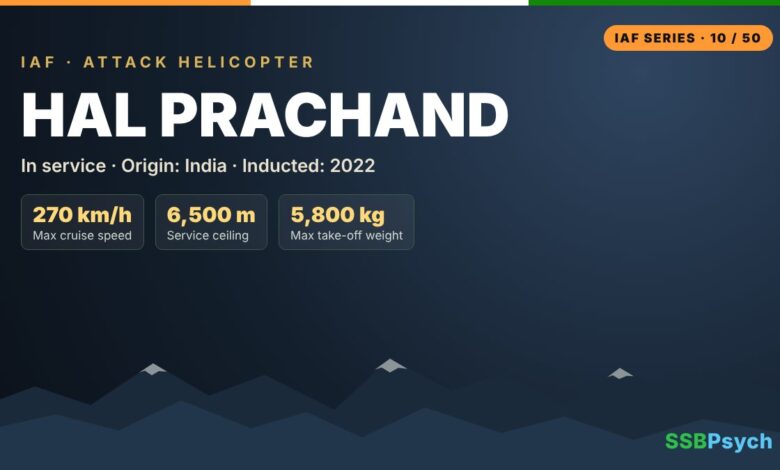
High in the Himalayas, the air is so thin that most attack helicopters struggle to carry fuel and weapons. India needed a gunship that could fight there, and when nobody else had one, Indian engineers built it themselves. Meet the Prachand, the Light Combat Helicopter (LCH) made by HAL. Its name means fierce, and it is the first attack helicopter ever to land in Siachen, the world’s highest battlefield.
In this guide you will learn why India built the Prachand, its history from prototype to induction, how its engines and rotors perform in simple words, its weapons, its key milestones, where it is based and who flies it, its strengths and limits, and its big future. A quiz and FAQ at the end will help you prepare for NDA, CDS, AFCAT and SSB.

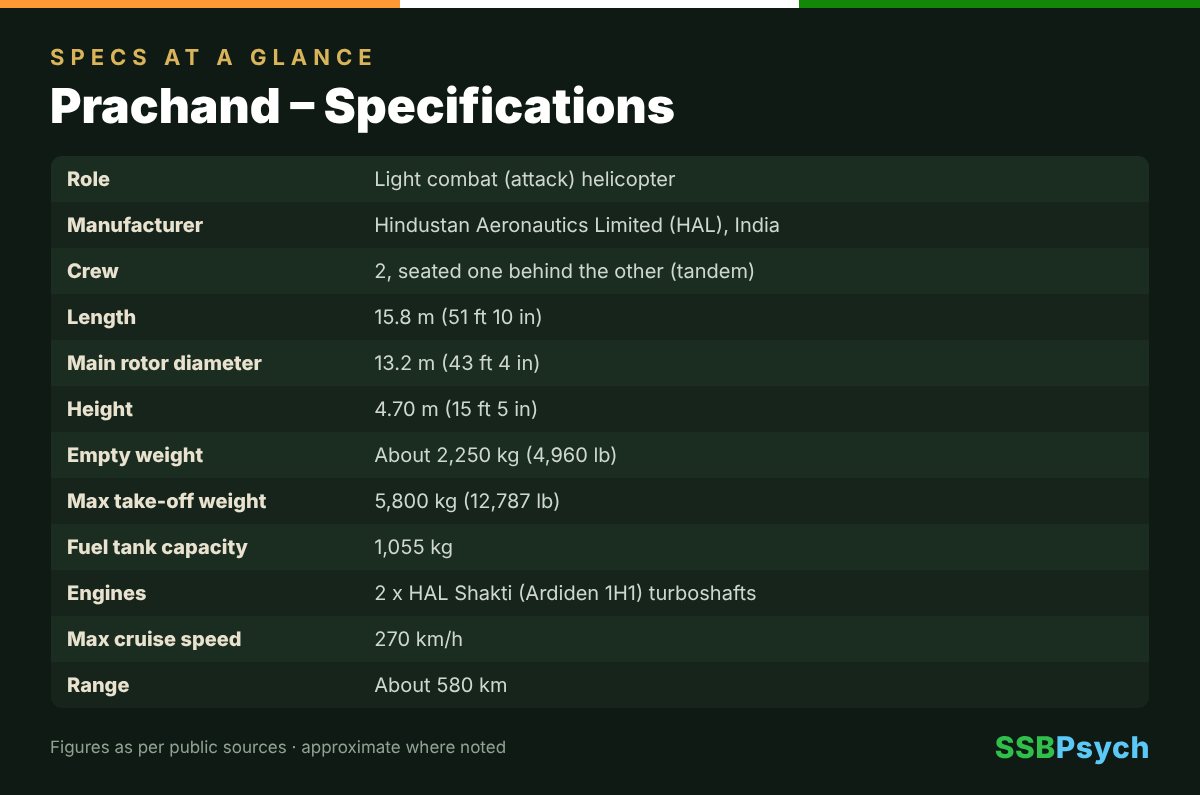
Prachand Specifications
| Role | Light combat (attack) helicopter |
| Manufacturer | Hindustan Aeronautics Limited (HAL), India |
| Crew | 2, seated one behind the other (tandem) |
| Length | 15.8 m (51 ft 10 in) |
| Main rotor diameter | 13.2 m (43 ft 4 in) |
| Height | 4.70 m (15 ft 5 in) |
| Empty weight | About 2,250 kg (4,960 lb) |
| Max take-off weight | 5,800 kg (12,787 lb) |
| Fuel tank capacity | 1,055 kg |
| Engines | 2 x HAL Shakti (Ardiden 1H1) turboshafts |
| Max cruise speed | 270 km/h |
| Range | About 580 km |
| Endurance | About 4 hours |
| Service ceiling | 6,500 m (21,300 ft) |
| Max rate of climb | 720 m per minute |
| First flight | 29 March 2010 |
| Inducted in IAF | 3 October 2022, Jodhpur |
| Number in IAF | 10 limited-series helicopters, with 66 more ordered in 2025 |
Why India Needed the Prachand
During the 1999 Kargil War, Indian forces fought enemy troops sitting on very high peaks. Defence Minister Rajnath Singh later said that the need for a suitable attack helicopter was seriously felt during that war. Most attack helicopters in the world are designed for lower heights. At 15,000 to 18,000 feet, the air is so thin that their rotors and engines lose much of their power, and they can carry very little.
India decided to build its own light attack helicopter, designed from the start for the mountains. HAL based it on the proven Dhruv Advanced Light Helicopter, using similar engines and rotor system, but gave it a new slim body with two crew seated one behind the other, armour, modern sensors and weapons. The aim was simple: a helicopter that could take off and land at around 5,000 m while carrying weapons and fuel.
History of the Prachand in the IAF
The first technology demonstrator flew on 29 March 2010 in Bengaluru. Over the next decade, four prototypes were tested in deserts, at sea level and in the high Himalayas. In 2015, during cold-weather trials, the LCH landed on Siachen helipads between 13,600 ft and 15,800 ft, becoming the first attack helicopter in the world to do so. In 2019 it test-fired Mistral-2 air-to-air missiles, and in February 2020 it was declared ready for production.
When tension rose with China in Ladakh in 2020, the IAF did not wait for the production model. In August 2020, HAL announced that two LCH prototypes had been deployed in Ladakh for armed patrols from forward bases. This was a strong vote of confidence in the home-built machine.
In 2022, India approved 15 limited-series helicopters, 10 for the IAF and 5 for the Army, at a cost of ₹3,887 crore. On 3 October 2022, at Jodhpur, the IAF formally inducted the first of them into No. 143 Helicopter Unit, the Dhanush, in the presence of the Defence Minister, the Chief of Defence Staff and the Chief of the Air Staff. That day, the helicopter received its proud name: Prachand.
The biggest step came on 28 March 2025. The Ministry of Defence signed two contracts with HAL for 156 more Prachand helicopters, 66 for the IAF and 90 for the Army, worth over ₹62,700 crore. They are to be built at HAL’s plants in Bengaluru and Tumakuru in Karnataka, with deliveries starting from the third year after the contract and spread over five years.
How the Prachand Performs: Engine and Performance Explained Simply
The Prachand has two Shakti turboshaft engines, developed with France’s Safran and built by HAL. A turboshaft is a jet-type engine that turns a shaft, which spins the rotor blades. Having two engines is a big safety feature: if one is damaged, the other can bring the crew home.
Its maximum cruise speed is about 270 km/h, faster than any train in India, and it can fly around 580 km on its fuel or stay in the air for about 4 hours. That range is more than the road distance from Delhi to Jaipur and back. It can climb at up to 720 m per minute, which means it could climb higher than the Qutub Minar in about six seconds.
Its service ceiling, the highest height at which it can still climb usefully, is about 6,500 m, more than 21,000 feet. Siachen and much of Ladakh lie below that height, which is why the Prachand can operate where many other attack helicopters cannot. HAL says it can take off and land at 5,000 m while carrying weapons and fuel.
The helicopter is slim and light. It is about 15.8 m long, roughly the length of a city bus plus a small car, and its main rotor is about 13.2 m across. Fully loaded it weighs about 5.8 tonnes, roughly the weight of a large elephant. Being narrow makes it harder to see and harder to hit from the front.
Weapons and Missiles
- 20 mm M621 cannon in a chin turret, aimed by the pilot’s helmet sight
- 70 mm rocket pods
- Mistral-2 air-to-air missiles against enemy helicopters and drones
- Anti-tank guided missiles (indigenous Helina/Dhruvastra family planned)
- Radar and laser warning receivers and missile approach warning
- Countermeasure dispensers (chaff and flares) for self-protection
The 20 mm cannon sits in a turret under the nose. It is linked to the pilot’s helmet sight, so the gun turns wherever the gunner looks, like a pointer following your eyes. The 70 mm rockets are used against ground targets such as vehicles and bunkers. The Mistral-2 missiles give the Prachand a rare skill for a helicopter: shooting down enemy helicopters and slow drones. Anti-tank missiles from India’s Helina and Dhruvastra family are planned to give it a strong punch against armoured vehicles.
Prachand Missions and Operations
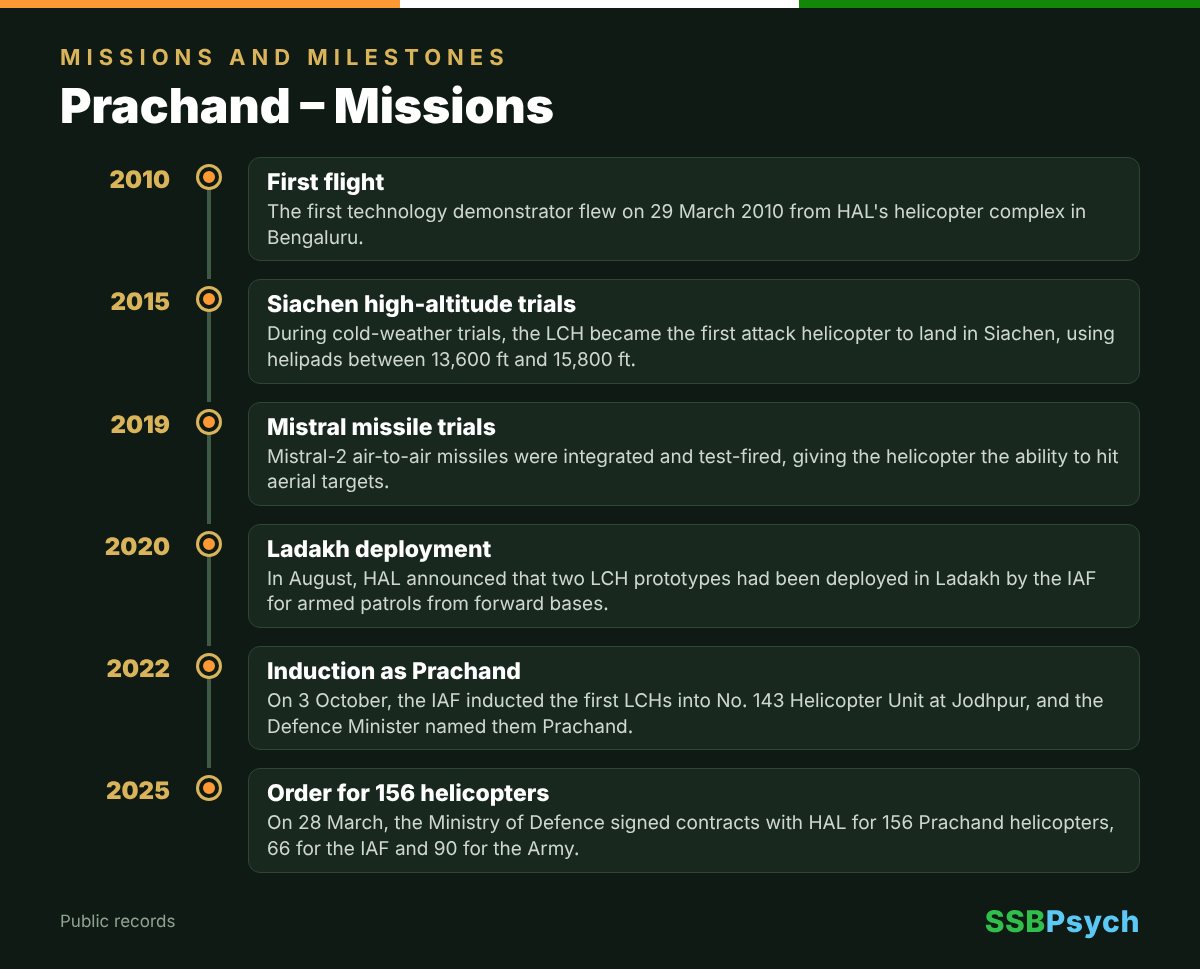
- 2010 – First flight: The first technology demonstrator flew on 29 March 2010 from HAL’s helicopter complex in Bengaluru.
- 2015 – Siachen high-altitude trials: During cold-weather trials, the LCH became the first attack helicopter to land in Siachen, using helipads between 13,600 ft and 15,800 ft.
- 2019 – Mistral missile trials: Mistral-2 air-to-air missiles were integrated and test-fired, giving the helicopter the ability to hit aerial targets.
- 2020 – Ladakh deployment: In August, HAL announced that two LCH prototypes had been deployed in Ladakh by the IAF for armed patrols from forward bases.
- 2022 – Induction as Prachand: On 3 October, the IAF inducted the first LCHs into No. 143 Helicopter Unit at Jodhpur, and the Defence Minister named them Prachand.
- 2025 – Order for 156 helicopters: On 28 March, the Ministry of Defence signed contracts with HAL for 156 Prachand helicopters, 66 for the IAF and 90 for the Army.

What the Prachand Does in Battle
An attack helicopter is like a flying tank-hunter that can hide behind hills and pop up to strike. The Prachand’s main jobs include destroying enemy armour and vehicles, attacking bunkers on high ridges, and supporting soldiers on the ground with accurate fire. It can also escort transport helicopters carrying troops into a landing zone, protect rescue teams searching for downed aircrew, and scout ahead of ground forces to find the enemy.
Because it carries air-to-air missiles, it can also take on enemy helicopters and slow-flying drones, a growing threat in modern wars. In counter-insurgency operations in jungles and towns, its cannon and rockets give ground forces quick, precise support. A data link lets it share information with other aircraft and ground units, so the crew is part of a bigger network rather than fighting alone. All of this is packed into a helicopter light enough to work where the air is thinnest.
Built to Survive
An attack helicopter flies low and close to the enemy, so survival matters as much as firepower. The Prachand’s body uses flat, angled panels that reduce how strongly it shows up on enemy radar. IAF officials have said it has features that reduce its visual, sound, radar and infrared signatures, which means it is harder to see, hear and track.
It also has crashworthy landing gear and seats, self-sealing fuel tanks that close up if hit, and a gearbox that can keep running for about 30 minutes even after losing its oil. Warning systems alert the crew to enemy radar, lasers and missiles, and dispensers can fire flares and chaff to fool incoming missiles.
Where the Prachand Is Based and Who Flies It
The IAF’s first Prachand unit, No. 143 Helicopter Unit (Dhanush), was raised on 1 June 2022 and is publicly reported to be based at Jodhpur Air Force Station in Rajasthan. The Indian Army also flies the Prachand, with No. 351 Army Aviation Squadron, which is publicly reported to have moved to Missamari in Assam.
An IAF helicopter unit is usually commanded by an experienced Wing Commander or Group Captain, with Squadron Leaders leading flights and younger Flight Lieutenants and Flying Officers flying as co-pilots and gunners. The two crew members sit one behind the other, which gives each a good view and makes the helicopter slimmer.
Officers who want to fly helicopters start at the Air Force Academy at Dundigal and, after basic flying training, are selected for the helicopter stream. They train at the Helicopter Training School at Hakimpet near Hyderabad. After earning their wings, they usually build experience on utility helicopters for a few years before converting to an attack helicopter like the Prachand.
Strengths and Limitations of the Prachand
- Designed for very high altitudes, including Siachen and Ladakh
- Can take off and land at about 5,000 m with weapons and fuel
- Two engines for safety
- Air-to-air missiles let it hunt enemy helicopters and drones
- Reduced radar, infrared and noise signatures help it survive
- Built in India, so spares, upgrades and repairs are easier
- Lighter weapon load than heavy attack helicopters like the Apache
- Anti-tank missile fit was still planned at the time of induction
- Small fleet so far; most of the 156 helicopters are still to be delivered
Future of the Prachand
With 156 more helicopters on order, the Prachand will become one of the most important attack helicopters in Indian service. Once deliveries are complete, the IAF and the Army will together field well over 150 of them across the mountains, deserts and plains. It is also a showcase for Aatmanirbhar Bharat, India’s push for self-reliance in defence, and could interest friendly countries that need a high-altitude gunship.
For young officers, this means many new cockpits to fill in the coming years. Every new Prachand unit will need trained pilots, engineers and technicians, so the helicopter is not just a weapon but also a source of careers in the IAF and the Army.
Why the Prachand Matters for SSB and AFCAT Aspirants
The Prachand is a favourite topic in current affairs because it ties together indigenous defence production, high-altitude warfare, the lessons of Kargil and a huge 156-helicopter order worth over ₹62,700 crore. In an SSB interview, it is a great example to discuss when asked about self-reliance in defence or how India prepares for mountain warfare.
Remember the key points: built by HAL, first flight on 29 March 2010, first attack helicopter to land in Siachen, inducted on 3 October 2022 at Jodhpur into No. 143 Helicopter Unit, and 156 more ordered on 28 March 2025.
Did You Know?
- Prachand means fierce, and the name was given at its induction in 2022.
- It is the first attack helicopter in the world to land in Siachen.
- The first IAF Prachand unit, No. 143 Helicopter Unit, is called Dhanush, meaning bow.
- The Prachand is based on the Dhruv Advanced Light Helicopter.
- Its gearbox can keep running for about 30 minutes even after losing oil.
- The 2025 order for 156 helicopters was worth over ₹62,700 crore.
- Two prototypes were deployed in Ladakh in 2020, even before the helicopter was formally inducted.
Quiz: Test Your Knowledge of Prachand
Click an option to see if you are right. Your score updates live.
Prachand: Frequently Asked Questions
Prachand is the Light Combat Helicopter designed and built by HAL. It is a twin-engine attack helicopter made especially for high-altitude operations and was inducted into the IAF on 3 October 2022.
The Prachand has a maximum cruise speed of about 270 km/h, according to official Ministry of Defence data, and a range of about 580 km.
It carries a 20 mm turret cannon, 70 mm rockets and Mistral-2 air-to-air missiles, with indigenous anti-tank missiles planned. It also has missile warning systems and flare and chaff dispensers.
The IAF received 10 limited-series helicopters, and in March 2025 it ordered 66 more as part of a 156-helicopter deal shared with the Army.
The IAF’s first Prachand unit, No. 143 Helicopter Unit (Dhanush), is publicly reported to be based at Jodhpur Air Force Station in Rajasthan.
This is part 10 of 50 in SSBPsych’s Indian Air Force aircraft series – a new aircraft every evening at 6 PM.
Sources: en.wikipedia.org, en.wikipedia.org, ddpmod.gov.in, businesstoday.in, vayuaerospace.in.
Preparing for NDA, CDS, AFCAT or your SSB? Join SSBPsych’s online and offline batches – explore our courses or call +91 8076540582.