INS Viraat vs INS Vikramaditya: British Veteran vs Russian Giant
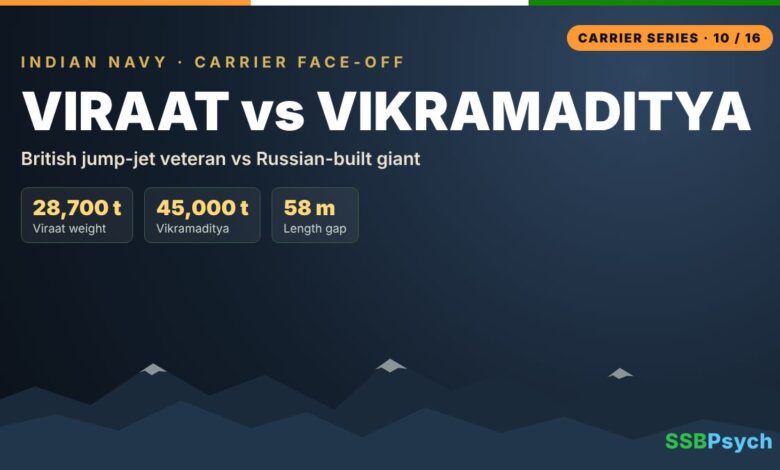
For a few years, India had two carriers from two very different worlds. One was a British veteran of the Falklands War that launched nimble Sea Harrier jump jets. The other was a Soviet-born giant rebuilt in Russia to launch supersonic MiG-29K fighters. This is the face-off of INS Viraat vs INS Vikramaditya, the ships that passed India’s flagship crown from one to the other.
In this guide we line them up side by side: size, weight, speed, range, crew, aircraft, launch systems, cost and operations. We explain each difference in plain language, show what each did best, share what India learned, and wrap up with a fun verdict. Ideal reading for NDA, CDS, AFCAT and SSB aspirants who want sharp defence GK.

INS Viraat vs INS Vikramaditya: Comparison Table
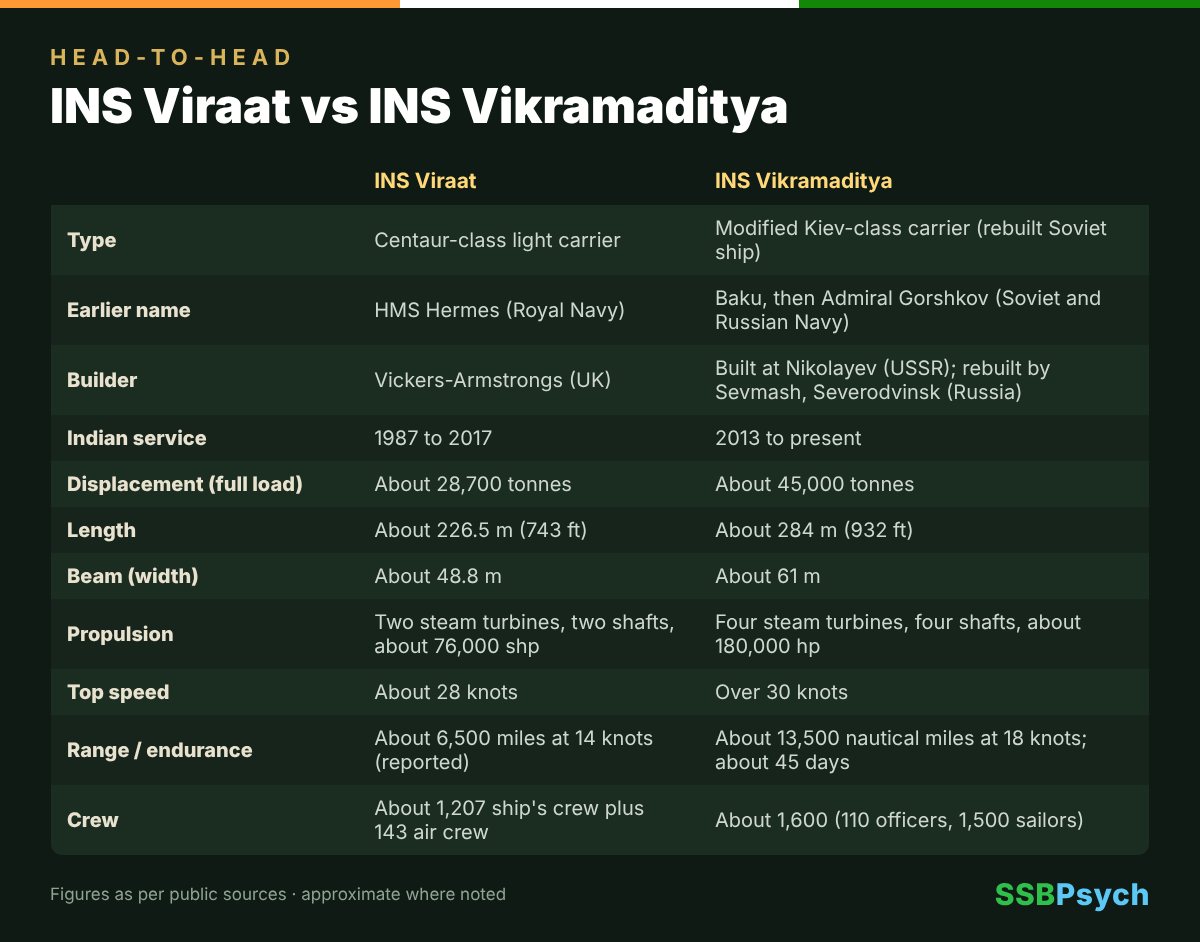
Here are the key figures, rounded from public sources. ‘About’ is used where sources vary slightly.
INS Viraat vs INS Vikramaditya: Side-by-Side Comparison
| INS Viraat | INS Vikramaditya | |
|---|---|---|
| Type | Centaur-class light carrier | Modified Kiev-class carrier (rebuilt Soviet ship) |
| Earlier name | HMS Hermes (Royal Navy) | Baku, then Admiral Gorshkov (Soviet and Russian Navy) |
| Builder | Vickers-Armstrongs (UK) | Built at Nikolayev (USSR); rebuilt by Sevmash, Severodvinsk (Russia) |
| Indian service | 1987 to 2017 | 2013 to present |
| Displacement (full load) | About 28,700 tonnes | About 45,000 tonnes |
| Length | About 226.5 m (743 ft) | About 284 m (932 ft) |
| Beam (width) | About 48.8 m | About 61 m |
| Propulsion | Two steam turbines, two shafts, about 76,000 shp | Four steam turbines, four shafts, about 180,000 hp |
| Top speed | About 28 knots | Over 30 knots |
| Range / endurance | About 6,500 miles at 14 knots (reported) | About 13,500 nautical miles at 18 knots; about 45 days |
| Crew | About 1,207 ship’s crew plus 143 air crew | About 1,600 (110 officers, 1,500 sailors) |
| Aircraft | Up to about 26: Sea Harrier, Sea King, Chetak, Dhruv | Up to about 34: MiG-29K plus Kamov and other helicopters |
| Launch method | STOVL: 12 degree ski-jump, vertical landing | STOBAR: 14 degree ski-jump, three arrester wires |
| Cost (reported) | Purchase price not widely reported; scrap sale about Rs 38.5 crore (2020) | Final refit price about US$2.35 billion |
| Operations | Op Jupiter 1989, Op Vijay 1999, Op Parakram 2001-02 | Malabar 2020; twin-carrier drills 2023 and 2024 |
| Status | Scrapped at Alang from 2020 | In service; based at Karwar |
Meet the Two Carriers
INS Viraat: The Falklands Veteran
INS Viraat was born as HMS Hermes, a Centaur-class carrier laid down in Britain in 1944 and commissioned into the Royal Navy in 1959. In 1982 she was the flagship of the British fleet in the Falklands War. India bought her in the 1980s and commissioned her as INS Viraat on 12 May 1987. She served India for 30 years, and was India’s flagship until Vikramaditya arrived. In her final years she was the oldest aircraft carrier still in service anywhere in the world.
INS Vikramaditya: The Soviet Giant Reborn
INS Vikramaditya was laid down in 1978 at Nikolayev, in today’s Ukraine, as the Soviet ship Baku. She joined the Soviet Navy in 1987, the same year Viraat joined India, and was later renamed Admiral Gorshkov. In Soviet form she was part cruiser, part carrier, with heavy missiles on her front deck. India signed a deal in 2004, and Russia’s Sevmash shipyard rebuilt her with a full flight deck and ski-jump. She was commissioned on 16 November 2013.
Size: Big vs Bigger
Warships are compared by displacement, the weight of water a ship pushes aside when floating, which equals the ship’s own weight. Viraat weighed about 28,700 tonnes fully loaded. Vikramaditya weighs about 45,000 tonnes, more than one and a half times as much. If a car weighs one tonne, that is like comparing 28,700 cars to 45,000 cars.
Viraat was about 226 metres long, a little more than two football fields. Vikramaditya is about 284 metres long, close to three football fields, and about 61 metres wide at the flight deck against Viraat’s roughly 49 metres. That extra space means a bigger hangar, more fuel tanks and more room for aircraft to take off and land.
Winner on size: Vikramaditya.
Engines, Speed and Range
Both ships run on steam turbines. Boilers burn fuel to make high-pressure steam, which spins turbines connected to the propellers, like a giant pressure cooker turning a fan. Viraat had two turbines and two propeller shafts producing about 76,000 shaft horsepower. Vikramaditya has eight boilers, four turbines and four shafts producing about 180,000 horsepower, more than double.
Speed at sea is measured in knots; one knot is one nautical mile per hour, about 1.85 km per hour. Viraat could reach about 28 knots, around 52 km per hour. Vikramaditya can go over 30 knots, more than 55 km per hour. Speed helps a carrier because sailing fast into the wind creates extra airflow over the deck, which makes take-offs easier.
Range is where Vikramaditya pulls far ahead. Her listed range is about 13,500 nautical miles at 18 knots, and she can stay at sea for about 45 days. Viraat’s listed range was about 6,500 miles at 14 knots. In simple words, Vikramaditya can cruise faster and still go much farther before refuelling.
Crew: Two Floating Towns
Viraat carried about 1,207 ship’s crew plus 143 air crew. Vikramaditya carries about 1,600 people, roughly 110 officers and 1,500 sailors. Both are like small towns at sea with kitchens, medical facilities, workshops and sleeping areas. Each is commanded by an officer of Captain rank, supported by heads of the aviation, engineering, weapons and logistics departments.
Aircraft and Launch: STOVL vs STOBAR
This is the heart of the INS Viraat vs INS Vikramaditya match-up, because the two ships launched jets in very different ways.
Viraat flew the British Sea Harrier, a jump jet whose engine nozzles can swivel to point downward. It can take off in a short run and land vertically, like a helicopter. This style is called STOVL: Short Take-Off, Vertical Landing. Viraat had a 12 degree ski-jump at the bow to help the Harrier climb with more fuel and weapons. Since Harriers landed vertically, Viraat did not need arrester wires for them.
Vikramaditya flies the MiG-29K, a supersonic fighter that cannot land vertically. So she uses STOBAR: Short Take-Off But Arrested Recovery. Jets race up a steeper 14 degree ski-jump to get airborne, and land by catching one of three arrester wires with a hook. Imagine a cyclist zooming off a ramp to take off, and then a rope catching the cycle’s back hook to stop it within a short distance.
The difference in fighters is huge. The Sea Harrier was agile but subsonic, with limited range and payload. The MiG-29K can fly faster than sound, carries more weapons and has more range. Vikramaditya also carries Kamov Ka-31 helicopters, whose big radar spots incoming threats far away, and Ka-28 anti-submarine helicopters. Viraat’s air group included Sea King anti-submarine helicopters, Chetaks and later Dhruv helicopters.
Winner on air power: Vikramaditya, clearly. India retired its Sea Harriers in 2016, a year before Viraat herself retired.
INS Viraat vs INS Vikramaditya Timeline
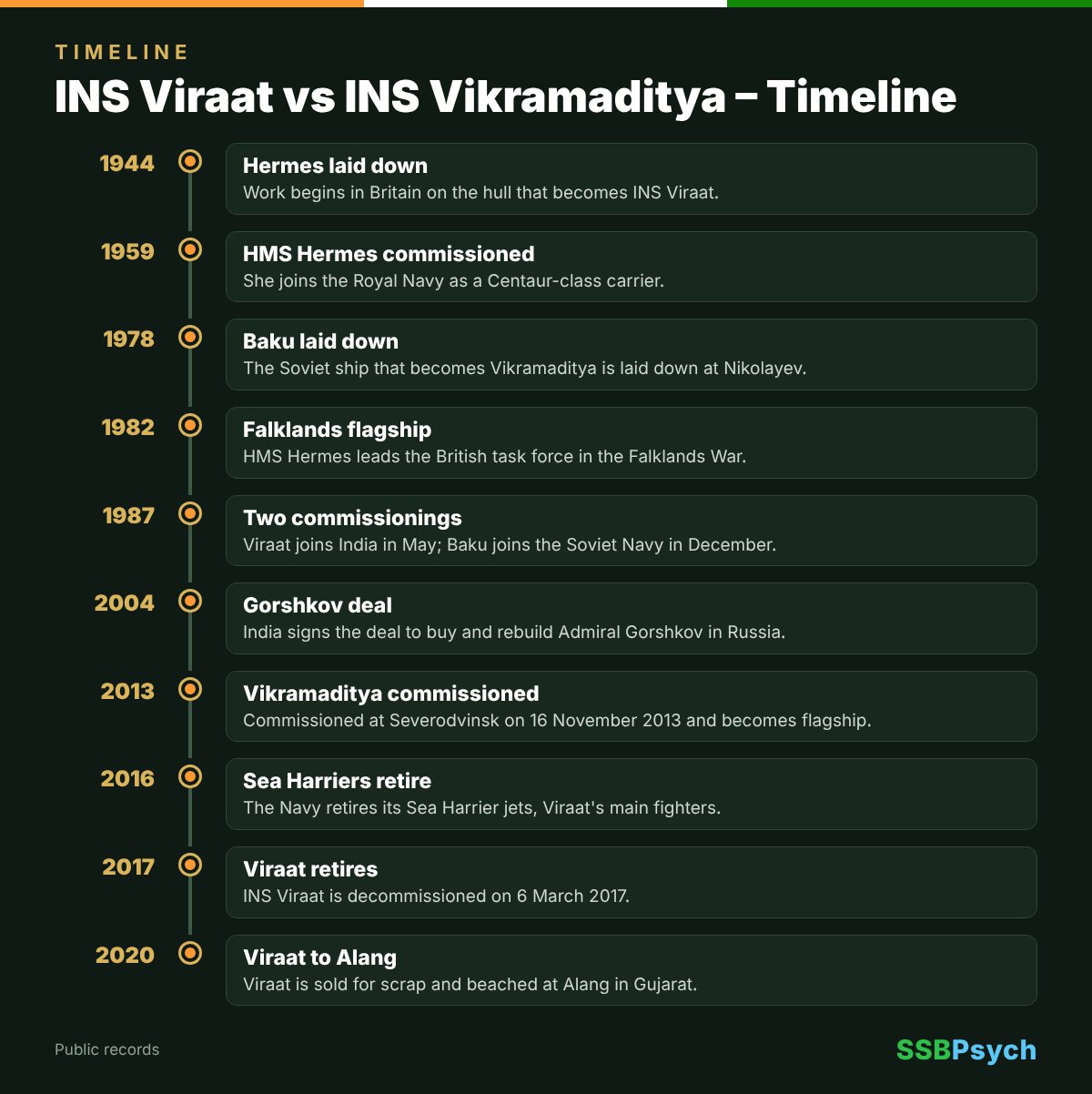
- 1944 – Hermes laid down: Work begins in Britain on the hull that becomes INS Viraat.
- 1959 – HMS Hermes commissioned: She joins the Royal Navy as a Centaur-class carrier.
- 1978 – Baku laid down: The Soviet ship that becomes Vikramaditya is laid down at Nikolayev.
- 1982 – Falklands flagship: HMS Hermes leads the British task force in the Falklands War.
- 1987 – Two commissionings: Viraat joins India in May; Baku joins the Soviet Navy in December.
- 2004 – Gorshkov deal: India signs the deal to buy and rebuild Admiral Gorshkov in Russia.
- 2013 – Vikramaditya commissioned: Commissioned at Severodvinsk on 16 November 2013 and becomes flagship.
- 2016 – Sea Harriers retire: The Navy retires its Sea Harrier jets, Viraat’s main fighters.
- 2017 – Viraat retires: INS Viraat is decommissioned on 6 March 2017.
- 2020 – Viraat to Alang: Viraat is sold for scrap and beached at Alang in Gujarat.
Aircraft, Weapons and Sensors
- BAe Sea Harrier FRS51 jump jets (Viraat)
- Westland Sea King anti-submarine helicopters (Viraat)
- Chetak and HAL Dhruv helicopters (Viraat)
- MiG-29K and MiG-29KUB supersonic fighters (Vikramaditya)
- Kamov Ka-31 airborne early warning helicopters (Vikramaditya)
- Kamov Ka-28 anti-submarine helicopters (Vikramaditya)
- 12 degree ski-jump for jump jets (Viraat)
- 14 degree ski-jump with three arrester wires (Vikramaditya)
Operations: Who Did What?
Viraat’s 30-year Indian career was full of deployments. She supported the Indian Peace Keeping Force off Sri Lanka during Operation Jupiter in 1989, joined the naval build-up in the Arabian Sea during the Kargil conflict (Operation Vijay, 1999), and was deployed during Operation Parakram in 2001-02. As HMS Hermes she had already led a real naval war in the Falklands.
Vikramaditya has been India’s main carrier since 2013. She made her first foreign port call to Colombo in 2016, hosted the naval Tejas on its first carrier landing in January 2020, sailed in Exercise Malabar in 2020, and has carried out twin-carrier drills with the new INS Vikrant in 2023 and 2024. Her home port is Karwar in Karnataka.
For a few years, from Vikramaditya’s arrival until Viraat’s retirement in 2017, India again had two carriers in its fleet, though Viraat was by then in the twilight of her career.
Operations and Missions
- 1982 – Falklands War (as HMS Hermes): Viraat, then HMS Hermes, served as flagship of the British task force.
- 1989 – Operation Jupiter: Viraat supported Indian Peace Keeping Force operations off Sri Lanka.
- 1999 – Operation Vijay (Kargil): Viraat was part of the naval build-up in the Arabian Sea.
- 2001-02 – Operation Parakram: Viraat deployed during the long India-Pakistan standoff.
- 2016 – Colombo port call: Vikramaditya made her first foreign port visit to Sri Lanka.
- 2020 – First Tejas deck landing: The naval Tejas made its first carrier landing on Vikramaditya.
- 2020 – Exercise Malabar: Vikramaditya sailed with partner navies in the Malabar exercise.
- 2023 – Twin-carrier operations: Vikramaditya and the new INS Vikrant operated together in the Arabian Sea.

Which Was Better at What, and Why?
- Size, range and air power: Vikramaditya, thanks to her bigger hull and supersonic MiG-29Ks.
- Speed: Vikramaditya, just ahead at over 30 knots.
- Battle experience: Viraat. As HMS Hermes she led the British fleet in the Falklands War.
- Longevity: Viraat. Her career stretched from 1959 to 2017, nearly 58 years across two navies.
- Value for money: Viraat was a lower-cost second-hand buy; Vikramaditya’s final refit price rose to about US$2.35 billion after a long renegotiation.
- Flexibility: Viraat’s Harriers could land vertically, so they did not depend on arrester wires.
Passing the Flagship Crown
A navy’s flagship is its lead ship, the one that usually carries the senior commander and represents the fleet. For about 26 years, from 1987 until 2013, that honour belonged to Viraat. When Vikramaditya was commissioned in November 2013, the title passed to the newer, bigger ship.
The handover was more than a ceremony. It marked India’s shift from British-designed carriers and jump jets to a Russian-built carrier flying conventional supersonic fighters. Pilots had to learn new skills, such as hooking an arrester wire at high speed instead of hovering down onto the deck. Deck crews learned new routines, and engineers learned a much larger steam plant. Viraat’s long service gave the Navy enough breathing room to make this switch without a gap in carrier cover.
For SSB aspirants, this is a useful talking point: good planning in defence means overlapping old and new equipment so there is never a gap in capability.
What India Learned From Viraat and Vikramaditya
Viraat kept Indian naval aviation alive for three decades. She trained generations of pilots, deck crews and engineers, and showed how much effort it takes to keep an old ship running with regular refits. Without her, India would have had a long gap with no carrier after the old Vikrant retired in 1997.
Vikramaditya taught India how to operate a STOBAR carrier with supersonic fighters, a big step up from jump jets. She also taught a tough lesson: rebuilding a used foreign ship took far longer and cost far more than first planned, with sea trials stretching from 2012 to 2013 after boiler problems. That experience pushed India harder towards building its own carrier, and the new INS Vikrant, commissioned in 2022, uses the same STOBAR method that Vikramaditya pioneered in Indian service.
The Fun Verdict: INS Viraat vs INS Vikramaditya
Think of a cricket team. Viraat is the senior all-rounder who has played in a World Cup final, served the team for decades and knows every trick. Vikramaditya is the tall new fast bowler who bowls at 150 km per hour and can win matches on his own.
On hard numbers, Vikramaditya wins comfortably: bigger, faster, longer range, more aircraft and far more powerful jets. Viraat wins the respect round: a war veteran, a record holder for longevity and the ship that kept India’s carrier dream alive for 30 years. If war broke out tomorrow, the Navy would choose Vikramaditya. But Viraat earned her place in history.
Did You Know?
- Viraat and the ship that became Vikramaditya were both commissioned in 1987, Viraat into India’s navy and Baku into the Soviet Navy.
- Viraat was the oldest aircraft carrier in service in the world in her final years.
- Sea Harriers could land vertically, so they did not need arrester wires on Viraat’s deck.
- Vikramaditya’s engines produce about 180,000 horsepower, more than twice Viraat’s.
- The naval Tejas made its first ever carrier landing on Vikramaditya in January 2020.
- Viraat’s scrap sale in 2020 was reported at about Rs 38.5 crore.
- Vikramaditya was commissioned in Russia and then sailed all the way to India.
Read our detailed profiles of both ships in this carrier series, then test yourself with the quiz below. Carrier comparisons are a favourite for SSB lecturettes and group discussions.
Quiz: Test Your Knowledge of INS Viraat vs INS Vikramaditya
Click an option to see if you are right. Your score updates live.
INS Viraat vs INS Vikramaditya: Frequently Asked Questions
INS Vikramaditya is bigger. She displaces about 45,000 tonnes and is about 284 metres long, while Viraat displaced about 28,700 tonnes and was about 226 metres long.
Yes. Vikramaditya was commissioned in November 2013 and Viraat retired in March 2017, so both were in the Indian Navy’s fleet for over three years.
In STOVL, jump jets like the Sea Harrier take off in a short run and land vertically. In STOBAR, jets like the MiG-29K take off from a ski-jump and land by catching an arrester wire.
India needed a bigger carrier able to operate modern supersonic fighters as Viraat aged. Vikramaditya was bought from Russia under a 2004 deal and rebuilt before joining the Navy in 2013.
After retiring in 2017, plans to make her a museum did not work out. She was sold for scrap in 2020 and broken up at Alang in Gujarat.
This is part 10 of 16 in SSBPsych’s Indian Navy aircraft carrier series – a new post every day at 2 PM.
Sources: en.wikipedia.org, en.wikipedia.org, indiannavy.nic.in, bharat-rakshak.com.
Preparing for NDA, CDS, AFCAT or your SSB? Join SSBPsych’s online and offline batches – explore our courses or call +91 8076540582.