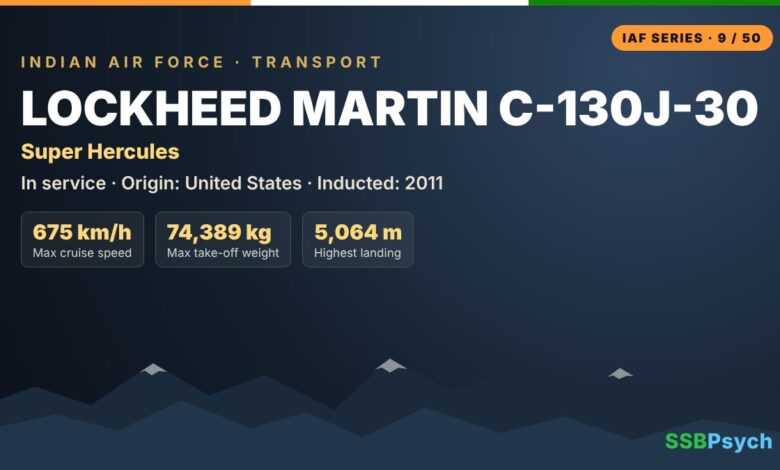
C-130J Super Hercules in IAF: Specs, Special Ops and Rescues
Picture a big four-engine aeroplane landing in pitch darkness on a tiny airstrip in a war zone, with no runway lights and no radio help, rescuing over a hundred people and flying them to safety. That is exactly what the Indian Air Force’s C-130J Super Hercules did in Sudan in 2023. This tough transport aircraft is the IAF’s favourite for special operations, high-altitude landings and daring rescues.
In this guide you will learn why India bought the C-130J Super Hercules, its history in the IAF, how it performs (explained simply), what it carries, its famous missions, where it is based, who flies it, its strengths and limits, and why it matters for your NDA, CDS, AFCAT and SSB preparation. A quiz and FAQ at the end will help you revise.

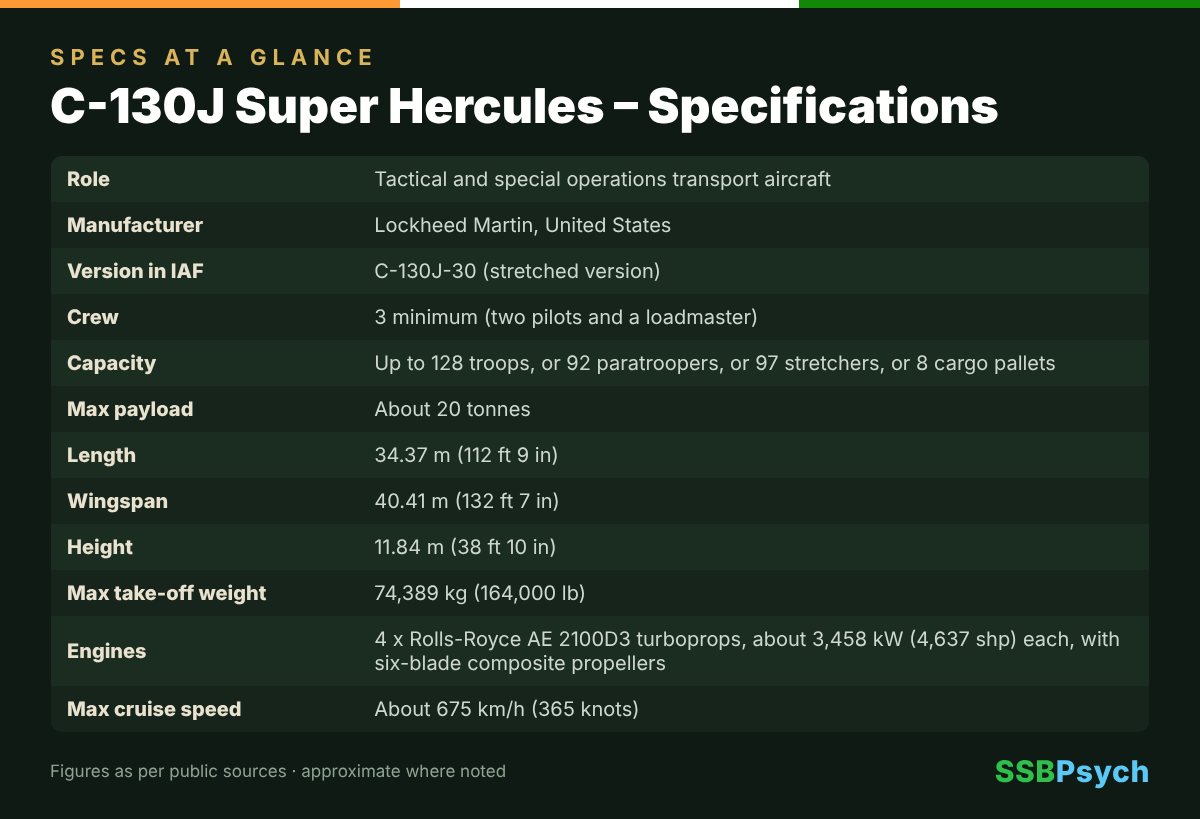
C-130J Super Hercules Specifications
| Role | Tactical and special operations transport aircraft |
| Manufacturer | Lockheed Martin, United States |
| Version in IAF | C-130J-30 (stretched version) |
| Crew | 3 minimum (two pilots and a loadmaster) |
| Capacity | Up to 128 troops, or 92 paratroopers, or 97 stretchers, or 8 cargo pallets |
| Max payload | About 20 tonnes |
| Length | 34.37 m (112 ft 9 in) |
| Wingspan | 40.41 m (132 ft 7 in) |
| Height | 11.84 m (38 ft 10 in) |
| Max take-off weight | 74,389 kg (164,000 lb) |
| Engines | 4 x Rolls-Royce AE 2100D3 turboprops, about 3,458 kW (4,637 shp) each, with six-blade composite propellers |
| Max cruise speed | About 675 km/h (365 knots) |
| Range | About 4,000 km with an 18-tonne (40,000 lb) payload |
| Landing distance | About 914 m (3,000 ft) at 61 tonnes landing weight |
| First flight | 5 April 1996 (C-130J) |
| Inducted in IAF | February 2011, Hindon |
| Number in IAF | 12 (as of 2019, after one 2014 loss was replaced) |
Why India Needed the C-130J Super Hercules
India’s armed forces often need to move small, highly trained teams fast, sometimes at night and sometimes to short or rough airstrips. Older transport aircraft like the An-32 were useful but could not do everything special forces needed. The IAF wanted a modern aircraft that could fly low, land short, work in the dark and carry a solid load.
The C-130 Hercules family from the United States is famous worldwide for exactly this kind of work. In early 2008, India bought six C-130J-30 aircraft for its special operations forces through the US government’s Foreign Military Sales route, in a deal worth up to about US$1.06 billion. The -30 means the stretched version with a longer cabin. India later decided to buy six more, and that order was cleared in December 2013.
History of the C-130J in the IAF
The name Hercules comes from the strong hero of Greek legend, and the family has lived up to it. The original C-130 dates back to the 1950s and has been flown by dozens of air forces around the world. The J model is a complete modern makeover: new engines, new propellers, a digital cockpit and computer systems, while keeping the same basic shape that made the Hercules so reliable. That is why it is called the Super Hercules.
The first C-130J arrived in February 2011, and No. 77 Squadron, known as the Veiled Vipers, was formed at Hindon near Delhi on 5 February 2011. It was the IAF’s first American-built transport aircraft in decades and brought a big jump in technology, including a digital glass cockpit, head-up displays and night vision capability.
In August 2013, the C-130J made headlines when it landed at Daulat Beg Oldi (DBO) in Ladakh, one of the highest airstrips in the world, at 5,064 m (16,614 ft). This is the highest landing ever recorded for a C-130J anywhere. It showed that India could quickly fly troops and supplies to a remote post close to the Line of Actual Control.
There was a sad moment too. On 28 March 2014, a C-130J of No. 77 Squadron crashed near Gwalior during a training flight, and all five people on board lost their lives. An inquiry linked the crash to the aircraft encountering wake turbulence, the swirling air left behind by another aircraft. The IAF later received a replacement, and by 2019 it again had 12 C-130Js.
The second batch of aircraft went to a new unit, No. 87 Squadron, the Raiding Raptors, at Panagarh in West Bengal, a base now named Air Force Station Arjan Singh. The squadron was formed in 2016 and its new aircraft arrived in 2017. Panagarh is close to India’s eastern borders and supports special forces and the Indian Army’s mountain strike formation there.
Engine and Performance Explained Simply
The C-130J has four Rolls-Royce AE 2100D3 turboprop engines. A turboprop is a jet engine that spins a propeller. Each engine produces about 3,458 kW, or roughly 4,600 horsepower, and turns a six-blade propeller made of composite material. Turboprops are very efficient at medium speeds and low heights, and they give strong pulling power for short take-offs.
Its maximum cruise speed is about 675 km/h. That is slower than a jet airliner, but nearly four times faster than a Vande Bharat express at its design speed of about 180 km/h. With an 18-tonne load, the aircraft can fly about 4,000 km, more than the straight-line distance from Kashmir to Kanyakumari.
The IAF version is about 34 m long, roughly the length of three city buses parked end to end, and its wings stretch about 40 m. It can take off at up to about 74 tonnes. The maximum load is about 20 tonnes, equal to the weight of around four big elephants. Inside it can carry up to 128 troops, 92 paratroopers with full kit, 97 stretchers or eight cargo pallets.
The real superpower of the C-130J is short landing. At a normal landing weight, it needs only about 914 m of runway, less than a kilometre. Many airliners need two or three times that. This is why it can use small advanced landing grounds in the mountains, like DBO and Kargil, where big jets cannot go.
The cockpit is just as important. Older transport aircraft needed a navigator and a flight engineer in addition to the pilots. In the C-130J, computers and large digital screens take over much of that work, so a crew of just two pilots and a loadmaster can fly the aircraft. Head-up displays show key flight information on a glass panel in front of the pilots’ eyes, so they can keep looking outside during tricky landings. Night vision goggles let them see in the dark without lights on the ground.
What It Carries
- Up to 128 troops or 92 paratroopers in the cabin
- Special forces teams such as the IAF’s Garud commandos
- Light vehicles and cargo pallets loaded through the rear ramp
- Up to 97 stretchers for medical evacuation
- Supplies for air-dropping by parachute
- Relief stores and rescue teams during disasters
- Self-protection systems to warn of and confuse incoming missiles
The C-130J is not a combat aircraft and carries no bombs or missiles. Its strength is what it carries and where it can take it. It can drop paratroopers or supplies by parachute, land special forces on a short strip at night, or evacuate wounded soldiers and civilians. It also has self-protection systems to warn the crew of threats and confuse incoming missiles.
Air-dropping is a special skill. The rear ramp opens in flight, and paratroopers jump out in a planned order, or cargo pallets fitted with parachutes roll out of the back. The pilots must hold exact speed, height and direction so that everyone and everything lands in the right zone. For a post cut off by snow or floods, a well-aimed air-drop can bring food, medicines and fuel within minutes.
C-130J Super Hercules Missions and Operations
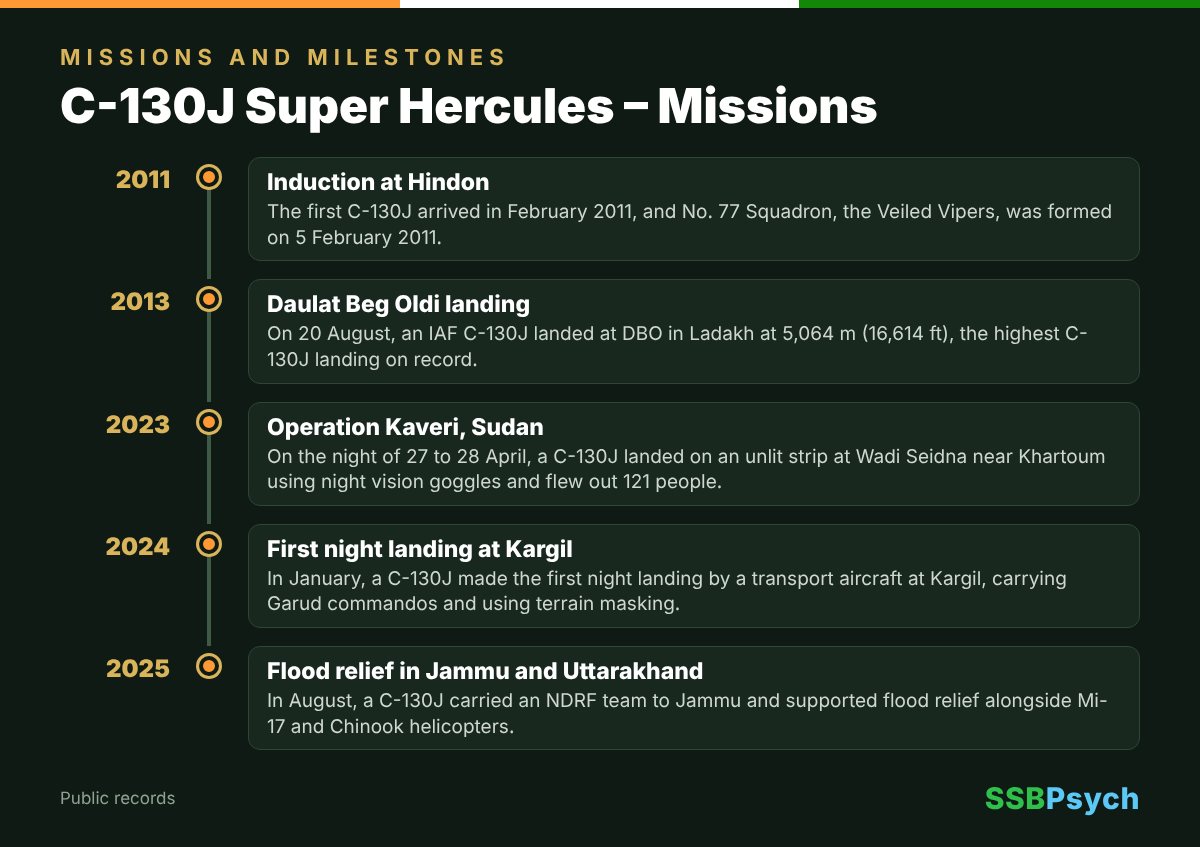
- 2011 – Induction at Hindon: The first C-130J arrived in February 2011, and No. 77 Squadron, the Veiled Vipers, was formed on 5 February 2011.
- 2013 – Daulat Beg Oldi landing: On 20 August, an IAF C-130J landed at DBO in Ladakh at 5,064 m (16,614 ft), the highest C-130J landing on record.
- 2023 – Operation Kaveri, Sudan: On the night of 27 to 28 April, a C-130J landed on an unlit strip at Wadi Seidna near Khartoum using night vision goggles and flew out 121 people.
- 2024 – First night landing at Kargil: In January, a C-130J made the first night landing by a transport aircraft at Kargil, carrying Garud commandos and using terrain masking.
- 2025 – Flood relief in Jammu and Uttarakhand: In August, a C-130J carried an NDRF team to Jammu and supported flood relief alongside Mi-17 and Chinook helicopters.

The Sudan Night Rescue and the Kargil Night Landing
In April 2023, fighting broke out in Sudan and Indians were trapped. Under Operation Kaveri, an IAF C-130J flew to a small airstrip at Wadi Seidna, about 40 km north of Khartoum. The strip had no landing lights, no navigation aids and no fuel. The crew used infrared sensors to check the runway was clear, then landed and took off in darkness using night vision goggles. They brought out 121 people.
In January 2024, a C-130J made the first-ever night landing by a transport aircraft at Kargil, carrying Garud commandos as part of a training mission. The crew used terrain masking, which means flying low and hiding behind mountains so that the aircraft is harder to detect by radar. Such missions show how the IAF trains for real special operations in the toughest places.
Where It Is Based and Who Flies It
As publicly reported, the IAF’s C-130Js fly with No. 77 Squadron at Hindon near Delhi and No. 87 Squadron at Panagarh in West Bengal. Hindon covers the western and northern sectors, while Panagarh covers the east.
An IAF transport squadron is usually commanded by a Wing Commander, supported by Squadron Leaders and younger Flight Lieutenants and Flying Officers. A C-130J crew has at least two pilots and a loadmaster, who is in charge of loading cargo, balancing the aircraft and handling air-drops.
Transport pilots begin at the Air Force Academy at Dundigal on basic trainer aircraft, then join the transport stream and train on twin-engine aircraft. After earning their wings, they usually start as co-pilots on transport aircraft and slowly build experience over several years before they are trusted with demanding special operations flying on the C-130J.
Strengths and Limitations of the C-130J Super Hercules
- Can land and take off from short, rough and high-altitude airstrips
- Night vision capability for secret and rescue missions in darkness
- Four engines give safety and strong performance in the mountains
- Modern glass cockpit with head-up displays reduces crew workload
- Flexible: troops, paratroopers, cargo, stretchers or relief stores
- Slower than jet transports like the C-17 Globemaster III
- Carries much less than the giant C-17
- Small fleet of 12, so each aircraft is in heavy demand
Future of the C-130J in India
The C-130J is expected to serve the IAF for many years. In August 2025, India’s Defence Acquisition Council approved support for keeping the C-17 and C-130J fleets flying, a sign that the IAF values them highly. As India builds more advanced landing grounds along its borders, the C-130J’s ability to land short will become even more useful.
India is also looking at a new medium transport aircraft for the future, and the C-130J family is among the types that have been discussed in public reports. Whatever is chosen, the Super Hercules has already set the standard for what the IAF expects from a special operations transport.
Why It Matters for SSB and AFCAT Aspirants
Questions about the C-130J often appear in defence exams and SSB interviews because it connects to many current topics: border infrastructure in Ladakh, evacuations of Indians from conflict zones, disaster relief and India-US defence ties. Stories like the DBO landing and Operation Kaveri are excellent examples of courage, planning and teamwork that you can quote.
Remember the key facts: six bought in 2008 and six more later, first squadron formed at Hindon in February 2011, highest C-130J landing at DBO in 2013, Operation Kaveri in 2023 and the first night landing at Kargil in 2024.
Did You Know?
- The C-130J’s landing at Daulat Beg Oldi in 2013 is the highest ever recorded for the type.
- No. 77 Squadron, the first IAF C-130J unit, is nicknamed the Veiled Vipers.
- The Panagarh base of No. 87 Squadron is named after Marshal of the Air Force Arjan Singh.
- In Sudan, the crew landed without runway lights, using night vision goggles.
- Each of its four engines turns a six-blade composite propeller.
- The first C-130J flew on 5 April 1996, but the Hercules family dates back to the 1950s.
Quiz: Test Your Knowledge of C-130J Super Hercules
Click an option to see if you are right. Your score updates live.
C-130J Super Hercules: Frequently Asked Questions
The IAF operates 12 C-130J-30 aircraft. Six were bought in 2008, six more were ordered later, and one lost in a 2014 crash was replaced in 2019.
They are publicly reported to fly with No. 77 Squadron at Hindon near Delhi and No. 87 Squadron at Panagarh in West Bengal.
On 20 August 2013, an IAF C-130J landed at Daulat Beg Oldi in Ladakh at 5,064 m (16,614 ft), the highest landing recorded for the type.
The C-130J-30 can carry about 20 tonnes at most, or up to 128 troops, 92 paratroopers or 97 stretchers.
In April 2023, an IAF C-130J landed at night on an unlit airstrip at Wadi Seidna in Sudan using night vision goggles and evacuated 121 people.
This is part 9 of 50 in SSBPsych’s Indian Air Force aircraft series – a new aircraft every evening at 6 PM.
Sources: en.wikipedia.org, lockheedmartin.com, en.wikipedia.org, en.wikipedia.org, freepressjournal.in.
Preparing for NDA, CDS, AFCAT or your SSB? Join SSBPsych’s online and offline batches – explore our courses or call +91 8076540582.