Rajputana Rifles: History, Motto, War Cry, Battles and Heroes
Ask any soldier which regiment is the oldest rifle regiment of the Indian Army, and the answer will be the Rajputana Rifles. With roots going back to 1775 and a fighting record that stretches from the deserts of Africa to the icy ridges of Kargil, Raj Rif, as it is fondly called, is one of the most decorated infantry regiments in India. Its soldiers march into battle shouting the name of Lord Rama and carry a motto that promises the earth to the brave.
This guide is written for NDA, CDS, AFCAT, TES and SSB aspirants who want to understand the regiment beyond a one-line fact. We will look at its history and lineage, a visual timeline, its major operations and battle honours, the meaning of its insignia, motto and war cry, its greatest heroes, the life of its soldiers, what the regiment means for SSB candidates, and a 10-question quiz at the end.
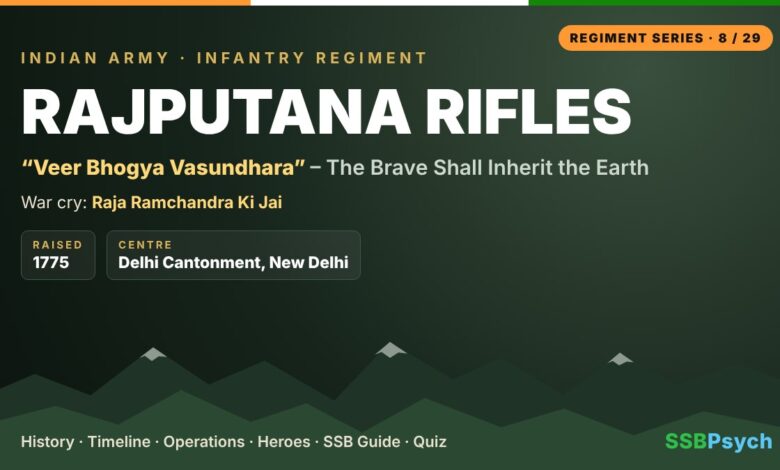
Rajputana Rifles – Quick Facts
| Raised | 1775 (oldest battalion); grouped as 6th Rajputana Rifles in 1921 |
| Regimental Centre | Delhi Cantonment, New Delhi |
| Motto | Veer Bhogya Vasundhara (The Brave Shall Inherit the Earth) |
| War Cry | Raja Ramchandra Ki Jai |
| Nickname | Raj Rif |
| Recruitment | Traditionally Rajputs and Jats, mainly from Rajasthan and nearby states |
| Battalions | Over 20 regular battalions, plus Rashtriya Rifles and Territorial Army units |
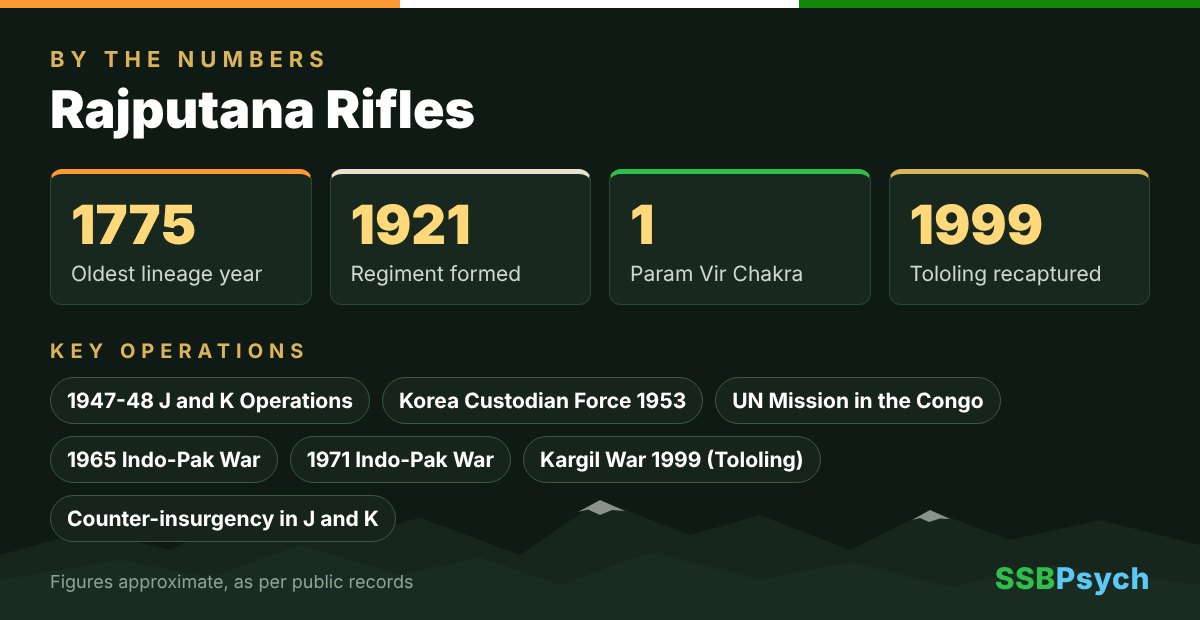
| Notable gallantry | 1 Param Vir Chakra and Victoria Crosses, including 2 in World War II |
| Regimental colours | Dark green, black and red |
| Famous action | Recapture of Tololing in the Kargil War, 1999 |
History of the Rajputana Rifles
In the eighteenth century the British East India Company recruited local soldiers to protect its trading posts and expanding territory. In January 1775 it raised the 5th Battalion of the Bombay Sepoys. This battalion is considered the oldest ancestor of the Rajputana Rifles, which is why the regiment is called the oldest rifle regiment of the Indian Army.
The battalion changed its name many times as the Bombay Army was reorganised. In 1800 it was commanded by Arthur Wellesley, who later became the famous Duke of Wellington. In 1903, under Lord Kitchener’s reforms, the battalion was renamed the 104th Wellesley’s Rifles in his honour. Other future battalions of the regiment carried names such as Outram’s Rifles and Napier’s Rifles, after well-known British commanders of the nineteenth century.
Early Campaigns
The ancestors of the regiment fought in many campaigns of the Bombay Army. The Battle of Khadki (Kirkee) near Pune in 1817 is among their oldest battle honours. Later they served in Persia, Afghanistan, Burma and China. In the First World War the battalions fought in France and Flanders, Egypt, Palestine, Mesopotamia and East Africa, earning honours such as Neuve Chapelle, Gaza, Megiddo, Jerusalem and Kut al Amara.
Birth of the 6th Rajputana Rifles in 1921
After the First World War, the British grouped single battalions into larger regiments. In 1921 the 104th Wellesley’s Rifles, 120th Rajputana Infantry, 122nd Rajputana Infantry, 123rd Outram’s Rifles, 125th Napier’s Rifles and the 13th Rajputs (Shekhawati Regiment) were brought together as the 6th Rajputana Rifles. The Shekhawati battalion became the training battalion. In 1945 the numeral was dropped and the regiment took its present name.
The Second World War
The Second World War made the regiment famous across the world. Its battalions fought in East Africa, North Africa, Syria, Italy, Malaya and Burma. The 4th Battalion alone produced two Victoria Crosses: one at Keren in Eritrea in 1941 and one in Tunisia in 1943. These actions showed the toughness of the Raj Rif soldier against well-equipped Italian and German forces.
After Independence
In 1947 the regiment was allotted to the Indian Army. On 1 September 1949, its 1st Battalion, the old Wellesley’s Rifles, joined the newly formed Brigade of the Guards as its 3rd Battalion. New battalions were raised over the following decades, and today the regiment has well over 20 regular battalions along with Rashtriya Rifles and Territorial Army units.
Rajputana Rifles Timeline: From Raising to Today
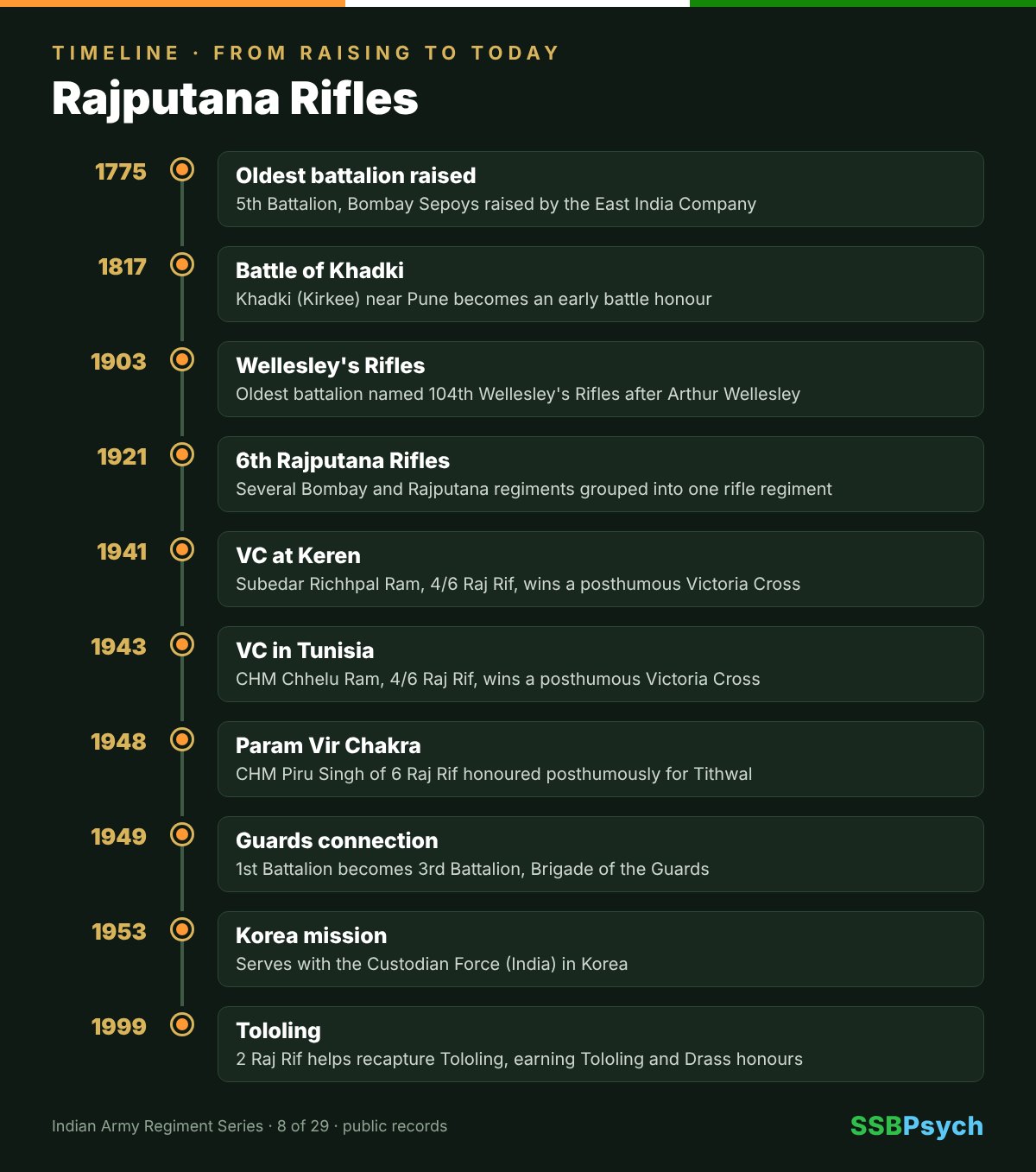
- 1775 – Oldest battalion raised: 5th Battalion, Bombay Sepoys raised by the East India Company
- 1817 – Battle of Khadki: Khadki (Kirkee) near Pune becomes an early battle honour
- 1903 – Wellesley’s Rifles: Oldest battalion named 104th Wellesley’s Rifles after Arthur Wellesley
- 1921 – 6th Rajputana Rifles: Several Bombay and Rajputana regiments grouped into one rifle regiment
- 1941 – VC at Keren: Subedar Richhpal Ram, 4/6 Raj Rif, wins a posthumous Victoria Cross
- 1943 – VC in Tunisia: CHM Chhelu Ram, 4/6 Raj Rif, wins a posthumous Victoria Cross
- 1948 – Param Vir Chakra: CHM Piru Singh of 6 Raj Rif honoured posthumously for Tithwal
- 1949 – Guards connection: 1st Battalion becomes 3rd Battalion, Brigade of the Guards
- 1953 – Korea mission: Serves with the Custodian Force (India) in Korea
- 1999 – Tololing: 2 Raj Rif helps recapture Tololing, earning Tololing and Drass honours
Major Operations and Battle Honours
The Rajputana Rifles has fought in every major war of independent India and has served in long counter-insurgency tours and United Nations missions. Here are the highlights.
1947-48: Jammu and Kashmir
Raj Rif battalions fought in the first war in Jammu and Kashmir. The most famous action took place near Tithwal on 18 July 1948, when Company Havildar Major Piru Singh of the 6th Battalion led his men against strongly held enemy positions. He kept charging forward even after being badly wounded and was awarded the Param Vir Chakra posthumously. Battle honours from this war include Darapari, Ledi Gali and Uri.
Peacekeeping in Korea and the Congo
After the Korean War, a Raj Rif battalion formed part of the Custodian Force (India) that supervised prisoners of war in 1953 and 1954. The regiment also served in the United Nations mission in the Congo in the early 1960s, beginning a long tradition of Indian peacekeeping.
The 1965 and 1971 Wars
In 1965 battalions fought in Jammu and Kashmir and Punjab, earning battle honours including Hajipir and Asal Uttar, along with the theatre honour Punjab 1965. In 1971 the regiment fought on both fronts. Honours such as Basantar in the west and Mynamati in the east, together with the theatre honour East Pakistan 1971, reflect its contribution to India’s decisive victory.
Kargil 1999: The Battle of Tololing
The 2nd Battalion wrote one of the most famous chapters of the Kargil War. In June 1999 it was tasked to recapture Tololing, a dominating height above the Srinagar-Leh highway in the Drass sector. In a bitter night battle on steep, exposed slopes, the battalion seized Point 4590 on Tololing on 13 June and later fought on the Three Pimples complex. Tololing was one of the first major victories of the war and changed its momentum. The battalion earned the battle honours Tololing and Drass and the theatre honour Kargil.
The victory came at a heavy price. Officers and men of the battalion fell while leading from the front, and several received high gallantry awards, including Maha Vir Chakras. Their sacrifice is remembered every year on Kargil Vijay Diwas, 26 July, when the nation honours those who fought in Operation Vijay.
Counter-Insurgency and Internal Security
Like most infantry regiments, Raj Rif has spent long years on counter-insurgency duty in Jammu and Kashmir and other troubled areas. Its battalions and the Rashtriya Rifles units linked to it have conducted patrols, cordon and search operations and ambushes against terrorists, while also helping local people through schools, medical camps and Sadbhavana projects. This work demands patience, discipline and respect for civilians as much as courage.
Rajputana Rifles and Rajput Regiment: Not the Same
Many aspirants confuse the Rajputana Rifles with the Rajput Regiment. They are two different regiments with separate histories. The Rajputana Rifles comes from the old Bombay Army, is a rifle regiment, has its centre in Delhi Cantonment and uses the war cry Raja Ramchandra Ki Jai. The Rajput Regiment comes from the old Bengal Army, is a line infantry regiment, has its centre at Fatehgarh in Uttar Pradesh and uses the war cry Bol Bajrang Bali Ki Jai. Knowing this difference clearly can save you from an embarrassing mistake in an interview.
Rajputana Rifles Insignia, Motto and War Cry
The regimental insignia is built around a bugle horn, the traditional symbol of rifle regiments, which recalls the days when riflemen spread out in open order and were controlled by bugle calls. The regimental colours are dark green, black and red. Unlike some rifle regiments abroad, Raj Rif marches at the normal Indian Army pace.
The motto is Veer Bhogya Vasundhara, a Sanskrit phrase meaning the brave shall inherit (or enjoy) the earth. It tells every soldier that only courage earns success and honour. The war cry is Raja Ramchandra Ki Jai, victory to Lord Rama, the ideal king who stands for duty and righteousness.
Heroes of the Rajputana Rifles
The regiment’s roll of honour includes some of the bravest soldiers in Indian military history. A few of them are listed below.
- Company Havildar Major Piru Singh, Param Vir Chakra (posthumous) – 6 Raj Rif, led a fearless assault near Tithwal on 18 July 1948.
- Subedar Richhpal Ram, Victoria Cross (posthumous) – 4/6 Raj Rif, led repeated attacks at Keren, Eritrea, in February 1941.
- Company Havildar Major Chhelu Ram, Victoria Cross (posthumous) – 4/6 Raj Rif, rallied his company at Djebel Garci, Tunisia, in April 1943.
- Major Vivek Gupta, Maha Vir Chakra (posthumous) – 2 Raj Rif, led his company in the assault on Tololing in June 1999.
- Major Padmapani Acharya, Maha Vir Chakra (posthumous) – 2 Raj Rif, fell leading his men on 28 June 1999 in the Kargil War.
- Naik Digendra Kumar, Maha Vir Chakra – 2 Raj Rif, decorated for his role in the capture of Tololing in 1999.
Role and Life in the Regiment
As an infantry regiment, Raj Rif’s job is to fight on foot, hold ground and take it from the enemy. Its battalions move between high-altitude posts, the Line of Control, the deserts of Rajasthan, counter-insurgency areas and peace stations. A soldier may serve in the snow one year and in the heat of the desert the next, so fitness, endurance and adaptability are central to daily life.
The soldiers of the regiment have traditionally been Rajputs and Jats, many from Rajasthan, Haryana and neighbouring areas, with strong family links to the Army. It is common to find sons and grandsons of Raj Rif veterans in the same battalions. This tradition creates deep loyalty to the paltan and a strong sense of honour, because every soldier knows his conduct reflects on his village and family.
The Regimental Centre in Delhi Cantonment trains every recruit and keeps the regiment’s history alive. It has a regimental museum that displays the story of the regiment through the years. Raj Rif is also known for sporting excellence and smart turnout on ceremonial occasions.
For officers, a Raj Rif battalion is a demanding but rewarding school of leadership. The men expect their officers to lead from the front, as Major Vivek Gupta and Major Padmapani Acharya did at Kargil. In return, they give complete loyalty.
Why the Rajputana Rifles Story Matters for SSB Aspirants
Questions about famous battles such as Tololing are common in SSB interviews and group discussions. The story of the 2nd Battalion is a lesson in planning, persistence and junior leadership. The first attempts to take the feature were costly, yet the units did not give up; they studied the ground, prepared carefully and attacked again. When you speak about such events, show that you understand why they succeeded, not only that they did. That is the kind of thinking assessors look for in a future officer.
Rajputana Rifles for SSB Candidates: What You Should Know
How officers join
- Officers join the infantry through the National Defence Academy (after Class 12), the Indian Military Academy (via CDS or entries such as TES after Class 12 with PCM) or the Officers Training Academy, Chennai (Short Service Commission).
- Every entry requires clearing the five-day SSB interview and a medical board.
- Arm and regiment are allotted near the end of academy training based on the cadet’s preferences, order of merit and vacancies, so no regiment is guaranteed in advance.
- Officers of any background can be commissioned into the Rajputana Rifles and lead its troops.
How soldiers join
- Soldiers have traditionally been recruited from Rajputs and Jats, mainly from Rajasthan and neighbouring states, as per the regiment’s recruitment pattern.
- Since 2022, soldiers join as Agniveers under the Agnipath scheme for four years, after which a portion (up to 25 percent as per the scheme) can be selected for regular service.
- Recruits are trained at the Rajputana Rifles Regimental Centre in Delhi Cantonment.
Questions you may face in the SSB interview, GD or lecturette
- Why do you want to join the Rajputana Rifles or the infantry?
- What happened at Tololing in 1999 and why was it important?
- What does Veer Bhogya Vasundhara mean to you personally?
- Name a Param Vir Chakra awardee from the Rajputana Rifles and describe his action.
- Lecturette topic: Lessons of the Kargil War for the Indian Army.
SSBPsych tip: Prepare a two-minute account of the Battle of Tololing with dates, units and lessons; it shows the interviewer that you read military history with understanding, not by rote.
Read the stories of its Param Vir Chakra heroes: CHM Piru Singh Shekhawat.
From the Bombay Sepoys of 1775 to the heroes of Tololing, the Rajputana Rifles has lived up to its motto in every generation. Read its story, remember its heroes and test yourself with the quiz below.
Quiz: How Well Do You Know the Rajputana Rifles?
Test yourself! Click an option to see if you are right. Your score updates live.
Rajputana Rifles: Frequently Asked Questions
The motto is Veer Bhogya Vasundhara, a Sanskrit phrase meaning the brave shall inherit the earth.
The Rajputana Rifles Regimental Centre is located in Delhi Cantonment, New Delhi.
The war cry is Raja Ramchandra Ki Jai, meaning victory to Lord Rama.
Yes. Its lineage goes back to 1775, and it is widely described as the oldest rifle regiment of the Indian Army.
They are two separate infantry regiments. The Rajputana Rifles is a rifle regiment with its centre in Delhi Cantonment, while the Rajput Regiment is a line infantry regiment with its centre at Fatehgarh.
Indian Army Regiments Series on SSBPsych
This is part 8 of 29 in our series on every infantry regiment of the Indian Army – a new regiment every day at 11 AM. Previous in the series: Maratha Light Infantry. Also follow our Param Vir Chakra series.
Sources: en.wikipedia.org, en.wikipedia.org, en.wikipedia.org, en.wikipedia.org, en.wikipedia.org.
Preparing for NDA, CDS, AFCAT or your SSB? Join SSBPsych’s online and offline batches – explore our courses or call +91 8076540582.