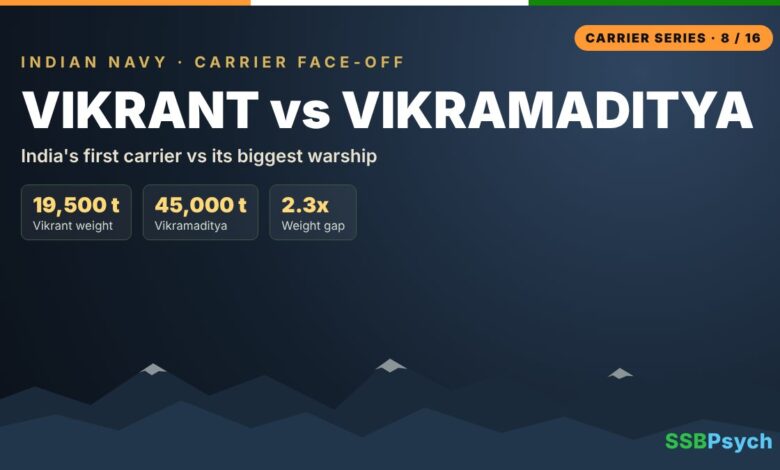
INS Vikrant vs INS Vikramaditya: India’s First vs Biggest Carrier
What happens when India’s very first aircraft carrier meets India’s biggest warship? You get one of the most fun match-ups in naval history: INS Vikrant vs INS Vikramaditya. One is the 1961 pioneer that went to war in 1971. The other is a 45,000-tonne giant rebuilt in Russia that today launches supersonic MiG-29K fighters from its deck.
In this guide we compare the old INS Vikrant (1961) with INS Vikramaditya side by side. We explain size, speed, crew, aircraft, launch systems, cost and history in simple words, tell you what each ship did best, share what India learned, and end with a fun verdict. If you are preparing for NDA, CDS, AFCAT or your SSB interview, this is quick, useful defence knowledge.

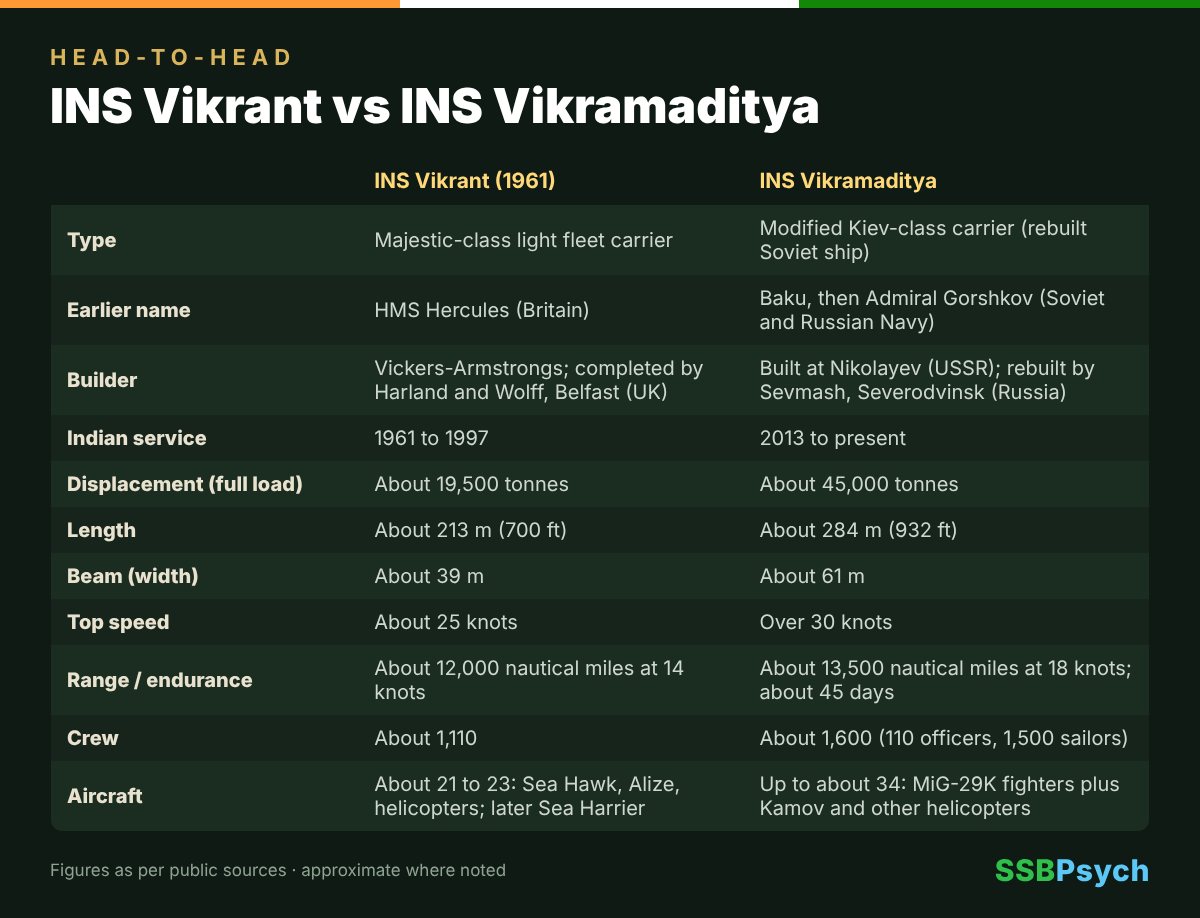
INS Vikrant vs INS Vikramaditya: Comparison Table
Here are the main numbers. They are rounded from public sources, and ‘about’ is used where figures vary slightly.
INS Vikrant vs INS Vikramaditya: Side-by-Side Comparison
| INS Vikrant (1961) | INS Vikramaditya | |
|---|---|---|
| Type | Majestic-class light fleet carrier | Modified Kiev-class carrier (rebuilt Soviet ship) |
| Earlier name | HMS Hercules (Britain) | Baku, then Admiral Gorshkov (Soviet and Russian Navy) |
| Builder | Vickers-Armstrongs; completed by Harland and Wolff, Belfast (UK) | Built at Nikolayev (USSR); rebuilt by Sevmash, Severodvinsk (Russia) |
| Indian service | 1961 to 1997 | 2013 to present |
| Displacement (full load) | About 19,500 tonnes | About 45,000 tonnes |
| Length | About 213 m (700 ft) | About 284 m (932 ft) |
| Beam (width) | About 39 m | About 61 m |
| Top speed | About 25 knots | Over 30 knots |
| Range / endurance | About 12,000 nautical miles at 14 knots | About 13,500 nautical miles at 18 knots; about 45 days |
| Crew | About 1,110 | About 1,600 (110 officers, 1,500 sailors) |
| Aircraft | About 21 to 23: Sea Hawk, Alize, helicopters; later Sea Harrier | Up to about 34: MiG-29K fighters plus Kamov and other helicopters |
| Launch method | Steam catapult, then 9.75 degree ski-jump from late 1980s | STOBAR: 14 degree ski-jump plus three arrester wires |
| Propulsion | Steam turbines, two shafts | Eight boilers, four steam turbines, four shafts |
| Cost (reported) | Purchase price not widely reported | Final refit price about US$2.35 billion |
| Famous for | 1971 war strikes and blockade | India’s biggest warship; MiG-29K carrier ops; twin-carrier drills |
| Status | Retired 1997; scrapped from 2014 | In service; based at Karwar |
Two Ships From Two Different Worlds
INS Vikrant (1961): A British Light Carrier
Vikrant began as HMS Hercules, a British light carrier laid down in 1943. World War II ended before she was finished, so she waited for years until India bought her in 1957. She was completed in Belfast with improvements and commissioned on 4 March 1961. Light carriers like her were designed to be cheaper and quicker to build than big fleet carriers, which is exactly why a young navy like India’s could afford one.
INS Vikramaditya: A Soviet Giant Reborn
Vikramaditya started life as the Soviet ship Baku, laid down in 1978 at Nikolayev, in today’s Ukraine. She joined the Soviet Navy in 1987 and was later renamed Admiral Gorshkov. In Soviet days she was a mix of cruiser and carrier, with heavy missiles on her front deck and vertical take-off jets. India signed a deal in 2004 to buy her, and Russia’s Sevmash shipyard rebuilt her into a proper carrier with a full flight deck and ski-jump. She was commissioned on 16 November 2013. Her name honours the legendary king Vikramaditya.
Size: A Toy Boat Next to a Floating City
Ships are compared by displacement, the weight of water a ship pushes aside when it floats. It is the same as the weight of the ship itself. Vikrant weighed about 19,500 tonnes fully loaded. Vikramaditya weighs about 45,000 tonnes, around 2.3 times more. If one car weighs one tonne, that is the difference between 19,500 cars and 45,000 cars.
Length tells the same story. Vikrant was about 213 metres long, close to two football fields. Vikramaditya is about 284 metres long, close to three football fields, and about 61 metres wide at her flight deck. Her deck area is so large that sailors use vehicles and tugs to move aircraft around.
More size means more fuel, more food, more spare parts, more aircraft and more weapons. It also makes the deck steadier in rough monsoon seas, which helps pilots land safely.
Speed and Range: Who Goes Farther?
Ship speed is measured in knots. One knot is one nautical mile per hour, about 1.85 km per hour. Vikrant could manage about 25 knots when healthy, around 46 km per hour. Vikramaditya can do over 30 knots, more than 55 km per hour, which is very fast for something as heavy as 45,000 cars.
Both ships use steam power. Boilers burn fuel to boil water, the high-pressure steam spins turbines, and the turbines turn the propellers. Vikrant had two propeller shafts. Vikramaditya has eight boilers, four turbines and four shafts, producing about 180,000 horsepower. That is like hundreds of truck engines working together.
For range, Vikrant’s listed figure was about 12,000 nautical miles at 14 knots. Vikramaditya’s listed range is about 13,500 nautical miles at 18 knots, and she can stay at sea for about 45 days. So the newer ship travels farther while also cruising faster. Endurance means how long the crew can stay at sea before food, fuel and stores need refilling.
Crew: From 1,100 to 1,600
Vikrant carried about 1,110 people. Vikramaditya carries about 1,600, made up of about 110 officers and 1,500 sailors. That is bigger than many Indian villages. On board you will find galleys cooking thousands of meals a day, a medical facility, workshops and huge fresh water plants. Indian carriers are commanded by an officer of Captain rank, with heads of department for aviation, engineering, weapons and logistics under him.
Aircraft and Launch Method: Slingshot vs Ramp and Wires
This is where the gap between INS Vikrant and INS Vikramaditya is the biggest.
Early Vikrant used a steam catapult, like a giant slingshot in the deck that throws a jet into the air, plus arrester wires to catch landing aircraft. She flew Sea Hawk fighter-bombers and Alize anti-submarine planes. In a late 1980s refit her catapult was removed and a 9.75 degree ski-jump added, so she could fly Sea Harrier jump jets.
Vikramaditya uses a system called STOBAR, which stands for Short Take-Off But Arrested Recovery. In simple words: jets take off under their own power by running up a steep ramp (a 14 degree ski-jump), and they land by catching one of three strong arrester wires with a hook. The ramp works like a ramp for a bicycle stunt; it throws the jet upward so it has a few more seconds to gain flying speed.
The aircraft are a huge leap too. Vikramaditya’s main jet is the MiG-29K, a supersonic carrier fighter that can fly faster than the speed of sound. Sea Hawks were subsonic jets of the 1950s. Vikramaditya also carries Kamov Ka-31 helicopters, which have a large radar to spot threats far away, and Ka-28 anti-submarine helicopters. She can carry up to about 34 aircraft, compared with about 21 to 23 on the old Vikrant.
INS Vikrant vs INS Vikramaditya Timeline
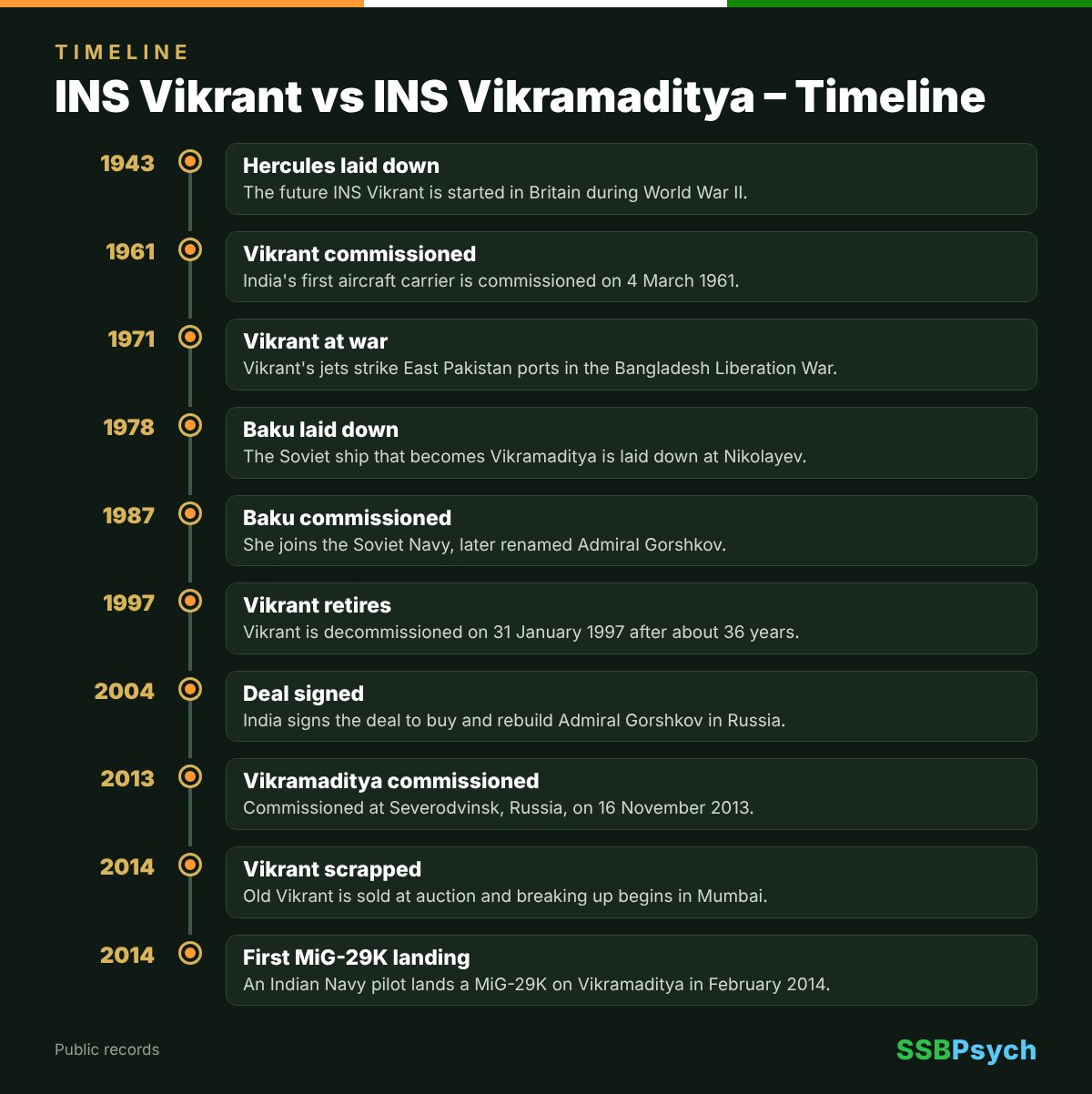
- 1943 – Hercules laid down: The future INS Vikrant is started in Britain during World War II.
- 1961 – Vikrant commissioned: India’s first aircraft carrier is commissioned on 4 March 1961.
- 1971 – Vikrant at war: Vikrant’s jets strike East Pakistan ports in the Bangladesh Liberation War.
- 1978 – Baku laid down: The Soviet ship that becomes Vikramaditya is laid down at Nikolayev.
- 1987 – Baku commissioned: She joins the Soviet Navy, later renamed Admiral Gorshkov.
- 1997 – Vikrant retires: Vikrant is decommissioned on 31 January 1997 after about 36 years.
- 2004 – Deal signed: India signs the deal to buy and rebuild Admiral Gorshkov in Russia.
- 2013 – Vikramaditya commissioned: Commissioned at Severodvinsk, Russia, on 16 November 2013.
- 2014 – Vikrant scrapped: Old Vikrant is sold at auction and breaking up begins in Mumbai.
- 2014 – First MiG-29K landing: An Indian Navy pilot lands a MiG-29K on Vikramaditya in February 2014.
Aircraft, Weapons and Sensors
- Hawker Sea Hawk fighter-bombers (Vikrant)
- Breguet Alize anti-submarine aircraft (Vikrant)
- BAe Sea Harrier jump jets (Vikrant, later years)
- MiG-29K and MiG-29KUB carrier fighters (Vikramaditya)
- Kamov Ka-31 airborne early warning helicopters (Vikramaditya)
- Kamov Ka-28 anti-submarine helicopters (Vikramaditya)
- Sea King and Chetak helicopters (served on both at different times)
- Steam catapult (Vikrant) vs 14 degree ski-jump with arrester wires (Vikramaditya)
Operations: A War Hero vs a Modern Guardian
The old Vikrant earned her fame in December 1971. In the Bay of Bengal, her Sea Hawks struck ports and shipping in East Pakistan, while she and her escorts blockaded the coast. She did this even with a cracked boiler that limited her speed. Her crew won two Maha Vir Chakras and twelve Vir Chakras.
Vikramaditya has not fought a war, but she has been the backbone of India’s carrier power since 2013. She visited Colombo in 2016 on her first foreign port call, hosted the first carrier landing of the naval Tejas prototype in January 2020, sailed in Exercise Malabar in 2020, and has carried out twin-carrier operations with the new INS Vikrant in 2023 and 2024. Her home port is Karwar in Karnataka.
Her career has had hard moments too. She suffered a fire in her boiler area in April 2019, and a gas leak during work in 2016 claimed lives. Old steam ships demand constant care, and these incidents remind us of the risks sailors accept.
Operations and Missions
- 1971 – Bangladesh Liberation War: Vikrant’s Sea Hawks struck Chittagong, Cox’s Bazar, Khulna and Mongla.
- 2014 – First MiG-29K deck landing: Vikramaditya began routine MiG-29K flying after her arrival in India.
- 2016 – First foreign port call: Vikramaditya visited Colombo, Sri Lanka, in January 2016.
- 2020 – First Tejas deck landing: The naval Tejas prototype made its first carrier landing on Vikramaditya.
- 2020 – Exercise Malabar: Vikramaditya sailed with partner navies in the Malabar exercise.
- 2023 – Twin-carrier operations: Vikramaditya and the new INS Vikrant operated together in the Arabian Sea.

Which Was Better at What, and Why?
- Combat record: Vikrant. She actually went to war in 1971 and made a difference.
- Size and strike power: Vikramaditya, by a huge margin. More than double the weight and more aircraft.
- Jets: Vikramaditya. Supersonic MiG-29Ks against 1950s-era Sea Hawks is no contest.
- Speed and range: Vikramaditya. Faster and with a longer listed range.
- Affordability: Vikrant. A light carrier was within reach of a young nation’s budget.
- Cost of buying: Vikramaditya’s final refit price rose to about US$2.35 billion after a long renegotiation, while Vikrant’s purchase price is not widely reported.
Why Did India Need a Bigger Carrier Than Vikrant?
A light carrier like the old Vikrant could only carry a small air group, and her aircraft had limited range and weapons. By the 2000s India’s interests had spread across the whole Indian Ocean, from the Gulf to the Strait of Malacca. Protecting trade routes, energy supplies and island territories over such a huge area needs a carrier that can stay at sea for weeks and launch fast, well-armed fighters far from home.
Vikramaditya answered that need. Her bigger fuel tanks, larger hangar and supersonic jets let the Navy push air cover hundreds of kilometres away from the fleet. In simple words, the old Vikrant was a strong local guard, while Vikramaditya is built to patrol an entire ocean.
What India Learned From Vikrant and Vikramaditya
Vikrant taught India the basics: how to fly jets at sea, how to protect a carrier with escort ships, and how air power can decide a naval war. Without that 36-year school, India would never have had the pilots, engineers and planners to handle a giant like Vikramaditya.
Vikramaditya taught India a different lesson: buying and rebuilding a used foreign ship can take far longer and cost far more than planned. The 2004 deal saw delays and a much higher final price, and her sea trials ran from 2012 to 2013 after boiler issues. That experience strengthened India’s push to design and build its own carrier, which led to the new INS Vikrant commissioned in 2022.
On the positive side, Vikramaditya brought India into the world of STOBAR operations with supersonic fighters. Those skills transferred directly to the new home-built Vikrant, which uses the same take-off and landing method.
The Fun Verdict: INS Vikrant vs INS Vikramaditya
Think of it like comparing a classic Ambassador car with a modern SUV. The Ambassador carried leaders through history and is loved by everyone, but the SUV is bigger, faster and packed with modern technology.
Vikramaditya wins on almost every number: size, speed, range, crew, aircraft and firepower. Vikrant wins on legacy: she was first, she fought, and she won. If you had to send one into a modern battle, it would be Vikramaditya. If you had to choose the ship that made Indian naval aviation possible, it would be Vikrant.
Did You Know?
- Vikramaditya was laid down in 1978, while Vikrant was laid down in 1943, a gap of 35 years.
- Vikramaditya was commissioned in Russia, at Severodvinsk, before sailing to India.
- In Soviet service Vikramaditya carried heavy anti-ship missiles on her front deck, removed when she was rebuilt as a full carrier.
- The naval Tejas made its first ever carrier landing on Vikramaditya in January 2020.
- Vikramaditya’s engines produce about 180,000 horsepower.
- Old Vikrant’s sailors won two Maha Vir Chakras in the 1971 war.
- Metal from the scrapped Vikrant was used in Bajaj’s V motorcycle launched in 2016.
Read the other posts in our carrier series for full profiles of each ship, then try the quiz below. Carrier facts are a favourite in SSB lecturettes and group discussions, so a clear story like this can help you stand out.
Quiz: Test Your Knowledge of INS Vikrant vs INS Vikramaditya
Click an option to see if you are right. Your score updates live.
INS Vikrant vs INS Vikramaditya: Frequently Asked Questions
INS Vikramaditya is far bigger. She displaces about 45,000 tonnes and is about 284 metres long, while the old Vikrant was about 19,500 tonnes and about 213 metres long.
She was built at Nikolayev in the former Soviet Union as Baku and later rebuilt for India by the Sevmash shipyard at Severodvinsk in Russia.
The final price agreed for her refit was reported at about US$2.35 billion, much higher than the figure in the original 2004 deal. Aircraft were bought separately.
No. The old Vikrant retired in 1997, while Vikramaditya joined the Indian Navy in 2013.
She operates MiG-29K fighters along with Kamov Ka-31 early warning and Ka-28 anti-submarine helicopters, plus other helicopters.
This is part 8 of 16 in SSBPsych’s Indian Navy aircraft carrier series – a new post every day at 2 PM.
Sources: en.wikipedia.org, en.wikipedia.org, indiannavy.nic.in, bharat-rakshak.com.
Preparing for NDA, CDS, AFCAT or your SSB? Join SSBPsych’s online and offline batches – explore our courses or call +91 8076540582.