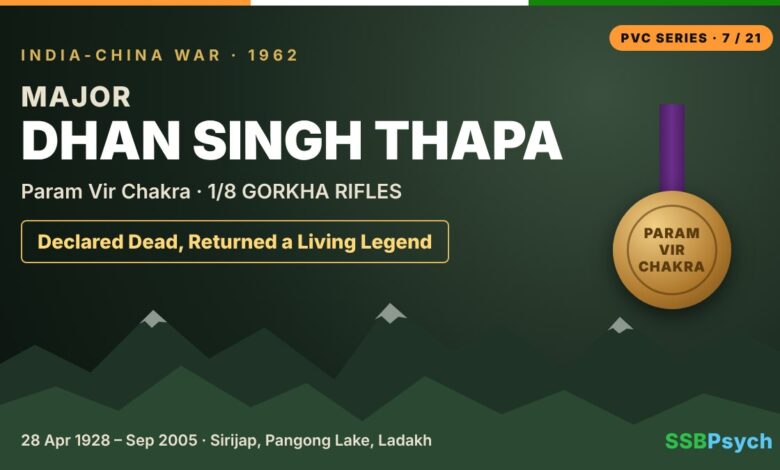
Major Dhan Singh Thapa, PVC: The Hero of Sirijap Who Came Back from Captivity – Full Story (with Quiz)
In late October 1962, word reached India that a small Gorkha post on the shore of Pangong Lake had been wiped out and that its commander had fallen fighting. The nation honoured him with the Param Vir Chakra. Then came a surprise few could have imagined. Months later, the officer walked back home from a Chinese prisoner-of-war camp. He was Major Dhan Singh Thapa of 1/8 Gorkha Rifles, and his story is one of the most remarkable in the history of India’s highest gallantry award.
For SSB aspirants, Major Thapa is a lesson in leadership under siege. With fewer than thirty men, cut off from his battalion and facing hundreds of attackers, he kept his post fighting for hours. Later, as a prisoner, he refused to say a word against his country. In this post we cover his early life, the background to the 1962 war, the battle of Sirijap in detail, his citation, captivity and legacy, followed by the OLQs he displayed and a 10-question quiz.
Major Dhan Singh Thapa – Quick Facts
| Full name | Dhan Singh Thapa |
| Born | 28 April 1928, Shimla |
| Father | Padam Singh Thapa |
| Commissioned | 28 August 1949 |
| Unit | 1st Battalion, 8 Gorkha Rifles (1/8 GR) |
| Battle | Defence of Sirijap-1 post, north bank of Pangong Lake, Ladakh |
| Date of action | 20 October 1962 |
| Strength at post | 28 men of D Company |
| Fate | Captured; prisoner of war, released in 1963 |
| Retired | 1980, as Lieutenant Colonel |
| Died | September 2005 |
| Award | Param Vir Chakra |
Early Life in Shimla
Dhan Singh Thapa was born on 28 April 1928 in Shimla, in the hills of present-day Himachal Pradesh. His father was Padam Singh Thapa, and the family belonged to the Magar community, one of the groups with a long tradition of service in Gorkha regiments. Growing up in a hill town with soldiering in the family background, the army was a natural calling for him.
Joining the Army
Thapa was commissioned on 28 August 1949 into the 1st Battalion of the 8th Gorkha Rifles, the battalion he would serve with through the defining moment of his life. Over the next decade he rose steadily, and by 1962 he was a company commander holding the rank of major. His men knew him as a calm, practical officer who believed in thorough preparation, a quality that would matter enormously on the shores of Pangong.
The War Background: Ladakh, 1962
By the early 1960s, India and China disagreed sharply over large stretches of the border, especially in Ladakh’s Aksai Chin and in the North East Frontier Agency. Under what was called the Forward Policy, India set up many small posts in disputed areas, often facing much stronger Chinese positions. These posts were thinly manned, poorly supplied and far from support.
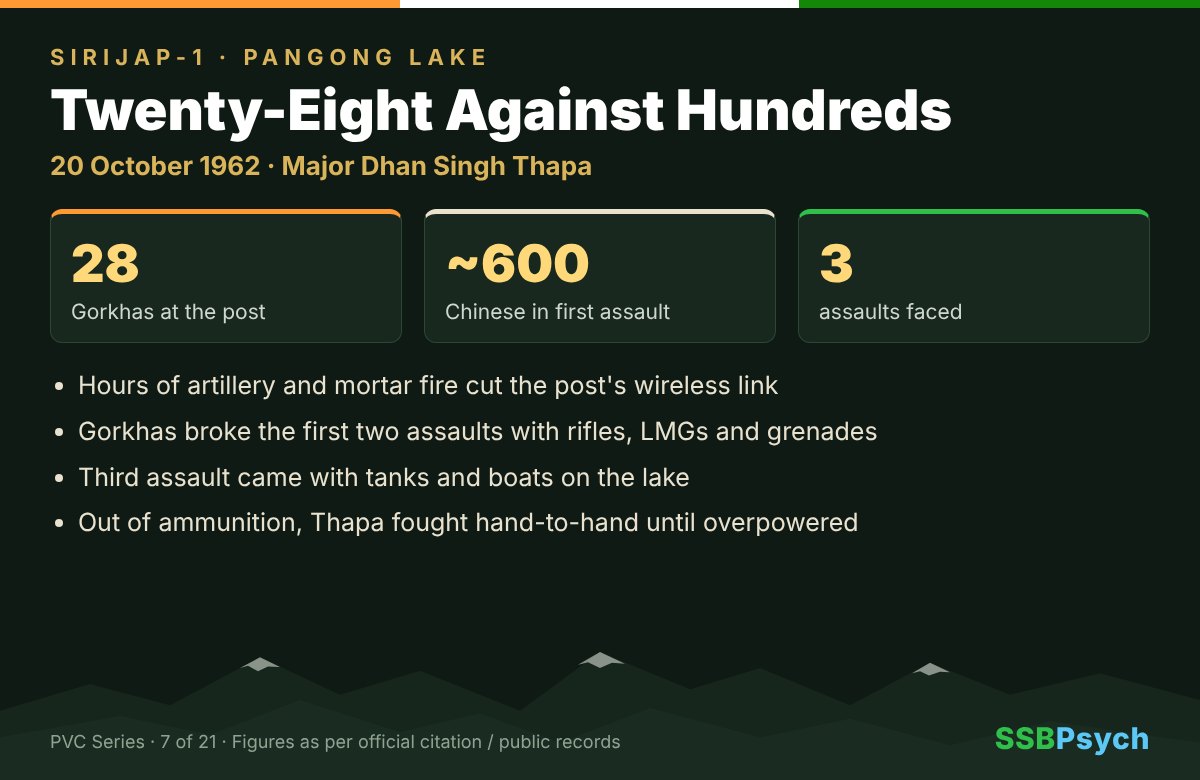
One such post was Sirijap-1, on the northern bank of the long, narrow Pangong Lake. It formed part of the defences that protected the vital airfield at Chushul. Major Thapa’s D Company of 1/8 GR was responsible for a large stretch of this area, but at Sirijap-1 he had only 28 men. The Chinese had built three posts around it, and in the days before the attack the number of Chinese troops in the area rose sharply.
Reading the signs, Thapa ordered his men to strengthen their defences, telling them to dig quickly and dig deep. The ground was hard and rocky, and where trenches could not go deep enough, sandbags were used. This preparation would keep the post alive far longer than anyone expected.
When the Chinese offensive finally began on 20 October 1962, it struck in both the eastern and western sectors almost at the same time. In Ladakh, posts in the Galwan valley, Chip Chap and around Pangong came under attack. Many were tiny outposts that had no real chance against the numbers thrown at them. What made Sirijap-1 different was not that it fell, but how long and how hard it fought before it did.
The Battle of Sirijap-1, 20 October 1962
The Bombardment
Before dawn on 20 October 1962, the Chinese opened up with artillery and mortars. The shelling went on for over two hours. It caused casualties and destroyed the post’s wireless set, cutting the company off from its battalion headquarters. From that moment the Gorkhas at Sirijap-1 were on their own.
The First Assault
As the shelling lifted, around 600 Chinese soldiers advanced on the post. Thapa’s men held their fire until the attackers were close, then opened up with rifles, light machine guns and grenades. The first assault was broken barely a hundred yards from the Indian trenches, and the attackers fell back with heavy losses.
The Second Assault
The Chinese came again, this time getting closer and using incendiary weapons that set parts of the position on fire. The Gorkhas fought back with grenades and small arms and threw the second attack back as well. The cost was high. Thapa’s second-in-command, Subedar Min Bahadur Gurung, was buried when a bunker collapsed under fire. He dug himself out and kept working his light machine gun until he was killed.
Boats on the Lake
Battalion headquarters, realising the post was in trouble, sent two storm boats across the lake. Both came under fire. One was sunk and everyone aboard was killed. The other, carrying Naik Rabilal Thapa, managed to get away. With the post now shrouded in smoke and fire, he reported back that Sirijap-1 had fallen with no survivors. That report is why India first believed Major Thapa was dead.
The Final Assault
But the fight was not over. Only a handful of Gorkhas were still alive when the third attack came, this time supported by tanks along with machine guns and rocket launchers. A bomb landed in Thapa’s own trench, but he got out. When his ammunition ran out, he leapt out and fought the attackers hand-to-hand, killing several of them before he was overpowered and taken prisoner along with the very few other survivors.
The Param Vir Chakra Citation (In Simple Words)
Major Thapa’s citation was written when India believed he had been killed. In simple terms, it records that he commanded a forward post in Ladakh that was attacked on 20 October 1962 by an enemy force far larger than his own, after intense artillery and mortar fire. Under his leadership the small garrison beat back the first two attacks and caused heavy enemy casualties. In the third attack, the enemy used tanks to support its infantry, and the post was finally overrun. Even then, Major Thapa came out of his trench and killed several attackers in hand-to-hand combat before he was overwhelmed. The citation praises his calm courage, outstanding fighting qualities and leadership as being in the finest traditions of the Indian Army.
Captivity and the Return of a Hero
As a prisoner of war, Thapa suffered harsh treatment. He was punished for the losses his men had inflicted, and again when he refused to make statements against the Indian Army and the Government of India. He did not give in. After the fighting ended in November 1962, prisoners were gradually returned, and he was repatriated in May 1963. His family, who had mourned him, welcomed back a man the country had already honoured as a fallen hero.
Thapa continued to serve in the army. He was promoted through the ranks and retired as a Lieutenant Colonel in 1980. After retirement he settled in Lucknow and briefly worked as a director with Sahara Airlines. He passed away in September 2005, aged 77.
Legacy of Major Dhan Singh Thapa
- He is one of the few Param Vir Chakra recipients who lived to receive the honour, after first being reported killed in action.
- An Indian border post on the northern bank of Pangong Tso is named the Dhan Singh Thapa Post in his memory.
- In January 2023, an island in the Andaman and Nicobar group was named Dhan Singh Island, as part of the naming of 21 islands after PVC recipients.
- The Shipping Corporation of India named a crude oil tanker MT Major Dhan Singh Thapa, PVC in the 1980s.
The name Pangong Tso returned to the headlines during the India-China standoff of 2020. For many Indians, it was a reminder that the same shoreline had once been defended by a few dozen Gorkhas under Major Thapa, who refused to give ground even when the odds were hopeless.
His story also carries a lesson about how a leader prepares. The fight at Sirijap-1 lasted as long as it did because Thapa had read the warning signs and made his men dig in before the first shell fell. Courage on the day of battle was built on discipline in the days before it.
Finally, his conduct as a prisoner deserves as much respect as his conduct in battle. It is one thing to be brave with a rifle in hand and comrades beside you. It is another to stay loyal alone, injured and under pressure, with no idea when or whether you will be freed. Major Thapa showed that integrity does not depend on circumstances. That quiet, private courage is exactly what the Services look for in the young men and women who want to lead their soldiers.
Lessons for SSB Aspirants: OLQs in Action
The SSB does not test whether you can recite history – it looks for the qualities of an officer. Here is how Major Dhan Singh Thapa showed them:
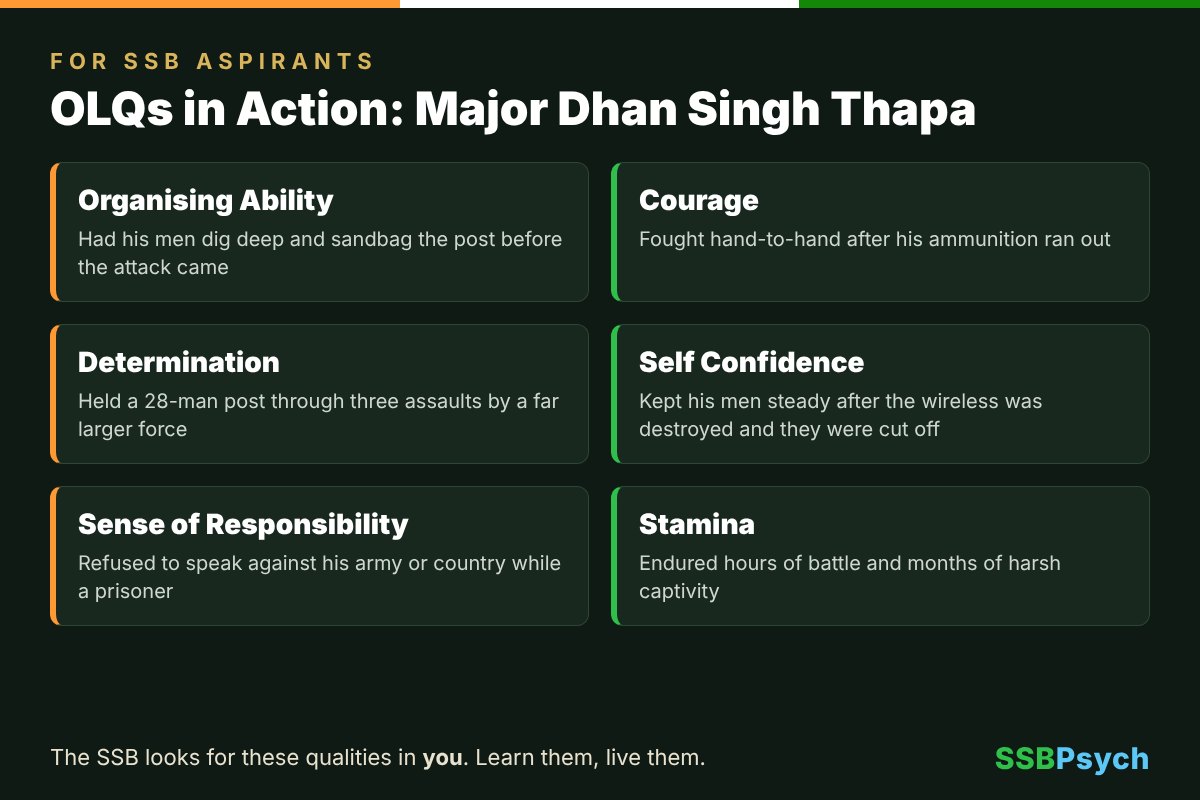
- Organising Ability – Had his men dig deep and sandbag the post before the attack came
- Courage – Fought hand-to-hand after his ammunition ran out
- Determination – Held a 28-man post through three assaults by a far larger force
- Self Confidence – Kept his men steady after the wireless was destroyed and they were cut off
- Sense of Responsibility – Refused to speak against his army or country while a prisoner
- Stamina – Endured hours of battle and months of harsh captivity
Tip for your SSB interview: Major Thapa’s story is perfect for questions about handling setbacks. If asked about a failure in your life, show how you prepared, what you learned and how you bounced back, just as he returned from captivity and served for 17 more years.
Practice Corner: WAT and SRT
Write your first spontaneous response to these before you scroll to the quiz. Keep WAT sentences short, positive and action-oriented.
WAT Words
- Prisoner
- Prepare
- Lake
- Loyal
- Surrender
SRTs
- He is commanding a small post and notices the enemy building up strength nearby day by day. He…
- He is cut off from his headquarters after the radio is destroyed during an attack. He…
- He is captured and asked to sign a statement criticising his own country. He…
Quiz: How Well Do You Know Major Dhan Singh Thapa?
Test yourself! Click an option to see if you are right. Your score updates live.
Frequently Asked Questions
Did Major Dhan Singh Thapa survive the 1962 war?
Yes. He was taken prisoner after his post was overrun and was believed dead, but he was released in May 1963 and went on to retire as a Lieutenant Colonel.
Was his Param Vir Chakra posthumous?
It was announced when he was thought to have been killed, but since he was alive, he received the award himself and is counted among the living PVC recipients.
Where is Sirijap?
Sirijap is an area on the northern bank of Pangong Lake in eastern Ladakh, close to the Line of Actual Control with China.
What honours are named after him?
The Dhan Singh Thapa Post near Pangong Tso, Dhan Singh Island in the Andaman and Nicobar Islands, and an SCI oil tanker.
The Param Vir Chakra Series on SSBPsych
This is part 7 of 21 in our series on every Param Vir Chakra awardee. A new hero goes live every morning at 7:30 AM. Also read the story of Captain Vikram Batra, PVC – the Sher Shah of Kargil.
Sources: en.wikipedia.org, bharat-rakshak.com, honourpoint.in, www.esamskriti.com, thehitavada.com.
Preparing for your SSB? Join SSBPsych’s online and offline SSB batches and learn how to show your OLQs with confidence – explore our courses or call +91 8076540582.