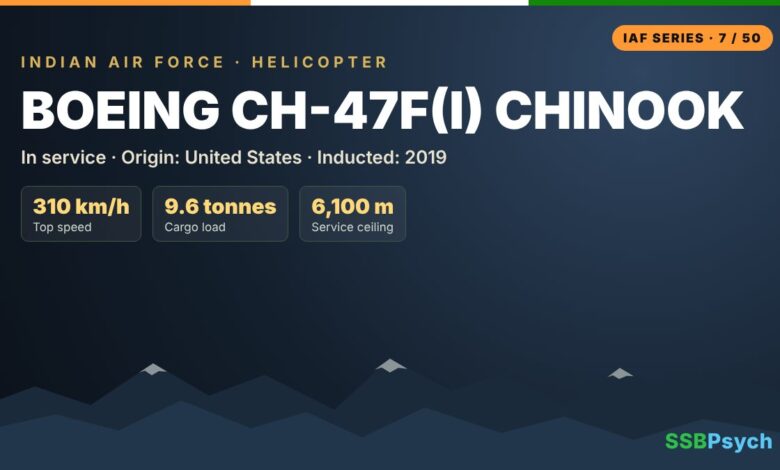
Chinook in Indian Air Force: CH-47F Specs, Payload, Missions
Have you ever seen a helicopter that looks like a flying bus with a rotor at each end? That is the Chinook, the Indian Air Force’s heavy-lift helicopter. Since 2019 it has carried soldiers, guns, machines and relief supplies to places where trucks cannot go, from the icy heights of Ladakh to flooded valleys in the Himalayas. It has even helped ISRO test India’s space vehicles.
In this guide you will learn why India bought the Chinook, how its unusual twin-rotor design works, how much it can lift, its famous missions, where it is based, its strengths and weaknesses, and why it matters for your NDA, CDS, AFCAT and SSB preparation. A 10-question quiz and an FAQ at the end will help you revise.

Chinook Specifications
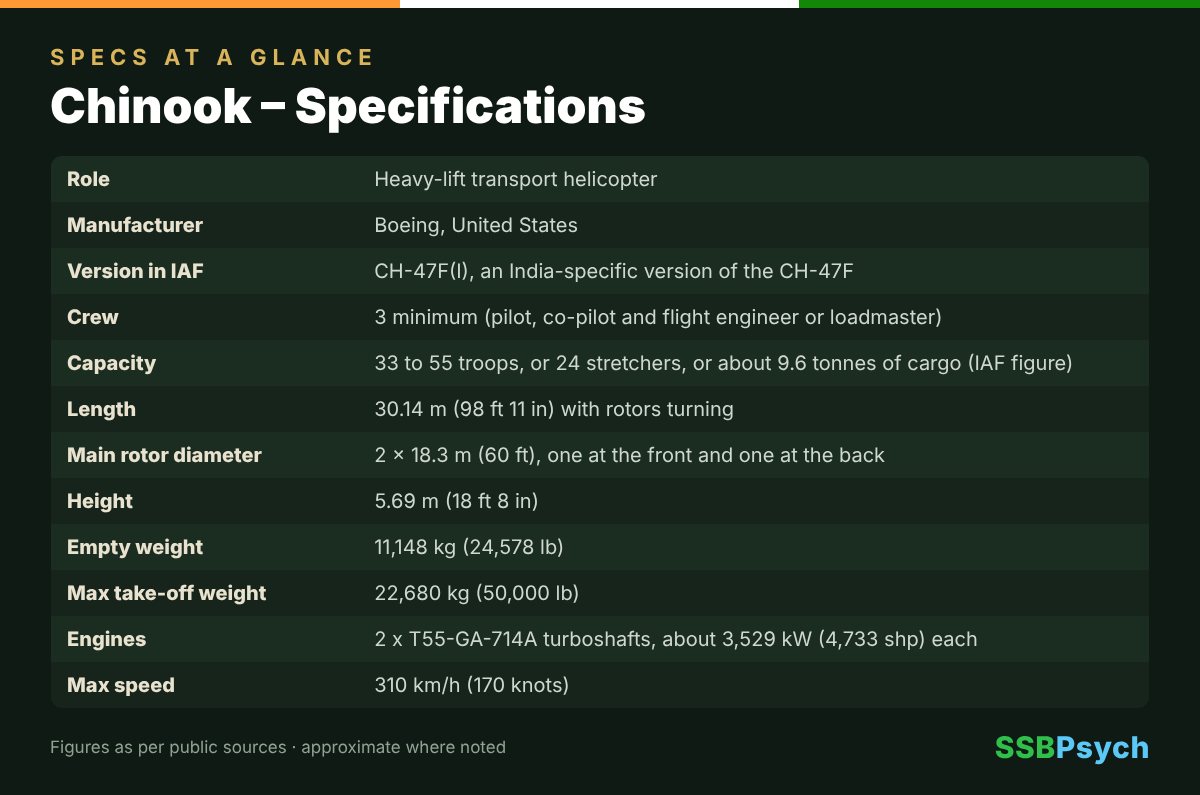
| Role | Heavy-lift transport helicopter |
| Manufacturer | Boeing, United States |
| Version in IAF | CH-47F(I), an India-specific version of the CH-47F |
| Crew | 3 minimum (pilot, co-pilot and flight engineer or loadmaster) |
| Capacity | 33 to 55 troops, or 24 stretchers, or about 9.6 tonnes of cargo (IAF figure) |
| Length | 30.14 m (98 ft 11 in) with rotors turning |
| Main rotor diameter | 2 x 18.3 m (60 ft), one at the front and one at the back |
| Height | 5.69 m (18 ft 8 in) |
| Empty weight | 11,148 kg (24,578 lb) |
| Max take-off weight | 22,680 kg (50,000 lb) |
| Engines | 2 x T55-GA-714A turboshafts, about 3,529 kW (4,733 shp) each |
| Max speed | 310 km/h (170 knots) |
| Cruise speed | About 291 km/h (157 knots) |
| Range | About 740 km (400 nautical miles) |
| Service ceiling | 6,100 m (20,000 ft) |
| First flight | 21 September 1961 (first Chinook prototype hover) |
| Inducted in IAF | 25 March 2019, Chandigarh |
| Number in IAF | 15 ordered in 2015 |
Why India Needed the Chinook
India has some of the toughest terrain on Earth. Much of the northern and eastern border runs through high mountains with few roads. Posts there need food, fuel, ammunition and building material all year. Before the Chinook, the IAF’s biggest helicopter was the Russian Mi-26, a true giant, but only a few were in service and they were getting old. India needed a modern, reliable heavy-lift helicopter that could work at high altitude.
In September 2015, India’s Ministry of Defence finalised an order with Boeing for 15 CH-47F(I) Chinooks, along with training and support. The (I) stands for India, because the helicopters were tailored to Indian needs. The deal was signed around the same time as the order for Apache attack helicopters, giving the IAF two powerful new American helicopters.
History of the Chinook in the IAF
The Chinook family is old and proven. The first prototype hovered in the United States on 21 September 1961, and the design has been improved again and again since then. The CH-47F, the version India bought, has a modern digital cockpit, better avionics and stronger engines than earlier models, while keeping the famous tandem-rotor shape.
The first Indian Chinooks arrived by ship at Mundra port in Gujarat in February 2019, ahead of schedule. On 25 March 2019, the first four were formally inducted at Air Force Station Chandigarh into No. 126 Helicopter Flight, known as the Featherweights. That name is a fun joke, because this unit has always flown the heaviest helicopters in the IAF. The rest of the 15 helicopters followed later.
Chandigarh was a smart choice. It sits close to the Himalayas and is a short flight from Ladakh and Himachal Pradesh, so Chinooks based there can reach high-altitude areas quickly. From February 2020, the helicopters began supporting forces in Ladakh and the Siachen Glacier region, carrying supplies and equipment to forward areas.
How the Chinook Works: Engine and Performance Explained Simply
Most helicopters have one big rotor on top and a small tail rotor at the back. The tail rotor stops the helicopter body from spinning the opposite way. The Chinook does things differently. It has two large rotors, one at the front and one at the back, and they spin in opposite directions. This cancels out the spinning force, so no tail rotor is needed, and all the engine power goes into lifting.
Power comes from two turboshaft engines mounted on either side of the rear pylon. A turboshaft is a jet-type engine that turns a shaft instead of pushing out a jet of hot air. Each engine gives about 3,529 kW, which is roughly 4,700 horsepower. Together that is the power of dozens of family cars combined.
Top speed is about 310 km/h, and the normal cruising speed is around 291 km/h. That is faster than many other helicopters and faster than India’s fastest trains. The Chinook can fly up to about 740 km without refuelling, a little more than the road distance from Delhi to Lucknow. Its service ceiling, the highest height at which it can still climb usefully, is about 6,100 m, which is higher than almost every mountain pass in Ladakh.
The real magic is lifting. The IAF has stated that its Chinook can carry about 9.6 tonnes of cargo. That is roughly the weight of ten small hatchback cars at once. Loads can go inside the cabin through a big rear ramp, or hang below the helicopter from cargo hooks. This underslung method lets the Chinook drop guns or machinery straight onto a mountain post without needing a runway or even a proper helipad.
The full length of the Chinook with rotors turning is about 30 m, roughly the length of two city buses parked end to end. When empty it weighs a little over 11 tonnes, and at maximum take-off weight it reaches about 22.7 tonnes. In simple terms, it can lift almost its own weight again.
Why does height matter so much for a helicopter? Rotor blades lift by pushing air downwards. High in the mountains the air is thin, so each turn of the blades pushes less air and creates less lift. The engines also breathe less oxygen and lose power. This is why many helicopters can carry only small loads in Ladakh. A machine with lots of spare power, like the Chinook, can still do useful work where the air is thin, and that is exactly what India’s northern borders demand.
What It Carries
- Up to 33 to 55 fully equipped troops inside the cabin
- Around 9.6 tonnes of cargo, as stated by the IAF at induction
- Heavy machinery and light artillery guns, inside or slung below
- Underslung loads on three cargo hooks under the fuselage
- 24 stretchers for casualty evacuation
- Engineering equipment and supplies for roads and posts in high mountains
- Relief material during floods and disasters
The Chinook is not an attack helicopter, so it is not built to fight. Its value lies in what it carries. For the Indian Army, that means moving light artillery guns, ammunition and troops to high posts quickly. For engineers, it means flying in heavy machinery to build roads and bridges. For disaster relief, it means food, water, medicines and the ability to take people out of danger.
Chinook Missions and Operations

- 2019 – Induction at Chandigarh: On 25 March, the first four Chinooks joined the IAF, having arrived by sea at Mundra port in Gujarat a month earlier.
- 2020 – Ladakh and Siachen support: From February, Chinooks began supporting troops in Ladakh and the Siachen Glacier area near the northern borders.
- 2023 – ISRO RLV landing test: On 2 April, a Chinook carried ISRO’s reusable launch vehicle high over Chitradurga and released it for an autonomous landing.
- 2024 – Pushpak drops for ISRO: On 22 March and 23 June, Chinooks lifted ISRO’s Pushpak winged vehicle and released it from about 4.5 km for its landing experiments.
- 2024 – Kedarnath rescue: In August, Chinooks and Mi-17s joined the operation to evacuate pilgrims stranded on the rain-damaged Kedarnath route.
- 2025 – Gaganyaan air drop test: On 24 August, a Chinook dropped a Gaganyaan crew module mock-up from about 3 km to test its parachutes over the sea near Sriharikota.
- 2025 – Flood relief in the Himalayas: In August, a Chinook joined Mi-17s and a C-130J for flood relief after flash floods in Uttarakhand and Kishtwar.

The Chinook and India’s Space Programme
One of the most exciting jobs of the IAF Chinook has nothing to do with war. ISRO is developing a reusable launch vehicle, a winged spacecraft that can land on a runway like an aeroplane. To test the landing, engineers needed a way to lift the vehicle high into the sky and drop it. The Chinook was the answer.
In 2023 and 2024, Chinooks carried the test vehicle, nicknamed Pushpak, to a height of around 4.5 km over the Aeronautical Test Range at Chitradurga in Karnataka and released it. Pushpak then glided down on its own and landed on the runway. In August 2025, a Chinook also dropped a model of the Gaganyaan crew module from about 3 km over the sea, so ISRO could test the parachutes that will one day bring Indian astronauts home safely.
The Chinook in Disaster Relief
Disasters often cut roads exactly when people need help most. In August 2024, a cloudburst washed away part of the trekking route to Kedarnath in Uttarakhand and left pilgrims stranded. The state asked for help, and IAF Chinooks and Mi-17 helicopters joined the rescue. Along with ground teams of the SDRF and NDRF, about 5,000 people were brought to safety within the first couple of days.
A year later, in August 2025, flash floods struck parts of Uttarakhand and Kishtwar in Jammu and Kashmir. Once again a Chinook was sent in, working alongside Mi-17 helicopters and a C-130J transport aircraft. In such operations the Chinook’s big cabin and rear ramp let it carry relief stores in and bring people or equipment out in a single trip, saving precious hours.
Where the Chinook Is Based and Who Flies It
The first IAF Chinooks were inducted at Air Force Station Chandigarh with No. 126 Helicopter Flight, as widely reported in public sources. From there they have been deployed to Ladakh, the Himalayan states and other areas whenever heavy lift is needed.
IAF helicopter units are usually commanded by an experienced officer of Wing Commander or Group Captain rank, supported by Squadron Leaders and younger Flight Lieutenants and Flying Officers. A Chinook crew includes two pilots and a flight engineer or loadmaster, who manages the cargo and the hooks and keeps an eye on the helicopter’s systems.
Pilots who want to fly helicopters join the Air Force Academy at Dundigal and, after basic flying training, are selected for the helicopter stream. They then train at the Helicopter Training School at Hakimpet, near Hyderabad. After earning their wings, they usually fly lighter helicopters first and build up hours and experience over several years before moving to a heavy machine like the Chinook.
Strengths and Limitations of the Chinook
- Very heavy lifting ability, about 9.6 tonnes of cargo by IAF figures
- Tandem rotors with no tail rotor, so all power goes into lift and control
- Fast for a helicopter, cruising at around 290 km/h
- Large rear ramp for quick loading of vehicles, troops and stores
- Can carry underslung loads to places without runways
- Useful in war, disaster relief and even space programme tests
- Big and noisy, so it is easy to see and hear
- Needs escort or a safe area in combat zones, as it is not armed for attack
- Only 15 ordered, so each helicopter is in high demand
Future of the Chinook in India
The Chinook is still young in IAF service and is expected to fly for decades. Its job is likely to grow as India builds more roads, tunnels and posts in the mountains, and as ISRO’s Gaganyaan and reusable launch vehicle programmes continue. Boeing has been upgrading the Chinook family worldwide, so improvements in engines, rotor blades and avionics could reach India in the future.
With the Mi-26 fleet ageing, the Chinook has become the IAF’s main heavy-lift helicopter. Whether the next crisis is a flood, a landslide or a tense border, it is one of the first machines the country turns to.
Why the Chinook Matters for SSB and AFCAT Aspirants
Questions on the Chinook pop up in defence exams because it links to many topics: India-US defence ties, border infrastructure, disaster relief and the space programme. In an SSB interview, if you are asked about recent IAF inductions or about how the armed forces help during disasters, the Chinook is an excellent example.
Remember the key points: 15 CH-47F(I) ordered in 2015, first four inducted on 25 March 2019 at Chandigarh, tandem twin rotors, about 9.6 tonnes of cargo, top speed about 310 km/h, and test drops for ISRO’s Pushpak and Gaganyaan programmes.
Did You Know?
- The Chinook is named after the Chinook people, a Native American community of the Pacific Northwest.
- Its two rotors spin in opposite directions, so it does not need a tail rotor.
- The unit that received the first IAF Chinooks is nicknamed the Featherweights, even though it flies the heaviest helicopters.
- Indian Chinooks arrived by sea at Mundra port in Gujarat before their induction.
- A Chinook dropped ISRO’s Pushpak spaceplane from around 4.5 km for its landing tests.
- The first Chinook prototype hovered in 1961, yet the design is still in production in modern form.
Quiz: Test Your Knowledge of Chinook
Click an option to see if you are right. Your score updates live.
Chinook: Frequently Asked Questions
India ordered 15 Boeing CH-47F(I) Chinooks in 2015. The first four were inducted on 25 March 2019 at Chandigarh, and the rest followed later.
At its induction the IAF said the Chinook can carry about 9.6 tonnes of cargo, including heavy machinery and artillery guns, either inside the cabin or slung underneath.
The CH-47F Chinook can reach about 310 km/h and usually cruises at around 291 km/h, which is fast for a large helicopter.
The first IAF Chinooks were inducted at Air Force Station Chandigarh with No. 126 Helicopter Flight, close to the Himalayas and Ladakh.
IAF Chinooks lifted ISRO’s Pushpak reusable launch vehicle to about 4.5 km and released it for landing tests, and in 2025 dropped a Gaganyaan crew module mock-up to test its parachutes.
This is part 7 of 50 in SSBPsych’s Indian Air Force aircraft series – a new aircraft every evening at 6 PM.
Sources: aviation-defence-universe.com, en.wikipedia.org, en.wikipedia.org, army.mil, isro.gov.in.
Preparing for NDA, CDS, AFCAT or your SSB? Join SSBPsych’s online and offline batches – explore our courses or call +91 8076540582.