Captain Gurbachan Singh Salaria, PVC: The Only UN Peacekeeper with a Param Vir Chakra – Full Story (with Quiz)
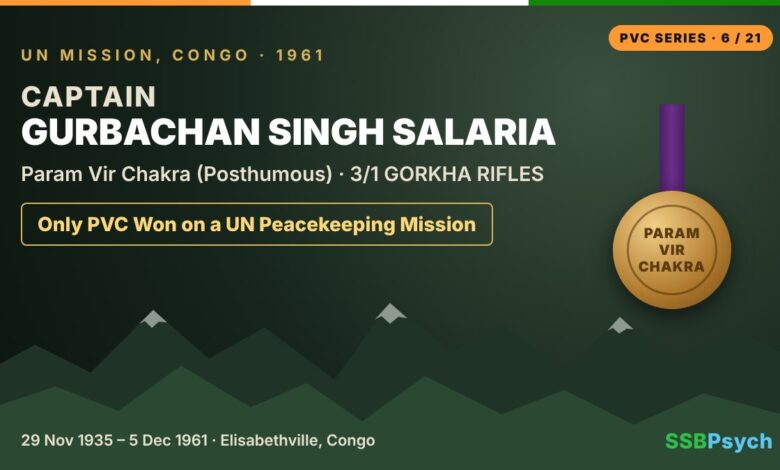
Most Param Vir Chakra stories unfold on the snowy heights of Kashmir and Ladakh or the plains of Punjab. One stands apart. In December 1961, thousands of kilometres from India, a young Gorkha officer wearing the blue beret of the United Nations led a handful of men against a far larger, well-armed force in the heart of Africa. He did not come back, but his charge broke the enemy and saved a UN headquarters from being cut off. His name was Captain Gurbachan Singh Salaria.
For SSB aspirants, Captain Salaria is a special hero. He walked the same path many of you hope to walk: a military school, the National Defence Academy, then the Indian Military Academy. He was the first NDA graduate to be awarded the Param Vir Chakra, and he remains the only Indian to win it while serving as a UN peacekeeper. In this post you will read about his early life, the Congo crisis, his final battle, his citation and his legacy, followed by Officer Like Qualities you can learn from him and a 10-question quiz to test yourself.
Captain Gurbachan Singh Salaria – Quick Facts
| Full name | Gurbachan Singh Salaria |
| Born | 29 November 1935, Jamwal village near Shakargarh, Punjab (now in Pakistan) |
| Parents | Munshi Ram and Dhan Devi |
| Schooling | King George’s Royal Indian Military College (Bangalore, then Jalandhar) |
| Academies | NDA (Joint Services Wing, 1956) and IMA, Dehradun |
| Commissioned | 9 June 1957 |
| Unit | 3rd Battalion, 1 Gorkha Rifles (3/1 GR) |
| Mission | United Nations Operation in the Congo (ONUC) |
| Date of action | 5 December 1961, Elisabethville, Katanga |
| Died | 5 December 1961, aged 26 |
| Award | Param Vir Chakra (Posthumous) |
| Notable | First NDA alumnus to receive the PVC |
Early Life: A Boy Inspired by His Father’s Regiment
Gurbachan Singh Salaria was born on 29 November 1935 in Jamwal, a village near Shakargarh in undivided Punjab. That area became part of Pakistan in 1947, and his family later settled in Jangal village in Gurdaspur district on the Indian side. He was the second of five children of Munshi Ram and Dhan Devi.
His father had served in the Dogra Squadron of Hodson’s Horse, a cavalry regiment of the British Indian Army. As a child, Gurbachan loved hearing his father’s stories about regimental life, and those tales planted a dream of becoming a soldier. In the village school he was not known as a bookworm. He was much happier on the kabaddi ground than at a desk.
Rejected Once, Admitted the Second Time
In 1946 he applied to King George’s Royal Indian Military College in Bangalore. He failed the medical test because his chest measurement was too small. Instead of giving up, he exercised hard for a few weeks, applied again and was accepted. In 1947 he moved to the college’s Jalandhar branch. This small episode tells you a lot about the man: one rejection did not define him.
NDA, IMA and Commission into the Gorkhas
From military school, Salaria joined the Joint Services Wing, the forerunner of today’s NDA, and passed out in 1956. He then completed his training at the Indian Military Academy, Dehradun, and was commissioned on 9 June 1957. His first posting was with the 2nd Battalion of 3 Gorkha Rifles. In March 1960 he moved to the 3rd Battalion, 1 Gorkha Rifles (3/1 GR), the unit with which he would make history. He was promoted to lieutenant in 1959 and later held the rank of captain.
The War Background: India in the Congo Crisis
The Republic of the Congo gained independence from Belgium in June 1960. Within weeks the new nation was in turmoil. Soldiers mutinied, violence spread, and the mineral-rich province of Katanga declared itself independent with the backing of foreign interests. The United Nations set up a peacekeeping force, the United Nations Operation in the Congo (ONUC), in July 1960.
India sent the 99th Infantry Brigade, around 3,000 troops, under Brigadier K.A.S. Raja in 1961. On 24 November 1961, the UN Security Council passed Resolution 169, which rejected Katanga’s breakaway and allowed UN forces to use force where needed. Katangese gendarmes, many led by foreign mercenaries, reacted by taking UN officials hostage. They captured and killed Major Ajit Singh of 1 Gorkha Rifles and his driver. They also set up roadblocks to isolate UN units from one another.
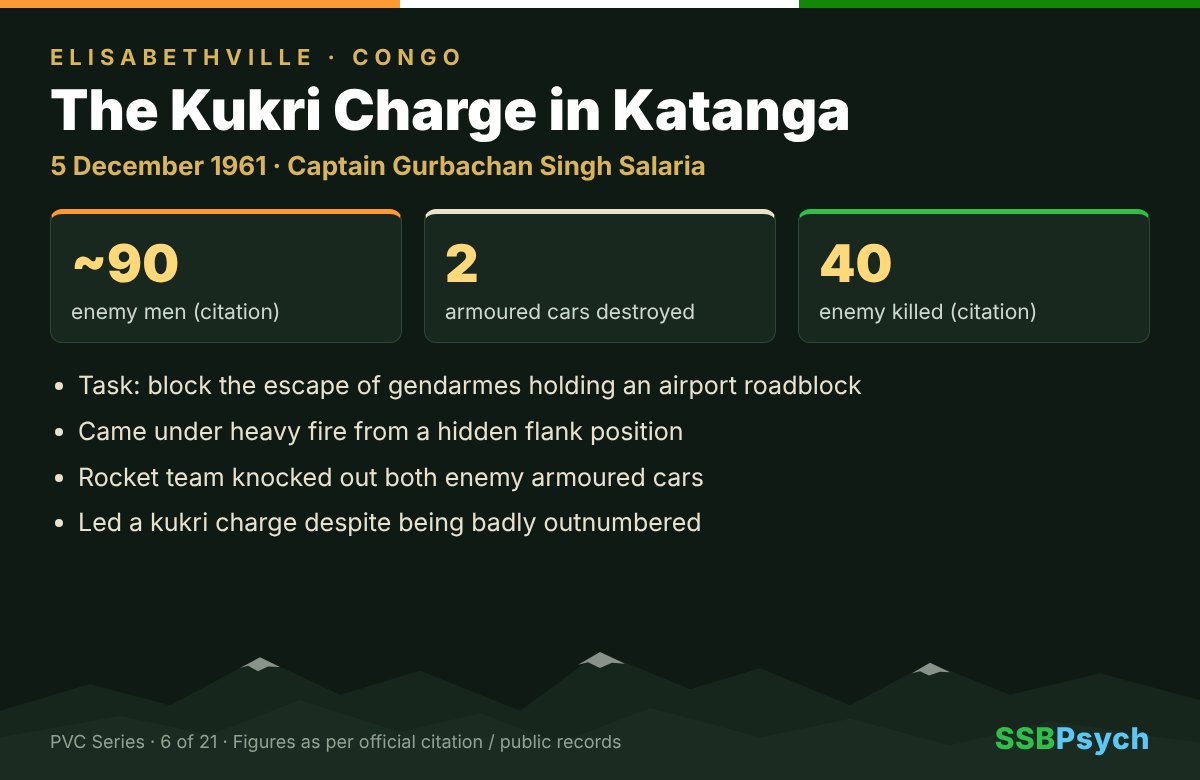
On 4 December 1961, the gendarmes blocked the road between Elisabethville (now Lubumbashi) and its airport at a key roundabout. If that position held, the UN headquarters in the city could be surrounded. The UN decided to act, and 3/1 GR was given the task of clearing the roadblock.
The Battle at the Elisabethville Roadblock, 5 December 1961
The Plan
The battalion plan was straightforward. Charlie Company, under Major Govind Sharma, would attack the roadblock from the front. Captain Salaria, with a platoon of Alpha Company, would take position behind the enemy to cut off their line of retreat. The rest of Alpha Company was kept in reserve. The attack was timed for around midday on 5 December.
Ambushed from the Flank
Salaria’s party moved forward in armoured personnel carriers. Shortly after 1 pm, while still well short of the roadblock, they came under heavy fire from an enemy position on their right that nobody had detected. According to his citation, the enemy here numbered about 90 men and had two armoured cars. Salaria’s own group was a fraction of that size.
He reacted instantly. His rocket launcher team engaged the two armoured cars and knocked both out. With the enemy’s heaviest weapons gone, Salaria faced a choice. He could wait for Charlie Company’s main attack, or he could strike at once while the gendarmes were shaken and before they could reorganise. He chose to attack.
Ayo Gorkhali!
With the Gorkha battle cry “Ayo Gorkhali!” ringing out, Salaria and his men charged the enemy trenches with bayonets and their famous kukris. The fighting was close and brutal. The citation credits Salaria and his small party with killing 40 of the enemy in this assault. The sheer boldness of the attack shattered the gendarmes’ will to fight.
During the charge, Salaria was hit twice in the neck by automatic fire. He kept going until he collapsed from loss of blood near the last line of enemy trenches. He was evacuated towards the airport hospital but died of his wounds. He was just 26 years old.
What His Sacrifice Achieved
The gendarmes lost a large part of their force and fled, leaving their dead and wounded behind. This allowed the rest of the battalion to clear the roadblock and the area around it. The threat of UN headquarters in Elisabethville being encircled was removed. One officer’s quick decision, taken in seconds under fire, changed the outcome of the day.
Military historians often point out that the hardest part of such an action is not the fighting itself but the decision to begin it. Salaria’s original task was defensive in nature: to sit across the enemy’s escape route and wait. Leaving that role to attack a stronger force meant accepting enormous risk. He judged that hesitation would let the enemy recover, and he backed that judgement with his own life.
The Param Vir Chakra Citation (In Simple Words)
Captain Salaria was awarded the Param Vir Chakra posthumously. In plain terms, his citation says that on 5 December 1961 he was tasked with blocking the enemy’s retreat from the roadblock near Elisabethville. When his force met strong resistance from a much larger group with armoured cars, he did not hold back. His rocket team destroyed both armoured cars, and he then led a charge with bayonets, kukris and grenades, killing 40 of the enemy. The citation notes that his unexpected, daring action demoralised the enemy, who fled despite their numbers and their protected positions. It records that he was badly wounded by automatic fire but continued to fight until he collapsed and died, and it praises his devotion to duty and complete disregard for his own safety.
A single officer’s decision to attack, rather than wait, broke an enemy many times stronger than his own party.
– SSBPsych summary of the action
Legacy of Captain G S Salaria
- First NDA graduate to receive the Param Vir Chakra, and the only PVC awarded to a UN peacekeeper.
- In January 2023, one of the 21 previously unnamed islands of the Andaman and Nicobar group named after PVC recipients became Salaria Island.
- The Shipping Corporation of India named a crude oil tanker, MT Capt. Gurbachan Singh Salaria, PVC, after him in the 1980s.
- A road at the 14 Gorkha Training Centre, Subathu, Himachal Pradesh, is called Paramveer Marg in his honour.
- Prime Minister Narendra Modi recalled his bravery in a 2017 Mann Ki Baat broadcast, and Army Chief General Bipin Rawat met his family in 2019.
Today, when Indian soldiers serve in UN missions around the world, Captain Salaria’s story reminds them that peacekeeping is not a soft job. It sometimes demands the same courage that war does. For cadets at the NDA, he is proof that the qualities trained into them can carry a young officer through the hardest test of all.
There is also a quieter lesson in his story. The boy who failed a medical test because his chest was too narrow did not complain or quit. He worked on the problem and came back. Years later, the same refusal to accept defeat showed up on a battlefield in Africa. Character is built in small moments long before it is tested in big ones.
Lessons for SSB Aspirants: OLQs in Action
The SSB does not test whether you can recite history – it looks for the qualities of an officer. Here is how Captain Gurbachan Singh Salaria showed them:
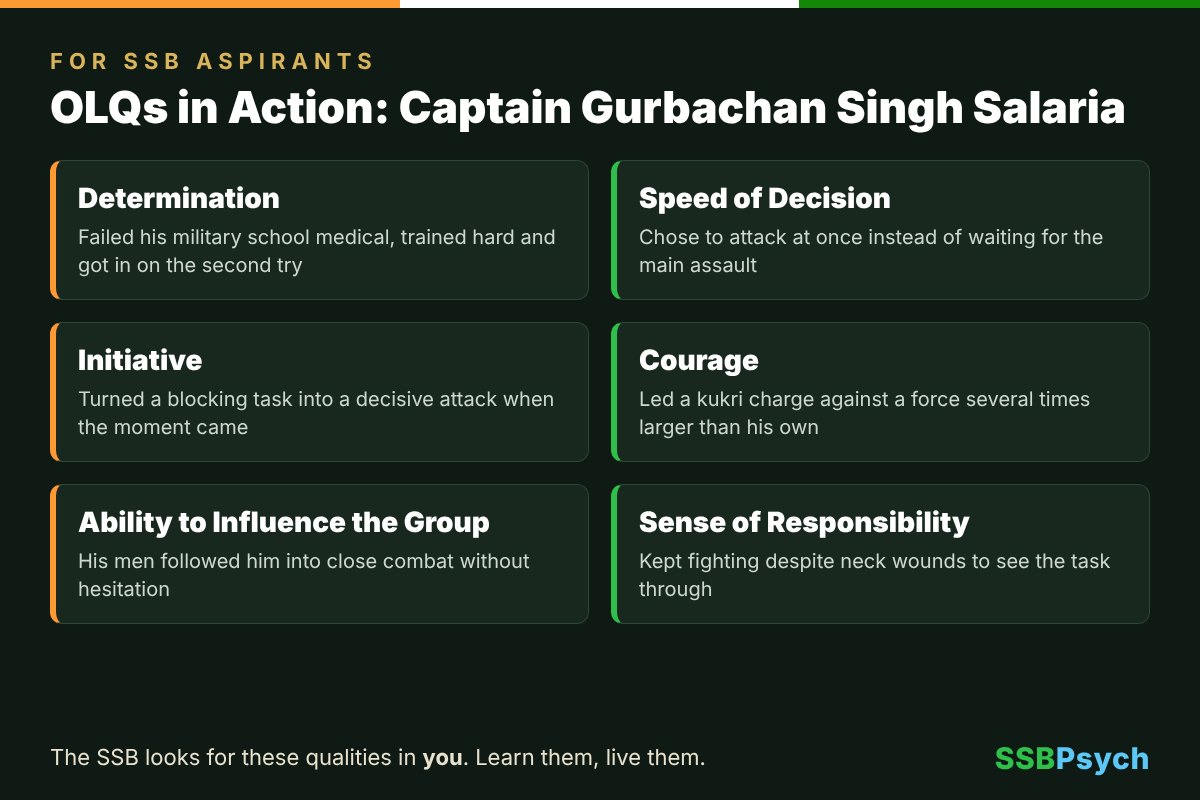
- Determination – Failed his military school medical, trained hard and got in on the second try
- Speed of Decision – Chose to attack at once instead of waiting for the main assault
- Initiative – Turned a blocking task into a decisive attack when the moment came
- Courage – Led a kukri charge against a force several times larger than his own
- Ability to Influence the Group – His men followed him into close combat without hesitation
- Sense of Responsibility – Kept fighting despite neck wounds to see the task through
Tip for your SSB interview: If the interviewing officer asks about India’s role in UN peacekeeping, mention Captain Salaria and the Congo mission, but also show you understand why India contributes troops to the UN. Linking a hero to the bigger picture shows Effective Intelligence, not just memory.
Practice Corner: WAT and SRT
Write your first spontaneous response to these before you scroll to the quiz. Keep WAT sentences short, positive and action-oriented.
WAT Words
- Kukri
- Peace
- Charge
- Duty
- Rejection
SRTs
- He is leading a small team to block an enemy’s escape route when they come under unexpected heavy fire from the flank. He…
- He fails a medical test for a course he has dreamt about because of a fitness issue. He…
- He is posted abroad on a peacekeeping mission and the local situation suddenly turns violent. He…
Quiz: How Well Do You Know Captain Gurbachan Singh Salaria?
Test yourself! Click an option to see if you are right. Your score updates live.
Frequently Asked Questions
Who is the only UN peacekeeper to receive the Param Vir Chakra?
Captain Gurbachan Singh Salaria of 3/1 Gorkha Rifles, for his action in the Congo on 5 December 1961.
Why was India’s army in the Congo in 1961?
India contributed the 99th Infantry Brigade to the United Nations Operation in the Congo (ONUC), which was trying to restore order and end Katanga’s breakaway.
What did Captain Salaria do to earn the PVC?
After his team destroyed two enemy armoured cars, he led a kukri and bayonet charge against a much larger force, killing 40 of them, and kept fighting until he died of his wounds.
Is there an island named after Captain Salaria?
Yes. In January 2023 one of 21 Andaman and Nicobar islands named after PVC recipients was named Salaria Island.
Was Captain Salaria an NDA cadet?
Yes. He graduated from the Joint Services Wing (the forerunner of the NDA) in 1956 and is the first NDA alumnus to win the Param Vir Chakra.
The Param Vir Chakra Series on SSBPsych
This is part 6 of 21 in our series on every Param Vir Chakra awardee. A new hero goes live every morning at 7:30 AM. Also read the story of Captain Vikram Batra, PVC – the Sher Shah of Kargil.
Sources: en.wikipedia.org, www.bharat-rakshak.com, honourpoint.in, thehitavada.com.
Preparing for your SSB? Join SSBPsych’s online and offline SSB batches and learn how to show your OLQs with confidence – explore our courses or call +91 8076540582.