
MiG-21 in Indian Air Force: History, Specs, Wars and Retirement
Imagine a fighter jet that joined the Indian Air Force when your grandparents were young and kept flying until 2025. That is the MiG-21. For 62 years this slim, dart-shaped jet guarded Indian skies, saw action in several conflicts, trained thousands of pilots and became a legend. On 26 September 2025, it flew its last flypast over Chandigarh, the same city where its Indian story began in 1963.
In this guide you will learn why India bought the MiG-21, how it changed the IAF forever, how fast and high it could fly (explained in plain words), what weapons it carried, the famous missions it flew, why it was called both a hero and a worry, and what replaced it. At the end there is a quick quiz and an FAQ to help you revise for NDA, CDS, AFCAT and SSB interviews.

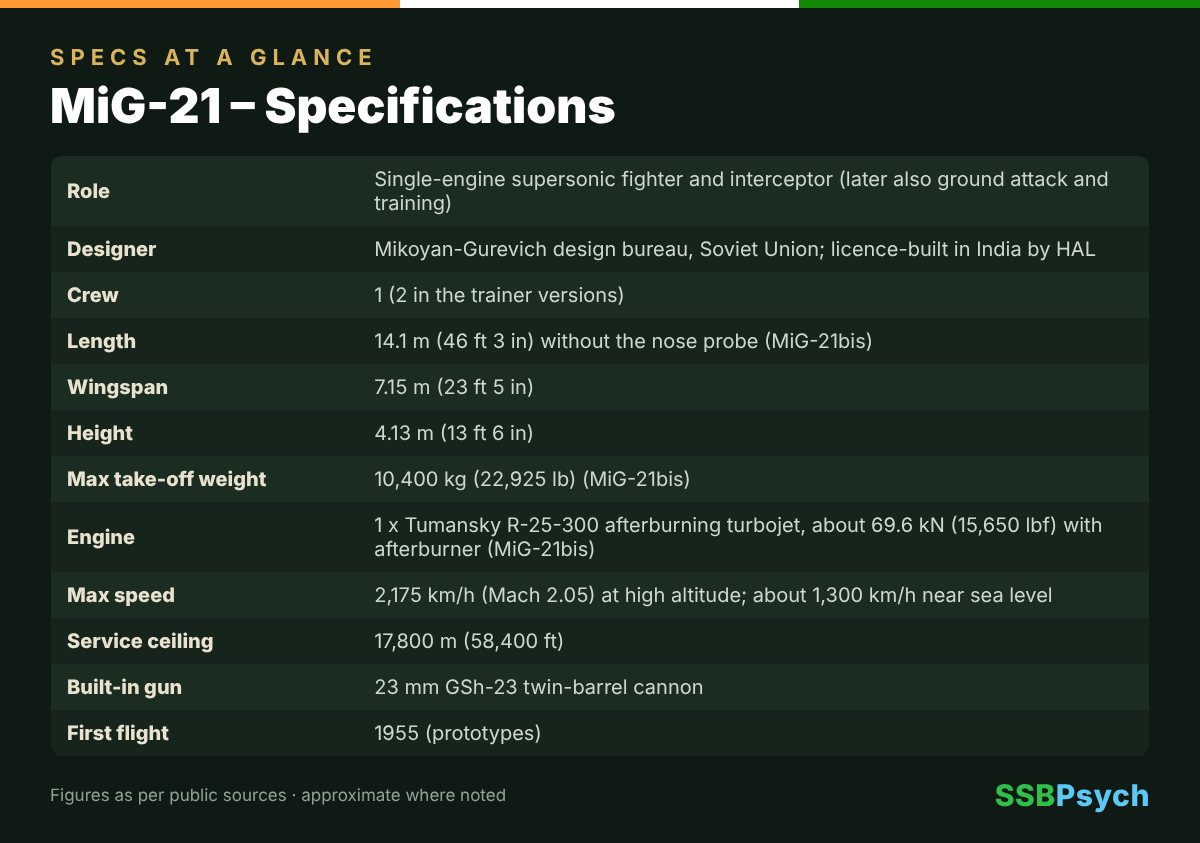
MiG-21 Specifications
| Role | Single-engine supersonic fighter and interceptor (later also ground attack and training) |
| Designer | Mikoyan-Gurevich design bureau, Soviet Union; licence-built in India by HAL |
| Crew | 1 (2 in the trainer versions) |
| Length | 14.1 m (46 ft 3 in) without the nose probe (MiG-21bis) |
| Wingspan | 7.15 m (23 ft 5 in) |
| Height | 4.13 m (13 ft 6 in) |
| Max take-off weight | 10,400 kg (22,925 lb) (MiG-21bis) |
| Engine | 1 x Tumansky R-25-300 afterburning turbojet, about 69.6 kN (15,650 lbf) with afterburner (MiG-21bis) |
| Max speed | 2,175 km/h (Mach 2.05) at high altitude; about 1,300 km/h near sea level |
| Service ceiling | 17,800 m (58,400 ft) |
| Built-in gun | 23 mm GSh-23 twin-barrel cannon |
| First flight | 1955 (prototypes) |
| Inducted in IAF | 1963 (No. 28 Squadron, Chandigarh) |
| Retired from IAF | 26 September 2025, Chandigarh |
| Number in IAF | 874 inducted over the years, nearly 600 of them built in India by HAL |
| Last version flown | MiG-21 Bison (upgraded MiG-21bis) |
Why India Needed the MiG-21
In the early 1960s, India’s fighter fleet was made up of subsonic jets, which means they flew slower than the speed of sound. Neighbouring air forces were getting faster aircraft, and after the 1962 war with China, India knew it needed a jet that could climb quickly and catch intruders. The answer came from the Soviet Union in the form of the MiG-21, a light, simple and very fast interceptor.
The deal was special for another reason. India did not just buy the jets; it also got the right to build them at home. Hindustan Aeronautics Limited (HAL) went on to build nearly 600 of the 874 MiG-21s that the IAF inducted. This gave Indian engineers and workers huge experience in making modern combat aircraft, which later helped projects like the Tejas.
History of the MiG-21 in the IAF
The first MiG-21s reached India in 1963 and went to No. 28 Squadron at Chandigarh. The squadron proudly took the name First Supersonics, because it was the first Indian unit to fly a jet faster than sound. It started with just six aircraft. Over the next two decades, many more versions arrived: the FL, the M, the MF and finally the MiG-21bis, along with two-seat trainers used to teach young pilots.
At its peak, the MiG-21 made up the largest part of India’s fighter force. Squadron after squadron flew it from bases across the country, from the deserts of Rajasthan to the valleys of Kashmir and the north-east. For many decades, a very large share of Indian fighter pilots flew the MiG-21 at some stage of their careers.
In the late 1990s, India decided to modernise its best MiG-21bis jets instead of retiring them. A 1996 contract started the upgrade of 125 aircraft. The improved version was named the MiG-21 Bison. It got a new multi-mode radar, a modern glass cockpit, a radar warning receiver, a helmet-mounted sight and the ability to fire newer missiles like the R-73 and R-77. The Bison kept the old airframe flying in a far more dangerous form.
Squadrons slowly gave up their MiG-21s as newer jets arrived. The last unit to fly the type was No. 23 Squadron, the Panthers. At the farewell on 26 September 2025, the Chief of the Air Staff himself led the final sortie, and six MiG-21s flew a last flypast while over 2,000 veterans and their families watched. It was the end of an era that had lasted 62 years.
Engine and Performance Explained Simply
The MiG-21bis used a single Tumansky R-25-300 turbojet engine. A turbojet sucks in air, squeezes it, mixes it with fuel and burns it to push hot gas out of the back. The engine also had an afterburner, which sprays extra fuel into the exhaust for a big burst of thrust. Think of it like the boost button in a racing video game: very powerful, but it drinks fuel very fast.
Top speed was about 2,175 km/h at high altitude, which is a little over twice the speed of sound, or Mach 2.05. Mach 1 simply means the speed of sound, and Mach 2 means double that. To compare, India’s Vande Bharat express is designed for about 180 km/h, so a MiG-21 at full speed was roughly twelve times faster. Near the ground, where the air is thicker, it was slower, at around 1,300 km/h.
Its service ceiling was about 17,800 m. Service ceiling means the highest height at which the jet can still climb usefully. That is about twice as high as Mount Everest and almost double the height at which passenger airliners normally cruise. The MiG-21 was also famous for climbing very quickly, which is exactly what an interceptor needs when enemy aircraft are spotted on radar.
The jet was small. Without its nose probe, the MiG-21bis was about 14 m long, roughly the length of three family cars parked in a row, and its delta wing spanned only about 7 m. That small size made it hard to spot in the air, but it also meant there was little room for fuel. Short range and short endurance were the price paid for its speed, which is why pilots often carried external drop tanks.
Weapons and Missiles
- 23 mm GSh-23 twin-barrel cannon
- R-60 short-range air-to-air missile
- R-73 short-range air-to-air missile (MiG-21 Bison, aimed with a helmet-mounted sight)
- R-77 beyond-visual-range air-to-air missile (MiG-21 Bison)
- Unguided rockets for ground attack
- Free-fall bombs
- Drop tanks for extra fuel
Weapons changed as the MiG-21 grew older. Early versions relied on a cannon and simple heat-seeking missiles. The Bison could fire the R-73, a very agile short-range missile that the pilot could aim simply by turning his head, thanks to the helmet-mounted sight. With its new radar, it could also use the R-77, a missile that can hit targets beyond visual range, meaning targets too far away to see with the eye.
MiG-21 Missions and Operations
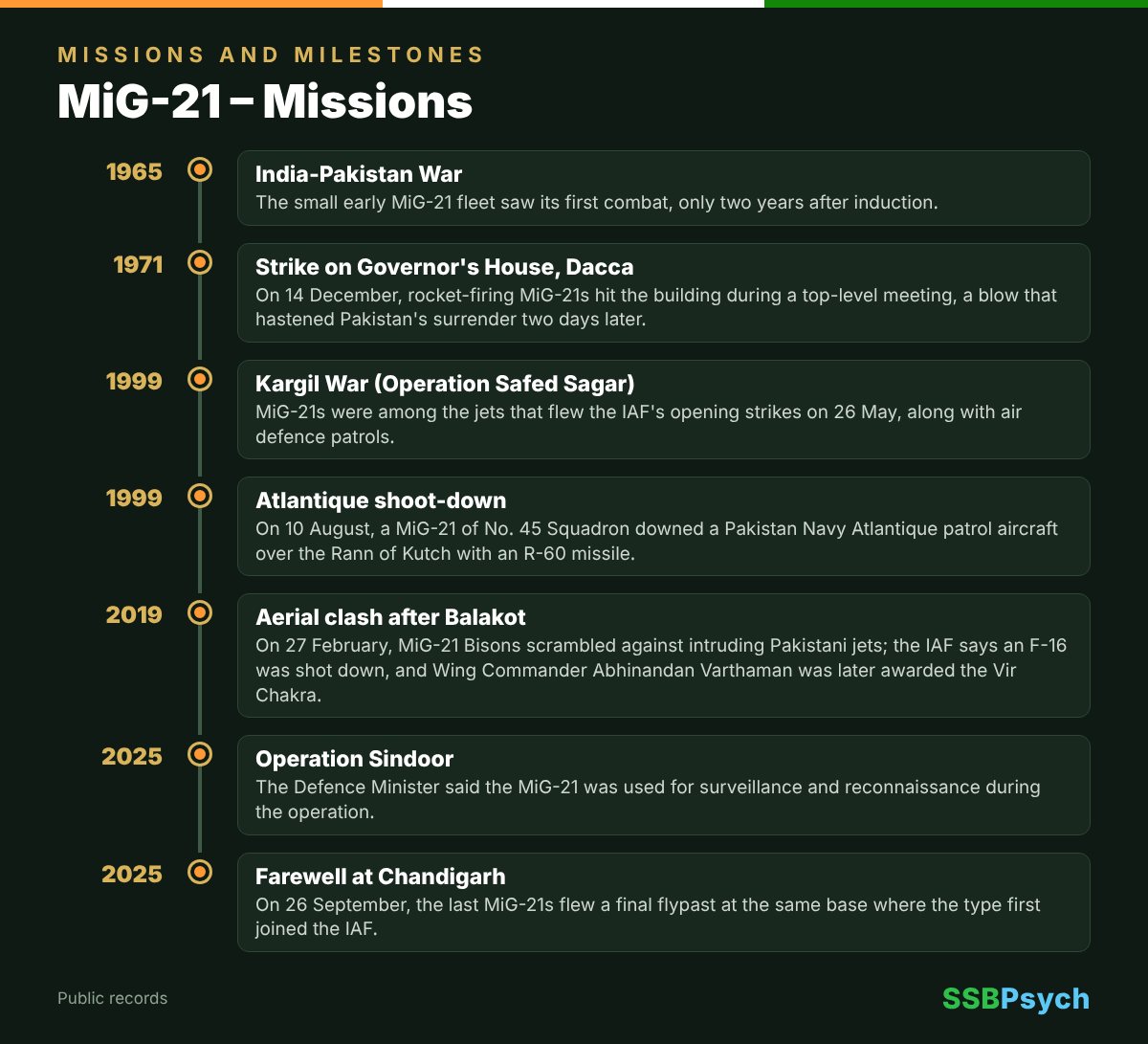
- 1965 – India-Pakistan War: The small early MiG-21 fleet saw its first combat, only two years after induction.
- 1971 – Strike on Governor’s House, Dacca: On 14 December, rocket-firing MiG-21s hit the building during a top-level meeting, a blow that hastened Pakistan’s surrender two days later.
- 1999 – Kargil War (Operation Safed Sagar): MiG-21s were among the jets that flew the IAF’s opening strikes on 26 May, along with air defence patrols.
- 1999 – Atlantique shoot-down: On 10 August, a MiG-21 of No. 45 Squadron downed a Pakistan Navy Atlantique patrol aircraft over the Rann of Kutch with an R-60 missile.
- 2019 – Aerial clash after Balakot: On 27 February, MiG-21 Bisons scrambled against intruding Pakistani jets; the IAF says an F-16 was shot down, and Wing Commander Abhinandan Varthaman was later awarded the Vir Chakra.
- 2025 – Operation Sindoor: The Defence Minister said the MiG-21 was used for surveillance and reconnaissance during the operation.
- 2025 – Farewell at Chandigarh: On 26 September, the last MiG-21s flew a final flypast at the same base where the type first joined the IAF.

The MiG-21 in Combat: Stories Every Aspirant Should Know
The most famous MiG-21 mission came on 14 December 1971. Indian intelligence learned that senior officials were meeting at the Governor’s House in Dacca (now Dhaka). MiG-21s flying from Guwahati fired rockets into the building with great accuracy, and the roof of the main hall came down. The Governor resigned soon after, and two days later Pakistani forces in the east surrendered. Bangladesh was born, and the MiG-21 had played a direct role.
In the 1999 Kargil War, MiG-21s were part of the very first IAF strikes on 26 May, attacking enemy positions in the high mountains. They flew ground-attack, reconnaissance and air defence missions. Weeks after the war, on 10 August 1999, a MiG-21 shot down a Pakistan Navy Atlantique patrol aircraft over the Rann of Kutch in Gujarat.
Then, on 27 February 2019, a day after the Balakot air strike, Pakistani jets came close to the Line of Control. MiG-21 Bisons scrambled to meet them. Wing Commander Abhinandan Varthaman fired an R-73 missile, and the IAF says a Pakistani F-16 was shot down. His own jet was hit, and he ejected and was captured, before being returned to India. He was later awarded the Vir Chakra.
Where It Was Based and Who Flew It
Over six decades, MiG-21 squadrons were spread across almost every corner of India. Publicly reported examples include Chandigarh, where the first and last squadrons were based, Srinagar, home of No. 51 Squadron at the time of the 2019 clash, and Nal near Bikaner in Rajasthan, where the final operational flights took place a month before the farewell ceremony.
An IAF fighter squadron is usually commanded by a Wing Commander. Under him or her are Squadron Leaders who lead flights, and younger Flight Lieutenants and Flying Officers who fly as wingmen. An air force station is normally commanded by a Group Captain or an Air Commodore.
To fly a fighter like this, a cadet first trains at the Air Force Academy at Dundigal, starting on basic trainer aircraft and moving to intermediate and advanced jet trainers like the Hawk. This takes about two to three years after joining the academy, followed by conversion training on the frontline type in a squadron. In the MiG-21 era, many pilots began their fighter careers on two-seat MiG-21 trainers, which is why the jet is remembered as a teacher of generations.
Strengths and Limitations of the MiG-21
- Very fast for its time, reaching about twice the speed of sound
- Excellent rate of climb, ideal for catching intruders quickly
- Small and hard to spot in the air
- Simple and cheap to build, and built in India in large numbers
- Upgraded Bison version could use modern missiles and a helmet-mounted sight
- Short range and limited fuel, so long missions needed drop tanks
- Small weapon load compared with modern multi-role fighters
- Very high landing speed, which made take-offs and landings demanding
- A long accident record in its final decades, as the airframes grew very old
The accident record is the hardest part of the MiG-21 story. Over the decades, hundreds of crashes led the media to call it the Flying Coffin. At the farewell, the Defence Minister pointed out that the jets still flying were about 40 years old and that the older models of the 1960s and 1970s had already been retired. Many experts also note that the jet stayed in service far longer than planned because replacements were delayed.
Legacy of the MiG-21: Museums and What Replaced It
The MiG-21’s role is being taken over by the home-grown Tejas. No. 23 Squadron, the last MiG-21 unit, has been publicly reported as slated to receive the Tejas Mk1A. In a sense, the jet that taught HAL how to build fighters is being replaced by a fighter that HAL designed and built itself.
Retired MiG-21s will not be scrapped. The IAF has said it will give airframes, without engines, weapons or sensitive equipment, to museums, war memorials and educational institutions for display, under rules that require them to be maintained in proper colours. You can already see MiG-21s at the Indian Air Force Museum at Palam in Delhi and at the IAF Heritage Museum in Chandigarh.
Why the MiG-21 Matters for SSB and AFCAT Aspirants
Questions about the MiG-21 are common in defence exams and SSB interviews because it touches so many topics: the 1971 war, Kargil, Balakot, Indo-Russian defence ties, licence production by HAL, and the debate on modernising the IAF. If an interviewing officer asks about an aircraft you admire, the MiG-21 gives you a story full of courage, technology and lessons in planning for replacements.
Remember the key facts: inducted in 1963 with No. 28 Squadron at Chandigarh, 874 jets inducted, top speed about Mach 2, upgraded as the Bison, retired on 26 September 2025 with No. 23 Squadron, and replaced by the Tejas. Learn the Dacca and Balakot stories well, and you will be able to speak confidently.
Did You Know?
- The MiG-21 served the IAF for 62 years, longer than any other fighter in its history.
- The first MiG-21 unit, No. 28 Squadron, is nicknamed the First Supersonics.
- Its farewell was officially called the MiG-21 Operational Flying Culmination Ceremony.
- Because of its triangular wing shape, the MiG-21 is nicknamed Balalaika, after a Russian stringed instrument.
- NATO gave the MiG-21 the reporting name Fishbed.
- Worldwide, more than 11,000 MiG-21s were built, making it one of the most produced supersonic jets ever.
- The last operational MiG-21 flights took place at Nal, near Bikaner in Rajasthan, a month before the farewell ceremony.
Quiz: Test Your Knowledge of MiG-21
Click an option to see if you are right. Your score updates live.
MiG-21: Frequently Asked Questions
The MiG-21 was formally retired on 26 September 2025 at Chandigarh Air Force Station, after 62 years of service. The last unit to fly it was No. 23 Squadron, the Panthers.
The MiG-21bis could reach about 2,175 km/h at high altitude, a little over twice the speed of sound (Mach 2.05). Near sea level it was limited to around 1,300 km/h.
The IAF inducted 874 MiG-21s of different versions over the years. Nearly 600 of them were built in India by HAL.
The media used the nickname because of the many crashes over the decades. The jets flying in recent years were very old, and the type stayed in service longer than planned because replacements were delayed.
The indigenous HAL Tejas is replacing the MiG-21, and No. 23 Squadron has been reported as slated to receive the Tejas Mk1A.
This is part 6 of 50 in SSBPsych’s Indian Air Force aircraft series – a new aircraft every evening at 6 PM.
Sources: deccanherald.com, deccanherald.com, onmanorama.com, tribuneindia.com, tribuneindia.com.
Preparing for NDA, CDS, AFCAT or your SSB? Join SSBPsych’s online and offline batches – explore our courses or call +91 8076540582.