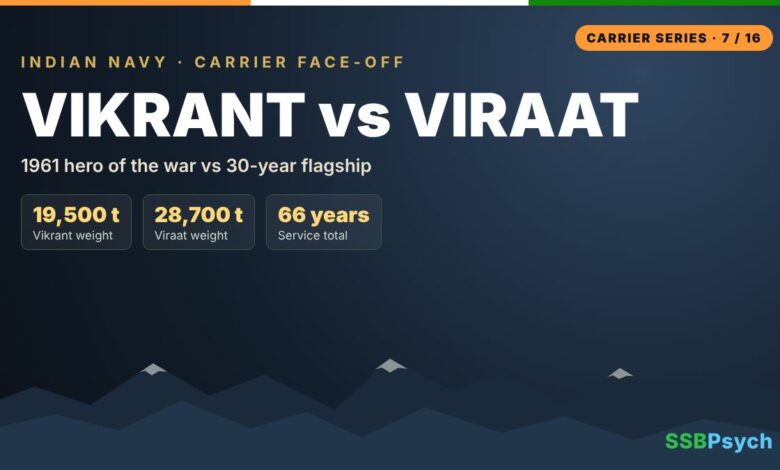
INS Vikrant vs INS Viraat: India’s Two Veteran Carriers Compared
Imagine two old warriors sitting side by side in a museum of the sea. One fought a real war and helped give birth to a new nation. The other guarded India’s waters for three full decades and earned the title of the oldest serving aircraft carrier in the world. That is the story of INS Vikrant vs INS Viraat, the two British-built carriers that taught the Indian Navy how to fly from the sea.
In this guide we put INS Vikrant (1961) and INS Viraat side by side. You will see a simple comparison table, then we explain every difference in plain words: size, weight, speed, crew, aircraft, launch method, wars and fate. Finally we tell you what India learned from these two ships, and give our fun verdict. Perfect reading for NDA, CDS, AFCAT and SSB aspirants who want strong defence general knowledge.

INS Vikrant vs INS Viraat: Quick Comparison Table
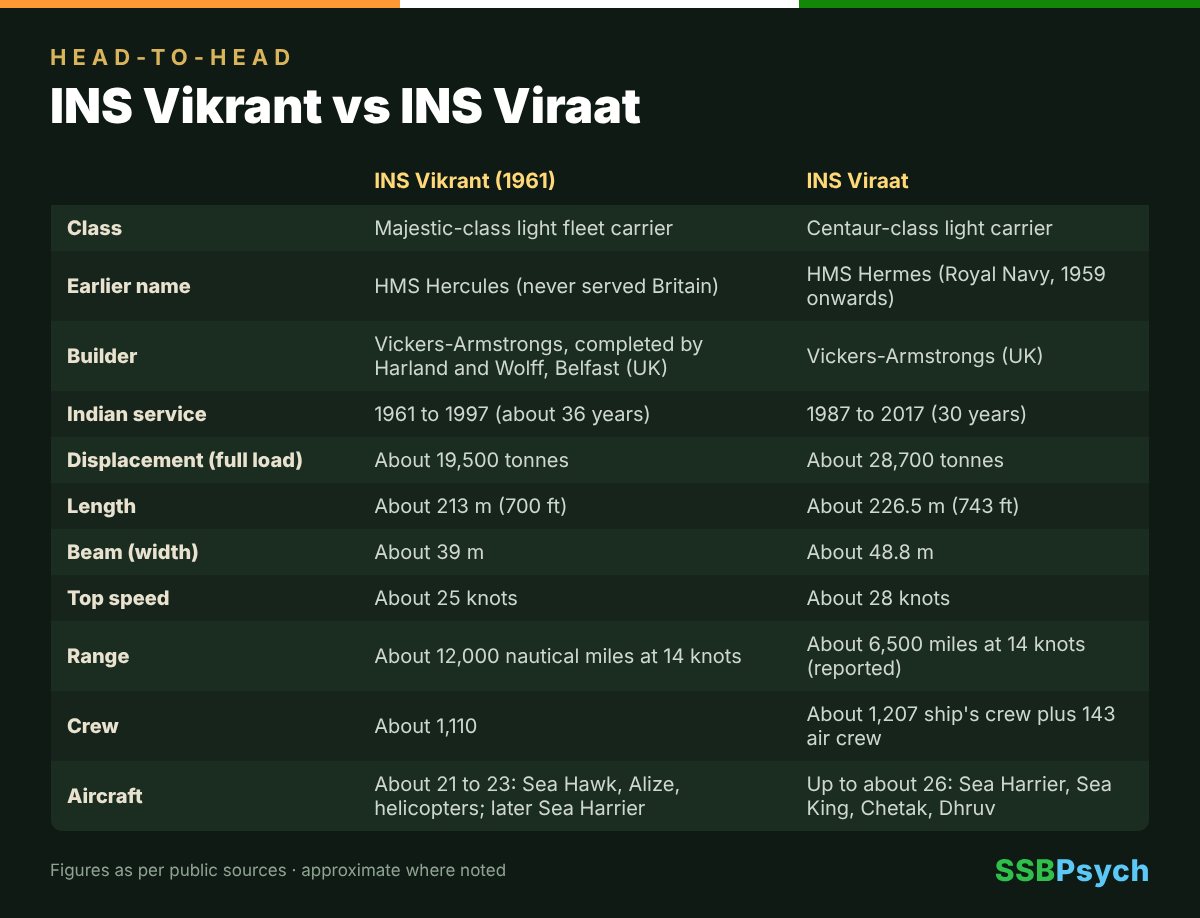
Here are the key numbers at a glance. Figures are rounded and taken from public sources. Where sources disagree we have used ‘about’.
INS Vikrant vs INS Viraat: Side-by-Side Comparison
| INS Vikrant (1961) | INS Viraat | |
|---|---|---|
| Class | Majestic-class light fleet carrier | Centaur-class light carrier |
| Earlier name | HMS Hercules (never served Britain) | HMS Hermes (Royal Navy, 1959 onwards) |
| Builder | Vickers-Armstrongs, completed by Harland and Wolff, Belfast (UK) | Vickers-Armstrongs (UK) |
| Indian service | 1961 to 1997 (about 36 years) | 1987 to 2017 (30 years) |
| Displacement (full load) | About 19,500 tonnes | About 28,700 tonnes |
| Length | About 213 m (700 ft) | About 226.5 m (743 ft) |
| Beam (width) | About 39 m | About 48.8 m |
| Top speed | About 25 knots | About 28 knots |
| Range | About 12,000 nautical miles at 14 knots | About 6,500 miles at 14 knots (reported) |
| Crew | About 1,110 | About 1,207 ship’s crew plus 143 air crew |
| Aircraft | About 21 to 23: Sea Hawk, Alize, helicopters; later Sea Harrier | Up to about 26: Sea Harrier, Sea King, Chetak, Dhruv |
| Launch method | Steam catapult; 9.75 degree ski-jump added in 1987-89 refit | 12 degree ski-jump for Sea Harrier jump jets |
| Propulsion | Steam turbines, two shafts | Steam turbines, two shafts |
| Big operations | 1971 war (East Pakistan blockade and strikes) | Op Jupiter 1989, Op Vijay 1999, Op Parakram 2001-02 |
| Scrap sale (reported) | About Rs 60 crore (2014) | About Rs 38.5 crore (2020) |
| Fate | Museum in Mumbai 2001 to 2012; scrapped from 2014 | Scrapped at Alang from 2020 |
Meet the Two Ships
INS Vikrant (1961): The Pioneer
INS Vikrant started life in Britain as HMS Hercules, a Majestic-class light carrier laid down in 1943 during World War II. When the war ended, Britain no longer needed her and she sat unfinished for years. India bought the half-built ship in 1957 and had her completed at Harland and Wolff in Belfast with newer equipment. She was commissioned on 4 March 1961 and became India’s first aircraft carrier. Her name means ‘courageous’ or ‘bold’, and she lived up to it.
INS Viraat: The Long-Serving Flagship
INS Viraat was born as HMS Hermes, a Centaur-class carrier laid down in 1944 and launched in 1953. She served the Royal Navy for over two decades and was the flagship of the British fleet in the 1982 Falklands War. India bought her in the 1980s, and she was commissioned as INS Viraat on 12 May 1987. Viraat means ‘giant’, and she remained India’s flagship until INS Vikramaditya arrived in 2013. She finally retired on 6 March 2017.
Size and Weight: The Little Brother and the Big Brother
Warships are measured by displacement, which simply means the weight of water the ship pushes aside when it floats. Think of a bucket of water: drop a heavy toy boat in and water spills over. The heavier the boat, the more water it pushes away. That pushed-away weight equals the ship’s own weight.
Fully loaded, Vikrant weighed about 19,500 tonnes. Viraat weighed about 28,700 tonnes, roughly half as much again. If one family car weighs about one tonne, Vikrant equalled nearly 20,000 cars and Viraat nearly 29,000 cars.
Length tells a similar story. Vikrant was about 213 metres long, close to two football fields placed end to end. Viraat was about 226 metres long and much wider, around 49 metres at her widest point compared with about 39 metres for Vikrant. A wider ship has a bigger flight deck and a bigger hangar below it, which means more room to park, repair and launch aircraft.
Winner on size: Viraat, clearly. More weight and more width gave her more fuel, more stores and a steadier deck in rough seas.
Speed and Range: Who Could Go Faster and Farther?
Ship speed is measured in knots. One knot is one nautical mile per hour, which is about 1.85 km per hour. Vikrant could reach about 25 knots (around 46 km per hour) when she was healthy. Viraat could reach about 28 knots (around 52 km per hour). Both used steam turbines, where boilers heat water into high-pressure steam that spins the propeller shafts, just like a giant pressure cooker pushing a fan.
Speed matters for a carrier because jets take off more easily when the ship races into the wind. The extra wind over the deck acts like a free boost. Viraat’s higher speed gave her Sea Harriers a little more help.
Range is different. Public sources list Vikrant’s range as about 12,000 nautical miles at a cruising speed of 14 knots, while Viraat’s listed figure is about 6,500 miles at 14 knots. On paper the older ship could go farther between refuelling stops. In real life, range also depends on age, boiler health and how the fuel is used, so treat these numbers as design figures rather than exact daily performance.
Vikrant had a famous weakness: boiler trouble. In 1971 one of her boilers had a crack, so she sailed to war with her speed restricted. Her crew still made it work, which is a lesson in itself.
Crew: Small Floating Towns
Vikrant carried about 1,110 people. Viraat’s listed complement was about 1,207 ship’s crew plus 143 air crew, so roughly 1,350 in normal service. Either way, both ships were like small towns at sea, with kitchens, a hospital bay, workshops, stores and sleeping spaces for over a thousand sailors. A carrier is commanded by a Captain-rank officer of the Indian Navy, supported by department heads for engineering, aviation, weapons, navigation and logistics.
Aircraft and Launch Method: Catapult vs Ski-Jump
This is the most interesting difference in the INS Vikrant vs INS Viraat story.
In her early years Vikrant used a steam catapult. Picture a giant slingshot built into the deck: steam pressure flings a jet from standstill to flying speed in a couple of seconds. Landing jets were stopped by arrester wires, strong cables that a hook on the aircraft catches. With this setup Vikrant flew Sea Hawk fighter-bombers and French-built Alize anti-submarine aircraft, plus helicopters.
Viraat was built around the British Sea Harrier, a jump jet that can take off in a short distance and land vertically like a helicopter. To help it get airborne with more fuel and weapons, Viraat had a ski-jump: a curved ramp at the front of the deck, tilted at about 12 degrees. Think of a cricket ball rolled up a ramp; it leaves the end moving upward, which gives the jet precious extra seconds to build speed. This style is called STOVL, short take-off and vertical landing.
Interestingly, Vikrant changed during her life. In the 1987 to 1989 refit, her catapult was removed and a 9.75 degree ski-jump was added so she too could operate Sea Harriers. So by the end, both ships flew the same jets in the same way.
Viraat could carry up to about 26 aircraft, including Sea Harriers, Sea King anti-submarine helicopters, Chetak helicopters and later Dhruv helicopters. Vikrant carried about 21 to 23 aircraft. Winner: Viraat for numbers and jet technology, Vikrant for flexibility because she operated both catapult planes and later jump jets.
INS Vikrant vs INS Viraat Timeline
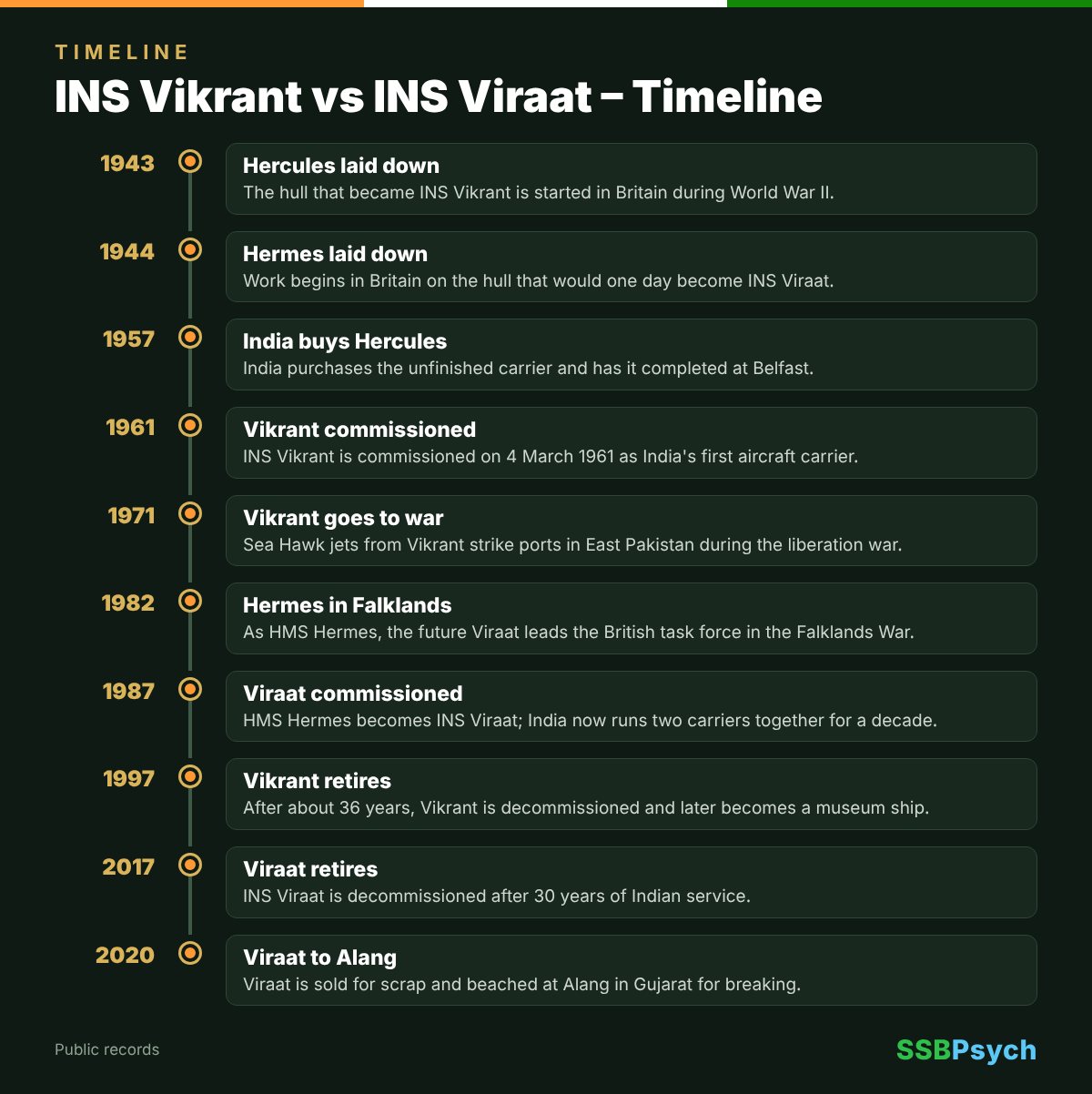
- 1943 – Hercules laid down: The hull that became INS Vikrant is started in Britain during World War II.
- 1944 – Hermes laid down: Work begins in Britain on the hull that would one day become INS Viraat.
- 1957 – India buys Hercules: India purchases the unfinished carrier and has it completed at Belfast.
- 1961 – Vikrant commissioned: INS Vikrant is commissioned on 4 March 1961 as India’s first aircraft carrier.
- 1971 – Vikrant goes to war: Sea Hawk jets from Vikrant strike ports in East Pakistan during the liberation war.
- 1982 – Hermes in Falklands: As HMS Hermes, the future Viraat leads the British task force in the Falklands War.
- 1987 – Viraat commissioned: HMS Hermes becomes INS Viraat; India now runs two carriers together for a decade.
- 1997 – Vikrant retires: After about 36 years, Vikrant is decommissioned and later becomes a museum ship.
- 2017 – Viraat retires: INS Viraat is decommissioned after 30 years of Indian service.
- 2020 – Viraat to Alang: Viraat is sold for scrap and beached at Alang in Gujarat for breaking.
Aircraft, Weapons and Sensors
- Hawker Sea Hawk fighter-bombers (Vikrant, 1961 to 1980s)
- Breguet Alize anti-submarine and patrol aircraft (Vikrant)
- BAe Sea Harrier FRS51 jump jets (Vikrant later; Viraat’s main strike jet)
- Westland Sea King anti-submarine helicopters (both carriers)
- Chetak (Alouette III) utility and rescue helicopters (both)
- HAL Dhruv helicopters (Viraat, later years)
- Steam catapult and arrester wires (Vikrant, early years)
- Ski-jump ramps: 9.75 degrees on Vikrant, 12 degrees on Viraat
Wars and Operations: Battle Hero vs Long Guardian
Vikrant’s finest hour came in December 1971. Operating in the Bay of Bengal with the Eastern Fleet, her Sea Hawks struck ports and shipping at Chittagong, Cox’s Bazar, Khulna and Mongla. Along with other ships she enforced a blockade so that East Pakistan could not be supplied by sea. This played an important part in the war that created Bangladesh. Her crew received two Maha Vir Chakras and twelve Vir Chakras.
Viraat never fought a full sea battle under the Indian flag, but she was always ready. She supported the Indian Peace Keeping Force off Sri Lanka in Operation Jupiter in 1989, joined the build-up in the Arabian Sea during the Kargil conflict (Operation Vijay, 1999), and deployed during Operation Parakram in 2001-02. Under her old British name she had already seen real combat as the flagship in the Falklands War of 1982.
Operations and Missions
- 1971 – Bangladesh Liberation War: Vikrant’s Sea Hawks hit Chittagong, Cox’s Bazar, Khulna and Mongla and helped blockade East Pakistan.
- 1982 – Falklands War (as HMS Hermes): Before joining India, Viraat served as flagship of the British task force.
- 1989 – Operation Jupiter: Viraat supported Indian Peace Keeping Force operations off Sri Lanka.
- 1999 – Operation Vijay (Kargil): Viraat was part of the naval build-up in the Arabian Sea during the Kargil conflict.
- 2001-02 – Operation Parakram: Viraat deployed during the long India-Pakistan military standoff.
- 2009 – Gulf of Aden deployment: Viraat sailed to the Gulf of Aden area as piracy threats grew.

Which Was Better at What, and Why?
- Combat record: Vikrant. She actually went to war and helped win it. Nothing beats a proven record.
- Size and aircraft numbers: Viraat. Heavier, wider and able to carry more aircraft.
- Speed: Viraat, at about 28 knots against Vikrant’s about 25 knots.
- Listed range: Vikrant, at least on paper.
- Jet technology: Viraat, designed to operate the Sea Harrier from a ski-jump.
- Total service life: Viraat. Counting her Royal Navy years her career ran from 1959 to 2017, a span of nearly 58 years, which made her the oldest serving carrier in the world in her final years.
What India Learned From INS Vikrant and INS Viraat
These two second-hand carriers were India’s training school for naval aviation. From Vikrant, the Navy learned how to fly jets from a moving deck, how to protect a carrier with escort ships, and how air power at sea can decide a war. From Viraat, India mastered jump-jet operations, ski-jump launches and the long, patient work of keeping an old ship alive through many refits.
They also taught a harder lesson: depending on old foreign ships means spares get costly, boilers get tired and refits take longer each time. That pushed India towards a bigger carrier from Russia (INS Vikramaditya) and finally towards building its own, the new INS Vikrant commissioned in 2022. In a way, every pilot and engineer on today’s carriers stands on the shoulders of these two veterans.
The two ships also served together from 1987 to 1997. During that decade India operated two carriers at the same time for the first time, gaining experience in running more than one carrier group.
End of the Road: Museum Dreams and Scrapyards
After retiring in 1997, Vikrant became a museum ship in Mumbai and opened to the public around 2001. By 2012 she was judged unsafe, and in 2014 she was sold at auction to a ship-breaker for about Rs 60 crore. In 2016 Bajaj launched a motorcycle called the V, made partly with metal from her scrap, so a piece of the old hero still rides on Indian roads.
Viraat faced a similar end. Plans to turn her into a museum did not succeed, and in 2020 she was sold for scrap for a reported Rs 38.5 crore and beached at Alang in Gujarat. A last-minute legal effort to save her reached the Supreme Court, but by then a large part of the ship had already been cut up.
The Fun Verdict: INS Vikrant vs INS Viraat
If these two were cricketers, Vikrant would be the young batsman who hit the match-winning century in a World Cup final and became a legend overnight. Viraat would be the steady captain who played for 30 seasons, never missed a match and quietly set records for longevity.
So who wins? For heroics, Vikrant takes the trophy. For size, speed, aircraft and staying power, Viraat wins on points. India needed both: the first to prove a carrier was worth having, the second to keep that capability alive until a home-built carrier could take over.
Did You Know?
- Vikrant was laid down in 1943 but joined the Indian Navy only in 1961, a wait of about 18 years.
- Viraat, as HMS Hermes, was the flagship of the British fleet in the 1982 Falklands War.
- Viraat was the oldest aircraft carrier in service anywhere in the world in her final years.
- Vikrant sailed into the 1971 war with a cracked boiler and restricted speed, yet still struck enemy ports.
- Both carriers ended up flying the same Sea Harrier jump jets from ski-jump ramps.
- Bajaj’s V motorcycle was made using metal from the scrapped Vikrant.
- The name Vikrant lives on in India’s first home-built carrier, commissioned in 2022.
Want to go deeper? Read our individual guides on each carrier in this series, and test yourself with the quiz below. Questions on India’s carriers often appear in SSB interviews and in GK sections of NDA and CDS papers, so knowing this story well can earn you easy marks.
Quiz: Test Your Knowledge of INS Vikrant vs INS Viraat
Click an option to see if you are right. Your score updates live.
INS Vikrant vs INS Viraat: Frequently Asked Questions
INS Viraat was bigger. She displaced about 28,700 tonnes at full load against about 19,500 tonnes for Vikrant, and she was longer and much wider.
Yes. Both served together from 1987, when Viraat was commissioned, until 1997, when Vikrant retired. It was India’s first spell of operating two carriers.
Under the Indian flag Viraat took part in operations such as Operation Jupiter, Operation Vijay and Operation Parakram, but did not fight a sea battle. As HMS Hermes she was the British flagship in the 1982 Falklands War.
She was India’s first aircraft carrier, and in the 1971 war her Sea Hawk jets struck East Pakistan ports and helped blockade the region, contributing to the birth of Bangladesh.
Vikrant was a museum ship in Mumbai until 2012 and was scrapped from 2014. Viraat was sold for scrap in 2020 and broken up at Alang in Gujarat.
This is part 7 of 16 in SSBPsych’s Indian Navy aircraft carrier series – a new post every day at 2 PM.
Sources: en.wikipedia.org, en.wikipedia.org, indiannavy.nic.in, bharat-rakshak.com.
Preparing for NDA, CDS, AFCAT or your SSB? Join SSBPsych’s online and offline batches – explore our courses or call +91 8076540582.