INS Chakra: India’s Leased Nuclear Attack Submarines
How do you learn to run a nuclear submarine if you have never had one? India’s answer was clever: borrow one. Twice, the Indian Navy leased a nuclear-powered attack submarine from Moscow and gave it the same proud name, INS Chakra. The first served from 1988 to 1991, and the second from 2012 to 2021. A third lease, often called Chakra III, has been signed but is still awaited.
In this guide you will learn what each INS Chakra was, how big and fast they were, what they were used for, why they went back, what life on board was like and why these leases matter so much for India’s own nuclear submarines. We use only publicly reported facts and clearly say when something is not known.

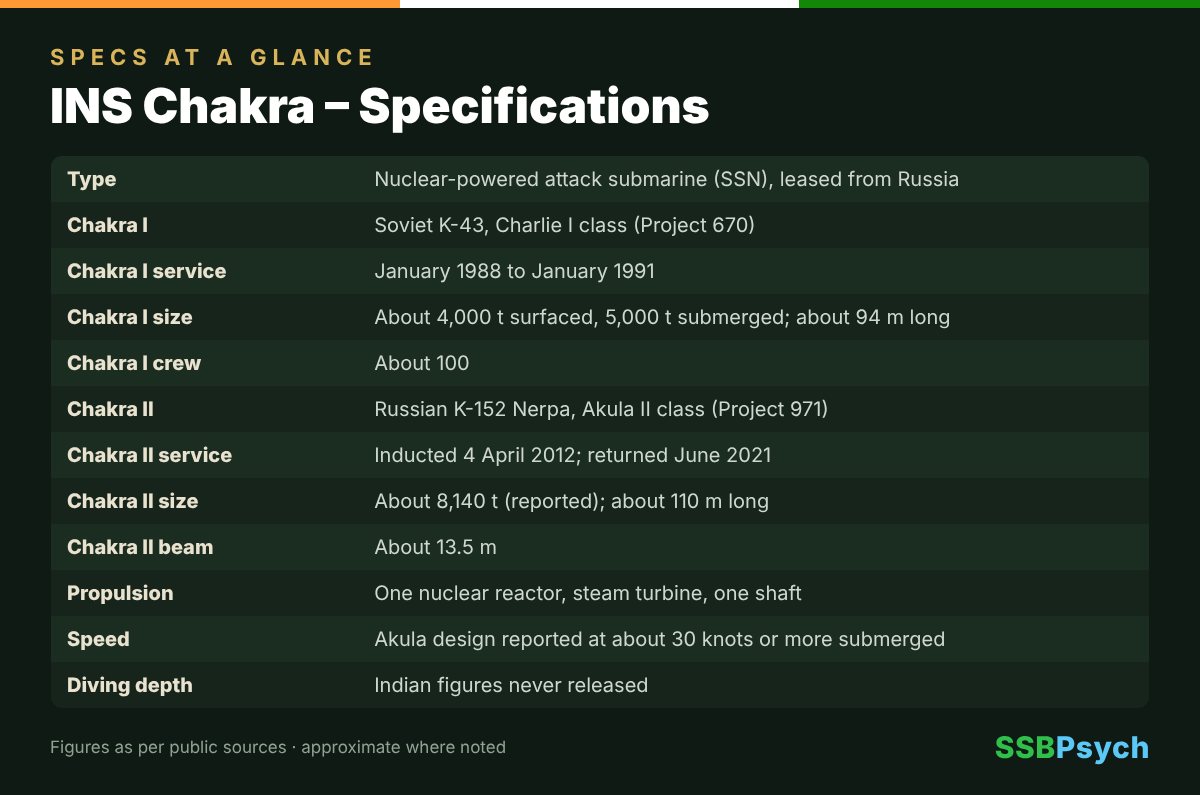
INS Chakra Specifications
| Type | Nuclear-powered attack submarine (SSN), leased from Russia |
| Chakra I | Soviet K-43, Charlie I class (Project 670) |
| Chakra I service | January 1988 to January 1991 |
| Chakra I size | About 4,000 t surfaced, 5,000 t submerged; about 94 m long |
| Chakra I crew | About 100 |
| Chakra II | Russian K-152 Nerpa, Akula II class (Project 971) |
| Chakra II service | Inducted 4 April 2012; returned June 2021 |
| Chakra II size | About 8,140 t (reported); about 110 m long |
| Chakra II beam | About 13.5 m |
| Propulsion | One nuclear reactor, steam turbine, one shaft |
| Speed | Akula design reported at about 30 knots or more submerged |
| Diving depth | Indian figures never released |
| Home port in India | Visakhapatnam (Eastern Naval Command) |
| Next lease | Chakra III: Akula-class deal of about US$3 billion signed March 2019 (reported) |
What Is a Nuclear Attack Submarine?
There are two main kinds of nuclear submarine. An SSBN, like INS Arihant, carries long-range ballistic missiles and hides to deter war. An SSN, or nuclear attack submarine, is a hunter. Its job is to track and, if needed, sink enemy submarines and warships, protect friendly fleets and gather information. Because a nuclear reactor gives almost endless power, an SSN can move fast underwater for long periods without ever coming up for air, something a diesel submarine cannot do.
Both versions of INS Chakra were SSNs. Neither carried India’s nuclear weapons. Their value was in giving the Navy real experience of operating a nuclear boat at sea.
INS Chakra I: The Charlie-Class Pioneer (1988 to 1991)
The first INS Chakra was a Soviet submarine named K-43, from the class NATO called Charlie I. It was commissioned into the Indian Navy on 5 January 1988 and arrived at Visakhapatnam on 3 February 1988. The boat weighed about 4,000 tonnes on the surface and about 5,000 tonnes underwater, and was about 94 metres long, roughly the length of a football pitch. It carried a crew of about 100.
Its main punch was a set of anti-ship cruise missiles that could be fired while submerged, plus torpedoes. For India, though, the bigger prize was knowledge. Indian officers and sailors learned how a nuclear plant behaves at sea, how to handle such a large submarine and how to maintain it in tropical waters.
The lease lasted about three years, and the boat was back in Vladivostok by January 1991. Accounts of that time mention technical problems in the hot, salty Indian Ocean and reports that Soviet specialists kept some sensitive compartments off-limits to Indian crews. These reasons are reported, not officially confirmed.
INS Chakra II: The Akula-Class Hunter (2012 to 2021)
Two decades later, India leased a far more modern boat: the Russian Akula II class submarine K-152 Nerpa. Akula is the Russian word for shark, and the class is known for being quiet and fast. Nerpa was handed over on 30 December 2011, commissioned in Russia in January 2012 and formally inducted into the Indian Navy at Visakhapatnam on 4 April 2012, for a ten-year lease.
This INS Chakra was huge by Indian standards. It is reported to have displaced about 8,140 tonnes and was about 110 metres long and 13.5 metres wide. That is longer than a football field and heavier than many destroyers. Its speed underwater was reported at about 30 knots or more for the Akula design, which is over 55 km/h, while its exact Indian performance figures were never published.
Before India took it over, Nerpa suffered a tragic accident during Russian trials in November 2008. A fire-suppression system wrongly released gas into crew areas, and at least 20 people died. The boat was repaired before the handover.
Why Did INS Chakra Go Back Early?
In June 2021, about a year before the lease was due to end, INS Chakra sailed back to Russia. Reports pointed to maintenance problems with its power plant and the cost of keeping an ageing boat running. In 2017 the submarine was also reported to have damaged its bow sonar dome, the curved front section that holds listening equipment, while entering harbour, with repairs reported at about Rs 125 crore.
INS Chakra Timeline
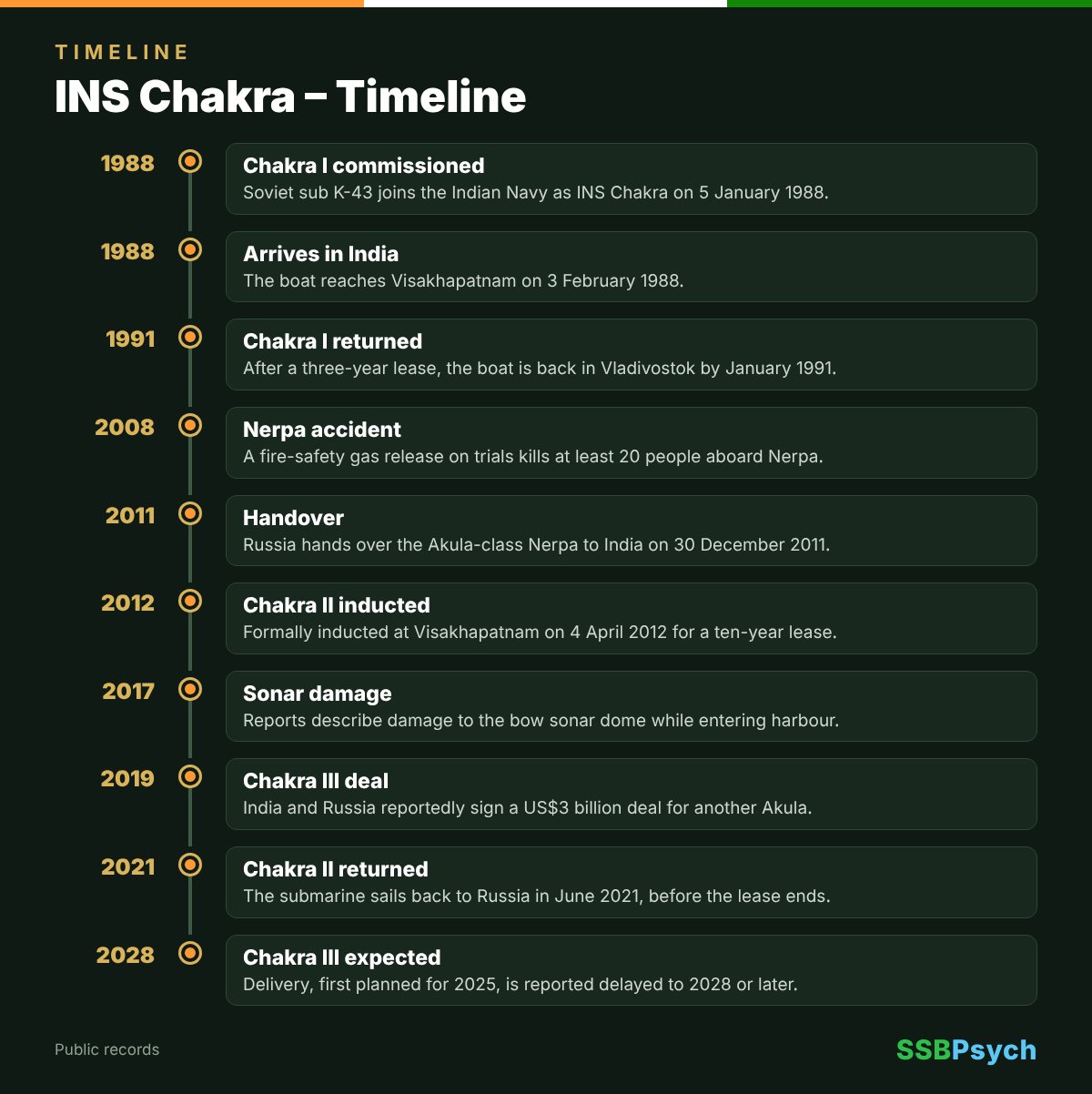
- 1988 – Chakra I commissioned: Soviet sub K-43 joins the Indian Navy as INS Chakra on 5 January 1988.
- 1988 – Arrives in India: The boat reaches Visakhapatnam on 3 February 1988.
- 1991 – Chakra I returned: After a three-year lease, the boat is back in Vladivostok by January 1991.
- 2008 – Nerpa accident: A fire-safety gas release on trials kills at least 20 people aboard Nerpa.
- 2011 – Handover: Russia hands over the Akula-class Nerpa to India on 30 December 2011.
- 2012 – Chakra II inducted: Formally inducted at Visakhapatnam on 4 April 2012 for a ten-year lease.
- 2017 – Sonar damage: Reports describe damage to the bow sonar dome while entering harbour.
- 2019 – Chakra III deal: India and Russia reportedly sign a US$3 billion deal for another Akula.
- 2021 – Chakra II returned: The submarine sails back to Russia in June 2021, before the lease ends.
- 2028 – Chakra III expected: Delivery, first planned for 2025, is reported delayed to 2028 or later.
Aircraft, Weapons and Sensors
- Chakra I: SS-N-7 anti-ship cruise missiles (up to eight)
- Chakra I: six 533 mm torpedo tubes
- Chakra II: 533 mm and 650 mm torpedo tubes of the Akula design
- Chakra II: heavyweight torpedoes and anti-ship weapons; long-range nuclear cruise missiles were not part of the lease (reported)
- Powerful bow and flank sonar arrays for hunting other submarines
Operations and Missions
- 1988 – Training India’s first nuclear crews: Chakra I gave Indian sailors their first hands-on nuclear submarine experience.
- 2012 – Training for the Arihant programme: Chakra II trained crews who later served on India’s own SSBNs.
- 2019 – Post-Balakot search: Reportedly deployed with INS Kalvari to look for a Pakistani submarine.

Duty, Role and Home Port of INS Chakra
Both INS Chakra boats were based at Visakhapatnam, home of the Eastern Naval Command. Their duties were to train crews, take part in exercises, practise hunting other submarines and protect the fleet. After the 2019 Balakot air strikes, media reports said INS Chakra and INS Kalvari were deployed to search for a Pakistani submarine, a sign that it was treated as a real fighting asset, not only a training boat.
Its most lasting role was as a school. Reports say around 300 Indian Navy personnel were trained in Russia for the second lease. Many of the skills learned on INS Chakra helped prepare crews for India’s home-built Arihant-class SSBNs.
Why Does India Lease Nuclear Submarines?
Building a nuclear submarine takes decades. Leasing bridges the gap. It lets the Navy train officers, engineers and sailors on real equipment, build up maintenance know-how and keep an SSN in the fleet while India’s own attack submarines are designed and built. It also gives the Navy a fast, long-range hunter that a diesel submarine cannot fully replace.
Crew, Command and Life on Board
A nuclear attack submarine is commanded by a senior officer, usually of Captain rank in the Indian Navy for a boat this size, assisted by specialist officers for the reactor, weapons, sensors and navigation. The Akula design is reported to need a crew of roughly 60 to 70, while the older Charlie needed about 100.
Life inside is cramped and busy. Sailors work in watches around the clock, sleep in narrow bunks and share small spaces with machinery and weapons. The reactor supplies power to make fresh water and oxygen, so the boat can stay down for long periods. There is no sunlight and very little contact with family, so mental strength and teamwork matter as much as technical skill.
How Deep Could INS Chakra Dive?
India never released diving depth figures for either INS Chakra. Western reference sources describe the Akula class as able to dive several hundred metres, but those are estimates for the Russian design, not official Indian figures. For the Charlie class, too, depth details remain uncertain, so we leave them out.
Cost of the INS Chakra Leases
Official lease costs were never fully published. Media estimates for the second lease varied, so we do not quote a single figure. For the planned third lease, media widely reported a deal worth about US$3 billion, signed in March 2019, covering a ten-year lease of another Akula-class boat.
What makes such a lease expensive? Mainly the refit and upgrade of the submarine in Russia, the nuclear fuel and reactor upkeep, spare parts that must come from abroad, crew training and special shore support at the home base.
Dangers of Nuclear Submarine Service
The 2008 Nerpa accident shows how unforgiving submarine life can be. Fire, flooding and gas leaks inside a sealed hull are the biggest threats. A nuclear boat also needs strict radiation safety. Crews spend a large part of their training on emergency drills so that they react correctly in seconds.
The Next Lease: Chakra III
Under the 2019 deal, Russia was to refit an Akula-class submarine and lease it to India. Delivery was first expected in 2025, but reports in late 2024 said it had slipped to 2028 or later. The exact boat has not been officially named. Meanwhile, India has approved plans to build its own nuclear attack submarines, which may one day make leasing unnecessary.
Name Origin: Why Chakra?
Chakra means wheel or disc in Sanskrit. In Indian tradition it calls to mind the Sudarshan Chakra, the spinning divine discus of Lord Vishnu that always returns after striking its target. It is a fitting name for a fast hunter that patrols and comes home.
How Does a Nuclear Reactor Drive a Submarine?
Think of the reactor as a very special kettle. Inside it, uranium fuel splits its atoms and releases a lot of heat. That heat boils water into high-pressure steam. The steam spins turbines, which turn the propeller and run generators for electricity. Because the fuel lasts for years, a nuclear submarine never needs to come up to recharge batteries the way a diesel-electric boat does. This is what makes an SSN like INS Chakra so useful for long, fast, hidden journeys.
INS Chakra vs INS Arihant: What Is the Difference?
- Origin: INS Chakra was leased from Russia, while INS Arihant was built in India.
- Role: INS Chakra was a hunter (SSN); INS Arihant is a missile carrier for deterrence (SSBN).
- Ownership: INS Chakra stayed Russian property and had to be returned; INS Arihant belongs to India.
- Weapons: INS Chakra carried torpedoes and anti-ship weapons; INS Arihant carries ballistic missiles.
- Link: skills learned on INS Chakra helped India crew INS Arihant.
Lessons India Learned from INS Chakra
The first lease taught India that a nuclear submarine is far more than a machine. It needs a whole system behind it: trained people, spare parts, dockyards, safety rules and strong shore support. The second lease built on this. Indian crews operated a modern, quiet boat for almost a decade, took it on long voyages and learned how to keep a nuclear plant safe in tropical waters.
These lessons now feed into India’s own projects. When India designs its future nuclear attack submarines, the experience of officers and engineers who served on INS Chakra will be part of the foundation.
Why INS Chakra Matters for Defence Aspirants
The INS Chakra story is a favourite in general knowledge papers and a strong example for SSB group discussions on India-Russia defence ties, self-reliance and strategic thinking. A smart answer explains both sides: leasing gave India quick experience, but true security comes from building our own submarines. That balanced view is exactly what assessors like to hear.
Did You Know?
- India is one of very few countries ever to lease a nuclear submarine from another nation.
- The same name, INS Chakra, was used for two completely different submarines.
- Akula, the class name of the second Chakra, means shark in Russian.
- The second INS Chakra was heavier than many Indian Navy destroyers.
- Experience gained on INS Chakra helped prepare crews for India’s own nuclear submarines.
- Chakra II went home early in June 2021, about a year before its lease ended.
Quiz: Test Your Knowledge of INS Chakra
Click an option to see if you are right. Your score updates live.
INS Chakra: Frequently Asked Questions
INS Chakra was the name given to two nuclear-powered attack submarines leased by India: a Soviet Charlie-class boat (1988 to 1991) and a Russian Akula-class boat (2012 to 2021).
To train crews and engineers on a real nuclear submarine, build maintenance skills and keep a fast hunter in the fleet while India developed its own nuclear submarines.
No. Both boats were attack submarines used for hunting and training. India’s nuclear-armed submarines are the home-built Arihant class.
Reports linked the early return to maintenance problems with the ageing boat and its power plant. It sailed back to Russia in June 2021.
A deal for another Akula-class lease was reportedly signed in March 2019 for delivery in 2025, but later reports said delivery has slipped to 2028 or later.
This is part 7 of 21 in SSBPsych’s submarine series – a new post every morning at 10 AM.
Sources: en.wikipedia.org, en.wikipedia.org, en.wikipedia.org, en.wikipedia.org, bbc.co.uk.
Preparing for NDA, CDS, AFCAT or your SSB? Join SSBPsych’s online and offline batches – explore our courses or call +91 8076540582.