The Grenadiers: History, Motto, Param Vir Chakras and Battles
Only a handful of regiments in the world can say that three of their soldiers have won their nation’s highest wartime gallantry award in three different wars. The Grenadiers of the Indian Army can. From Abdul Hamid at Asal Uttar in 1965 to Hoshiar Singh at Jarpal in 1971 and Yogendra Singh Yadav on Tiger Hill in 1999, the regiment’s record lives up to its motto, Sarvada Shaktishali, meaning Ever Powerful.
This guide for NDA, CDS, AFCAT, TES and SSB aspirants covers the history of The Grenadiers, a visual timeline, major operations and battle honours, its motto and insignia, its heroes, and life in the regiment, followed by SSB tips, likely interview questions and a 10-question quiz.
The Grenadiers – Quick Facts
| Raised | Origins in 1778-79 in the Bombay Army |
| Regimental Centre | Jabalpur, Madhya Pradesh (since 1975) |
| Motto | Sarvada Shaktishali (Ever Powerful) |
| War Cry | Sarvada Shaktishali, also used as the regiment’s rallying cry |
| Earlier titles | 4th Bombay Grenadiers (1922), Indian Grenadiers (1945) |
| Recruitment | Mixed classes including Rajputs, Jats, Ahirs, Dogras, Gujjars, Meenas, Kaimkhanis and Muslims |
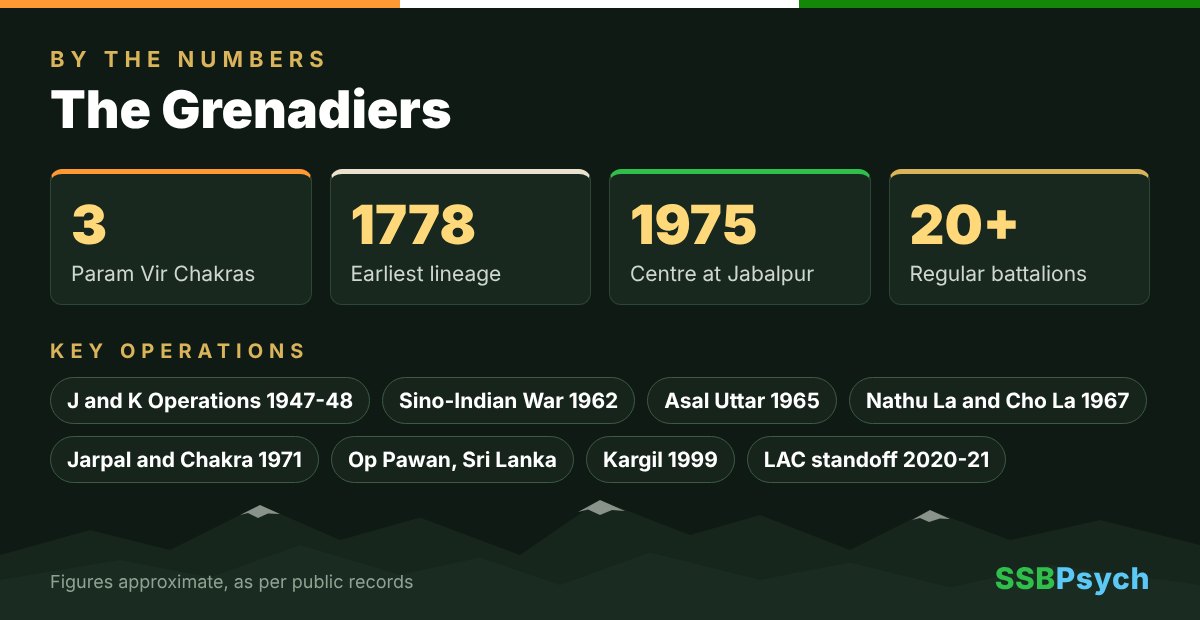
| Battalions | Over 20 regular battalions, plus RR and TA battalions |
| Param Vir Chakras | Three: Abdul Hamid (1965), Hoshiar Singh (1971), Yogendra Singh Yadav (1999) |
| Post-1947 honours | Gurais, Asal Uttar, Jarpal, Chakra, Tololing, Tiger Hill |
| Role | Infantry |
History of The Grenadiers
Grenadiers were originally the strongest and bravest soldiers of an army, picked to throw grenades and lead assaults. In the eighteenth century, every sepoy battalion of the East India Company’s Bombay Army had a grenadier company. In 1778, the grenadier companies of several Bombay battalions were brought together for a campaign against the Marathas and won fame at the battle of Talegaon.
Impressed by their performance, the Bombay government made the arrangement permanent in 1779, forming a grenadier battalion from the grenadier companies of six sepoy battalions and the Marine Battalion. This was the beginning of the regiment we know today. Over the next 150 years, Bombay grenadier battalions fought in Egypt, Afghanistan, Burma, East Africa, Mesopotamia and Palestine, and against the Mysore and Maratha armies in India.
In the reorganisation of 1922, these battalions were grouped into the 4th Bombay Grenadiers, with six battalions. The regiment served in both World Wars and earned honours such as Kohima, Meiktila and Pegu in Burma during the Second World War. In 1945 it was renamed the Indian Grenadiers, and at Independence it was allotted to India, becoming simply The Grenadiers. Its senior battalion, 1 Grenadiers, was later converted into 2 Guards, one of the founding battalions of the Brigade of the Guards.
The regimental centre moved several times, from Ajmer to Bareilly and Nasirabad, before settling at Jabalpur in Madhya Pradesh in 1975. The regiment has grown to over 20 regular battalions, along with Rashtriya Rifles and Territorial Army units. Its soldiers are sometimes nicknamed the Grinders.
The Grenadiers Timeline: From Raising to Today
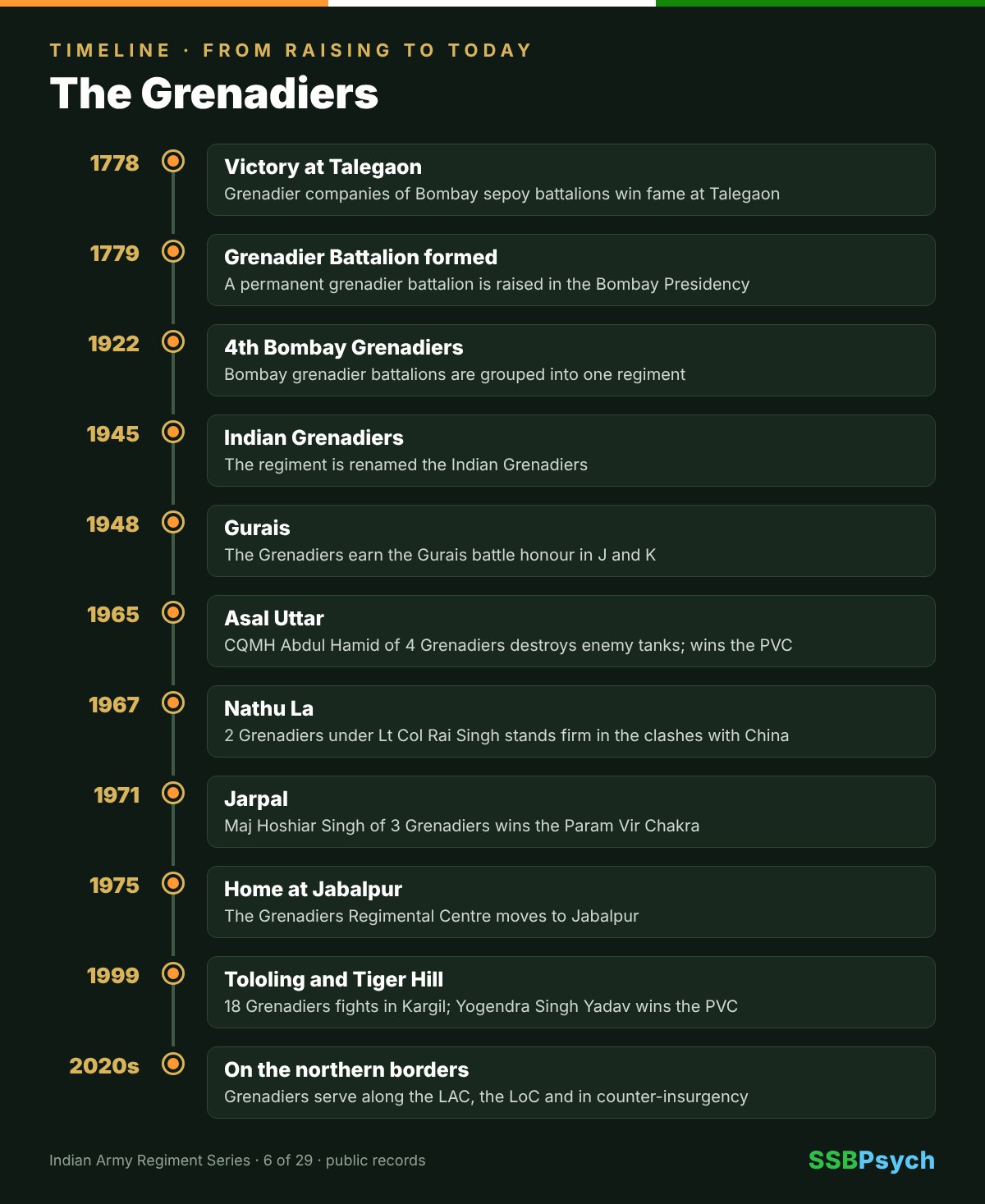
- 1778 – Victory at Talegaon: Grenadier companies of Bombay sepoy battalions win fame at Talegaon
- 1779 – Grenadier Battalion formed: A permanent grenadier battalion is raised in the Bombay Presidency
- 1922 – 4th Bombay Grenadiers: Bombay grenadier battalions are grouped into one regiment
- 1945 – Indian Grenadiers: The regiment is renamed the Indian Grenadiers
- 1948 – Gurais: The Grenadiers earn the Gurais battle honour in J and K
- 1965 – Asal Uttar: CQMH Abdul Hamid of 4 Grenadiers destroys enemy tanks; wins the PVC
- 1967 – Nathu La: 2 Grenadiers under Lt Col Rai Singh stands firm in the clashes with China
- 1971 – Jarpal: Maj Hoshiar Singh of 3 Grenadiers wins the Param Vir Chakra
- 1975 – Home at Jabalpur: The Grenadiers Regimental Centre moves to Jabalpur
- 1999 – Tololing and Tiger Hill: 18 Grenadiers fights in Kargil; Yogendra Singh Yadav wins the PVC
- 2020s – On the northern borders: Grenadiers serve along the LAC, the LoC and in counter-insurgency
Major Operations and Battle Honours
The Grenadiers carry a long list of honours from before 1947, including Mangalore, Seringapatam, Egypt, Kirkee, Afghanistan 1878-80, Burma, Mesopotamia, Megiddo, Kohima and Meiktila. Since Independence they have added Gurais (1948), Asal Uttar (1965), Jarpal and Chakra (1971), and Tololing and Tiger Hill (1999).
1947-48 and 1962
In the first Kashmir war, Grenadier battalions fought in the mountains and earned the Gurais battle honour in the northern part of the Kashmir Valley. In the 1962 war with China, the regiment’s battalions were again in action on the northern borders.
1965: Asal Uttar
During the 1965 war, Pakistan launched a major tank offensive in the Khem Karan sector of Punjab. At Asal Uttar, Indian forces laid a trap in the sugarcane fields, and Pakistani armour suffered very heavy losses. Company Quartermaster Havildar Abdul Hamid of 4 Grenadiers, firing a recoilless gun mounted on a jeep, knocked out several enemy tanks before he was killed. He was posthumously awarded the Param Vir Chakra, and 4 Grenadiers won the Asal Uttar battle honour.
Abdul Hamid’s story is remembered across India. Memorials, school lessons and books keep his name alive, and the jeep-mounted recoilless gun he used has become an image of how a determined soldier can defeat far heavier machines. For young readers, his action is a reminder that skill, courage and good use of ground often matter more than the size of the weapon.
1967: Nathu La
In September 1967, Chinese troops clashed with Indian forces at Nathu La in Sikkim. 2 Grenadiers, commanded by Lt Col Rai Singh, was holding the pass. The Indian response was firm and effective, and the clashes became an important morale booster just five years after 1962. Lt Col Rai Singh was awarded the Maha Vir Chakra.
1971: Jarpal
In the Shakargarh sector, 3 Grenadiers captured Jarpal and then faced repeated counter-attacks by Pakistani infantry and armour. Major Hoshiar Singh moved from trench to trench under heavy fire, encouraging his men and personally manning a machine gun when its crew was hit. Though badly wounded, he refused to be evacuated until the fighting ended. He was awarded the Param Vir Chakra, and the battalion earned the Jarpal battle honour.
1999: Tololing and Tiger Hill
In the Kargil War, 18 Grenadiers fought some of the hardest battles of Operation Vijay. The battalion took part in the attacks on Tololing, where Major Rajesh Singh Adhikari, attached from the Mechanised Infantry, and Lt Col R. Vishwanathan were among those who laid down their lives. It then climbed the near-vertical slopes of Tiger Hill. Grenadier Yogendra Singh Yadav, part of the leading Ghatak team, kept climbing and fighting despite multiple bullet wounds, helping to capture enemy bunkers. Aged only 19, he became the youngest recipient of the Param Vir Chakra.
The capture of Tololing in June 1999 was the first major Indian success of the Kargil War, and it changed the momentum of the conflict. Soldiers had to climb steep, rocky slopes at night in thin air, carrying heavy loads, while the enemy fired down from well-prepared positions. The victory at Tiger Hill soon after, which was widely covered in the media, became a symbol of the Army’s determination. 18 Grenadiers paid a heavy price in both battles, but its success earned the regiment two battle honours from a single war.
Peacekeeping and Recent Years
Grenadier battalions served with the IPKF in Sri Lanka during Operation Pawan, and they have served in counter-insurgency in Jammu and Kashmir and the North-East. They were also among the units deployed during the tense standoff with China along the Line of Actual Control in 2020 and 2021.
The Grenadiers Insignia, Motto and War Cry
The badge of The Grenadiers is a flaming grenade, the traditional symbol of grenadier units in many armies around the world. It recalls the regiment’s origin as a force of picked assault troops.
The motto is Sarvada Shaktishali, meaning Ever Powerful. The same phrase is widely used by the regiment as its rallying cry in battle and on ceremonial occasions, so you will often see it listed as both motto and war cry. Its message is simple: whatever the odds, a Grenadier remains strong.
Heroes of The Grenadiers
- CQMH Abdul Hamid, Param Vir Chakra (posthumous) – 4 Grenadiers, Asal Uttar, Khem Karan sector, 1965.
- Major Hoshiar Singh, Param Vir Chakra – 3 Grenadiers, Jarpal, Shakargarh sector, 1971; he later retired as a Colonel.
- Grenadier Yogendra Singh Yadav, Param Vir Chakra – 18 Grenadiers, Tiger Hill, 1999; the youngest PVC recipient.
- Lt Col Rai Singh, Maha Vir Chakra – commanded 2 Grenadiers at Nathu La, 1967; later Brigadier.
- Lt Col Balwan Singh, Maha Vir Chakra – 18 Grenadiers, Tiger Hill, 1999.
- Major Rajesh Singh Adhikari, Maha Vir Chakra (posthumous) – attached to 18 Grenadiers, Tololing, 1999.
Battalions that produced Param Vir Chakra winners are proudly known within the Army as Param Vir Chakra Paltans. The Grenadiers have three of them: 3, 4 and 18 Grenadiers. The regiment’s soldiers have also won Ashok Chakras, Maha Vir Chakras, Kirti Chakras and many Vir Chakras, and British officers serving with the regiment won Victoria Crosses before Independence.
Role and Life in the Regiment
The Grenadiers is a standard infantry regiment with a mixed-class composition. Its soldiers come from several communities, including Rajputs, Jats, Ahirs, Dogras, Gujjars, Meenas, Kaimkhanis and Muslims, mostly from northern and western India. This mix gives the regiment a strong sense of unity across faiths and backgrounds, much like the story of Abdul Hamid and Hoshiar Singh, who came from different communities but share the same place in the regiment’s hall of fame.
Grenadier battalions serve in every kind of terrain: high-altitude posts in Ladakh and Sikkim, the Line of Control in Kashmir, the plains of Punjab and the deserts of Rajasthan. The regiment is known for its aggressive spirit and its Ghatak platoons, which are trained for raids and difficult assaults, as shown at Tiger Hill.
At the regimental centre in Jabalpur, recruits learn the stories of the three Param Vir Chakra heroes as part of their training. Regimental days, battle honour days and memorial services keep these memories alive, and every young Grenadier is reminded that the regiment expects him to live up to Sarvada Shaktishali. Jabalpur itself is an important military station, and the centre’s parade grounds and training areas see a steady flow of recruits, young officers and veterans throughout the year. For a recruit, the day he passes out from the centre and joins a battalion with such a history is one he never forgets.
Like every infantry regiment, The Grenadiers also play a large role in peacetime. Battalions assist civil authorities during floods and other disasters, run goodwill projects in remote border villages, and encourage sports and adventure activities among their soldiers. These tasks build the same qualities of teamwork and initiative that are needed in battle, and they strengthen the bond between the Army and the people it protects.
Why The Grenadiers Matters for SSB Aspirants
Param Vir Chakra stories are among the most common topics in SSB interviews and lecturettes, and The Grenadiers have three of them. Make sure you know the basics accurately: Abdul Hamid with 4 Grenadiers at Asal Uttar in 1965, Hoshiar Singh with 3 Grenadiers at Jarpal in 1971, and Yogendra Singh Yadav with 18 Grenadiers at Tiger Hill in 1999.
Beyond facts, the board wants to see what you take from these stories. Abdul Hamid shows initiative and skill with limited resources. Hoshiar Singh shows leadership by example under pressure. Yogendra Singh Yadav shows determination and endurance. Linking each hero to an officer-like quality, and then to an example from your own life, will make your answer genuine and memorable.
The Grenadiers for SSB Candidates: What You Should Know
How officers join
- Officers join the Army through NDA, the IMA (via CDS, TES or TGC) or the OTA Chennai (Short Service Commission), after clearing the SSB and medicals.
- Regiment allotment is made during academy training, based on choice, training merit and vacancies; no entry guarantees The Grenadiers.
- Young officers attend infantry courses and then join their battalion to lead a platoon.
- Officers of the regiment can later volunteer for specialised roles such as Ghatak platoon command or other units.
How soldiers join
- The regiment recruits from several classes, including Rajputs, Jats, Ahirs, Dogras, Gujjars, Meenas, Kaimkhanis and Muslims, mainly from north and west India.
- Since 2022, soldiers join through the Agnipath scheme as Agniveers, via Army recruitment rallies and the online common entrance exam.
- Recruits train at the Grenadiers Regimental Centre, Jabalpur.
Questions you may face in the SSB interview, GD or lecturette
- Name the three Param Vir Chakra winners of The Grenadiers and their battles.
- What leadership lessons do you draw from Major Hoshiar Singh at Jarpal?
- What was the significance of the 1967 Nathu La clashes?
- What does the motto Sarvada Shaktishali mean to you?
- How did Grenadier Yogendra Singh Yadav help capture Tiger Hill?
SSBPsych tip: Prepare a two-minute lecturette on one Grenadier PVC hero, with correct names, units and dates, ending with the officer-like quality it shows and how you apply it yourself.
The Grenadiers’ journey from the grenadier companies of the Bombay Army to the heights of Tiger Hill is one of the great stories of the Indian Army. Revise the key facts and then take the quiz below.
Quiz: How Well Do You Know The Grenadiers?
Test yourself! Click an option to see if you are right. Your score updates live.
The Grenadiers: Frequently Asked Questions
The motto is Sarvada Shaktishali, meaning Ever Powerful. The phrase is also widely used as the regiment’s war cry.
The Grenadiers Regimental Centre is at Jabalpur, Madhya Pradesh, where it has been since 1975.
CQMH Abdul Hamid (4 Grenadiers, 1965), Major Hoshiar Singh (3 Grenadiers, 1971) and Grenadier Yogendra Singh Yadav (18 Grenadiers, 1999).
The regiment traces its origin to 1778-79, when grenadier companies of the Bombay Army were formed into a permanent grenadier battalion.
Join the Army through NDA, CDS, TES or SSC entries after clearing the SSB. Regiments are allotted during academy training based on choice, merit and vacancies.
Indian Army Regiments Series on SSBPsych
This is part 6 of 29 in our series on every infantry regiment of the Indian Army – a new regiment every day at 11 AM. Previous in the series: Madras Regiment. Also follow our Param Vir Chakra series.
Sources: en.wikipedia.org, thehitavada.com, en.wikipedia.org, en.wikipedia.org, en.wikipedia.org.
Preparing for NDA, CDS, AFCAT or your SSB? Join SSBPsych’s online and offline batches – explore our courses or call +91 8076540582.