Maratha Light Infantry: History, Motto, War Cry and Heroes
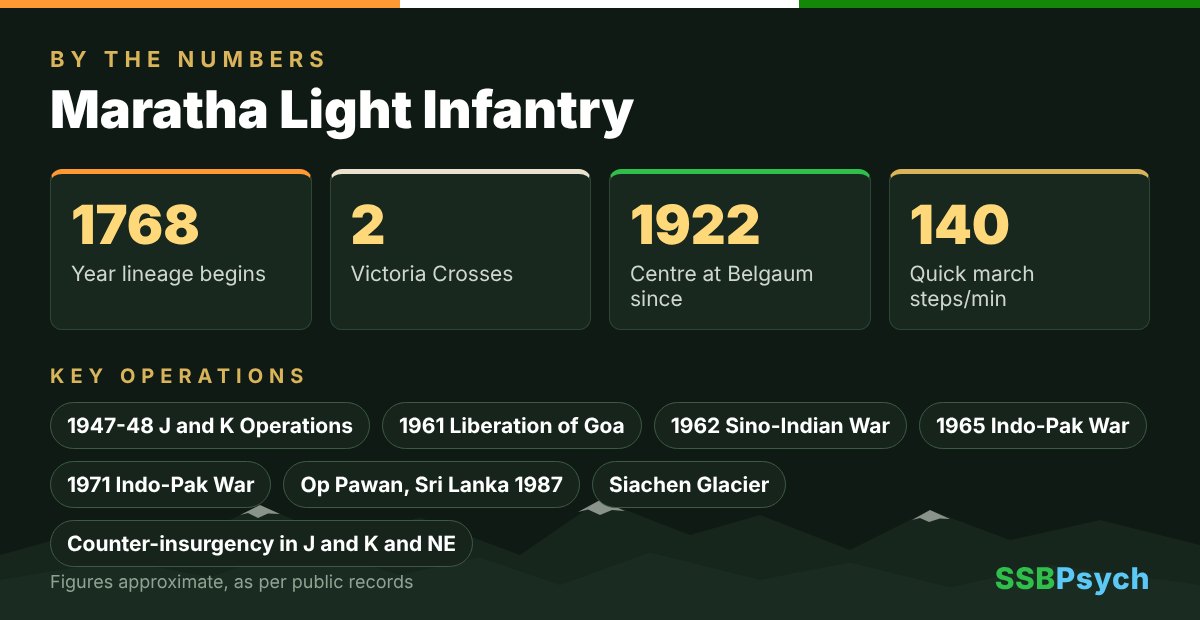
Few regiments in the world can trace an unbroken line of service across more than 250 years. The Maratha Light Infantry is one of them. Its oldest battalion was raised in 1768, and today it stands as the senior light infantry regiment of the Indian Army, carrying the fighting spirit of the Maratha warriors of Chhatrapati Shivaji Maharaj into modern battlefields from the Siachen Glacier to the jungles of the North East.
If you are preparing for NDA, CDS, AFCAT, TES or the SSB interview, knowing the story of the Maratha Light Infantry will help you in lectures, group discussions and personal interviews. In this guide we cover its history and lineage, a quick visual timeline, major operations and battle honours, the meaning of its insignia, motto and war cry, its greatest heroes, life in the regiment, what it means for SSB candidates, and finally a 10-question quiz to test yourself.
Maratha Light Infantry – Quick Facts
| Raised | 1768 (oldest battalion, as 2nd Battalion, Bombay Sepoys) |
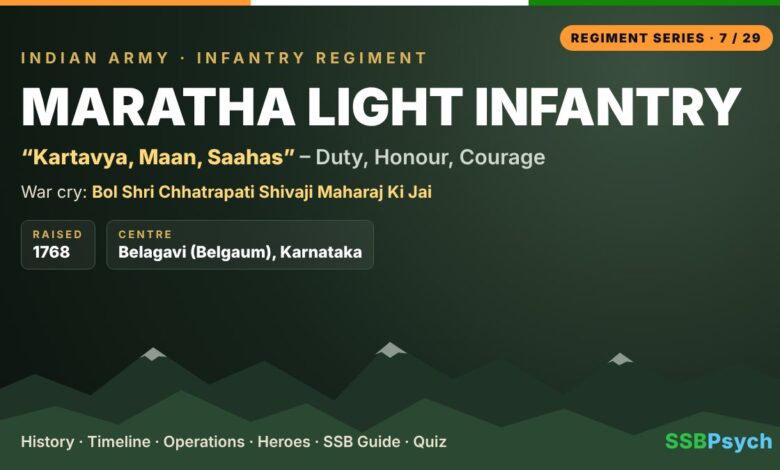
| Regimental Centre | Belagavi (Belgaum), Karnataka, since 1922 |
| Motto | Kartavya, Maan, Saahas (Duty, Honour, Courage) |
| War Cry | Bol Shri Chhatrapati Shivaji Maharaj Ki Jai |
| Type | Light infantry |
| Recruitment | Mainly Marathas from Maharashtra, with smaller shares from Karnataka and nearby states |
| Battalions | Around 18 regular battalions, plus Territorial Army units |
| Famous battalions | 1st Battalion (Jangi Paltan) and 2nd Battalion (Kali Panchwin) |
| Notable gallantry | 2 Victoria Crosses (World War II) and Ashoka Chakras after 1947 |
| Quick march | Faster light infantry pace of about 140 steps per minute |
| Army Chief | General J.J. Singh, Chief of the Army Staff 2005 to 2007 |
History of the Maratha Light Infantry
The story begins on the islands of Bombay in the eighteenth century. The British East India Company needed local troops to guard its growing trading settlements on the west coast, and in August 1768 it raised the 2nd Battalion of the Bombay Sepoys. That battalion is today the 1st Battalion of the regiment, proudly known as Jangi Paltan, which means the fighting battalion. A year later, in 1769, another battalion was raised which would later earn the famous nickname Kali Panchwin, the Black Fifth.
In the late eighteenth century these early battalions fought along the west coast of India, from Surat in the north to Cannanore in the south. They saw action in the Mysore campaigns, including the battles of Seedaseer and Seringapatam, and these names are still carried as battle honours. More battalions were raised around 1800, slowly building the family that would later form one regiment.
Earning the Light Infantry Title
Light infantry troops were trained to move fast, fight in open order and act as skirmishers ahead of the main army. The title had to be earned. In 1841, during the First Anglo-Afghan War, Kali Panchwin was made light infantry in recognition of its gallantry at the siege of Kahun and the defence of Dadar. A few decades later, two more units received the same status for their service in the Abyssinian campaign of 1867 to 1868.
The 1922 Reorganisation
After the First World War, the British reorganised the Indian Army into large regiments. In 1922 the Maratha battalions were grouped together as the 5th Mahratta Light Infantry, and a training battalion was set up at Belgaum, then part of the Bombay Presidency. Belgaum, now Belagavi in Karnataka, has remained the home of the regiment ever since. One battalion was given the rare title of Royal for its outstanding service in Mesopotamia during the First World War, an honour seldom granted to a single battalion.
In both World Wars the Marathas served with great distinction in Mesopotamia, Palestine, Persia, North Africa, Italy and Burma. The Second World War brought the regiment two Victoria Crosses, both won in Italy. After independence the numeral was dropped and the regiment became the Maratha Light Infantry of the Indian Army. In 1952 one battalion was converted to the airborne role and became the 2nd Battalion of the Parachute Regiment, and other battalions have since helped form mechanised infantry and Rashtriya Rifles units.
Who Serves in the Regiment
The Maratha Light Infantry has always drawn its strength from the hardy farming communities of the Deccan. The large majority of its soldiers are Marathas from Maharashtra, while smaller numbers come from Karnataka and other neighbouring states. Tradesmen such as clerks and cooks can be recruited from across India. This shared background gives each battalion a common language, common customs and a strong bond between men who often come from the same districts, and sometimes from the same villages.
The Maratha heritage itself is a source of pride. Soldiers grow up hearing stories of the hill forts of the Sahyadri ranges and of the swift tactics used by Shivaji Maharaj against much larger armies. That idea of speed, surprise and fighting spirit fits naturally with the light infantry role, and the regiment’s march past tune, Sinhgad, is named after one of the most famous Maratha forts.
Maratha Light Infantry Timeline: From Raising to Today
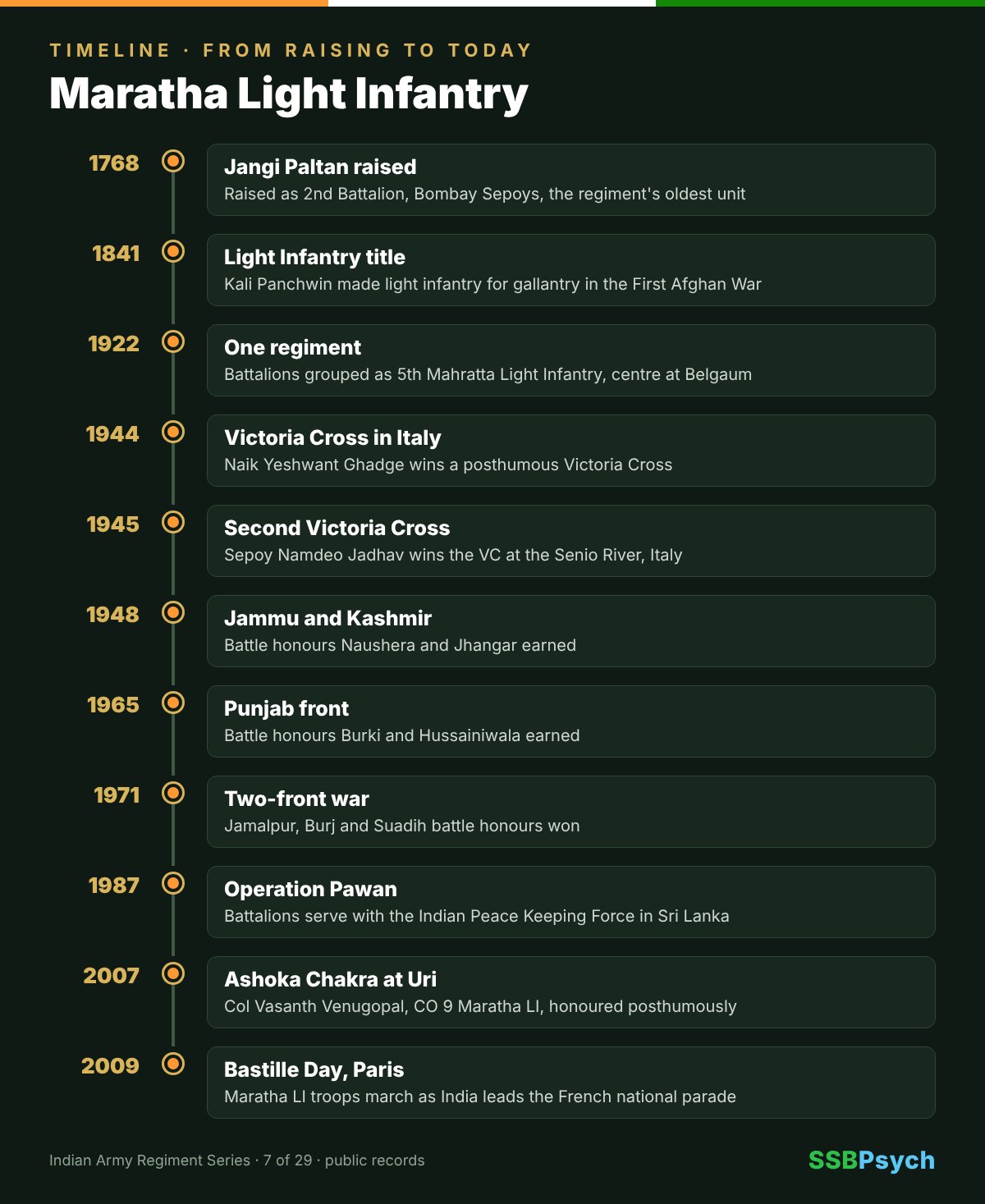
- 1768 – Jangi Paltan raised: Raised as 2nd Battalion, Bombay Sepoys, the regiment’s oldest unit
- 1841 – Light Infantry title: Kali Panchwin made light infantry for gallantry in the First Afghan War
- 1922 – One regiment: Battalions grouped as 5th Mahratta Light Infantry, centre at Belgaum
- 1944 – Victoria Cross in Italy: Naik Yeshwant Ghadge wins a posthumous Victoria Cross
- 1945 – Second Victoria Cross: Sepoy Namdeo Jadhav wins the VC at the Senio River, Italy
- 1948 – Jammu and Kashmir: Battle honours Naushera and Jhangar earned
- 1965 – Punjab front: Battle honours Burki and Hussainiwala earned
- 1971 – Two-front war: Jamalpur, Burj and Suadih battle honours won
- 1987 – Operation Pawan: Battalions serve with the Indian Peace Keeping Force in Sri Lanka
- 2007 – Ashoka Chakra at Uri: Col Vasanth Venugopal, CO 9 Maratha LI, honoured posthumously
- 2009 – Bastille Day, Paris: Maratha LI troops march as India leads the French national parade
Major Operations and Battle Honours
The regiment carries a long list of battle honours, with the earliest dating back to the Mysore wars. Some honours earned under colonial rule have since been declared repugnant, as they were won against Indian rulers, but the list still reflects the wide range of campaigns the Marathas have fought in. Here are the key chapters after independence.
1947-48: Jammu and Kashmir
Maratha battalions took part in the first war in Jammu and Kashmir and earned the battle honours Naushera and Jhangar in 1948. The fighting around these towns in the Rajouri and Naushera sector was some of the toughest of that war, and holding them was vital for the defence of Jammu. Battalions of the regiment were also involved in the operations that brought Junagadh and Hyderabad into the Indian Union.
Goa 1961 and the Sino-Indian War of 1962
The regiment was part of the operations that ended Portuguese rule in Goa in December 1961. A year later, during the Sino-Indian War of 1962, Maratha units served in the high mountains on the northern border, facing a determined enemy in harsh terrain and freezing weather.
The 1965 and 1971 Wars
In the 1965 war against Pakistan the regiment fought on the Punjab front and earned the battle honours Burki and Hussainiwala. In the 1971 war, battalions fought on both the western and eastern fronts. The honours Jamalpur, Burj and Suadih were won in this war, along with the theatre honours Punjab and East Pakistan. The action at Jamalpur formed part of the rapid advance in the east that led to the liberation of Bangladesh.
Sri Lanka, Siachen and Counter-Insurgency
Battalions served with the Indian Peace Keeping Force in Sri Lanka under Operation Pawan. The regiment has also served on the Siachen Glacier, the highest battlefield in the world, and has carried out long counter-insurgency tours in Jammu and Kashmir and the North Eastern states. Several of its post-independence gallantry awards came from these demanding operations.
Maratha Light Infantry Insignia, Motto and War Cry
The regimental insignia shows a bugle with cords, together with crossed swords and a shield, topped by the Lion Capital of Ashoka. The bugle is the classic symbol of light infantry, because in the old days skirmishers spread out over wide areas were controlled by bugle calls rather than shouted orders. Soldiers of the regiment wear a green beret with a red and green hackle, and the regimental colours are red, black and grey.
The motto is Kartavya, Maan, Saahas, which means Duty, Honour, Courage. Each word is a reminder of what a soldier owes to the nation, to the regiment and to his comrades. The war cry is Bol Shri Chhatrapati Shivaji Maharaj Ki Jai, which honours the great Maratha king and founder of the Maratha Empire. Traditional cries such as Har Har Mahadev are also linked with the regiment’s history.
Like other light infantry regiments, the Marathas march at a faster pace than the rest of the Army, at about 140 steps per minute. Their contingents have won the best marching contingent award at the Republic Day parade in New Delhi, and in July 2009 Maratha Light Infantry troops marched down the Champs-Elysees in Paris when India led the Bastille Day parade.
Heroes of the Maratha Light Infantry
Courage runs deep in this regiment. Here are some of its best known heroes, from the Second World War to modern counter-insurgency.
- Naik Yeshwant Ghadge, Victoria Cross (posthumous) – led a fierce charge against an enemy machine-gun post in the Upper Tiber Valley, Italy, in July 1944.
- Sepoy Namdeo Jadhav, Victoria Cross – rescued wounded comrades and destroyed enemy posts at the Senio River, Italy, in April 1945.
- Colonel N.J. Nair, Ashoka Chakra (posthumous) and Kirti Chakra – of 16 Maratha LI, killed while fighting off an ambush in Nagaland in December 1993.
- Colonel Vasanth Venugopal, Ashoka Chakra (posthumous) – Commanding Officer of 9 Maratha LI, killed leading his men against infiltrators near Uri in July 2007.
- General J.J. Singh – Chief of the Army Staff from 2005 to 2007, commissioned into the Maratha Light Infantry.
- Lieutenant General Satish Nambiar – first Force Commander of the United Nations Protection Force in the former Yugoslavia.
Role and Life in the Regiment
Like every infantry regiment, the Maratha Light Infantry exists to close with and defeat the enemy on the ground. Its battalions rotate between high-altitude posts, the Line of Control, counter-insurgency areas and peace stations. A soldier may spend one tenure in the snow of Siachen and the next in the forests of the North East, so physical fitness, adaptability and teamwork are part of daily life.
Life in a Maratha battalion is built around a strong sense of family. Most soldiers come from the villages of Maharashtra and share a common language, food and festivals. Officers are expected to learn Marathi and to know their men and their families well. Festivals such as Ganesh Chaturthi and Shivaji Jayanti are celebrated with great energy in the unit lines, and these shared traditions build the trust that holds a unit together under fire.
The Regimental Centre at Belagavi trains every recruit who joins the regiment. It also houses the memories of the regiment, with memorials and displays that remind young soldiers of the sacrifices made by those who came before them. Sport is another proud tradition, and Maratha soldiers have represented India in hockey, boxing, wrestling and shooting.
Officers posted to a Maratha battalion quickly learn that the troops respond best to leaders who share their hardships. The regiment’s reputation for aggressive, fast-moving infantry, combined with deep loyalty to the paltan, gives young officers an excellent school of leadership.
What the Maratha Light Infantry Means for SSB Candidates
For an aspirant, the regiment is more than a set of facts to memorise. Its story shows the officer like qualities that SSB assessors look for: initiative, courage, responsibility and the ability to win the trust of a team. Officers of the regiment have led from the front in Italy, in Jammu and Kashmir and in Nagaland, and several paid with their lives while protecting their men. When you speak about such examples in your interview or lecturette, focus on what the leader did and why it mattered, not only on the award.
Maratha Light Infantry for SSB Candidates: What You Should Know
How officers join
- Officers join the infantry through the National Defence Academy (after Class 12), the Indian Military Academy (via CDS or other direct entries such as TES after Class 12 with PCM) or the Officers Training Academy, Chennai (Short Service Commission via CDS and other entries).
- Every entry requires clearing the five-day SSB interview and a medical board.
- Arm and regiment are allotted near the end of academy training based on the cadet’s preferences, order of merit and the vacancies available, so no regiment is guaranteed in advance.
- Once commissioned into the Maratha Light Infantry, a young officer joins a battalion and is expected to learn the language and customs of his troops.
How soldiers join
- Soldiers are recruited mainly from Marathas of Maharashtra, with smaller shares from Karnataka and nearby states, as per the regiment’s recruitment pattern.
- Since 2022, soldiers join as Agniveers under the Agnipath scheme for four years, after which a portion (up to 25 percent as per the scheme) can be selected for regular service.
- Recruits are trained at the Maratha Light Infantry Regimental Centre in Belagavi before joining their battalions.
Questions you may face in the SSB interview, GD or lecturette
- Why do you want to join the Maratha Light Infantry or any infantry regiment?
- What is the motto of the Maratha Light Infantry and what does it mean to you?
- What is the role of light infantry in modern warfare?
- Tell us about a Victoria Cross or Ashoka Chakra awardee from the Maratha Light Infantry.
- Lecturette topic: Lessons from the Indian Army’s role in counter-insurgency operations.
SSBPsych tip: Learn the motto Kartavya, Maan, Saahas and connect each word to a real example from your own life; interviewing officers value candidates who can link values to actions, not just recite facts.
The Maratha Light Infantry shows how history, identity and discipline can combine to create a regiment that is ready for any mission. Study its story, remember its heroes and test yourself with the quiz below.
Quiz: How Well Do You Know the Maratha Light Infantry?
Test yourself! Click an option to see if you are right. Your score updates live.
Maratha Light Infantry: Frequently Asked Questions
The motto is Kartavya, Maan, Saahas, which means Duty, Honour, Courage.
The Maratha Light Infantry Regimental Centre is at Belagavi (Belgaum) in Karnataka, where it has been since 1922.
The war cry is Bol Shri Chhatrapati Shivaji Maharaj Ki Jai, a tribute to the founder of the Maratha Empire.
Its oldest battalion, Jangi Paltan, was raised in 1768, making it the senior light infantry regiment of the Indian Army.
Join the Army through NDA, CDS (IMA or OTA) or TES, clear the SSB interview and training, and opt for the infantry. Regiment allotment depends on your preference, merit and vacancies.
Indian Army Regiments Series on SSBPsych
This is part 7 of 29 in our series on every infantry regiment of the Indian Army – a new regiment every day at 11 AM. Previous in the series: The Grenadiers. Also follow our Param Vir Chakra series.
Sources: en.wikipedia.org, en.wikipedia.org, en.wikipedia.org, bharat-rakshak.com, ssbcrackexams.com.
Preparing for NDA, CDS, AFCAT or your SSB? Join SSBPsych’s online and offline batches – explore our courses or call +91 8076540582.