Kalvari class submarine: India’s Six Scorpene Boats Explained
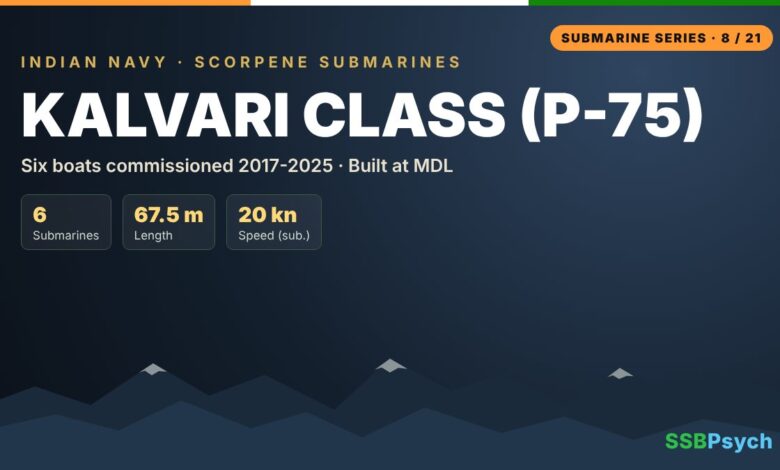
Silent, deadly and built in Mumbai, the Kalvari class submarine family is the backbone of India’s modern conventional submarine force. These six boats, built under Project-75 to the French Scorpene design, entered service between 2017 and 2025 and brought fresh muscle to a fleet that had been ageing for years.
In this guide we cover the whole class: why India needed it, how it was built, the six boats and their dates, size, weapons, crew, life on board, dangers, costs and the upgrade that will help them stay underwater longer. Every figure here comes from public reports, and we clearly mark where details are not official.

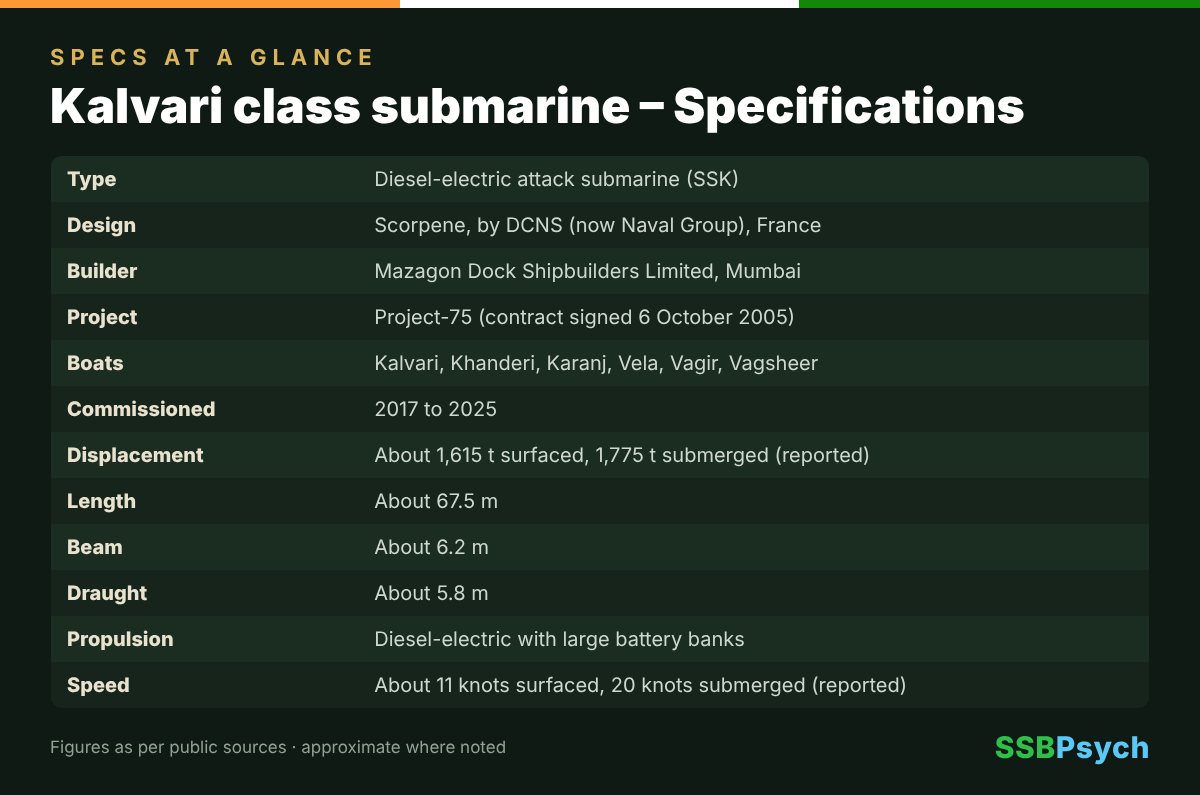
Kalvari class submarine Specifications
| Type | Diesel-electric attack submarine (SSK) |
| Design | Scorpene, by DCNS (now Naval Group), France |
| Builder | Mazagon Dock Shipbuilders Limited, Mumbai |
| Project | Project-75 (contract signed 6 October 2005) |
| Boats | Kalvari, Khanderi, Karanj, Vela, Vagir, Vagsheer |
| Commissioned | 2017 to 2025 |
| Displacement | About 1,615 t surfaced, 1,775 t submerged (reported) |
| Length | About 67.5 m |
| Beam | About 6.2 m |
| Draught | About 5.8 m |
| Propulsion | Diesel-electric with large battery banks |
| Speed | About 11 knots surfaced, 20 knots submerged (reported) |
| Range | About 6,500 nautical miles at 8 knots surfaced (reported) |
| Diving depth | Reported over 300 m; exact figure not official |
| Crew | About 8 officers and 35 sailors |
| Weapons | Six 533 mm tubes; torpedoes, SM39 Exocet missiles or mines |
What Is the Kalvari Class Submarine?
The Kalvari class is a group of six diesel-electric attack submarines. Diesel-electric means the boat runs diesel engines to charge huge batteries, and then moves almost silently underwater on electric motors. Navies call such boats SSKs. They are smaller and cheaper than nuclear submarines but can be even quieter when running on batteries, which makes them excellent ambush hunters close to home waters.
The design is the Scorpene, created by the French firm DCNS, now called Naval Group. India did not simply buy finished submarines. Under technology transfer, all six were built by Mazagon Dock Shipbuilders Limited (MDL) in Mumbai, which gave Indian engineers and workers priceless experience.
Why Did India Need Project-75?
By the late 1990s India’s submarine fleet was getting old. In 1999 the government approved a 30-year plan to build 24 submarines. Project-75 was its first big step. The contract for six Scorpenes was signed on 6 October 2005.
India has a long coastline, important island territories and busy sea lanes that carry most of its trade and oil. Submarines guard these by watching enemy fleets, threatening their warships and making any attacker think twice. A single hidden submarine can force an enemy to spend huge effort searching for it.
Meet the Six Boats of the Kalvari Class
- INS Kalvari (S21): commissioned 14 December 2017.
- INS Khanderi (S22): commissioned 28 September 2019.
- INS Karanj (S23): commissioned 10 March 2021.
- INS Vela (S24): commissioned 25 November 2021.
- INS Vagir (S25): commissioned 23 January 2023.
- INS Vagsheer (S26): commissioned 15 January 2025.
All six names were proudly reused from the Navy’s first generation of submarines, the Soviet-built Foxtrot-class boats of the 1960s and 1970s. The first INS Kalvari, commissioned on 8 December 1967, was India’s very first submarine. Keeping the old names links today’s sailors to that pioneering generation.
Kalvari class submarine Timeline
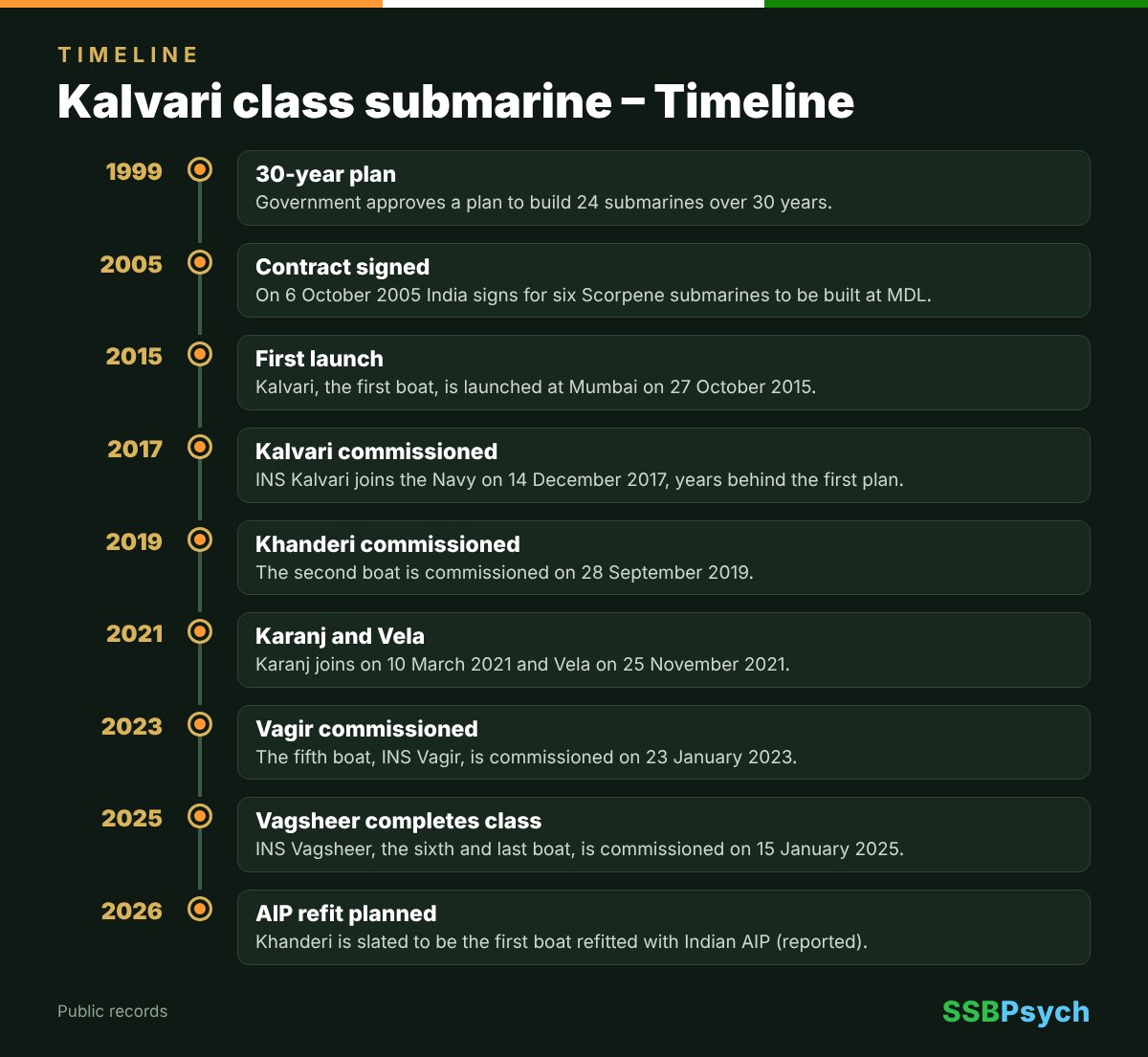
- 1999 – 30-year plan: Government approves a plan to build 24 submarines over 30 years.
- 2005 – Contract signed: On 6 October 2005 India signs for six Scorpene submarines to be built at MDL.
- 2015 – First launch: Kalvari, the first boat, is launched at Mumbai on 27 October 2015.
- 2017 – Kalvari commissioned: INS Kalvari joins the Navy on 14 December 2017, years behind the first plan.
- 2019 – Khanderi commissioned: The second boat is commissioned on 28 September 2019.
- 2021 – Karanj and Vela: Karanj joins on 10 March 2021 and Vela on 25 November 2021.
- 2023 – Vagir commissioned: The fifth boat, INS Vagir, is commissioned on 23 January 2023.
- 2025 – Vagsheer completes class: INS Vagsheer, the sixth and last boat, is commissioned on 15 January 2025.
- 2026 – AIP refit planned: Khanderi is slated to be the first boat refitted with Indian AIP (reported).
How Big Is a Kalvari Class Submarine?
Each boat is about 67.5 metres long, a little shorter than a football field, and about 6.2 metres wide, roughly the width of two cars parked side by side. It weighs about 1,615 tonnes on the surface and about 1,775 tonnes when submerged. That is about the weight of 1,700 small cars of one tonne each.
Speed is measured in knots, where one knot is about 1.85 km/h. The boats are reported to do about 20 knots underwater for short bursts, roughly 37 km/h, but they usually move much more slowly to stay quiet and save battery power. Surfaced range is reported at about 6,500 nautical miles at 8 knots.
Aircraft, Weapons and Sensors
- Six 533 mm torpedo tubes in the bow
- Up to 18 weapons in total (torpedoes and missiles)
- Heavyweight torpedoes such as the SUT
- SM39 Exocet anti-ship missiles fired from underwater
- Option to carry about 30 sea mines instead of torpedoes
- Sonar suite and periscopes for silent detection
The Exocet SM39 is clever: it is launched from a torpedo tube inside a capsule, rises to the surface and then flies low over the sea toward an enemy ship. In March 2017, INS Kalvari test-fired one during trials, showing the class could strike ships from underwater.
Operations and Missions
- 2017 – First missile and torpedo firing: INS Kalvari fired a torpedo and an Exocet missile during trials in the Arabian Sea.
- 2019 – Post-Balakot search: INS Kalvari was reportedly deployed with INS Chakra to look for a Pakistani submarine.
- 2022 – Defence Minister at sea: The Defence Minister sailed on INS Khanderi off Karwar to watch its combat systems.

Duty, Role and Base
Kalvari class boats can carry out anti-ship and anti-submarine warfare, gather intelligence, lay mines, watch an area silently and support special operations. Their stealth comes from a smooth hull shape, special coatings and quiet machinery.
The boats were all built and commissioned in Mumbai, and are widely reported to operate mainly on India’s western seaboard. The Navy does not publish exact deployment plans, and that is normal for submarines.
Crew and Command
Each submarine carries a small crew of about 8 officers and 35 sailors. That is roughly the number of students in a single school classroom, running a complete warship. The boat is commanded by a Commanding Officer, usually of Commander or Captain rank, helped by officers who handle navigation, weapons, engineering and sensors. Because the crew is so small, almost everyone is trained to do more than one job.
Life on Board a Kalvari Class Submarine
Space is the biggest luxury that a submarine sailor does not have. Corridors are narrow, bunks are stacked tightly, and on many submarines around the world sailors even share bunks in turns, a practice called hot bunking. Fresh water is carefully saved, and the smell of diesel and cooking often mixes in the air. Day and night lose meaning, so life follows a fixed watch routine.
The crew must stay calm, quiet and alert at all times. Even dropping a spanner can make noise that enemy sonar might hear. This is why submariners are known for strong discipline, close teamwork and a great sense of humour that helps them through long weeks at sea.
How Deep Can It Dive?
The Navy has not officially published the diving depth. Open sources report that Scorpene boats can safely go deeper than 300 metres, about the height of a 100-storey building. Treat this as a reported figure, not an official one.
The AIP Upgrade: Staying Underwater Longer
A diesel-electric submarine must come close to the surface every few days to run its engines and recharge batteries using a breathing pipe called a snorkel. This is the moment it is most likely to be spotted. Air Independent Propulsion (AIP) fixes much of this problem. It produces electricity without needing outside air, so the boat can stay submerged much longer.
India’s DRDO has developed a fuel-cell AIP system. Reports say it will be fitted as an extra hull section, or plug, during each boat’s major refit. INS Khanderi is reported to be the first in line, with its refit planned to start in mid-2026. INS Kalvari’s first refit went ahead without AIP because the system was not ready in time.
How Was the Kalvari Class Built?
Building a submarine is like building a pressure cooker the size of a small building, packed with machines, wires and pipes, and then making sure it never leaks. MDL used a modular method. Each hull was built in five large sections that were fitted out separately and then welded together, a moment shipbuilders call boot together. INS Kalvari was the first Indian Navy vessel built this way. Steel cutting for the first boat began in December 2006.
Delays and Challenges
Project-75 faced many hurdles. Reports describe flooding at the MDL dockyard in 2011 that damaged some parts, extra money needed for components, and the slow learning curve of building a complex foreign design for the first time. A planned purchase of heavyweight torpedoes for the class was also cancelled in 2016. As a result, the first boat arrived about five years later than the original schedule. Still, each new boat was delivered faster than the one before, showing how much MDL learned.
Diesel-Electric vs Nuclear: Where the Kalvari Class Fits
- Size: a Kalvari class boat weighs under 2,000 tonnes, while India’s nuclear submarines weigh several times more.
- Endurance: nuclear boats can stay down for very long periods; diesel boats must snorkel to recharge batteries unless fitted with AIP.
- Noise: on batteries, a diesel-electric boat can be extremely quiet, ideal for waiting in ambush.
- Cost: conventional submarines are far cheaper to build and run, so a navy can have more of them.
- Job: they mainly guard nearby seas, while nuclear boats travel far and fast.
Name Origins
Kalvari is the Malayalam word for the tiger shark, a fierce predator of the Indian Ocean. Khanderi is named after the island fort of Chhatrapati Shivaji Maharaj off the Maharashtra coast. The other four names, Karanj, Vela, Vagir and Vagsheer, also come from the old Foxtrot-class boats, so each new submarine carries forward the memory and spirit of an earlier one that served the nation.
Cost and Running Costs
The total cost of Project-75 has been reported at over Rs 23,500 crore for the six boats, higher than first planned because of delays and extra components. The project was originally meant to deliver boats between 2012 and 2017, but the first was commissioned only in December 2017.
Running costs are not published, but they are driven by fuel, battery replacement, regular refits in dry dock, weapons and their testing, spare parts, and training of highly skilled crews.
Dangers Faced by Submariners
Submarine service is one of the most demanding jobs in any navy. The dangers include flooding, fire in a closed space, battery gas build-up and the risk of collisions while near the surface. To prepare, Indian submariners practise escape training and damage control regularly, and the Navy has set up special submarine escape training facilities.
What Comes After the Kalvari Class?
India planned to order three more Scorpenes, but reports in 2025 and 2026 suggested the Navy was more interested in moving straight to Project-75 (India), a new set of six larger submarines with AIP built in India with a foreign partner. As of early 2026 that contract had not yet been signed, according to media reports.
Why the Kalvari Class Submarine Matters for Aspirants
Project-75 is a frequent topic in defence general knowledge and current affairs. It is also a great example for SSB discussions on Make in India and technology transfer: the boats were designed abroad but built by Indian hands, and the skills gained now help India plan its own future submarines.
Did You Know?
- INS Kalvari was the first Indian Navy vessel built using a modular method, joining large ready-made sections together.
- All six Kalvari class names come from India’s first generation of Foxtrot-class submarines.
- The Indian Navy celebrates Submarine Day on 8 December, the day the first INS Kalvari was commissioned in 1967.
- INS Vagsheer was commissioned on 15 January 2025, completing the class.
- A Kalvari class boat can fire an anti-ship missile while staying hidden underwater.
- The whole crew of a Kalvari class submarine is smaller than many school classes.
- Each hull was built in five separate sections and then joined together like giant building blocks.
Quiz: Test Your Knowledge of Kalvari class submarine
Click an option to see if you are right. Your score updates live.
Kalvari class submarine: Frequently Asked Questions
It is a class of six diesel-electric attack submarines built by Mazagon Dock in Mumbai under Project-75, using the French Scorpene design. They were commissioned between 2017 and 2025.
INS Kalvari, INS Khanderi, INS Karanj, INS Vela, INS Vagir and INS Vagsheer.
Six 533 mm tubes can launch heavyweight torpedoes and SM39 Exocet anti-ship missiles, with up to 18 weapons in total, or sea mines instead.
The total has been reported at over Rs 23,500 crore for six boats, after delays and extra components raised the cost.
Yes, reports say DRDO’s fuel-cell AIP will be added during major refits, starting with INS Khanderi from mid-2026.
This is part 8 of 21 in SSBPsych’s submarine series – a new post every morning at 10 AM.
Sources: en.wikipedia.org, en.wikipedia.org, en.wikipedia.org, en.wikipedia.org, indiannavy.nic.in.
Preparing for NDA, CDS, AFCAT or your SSB? Join SSBPsych’s online and offline batches – explore our courses or call +91 8076540582.