INS Kalvari (S21): India’s First Scorpene Tiger Shark
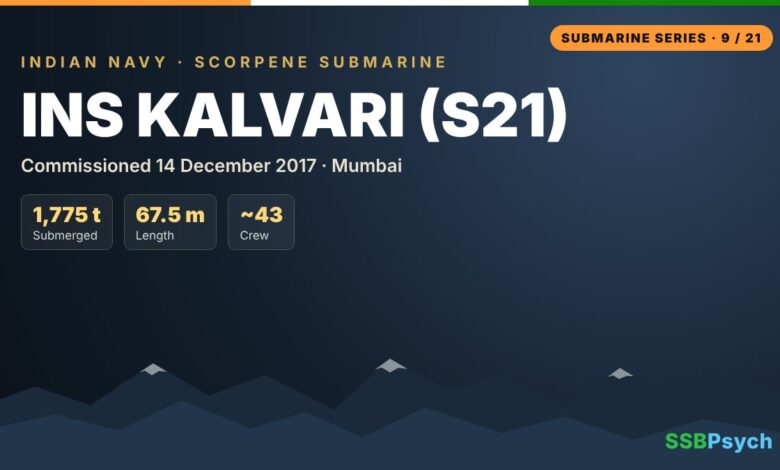
Few names in the Indian Navy carry as much history as INS Kalvari. The first submarine with this name started India’s underwater story in 1967. Fifty years later, a brand-new INS Kalvari (S21), built in Mumbai to the French Scorpene design, was commissioned on 14 December 2017 and became the lead boat of the modern Kalvari class.
In this post you will learn how INS Kalvari was built, how big it is, what weapons it carries, what it does, what life is like for its small crew, what its name means and why it matters for India. We also look back briefly at the original 1967 Kalvari, the boat that started it all.

INS Kalvari Specifications
| Type | Diesel-electric attack submarine (SSK) |
| Class | Kalvari class (Project-75, Scorpene design) |
| Pennant number | S21 |
| Builder | Mazagon Dock Shipbuilders Limited, Mumbai |
| Launched | 27 October 2015 |
| Commissioned | 14 December 2017, Mumbai |
| Displacement | About 1,615 t surfaced, 1,775 t submerged (reported) |
| Length | About 67.5 m |
| Beam | About 6.2 m |
| Propulsion | Diesel-electric with battery banks |
| Speed | About 20 knots submerged (reported) |
| Diving depth | Not officially disclosed |
| Crew | About 8 officers and 35 sailors |
| Weapons | Six 533 mm tubes; torpedoes, SM39 Exocet missiles or mines |
| Motto | Ever Onward |
| Status | In service; first major refit done without AIP (reported) |
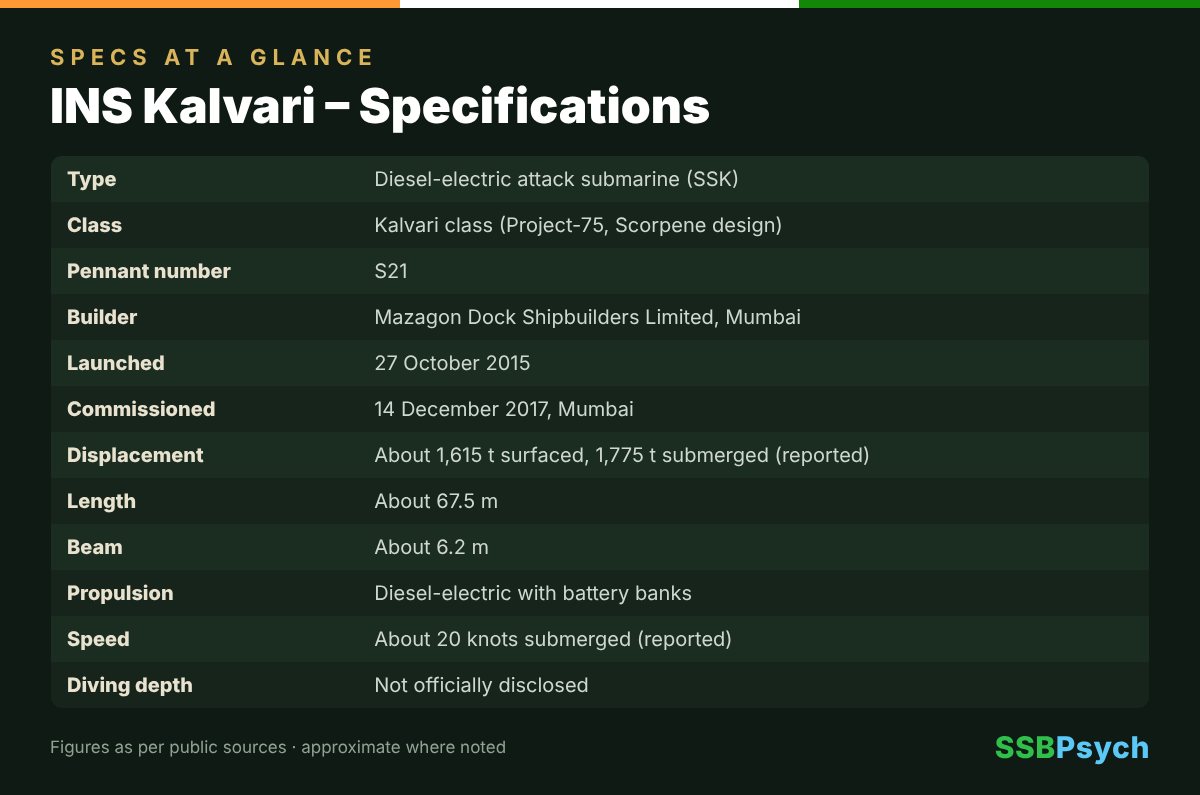
INS Kalvari at a Glance
INS Kalvari is a diesel-electric attack submarine. It runs diesel engines to charge large batteries, then glides almost silently underwater on electric motors. It is the first of six boats built under Project-75 at Mazagon Dock Shipbuilders Limited (MDL), Mumbai, with design help and technology transfer from France’s Naval Group, earlier known as DCNS.
It was commissioned at MDL in Mumbai on 14 December 2017 in the presence of the Prime Minister. It had been expected years earlier, but delays meant India waited a long time for this boat, which made the day even more special for the Navy.
The Original INS Kalvari (1967 to 1996)
The story begins with the first INS Kalvari, pennant number S23. It was a Soviet-built submarine of the Foxtrot family, and it was commissioned on 8 December 1967. It was India’s very first submarine. The Navy now marks 8 December every year as Submarine Day in its honour.
The old Kalvari served for almost three decades and was decommissioned on 31 May 1996. Its sail, the tall tower on top of a submarine, is preserved at a museum in Visakhapatnam. When the new boat took the same name in 2017, it was a proud link between two generations of Indian submariners.
How INS Kalvari Was Built
Steel cutting began at MDL on 14 December 2006. The hull was built in five large sections that were fitted out and then welded together in July 2014, a step called boot together. INS Kalvari was the first Indian Navy vessel built with this modular approach, much like putting together giant building blocks.
The submarine was launched, or floated out, on 27 October 2015. It began sea trials on 1 May 2016. During trials in the Arabian Sea on 2 March 2017, it fired a torpedo and an SM39 Exocet anti-ship missile, proving its weapons worked. It was handed over to the Navy in September 2017 and commissioned that December.
INS Kalvari Timeline
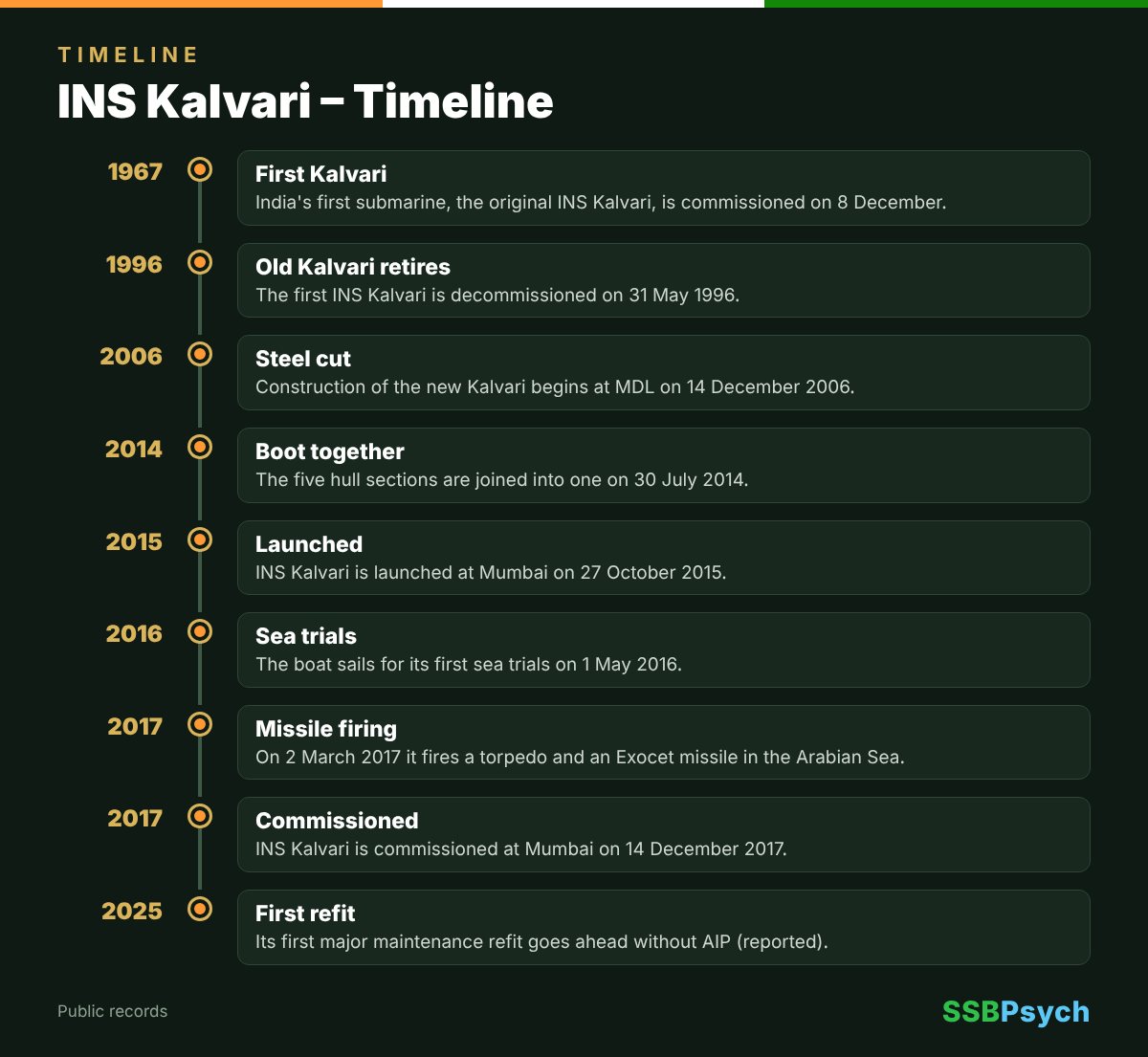
- 1967 – First Kalvari: India’s first submarine, the original INS Kalvari, is commissioned on 8 December.
- 1996 – Old Kalvari retires: The first INS Kalvari is decommissioned on 31 May 1996.
- 2006 – Steel cut: Construction of the new Kalvari begins at MDL on 14 December 2006.
- 2014 – Boot together: The five hull sections are joined into one on 30 July 2014.
- 2015 – Launched: INS Kalvari is launched at Mumbai on 27 October 2015.
- 2016 – Sea trials: The boat sails for its first sea trials on 1 May 2016.
- 2017 – Missile firing: On 2 March 2017 it fires a torpedo and an Exocet missile in the Arabian Sea.
- 2017 – Commissioned: INS Kalvari is commissioned at Mumbai on 14 December 2017.
- 2025 – First refit: Its first major maintenance refit goes ahead without AIP (reported).
How Big Is INS Kalvari?
INS Kalvari is about 67.5 metres long, a little shorter than a football field, and about 6.2 metres wide. It weighs about 1,615 tonnes on the surface and about 1,775 tonnes underwater. Displacement just means the weight of water the boat pushes aside, which equals its own weight.
Underwater it is reported to reach about 20 knots, around 37 km/h, in short bursts. On patrol it moves far more slowly, because slow means quiet and quiet means safe. Its exact diving depth has not been officially published.
Aircraft, Weapons and Sensors
- Six 533 mm torpedo tubes
- Heavyweight torpedoes
- SM39 Exocet anti-ship missiles launched from underwater
- Sea mines as an alternative load
- Up to 18 weapons carried in total (reported)
- Sonar and periscopes for quiet detection
Operations and Missions
- 2017 – Weapon firing trials: Fired a torpedo and an SM39 Exocet missile during sea trials in the Arabian Sea.
- 2019 – Post-Balakot search: Reportedly deployed with INS Chakra to look for a Pakistani submarine after Balakot.

Duty and Role of INS Kalvari
INS Kalvari is a hunter. Its jobs include finding and attacking enemy ships and submarines, gathering intelligence, laying mines, guarding sea lanes and supporting special operations. Its smooth shape and quiet machinery help it stay hidden. Like all submarines, its exact patrol areas are secret. It was built and commissioned in Mumbai, and the class is widely reported to operate mainly on the western seaboard.
After the Balakot air strikes in 2019, media reports said INS Kalvari and the nuclear submarine INS Chakra were deployed to search for a Pakistani submarine. This showed that the young boat was quickly trusted with real operational work.
Crew and Command
INS Kalvari has a crew of about 8 officers and 35 sailors, around 43 people in all. It is led by a Commanding Officer, usually of Commander or Captain rank, supported by officers for navigation, weapons, engineering and communication. Every sailor must know the boat well enough to act fast in an emergency.
Life on Board INS Kalvari
Imagine living in a long metal tube with dozens of people, no windows and very little privacy. Sailors sleep in narrow bunks, often near machinery or weapons. Fresh water is limited, so long showers are out of the question. Meals are cooked in a tiny galley and eaten in shifts. Day and night are set by the watch routine rather than the sun.
Silence is a rule. Sound travels far underwater, so the crew moves gently and avoids banging metal. This life builds remarkable patience, teamwork and calm under pressure, the same officer-like qualities that SSB assessors look for in candidates.
Why Does India Need INS Kalvari?
India’s long coastline, island territories and busy trade routes need protection. A quiet submarine like INS Kalvari forces any enemy navy to slow down and search carefully, because it never knows where the threat may be hiding. Before the Kalvari class arrived, much of India’s submarine fleet was old. INS Kalvari began the job of renewing it with modern, home-built boats.
Cost and Running Costs
No separate official price for INS Kalvari has been released. Project-75 as a whole, covering six boats, has been reported to cost over Rs 23,500 crore. Running costs depend on diesel fuel, battery maintenance and replacement, refits in dry dock, weapons, spare parts and crew training.
The Refit and the AIP Question
Every submarine needs a major maintenance refit after several years of service. INS Kalvari’s first such refit went ahead without the planned Indian Air Independent Propulsion system, because reports in 2025 said the system was not ready in time. AIP allows a diesel-electric boat to stay submerged much longer without coming up to recharge its batteries. INS Khanderi is now reported to be the first boat lined up to receive it.
How a Diesel-Electric Submarine Like INS Kalvari Works
Think of INS Kalvari as a giant hybrid vehicle. Its diesel engines work like a generator, charging hundreds of battery cells. Underwater, the engines stop and electric motors take over, drawing power from the batteries. Electric motors are very quiet, which is why a diesel-electric boat running on batteries can be harder to hear than many nuclear submarines.
The catch is that diesel engines need air. To recharge, the boat rises to just below the surface and pushes up a breathing pipe called a snorkel, while keeping the hull hidden. This is the riskiest time, because the snorkel, engine noise and exhaust can give the boat away. Crews plan these charging periods very carefully.
Ballast Tanks: How It Dives and Rises
A submarine dives by letting seawater into special compartments called ballast tanks, which makes it heavier. To come up, it blows high-pressure air into the tanks, pushing the water out so it becomes lighter. Small trim tanks inside help balance the boat so it stays level, like a person keeping balance on a seesaw.
How INS Kalvari Fires a Missile from Underwater
The SM39 Exocet sits inside a watertight capsule that is pushed out of a torpedo tube. The capsule rises to the surface, the missile bursts out, and its rocket motor carries it low over the waves toward the target ship. Flying close to the sea makes it harder for enemy radar to spot. INS Kalvari proved this ability in March 2017.
INS Kalvari and Its Sister Submarines
- INS Kalvari (S21), commissioned 2017, the lead boat.
- INS Khanderi (S22), commissioned 2019.
- INS Karanj (S23), commissioned 2021.
- INS Vela (S24), commissioned 2021.
- INS Vagir (S25), commissioned 2023.
- INS Vagsheer (S26), commissioned 2025, the last of the six.
As the lead boat, INS Kalvari did much of the hard work of proving the design in Indian waters. Lessons from its trials helped the later boats enter service faster.
Dangers of Submarine Life
Submariners face dangers that most people never think about. Water pressure deep down is huge, so any leak is serious. Fire in a sealed space spreads smoke quickly. Batteries can release harmful gases if not handled correctly. Collisions near the surface are another risk. Constant drills, careful maintenance and strict discipline keep the crew safe.
What Does Kalvari Mean?
Kalvari is the Malayalam word for the tiger shark, a powerful deep-sea predator of the Indian Ocean. The name reflects speed, strength and hunting skill. The submarine’s motto is Ever Onward, which captures its spirit of always moving forward.
What Makes a Good Submariner?
Not every sailor is suited to life on a submarine. Those who join the submarine arm go through extra medical checks and special training, including practice in escaping from a sunken boat, before they earn their place in the crew. They must learn every pipe, valve and switch on board, because in an emergency there is no time to look things up.
- Calm temperament: panic spreads fast in a small space, so steady nerves are vital.
- Teamwork: about 43 people depend on each other for survival.
- Technical skill: each person must handle more than one job.
- Patience: long hours of quiet watching are part of the job.
- Humour and adaptability: they make tough weeks at sea easier for everyone.
Why INS Kalvari Matters for Aspirants
Questions about INS Kalvari, Project-75 and Submarine Day appear in defence exams and current affairs. In SSB discussions, it is a strong example of how India built a complex warship at home with foreign help, and of the patience needed to see a long project through.
Did You Know?
- The first INS Kalvari was India’s first-ever submarine, commissioned on 8 December 1967.
- Submarine Day is celebrated on 8 December in honour of the first Kalvari.
- The new INS Kalvari was the first Indian Navy vessel built using a modular method.
- Kalvari means tiger shark in Malayalam.
- The sail of the first INS Kalvari is preserved at a museum in Visakhapatnam.
- INS Kalvari fired an Exocet anti-ship missile from underwater during trials in 2017.
- The new INS Kalvari was commissioned almost exactly fifty years after the first one, a fitting tribute to India’s submarine pioneers who served on the old boat.
Quiz: Test Your Knowledge of INS Kalvari
Click an option to see if you are right. Your score updates live.
INS Kalvari: Frequently Asked Questions
INS Kalvari (S21) is the first of six Kalvari-class Scorpene submarines built at Mazagon Dock, Mumbai, and was commissioned on 14 December 2017.
Kalvari is the Malayalam word for tiger shark. The name also honours India’s first submarine, INS Kalvari, commissioned in 1967.
It has six 533 mm tubes that can fire heavyweight torpedoes and SM39 Exocet anti-ship missiles, or it can carry sea mines.
About 8 officers and 35 sailors, roughly 43 people in all.
Because the first INS Kalvari, India’s first submarine, was commissioned on 8 December 1967.
This is part 9 of 21 in SSBPsych’s submarine series – a new post every morning at 10 AM.
Sources: en.wikipedia.org, en.wikipedia.org, en.wikipedia.org, pib.nic.in, indiannavy.nic.in.
Preparing for NDA, CDS, AFCAT or your SSB? Join SSBPsych’s online and offline batches – explore our courses or call +91 8076540582.