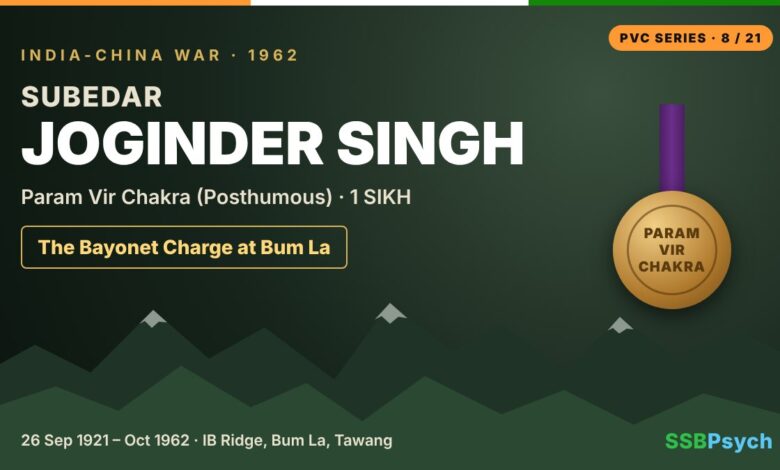
Subedar Joginder Singh, PVC: The Lion of Bum La, 1962 – Full Story (with Quiz)
High in the mountains of Arunachal Pradesh, close to the Bum La pass on the road to Tawang, a handful of Sikh soldiers faced an enemy many times their number on a cold October morning in 1962. They threw back one wave, then another. When the third came and their bullets ran out, they fixed bayonets, shouted their battle cry and charged. Leading them, with a wound in his thigh, was Subedar Joginder Singh of 1 Sikh.
Subedar Joginder Singh is a special hero for SSB aspirants because he rose from a village boy with limited schooling to become a Junior Commissioned Officer who led men by personal example. He also worked hard on his own education after joining the army. In this post you will read about his early life, the war background, his last battle, his citation and his legacy, followed by Officer Like Qualities and a 10-question quiz.
Subedar Joginder Singh – Quick Facts
| Full name | Joginder Singh Sahnan |
| Born | 26 September 1921, Mahla Kalan village (present-day Moga district), Punjab |
| Parents | Sher Singh Sahnan and Krishan Kaur |
| Enlisted | 28 September 1936 |
| Unit | 1st Battalion, The Sikh Regiment (1 Sikh) |
| Earlier service | Burma front in World War II; Srinagar in 1947-48 |
| Battle | Defence of a ridge near Tongpen La on the Bum La axis, Tawang |
| Date of action | 23 October 1962 |
| Platoon strength | About 20 men |
| Fate | Wounded and captured; died of his wounds in enemy hands |
| Award | Param Vir Chakra (Posthumous) |
Early Life in Punjab
Joginder Singh was born on 26 September 1921 in Mahla Kalan, a village in what is now the Moga district of Punjab. His father, Sher Singh Sahnan, and mother, Krishan Kaur, came from a farming Saini Sikh family that had earlier moved to Mahla Kalan from Hoshiarpur district. He went to primary school in Nathu Ala and middle school in Daroli. The family’s means were modest, and young Joginder looked to the army as a path to a respectable life.
Joining the Army and Early Service
He enlisted on 28 September 1936 and was posted to the 1st Battalion of the Sikh Regiment. The army gave him more than a job. He took his studies seriously, passed the Army Education Examination and was appointed the unit’s education instructor, a role that showed both his intelligence and his commitment to improving himself.
His war experience was long before 1962. He served on the Burma front during the Second World War. During the 1947-48 war in Jammu and Kashmir, he was with his battalion in Srinagar. Over the years he earned his promotions the hard way, and by 1962 he was a Subedar, a senior Junior Commissioned Officer, commanding a platoon.
What Does a Subedar Do?
Many aspirants know officer ranks well but are less sure about Junior Commissioned Officers (JCOs). In the Indian Army, the JCO ranks are Naib Subedar, Subedar and Subedar Major. JCOs are promoted from the ranks after many years of service, and they form a vital bridge between the officers and the soldiers. A Subedar often commands a platoon, advises young officers who are new to the unit, and knows every soldier, his family and his strengths. When you join a unit as a young lieutenant, men like Subedar Joginder Singh will be your guides. Respecting their experience is one of the first lessons any good officer learns.
The War Background: NEFA, 1962
In 1962, tension between India and China over the border in the North East Frontier Agency (today’s Arunachal Pradesh) turned into open war. In September, Indian troops, including 1 Sikh, were moved into the Namka Chu area near the Thag La ridge, a position many soldiers felt was badly chosen and hard to defend. On 20 October 1962, Chinese forces launched a major offensive, overran the Namka Chu posts, and began advancing towards the monastery town of Tawang.
One of the routes into Tawang ran through the Bum La pass. Subedar Joginder Singh and his platoon held a ridge near Tongpen La on this axis, a feature remembered today as IB Ridge. From their positions the Sikhs watched the enemy build up strength across the pass in the days after 20 October. They knew an attack was coming, and they knew they would be heavily outnumbered.
The Bum La area was held by only a small number of Indian troops at the time, including a platoon of the Assam Rifles alongside the Sikhs. Supplies had to be carried up steep mountain tracks, and the soldiers were living at high altitude in bitter cold. These were the conditions in which Joginder Singh prepared his men for the fight ahead.
The Battle Near Bum La, 23 October 1962
The First Wave
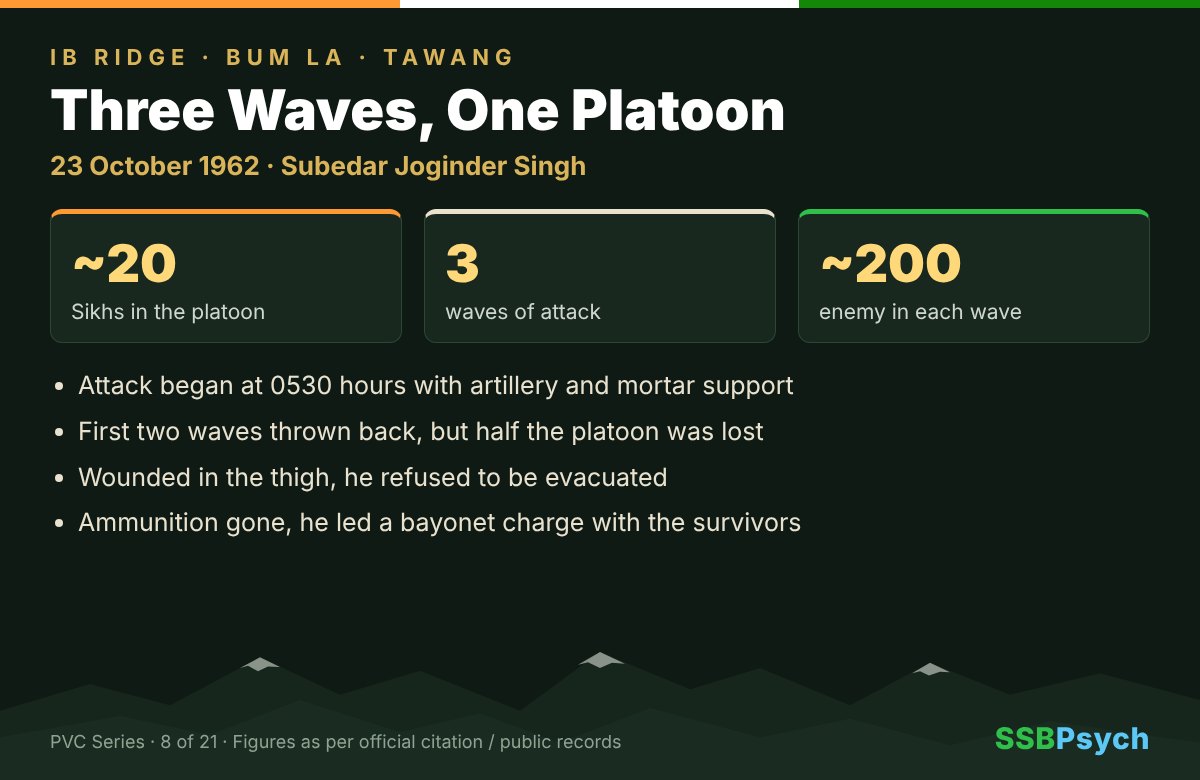
At 0530 hours on 23 October 1962, the Chinese attacked, backed by artillery and mortar fire. They came in three waves, each of roughly 200 men. Joginder Singh’s platoon numbered only around 20. The Sikhs waited for the first wave to get close and then poured in fire. The attackers suffered heavy losses and were forced back.
The Second Wave
The enemy regrouped and attacked again under a fresh barrage. Once more the platoon held, but now the price was heavy: by the end of the second assault, about half of Joginder Singh’s men had been killed or wounded. He himself had been hit in the thigh. His men urged him to go back for treatment. He refused. His place, he believed, was with his platoon.
The Third Wave and the Last Charge
The third assault was the most determined. Subedar Joginder Singh took over a light machine gun himself and kept firing into the attackers, inflicting heavy casualties. But no amount of courage could replace ammunition, and soon the platoon had nothing left to fire. The few survivors fixed their bayonets. Shouting “Waheguru ji ka Khalsa, Waheguru ji ki Fateh”, as widely recounted, they rose from their trenches and charged the enemy.
Joginder Singh bayoneted several enemy soldiers before he was overwhelmed. Badly wounded, he fell into enemy hands, and he died of his injuries while in captivity. His platoon had been destroyed, but it had held up a far larger force for hours and made the enemy pay a heavy price for every step.
Why the Stand Mattered
Military defeats are made up of many small fights, and not all of them are lost in the same way. Some posts in 1962 were abandoned, while others were overrun quickly. The platoon at IB Ridge did neither. It forced the enemy to stop, regroup and attack again, twice, before it could move forward. Every hour gained on such a ridge meant more time for the defences behind it. Just as important, the stand gave the Army and the nation an example of what a well-led small team can do, even when the larger battle is going badly.
The Param Vir Chakra Citation (In Simple Words)
Subedar Joginder Singh was awarded the Param Vir Chakra posthumously. In simple language, his citation records that he commanded a platoon holding a ridge near Tongpen La in NEFA. When the enemy attacked in great strength early on 23 October 1962, his men beat off the first assault and caused heavy losses. Though wounded, he refused to leave and kept his depleted platoon fighting through the next attacks, personally manning a light machine gun. When the ammunition was exhausted, he led his remaining men forward with bayonets until they were overwhelmed. The citation praises his devotion to duty, inspiring leadership and bravery of the highest order.
Legacy of Subedar Joginder Singh
In a rare gesture, the Chinese side returned his ashes to his battalion with military honours on 17 May 1963. The urn was taken to the Sikh Regimental Centre at Meerut and later handed over to his wife, Gurdyal Kaur.
For his family in Punjab, the news of his death came along with the knowledge that he had died the way he had lived, at the front of his men. His village and district have kept his memory alive ever since, and young people in the region still grow up hearing his name.
- The Indian Army has built a memorial at IB Ridge, near Bum La, where he and his platoon made their stand.
- A statue of the Subedar stands near the office of the District Collector in Moga, Punjab.
- In January 2023, an island in the Andaman and Nicobar group was named Joginder Island as part of the naming of 21 islands after PVC recipients.
- The Shipping Corporation of India named a crude oil tanker MT Subedar Joginder Singh, PVC in the 1980s.
- His life inspired the 2018 Punjabi film Subedar Joginder Singh, with Gippy Grewal in the title role.
The 1962 war is often remembered as a painful defeat for India. Yet stories like that of Subedar Joginder Singh show that the soldiers on the ground fought with extraordinary spirit, often with poor equipment, little warm clothing and no hope of reinforcement. Their courage is part of what the Indian Army rebuilt itself on in the years that followed.
For an aspirant, there is one more lesson. Joginder Singh did not have a privileged start. He built himself up, from passing army education exams to leading men in battle. Whatever your background, the qualities that matter most in uniform are ones you can develop through effort.
Lessons for SSB Aspirants: OLQs in Action
The SSB does not test whether you can recite history – it looks for the qualities of an officer. Here is how Subedar Joginder Singh showed them:
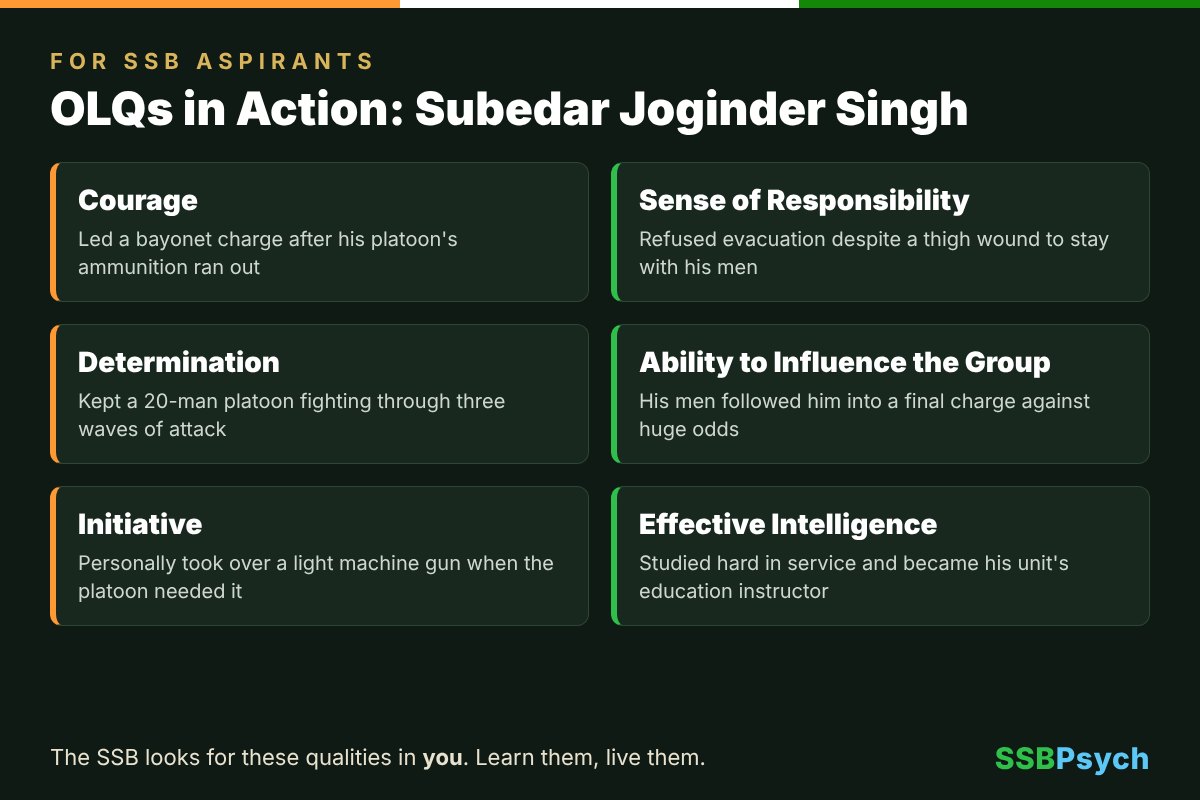
- Courage – Led a bayonet charge after his platoon’s ammunition ran out
- Sense of Responsibility – Refused evacuation despite a thigh wound to stay with his men
- Determination – Kept a 20-man platoon fighting through three waves of attack
- Ability to Influence the Group – His men followed him into a final charge against huge odds
- Initiative – Personally took over a light machine gun when the platoon needed it
- Effective Intelligence – Studied hard in service and became his unit’s education instructor
Tip for your SSB interview: If you come from a small town or village, do not hide it in your interview. Like Subedar Joginder Singh, show how you have worked to improve yourself. Honest stories of self-improvement impress the IO far more than polished but empty answers.
Practice Corner: WAT and SRT
Write your first spontaneous response to these before you scroll to the quiz. Keep WAT sentences short, positive and action-oriented.
WAT Words
- Bayonet
- Platoon
- Wound
- Ammunition
- Village
SRTs
- He is injured during a tough task and his team asks him to step back and rest. He…
- He is leading a team in a competition and they run out of resources halfway through. He…
- He comes from a village school and finds his classmates at a city college far ahead in English. He…
Quiz: How Well Do You Know Subedar Joginder Singh?
Test yourself! Click an option to see if you are right. Your score updates live.
Frequently Asked Questions
Why is Subedar Joginder Singh famous?
He led a platoon of about 20 Sikhs against three waves of enemy attack near Bum La on 23 October 1962 and, after running out of ammunition, led a bayonet charge. He was awarded the Param Vir Chakra posthumously.
Where is IB Ridge?
IB Ridge is near the Bum La pass on the route to Tawang in Arunachal Pradesh. An Indian Army memorial there honours Subedar Joginder Singh and his men.
What happened to Subedar Joginder Singh after the battle?
He was badly wounded and captured, and he died of his wounds in enemy custody. His ashes were returned to his battalion on 17 May 1963.
Is there a film on Subedar Joginder Singh?
Yes. The Punjabi film Subedar Joginder Singh was released in 2018, with Gippy Grewal playing him.
The Param Vir Chakra Series on SSBPsych
This is part 8 of 21 in our series on every Param Vir Chakra awardee. A new hero goes live every morning at 7:30 AM. Also read the story of Captain Vikram Batra, PVC – the Sher Shah of Kargil.
Sources: en.wikipedia.org, www.bharat-rakshak.com, en.wikipedia.org, www.honourpoint.in, thehitavada.com.
Preparing for your SSB? Join SSBPsych’s online and offline SSB batches and learn how to show your OLQs with confidence – explore our courses or call +91 8076540582.